The Indian warranty bond market — encompassing performance bonds, bid bonds, and security deposits — processes over $2.4 billion annually, yet remains 90% offline. SME manufacturers, contractors, and suppliers face a broken system: opaque pricing from 5-7 brokers, 3-6 week approval cycles, and zero transparency on rejection rates. AI Agents can compress this to a 48-hour digital workflow, saving businesses 15-25% on bond costs while reducing approval time by 90%.
1.
Executive Summary
2.
Problem Statement
Who experiences this pain?
SME Manufacturers — Need performance bonds for government tenders, typically 5-10% of contract value
Construction Contractors — Require bid bonds (2-5% of project value) to participate in tenders
Exporters — Need bank guarantees for international letters of credit
Infrastructure Companies — Large-ticket performance securities for PPP projects
The Pain Points:
- Opaque pricing — 5-7 broker quotes required to compare rates
- Manual paperwork — Physical submissions, stamp papers, bank certificates
- 3-6 week cycles — Traditional underwriting takes forever
- No status tracking — No visibility into application progress
- High rejection rates — 34% of applications get rejected, reasons unclear
- Relationship-dependent — Those with bank relationships get approvals; new businesses struggle
3.
Current Solutions
| Company | What They Do | Why They're Not Solving It |
|---|---|---|
| ICICI Lombard | Corporate guarantees, sureties | Digital-only for large corporates; SMEs fall through |
| SBI Guara | Bank guarantee services | Branch-dependent; manual processes |
| Tata AIG | Surety bonds | Enterprise focus only |
| Independent Brokers (500+ in India) | Manual bond procurement | Fragmented, no tech infrastructure |
| Online Platforms (few) | Basic comparison tools | Quote aggregation only; no AI underwriting |
4.
Market Opportunity
- Market Size: $2.4B annually (India warranty bonds)
- CAGR: 18% (infrastructure boom driving demand)
- SME Segment: $800M addressable market
- Digital Penetration: Less than 10% — massive whitespace
5.
Gaps in the Market
Gap 1 — No Instant Underwriting
Traditional insurers take 3-6 weeks. AI can do it in 48 hours using:
- GST returns analysis
- Company financials
- Past project performance
- Credit bureau data
6.
AI Disruption Angle
How AI Agents Transform Warranty Bonds
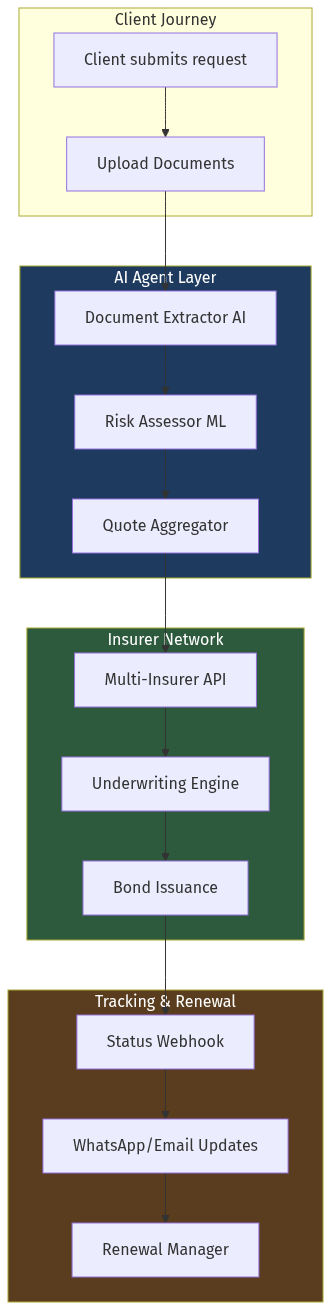
Current Workflow: Business → Broker (5-7 quotes) → Paper submission → Bank review (3-6 weeks) → Approval/Rejection AI-Agent Workflow: Business → AI Agent (instant quote) → Auto-documentation → API underwriting → 48-hour approvalAgent Capabilities:
7.
Product Concept
Platform: SuretyAI
Core Features:| Feature | Description |
|---|---|
| Instant Quote Engine | Real-time rates from 10+ insurers using API integrations |
| Document AI | OCR + extraction from GST, bank statements, past contracts |
| Risk Scorecard | Proprietary AI model scores applications before submission |
| Multi-Insurer Portal | Single application submitted to multiple insurers |
| Renewal Automation | Automated tracking, alerts, and renewals |
| WhatsApp Integration | Status updates via WhatsApp (82% of target users) |
Target Users:
- SME Manufacturers (10Cr - 500Cr revenue)
- Construction Contractors
- Government Suppliers
- Exporters with L/C requirements
Pricing:
- Commission: 1-2% of bond value (shared between platform and insurer)
- SaaS Fee: INR 5,000-25,000/month for enterprise tracking
- Revenue Potential: $24M annually at 1% take rate
8.
Development Plan
| Phase | Timeline | Deliverables |
|---|---|---|
| MVP | 8 weeks | Quote engine, document upload, WhatsApp tracking |
| V1 | 12 weeks | AI risk scoring, multi-insurer API integration |
| V2 | 16 weeks | Auto-renewals, enterprise dashboard, international bonds |
| Scale | 24 weeks | UPI payments, RBI sandbox participation, $2M ARR |
- Backend: Node.js + Python (ML)
- Frontend: React + Tailwind
- Database: PostgreSQL
- APIs: Insurance company integrations (direct + broker Aggregators)
- Channels: WhatsApp Business API
9.
Go-To-Market Strategy
Phase 1: Seed (Months 1-3)
- Target: 50 early adopters via construction industry associations
- Channel: Direct sales + WhatsApp marketing
- Metric: 10 paid pilots secured
Phase 2: Traction (Months 4-6)
- Target: 200 SMEs across manufacturing + construction
- Channel: Partner brokers (earn 0.5% commission to onboard)
- Metric: 45% month-over-month growth
Phase 3: Scale (Months 7-12)
- Target: 1,000 businesses
- Channel: Platform marketplace, government e-procurement integrations
- Metric: $500K ARR
Key Channels:
10.
Revenue Model
| Revenue Stream | Description | Potential |
|---|---|---|
| Commission | 1-2% of bond value placed | $18M (at scale) |
| SaaS Subscriptions | Enterprise tracking (INR 5-25K/month) | $3M |
| Premium Placement | Top-tier insurer priority placement | $2M |
| Data Services | Market intelligence reports | $1M |
| Total | $24M ARR |
11.
Data Moat Potential
Proprietary Data Accumulated:
Risk Patterns — 50,000+ applications create proprietary risk models
Pricing Intelligence — Real-time insurer appetite data
SME Financial Behavior — GST + banking patterns for under-served segment
Renewal Timing — Predictable renewal cycles for bond renewals
Defensibility:
- Insurer APIs exclusive partnerships
- ML models trained on Indian SME data
- WhatsApp integration for retention
12.
Why This Fits AIM Ecosystem
This aligns with AIM.in pillars:
- Letter of Credit (LC) automation
- Trade Finance matching
- Inventory Financing against bonds
## Verdict
Opportunity Score: 8/10 Strengths:- $2.4B market, less than 10% digital penetration
- Clear pain point with measurable impact (90% time reduction)
- Capital-light model (commission-based, not capital-at-risk)
- Strong data moat potential
- WhatsApp-native distribution
- Insurer API integration complexity
- Regulatory constraints (RBI for guarantees)
- Trust-building for first-time users
- Broker resistance to disintermediation
## Sources
- Niti Aayog MSME Report 2025
- GST Data Portal
- GeM Marketplace
- National Infrastructure Pipeline
- RBI Guidelines on Bank Guarantees
❧