ResearchTuesday, March 31, 2026

AI Agents for B2B Industrial Pump & Valve Sourcing: The $25 Billion Market India Is Ignoring

India's industrial pump and valve market ($25B+) operates through phone calls, WhatsApp messages, and trusted dealer networks. No price transparency, no quality certification database, and 60%+ of buyer time spent on supplier discovery. AI agents can automate the entire procurement workflow — becoming the transactional backbone for a fragmented industry that powers every chemical plant, water treatment facility, and manufacturing unit.

1.

Executive Summary

India's industrial pump and valve market is massive but incredibly fragmented. With 2,500+ manufacturers, 10,000+ distributors, and a market size exceeding $25 billion, the industry powers everything from water treatment plants to chemical processing units, from pharmaceutical manufacturing to power generation.

Yet 80% of procurement still happens through phone calls, WhatsApp messages, and trusted dealer relationships. Buyers spend 40-60% of their time on supplier discovery, price negotiation, and quality verification — work that AI agents can automate completely.

The opportunity is to build an AI agent that transacts on behalf of buyers, automating supplier discovery, credential verification, price comparison, and purchase order execution. The first mover builds a data moat that improves with every transaction.

2.

Problem Statement

The Pain

  • Supplier Discovery Hell: Buyers call 15-20 vendors to find the right pump/valve specification
  • Price Opacity: No standardized pricing — each distributor quotes differently based on relationship and guess
  • Quality Uncertainty: No centralized certification database — buyers rely on brand reputation or physical inspection
  • Specification Complexity: Pumps and valves have hundreds of parameters (flow rate, pressure, material, temperature rating, etc.) — matching requirements to products is error-prone
  • Lead Time Uncertainty: No visibility into manufacturer inventory, import status, or delivery timelines
  • After-Sales Chaos: No centralized warranty tracking, spare parts availability, or service network mapping

Who Experiences This Pain?

  • Plant managers at chemical, pharmaceutical, and manufacturing facilities
  • Procurement teams in water treatment plants and municipal corporations
  • Maintenance managers in power plants, refineries, and steel plants
  • OEM manufacturers sourcing components for equipment assembly
  • Contractors working on industrial project installations

3.

Current Solutions

CompanyWhat They DoWhy They're Not Solving It
IndiaMart - Industrial PumpsB2B marketplace with product listingsStatic catalog, no AI matching, no transaction automation
TradeIndiaB2B directory for industrial productsDirectory only, no procurement workflow
Grainger IndiaIndustrial distribution with catalogUS-centric, limited local inventory, no AI
RS Components IndiaElectronic & industrial componentsFocus on electronics, limited pump/valve range
Local dealer networksRegional distributors with relationshipsNo technology, no scale, fragmented
Gap Analysis: No player combines (1) AI-powered specification matching, (2) real-time price comparison, (3) supplier credential verification, (4) automated procurement, and (5) integrated logistics for pumps and valves.
4.

Market Opportunity

Market Size

  • India Industrial Pump Market: $12-14 billion (2025)
  • India Industrial Valve Market: $10-12 billion (2025)
  • Combined Market: $22-26 billion
  • Growth Rate: 8-10% CAGR through 2030
  • Export Potential: $3+ billion annually

Why Now

  • UPI for B2B: India has successfully digitized B2B payments through TReDS, ESCROW mechanisms
  • AI Maturity: Large language models can now understand technical specifications and match products
  • WhatsApp Integration: Indian buyers prefer WhatsApp — AI agents can operate natively
  • PLI Schemes: Government production-linked incentive schemes are driving manufacturing capacity
  • Quality Awareness: Increasing focus on IS0/API certifications is creating demand for verification

  • 5.

    Gaps in the Market

  • No specification-matching AI: Buyers manually match requirements to products
  • No certified supplier database: No centralized source for ISO/API certified manufacturers
  • No real-time price discovery: Prices vary 20-40% between distributors for same product
  • No inventory visibility: Buyers don't know what's available locally vs. import
  • No automated re-ordering: Maintenance teams manually track and re-order consumables
  • No quality verification layer: No third-party quality certification marketplace
  • No spare parts ecosystem: Finding replacement parts for legacy equipment is a nightmare
  • No performance data: No aggregate data on supplier delivery times, quality issues, etc.

  • 6.

    AI Disruption Angle

    How AI Agents Transform the Workflow

    Current Flow (Manual):
    Buyer → Calls 15 vendors → Waits for quotes → Compares manually → Negotiates → Places order → Tracks delivery → Manual quality check
    AI Agent Flow (Automated):
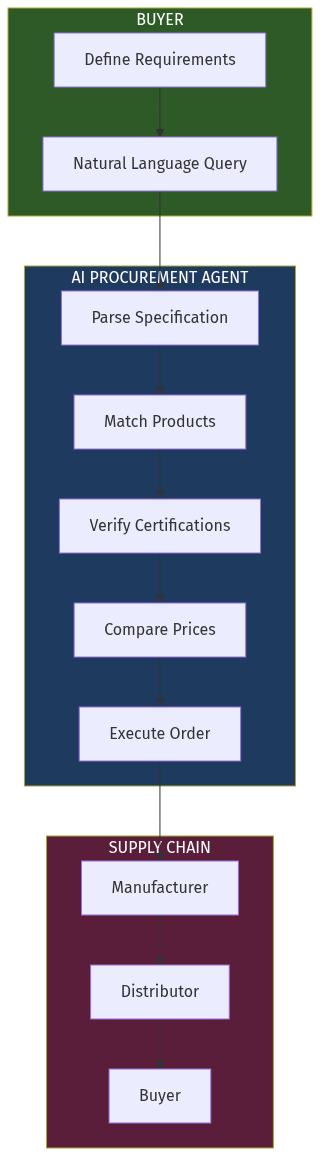
    Buyer: "I need a centrifugal pump, 50 HP, 3000 RPM, cast iron, for water application"
    Agent: [Matches specs] → [Finds 5 certified suppliers] → [Compares prices in real-time] → [Verifies certifications] → [Executes order] → [Tracks delivery] → [Quality confirmation]
    Procurement Flow Diagram
    Procurement Flow Diagram

    Key AI Capabilities

  • Specification Understanding: Parse technical requirements from natural language
  • Product Matching: Match requirements to product database using semantic search
  • Price Intelligence: Aggregate pricing across distributors in real-time
  • Credential Verification: Auto-verify ISO/API certifications via API integration
  • Order Execution: Handle entire procurement workflow via API integrations
  • Logistics Coordination: Coordinate delivery, installation, and after-sales
  • The Agent as Procurement Manager

    The AI agent doesn't just find products — it transacts on behalf of the buyer:

    • Maintains approved vendor list
    • Tracks spending patterns
    • Auto-reorders consumables based on usage
    • Flags unusual pricing or delivery delays
    • Negotiates better rates based on volume
    ---

    7.

    Product Concept

    Product: PumpValve.ai (Working Title)

    Core Features:
  • AI Procurement Agent
  • - Natural language product search - Automatic specification matching - Multi-supplier price comparison - One-click order placement
  • Supplier Intelligence Dashboard
  • - Certified supplier database - Performance metrics (delivery, quality, pricing) - Real-time inventory status - Certification verification
  • Specification Assistant
  • - Help buyers define requirements - Recommend best-fit products - Flag incompatible selections - Technical comparison tables
  • Maintenance Tracker
  • - Equipment inventory management - Spare parts lifecycle tracking - Predictive re-ordering - Warranty expiration alerts
  • Market Intelligence
  • - Price benchmarking - Demand forecasting - Supplier capacity monitoring - Import duty tracking

    User Flow

  • Onboarding: Connect via WhatsApp or web → Upload catalog of requirements
  • Query: "Need API-certified ball valve, 2 inch, SS316, for steam service"
  • Match: AI returns 3-5 matching products with prices, supplier ratings, lead times
  • Select: Buyer selects → Agent generates purchase order → Payment via ESCROW
  • Track: Agent tracks delivery, quality, installation
  • Repeat: Agent learns preferences, auto-suggests re-orders

  • 8.

    Development Plan

    PhaseTimelineDeliverables
    Phase 1: Foundation8 weeksProduct catalog (50K SKUs), supplier database (500+), basic search
    Phase 2: AI Agent12 weeksSpecification matching, price comparison, WhatsApp integration
    Phase 3: Transaction8 weeksESCROW payments, order management, logistics integration
    Phase 4: Intelligence8 weeksAnalytics dashboard, predictive ordering, maintenance tracking
    Phase 5: Scale12 weeksAPI integrations, enterprise features, multi-language
    Total MVP to Launch: 36 weeks

    Key Technical Components

    • Product Database: Normalized pump/valve specifications
    • Supplier Database: Company profiles, certifications, ratings
    • Search Engine: Semantic search + filter + ranking
    • LLM Integration: Specification parsing, product matching
    • Payment Gateway: ESCROW for B2B transactions
    • CRM Integration: ERP connectors for enterprise buyers

    9.

    Go-To-Market Strategy

    Phase 1: Seed Supply Side (Weeks 1-8)

  • Identify top 50 manufacturers in Maharashtra, Gujarat, Tamil Nadu
  • Offer free listing + leads in exchange for catalog data
  • Deploy sales team to sign up 200+ suppliers
  • Verify certifications via API integration with BIS/API/ISO databases
  • Phase 2: Seed Demand Side (Weeks 8-16)

  • Target maintenance managers in mid-size chemical/pharma plants
  • Offer pilot program with 3-month free procurement
  • Integrate with WhatsApp — preferred channel for Indian buyers
  • Build case studies with 10 pilot customers
  • Phase 3: Scale (Weeks 16-36)

  • Expand to water treatment plants, municipal corporations
  • Add enterprise features — ERP integration, approval workflows
  • Launch mobile app for field engineers
  • Regional expansion — South, North, East India
  • Channel Strategy

    • Direct Sales: Field sales team targeting plant managers
    • Digital Marketing: LinkedIn ads targeting procurement professionals
    • WhatsApp Marketing: Message-based outreach to existing dealer networks
    • Trade Shows: Industry events (ChemTech, IPLEX)
    • Partner Integration: Work with EPC companies who recommend suppliers

    10.

    Revenue Model

    Revenue Streams

  • Commission on Transactions (Primary)
  • - 3-5% commission on order value - Paid by seller or buyer (marketplace model) - Target: ₹500 Crore GMV in Year 3
  • Premium Listings (Secondary)
  • - ₹10,000-50,000/month for featured placement - Certified supplier badges - Priority in search results
  • Data & Analytics (Future)
  • - Market intelligence reports - Price benchmarking subscriptions - Supplier performance data
  • Services Revenue
  • - Quality inspection services - Logistics coordination - After-sales support packages

    Unit Economics

    • Average Order Value: ₹2-5 lakhs
    • Commission Rate: 3-5%
    • Take Rate: 4% average
    • Customer Acquisition Cost: ₹50,000 (B2B, high LTV)
    • LTV:CAC Ratio Target: 5:1

    11.

    Data Moat Potential

    Proprietary Data Assets

  • Product Specification Database
  • - Normalized specifications for 50,000+ SKUs - Cross-referenced with manufacturer data - Competitor analysis: hard to replicate
  • Supplier Performance Metrics
  • - Delivery times, quality scores, pricing history - Buyer ratings and reviews - Competitor analysis: competitive moat
  • Transaction Patterns
  • - Category preferences, price sensitivity, seasonal demand - Buyer behavior insights - Competitor analysis: predictive advantage
  • Specification-Quality Mapping
  • - Which specifications correlate with quality - Performance data from installed base - Competitor analysis: hard to replicate

    Moat Strength

    • Data Moat: Strong — improves with every transaction
    • Network Effects: Strong — more buyers attract more sellers, and vice versa
    • Switching Costs: Medium — enterprise integration creates stickiness
    • Brand: Low at start, grows with trust

    12.

    Why This Fits AIM Ecosystem

    This opportunity aligns perfectly with AIM's vision of becoming India's B2B discovery platform:

  • Vertical Extension: Pumps and valves are complementary to existing categories (industrial machinery, chemicals, MRO)
  • AI-First Design: Perfect use case for AI agents in B2B procurement
  • Data Moat: Specification database becomes proprietary asset
  • India-First: Fragmented market with 2,500+ manufacturers — ideal for platform approach
  • Recurring Revenue: Maintenance and replacement parts create repeat purchases
  • Adjacent Expansion: Can expand to compressors, motors, and other rotating equipment
  • Integration with AIM

    • Leverage existing domain portfolio for SEO
    • Cross-sell to existing chemical/industrial buyer base
    • Use AIM's WhatsApp integration for native communication
    • Build vertical-specific AI agents that can be templated

    ## Verdict

    Opportunity Score: 8.5/10

    Why 8.5/10

    • Market Size: $25B+ market with 8-10% growth
    • Fragmentation: 2,500+ manufacturers, 10,000+ distributors — perfect for platform
    • Pain Severity: 40-60% time wasted on procurement — high willingness to pay
    • AI Readiness: Specification matching is a solved problem with LLMs
    • Timing: UPI, WhatsApp, AI maturity all align now
    • Moat: Transaction data creates strong competitive advantage

    Risks

    • Quality Assurance: Need robust verification for critical industrial equipment
    • Complex Specifications: Technical requirements are nuanced and require domain expertise
    • Trust Building: Buyers hesitant to change established supplier relationships
    • Regulatory: BIS/API certifications need careful handling

    Why This Wins

    The pump and valve market is too fragmented and technical for generic B2B marketplaces. An AI agent that understands specifications, verifies certifications, and executes transactions can capture this market. The data moat from transactions makes it defensible, and the high average order value makes unit economics attractive.


    ## Sources