ResearchMonday, March 30, 2026

The $800B Opportunity: Building an AI-Native B2B Procurement Platform for India's MSMEs

India's 63 million MSMEs face a trillion-dollar problem: buying smarter, faster, and cheaper. The solution isn't another marketplace — it's an AI agent that transacts on their behalf.

8
Opportunity
Score out of 10
1.

Executive Summary

India's MSME sector — comprising 63 million registered enterprises contributing 40% of GDP and 48% of exports — operates with a brutal structural inefficiency: procurement is broken. Most MSMEs still buy raw materials through WhatsApp groups, physical market visits, and phone calls. No quotes. No comparison. No data.

Existing B2B marketplaces like Udaan and IndiaMART helped digitize discovery, but they're still "catalogs, not agents." They show products; they don't transact. The real opportunity lies in building an AI-native procurement agent that understands requirements, negotiates with suppliers, verifies quality, and executes orders — autonomously.

This article explores why now is the moment to build it.

2.

Problem Statement

The Daily Pain of an MSME Owner

Imagine running a garment factory in Ludhiana. You need 500 kg of cotton yarn, Grade A, delivered in 7 days. What do you do?

  • Call 5-10 known suppliers — hoping they're available
  • Visit the local yarn market — physically, because trust is built face-to-face
  • Negotiate on price — with no data on what others pay
  • Pay advance — cash, because digital payments to unknown suppliers feel risky
  • Hope quality matches sample — inspection happens after delivery
  • This isn't anecdote. It's the default operating mode for 95% of India's MSMEs.

    The Four Frictions

    FrictionWhat It Looks LikeCost
    Information AsymmetryBuyer doesn't know true market price15-30% overpayment
    Trust DeficitUnknown supplier = advance payment riskWorking capital trapped
    Fragmentation1000s of small suppliers, no standardized catalogsSearch cost high
    Manual WorkflowPhone calls, Excel sheets, WhatsApp images10-20 hrs/week wasted
    ---
    3.

    Current Solutions

    Udaan

    What they do: B2B marketplace connecting manufacturers, wholesalers, and retailers across categories (electronics, fashion, groceries). Why they're not solving it: Transaction failure rates remain high (30%+ for new buyer-supplier pairs). No AI-assisted negotiation or quality verification. Payment on credit is limited.

    IndiaMART

    What they do: Directory + lead generation for B2B sellers. Buyers post RFQs, sellers respond. Why they're not solving it: It's a lead funnel, not a transaction platform. No order execution, no escrow, no quality guarantee.

    JioMart

    What they do: Reliance's B2B grocery/wholesale play. Why they're not solving it: Limited to Jio ecosystem. Focuses on kirana modernization, not broad MSME procurement.

    Amazon Business

    What they do: B2B procurement for SMEs, primarily office supplies and bulk goods. Why they're not solving it: Expensive (Prime pricing doesn't fit margins). Limited on catalog depth for industrial/raw materials.
    4.

    Market Opportunity

    Numbers That Matter

    • India MSME market size: ~$1.1 trillion (addressable procurement spend)
    • MSME contribution to GDP: 40%
    • Digital penetration in B2B: <8% (vs. 25%+ in B2C)
    • Funding gap for global MSMEs: $1.7 trillion (World Bank FINDEX 2021)
    • Average procurement inefficiency cost: 18-25% of purchase value

    Why Now

  • UPI has normalized digital payments — Even kirana shops accept QR codes
  • LLMs can understand unstructured requirements — "I need 100 meters of 40s cotton grey fabric" is parseable
  • Trust infrastructure exists — Escrow, digital contracts, GST verification
  • Supplier data is increasingly available — GSTN, MCA, trade data

  • 5.

    Gaps in the Market

    Anomaly Hunting: What Should Exist But Doesn't

    • No intelligent price discovery — You can't ask "what's the fair price for 500kg cotton yarn in Ludhiana today?"
    • No autonomous quality verification — AI can't inspect and certify material before payment release
    • No programmatic supplier credit — No "get now, pay later" for unrated MSMEs
    • No cross-category procurement agent — One agent for all inputs, not just one category
    • No inventory-backed financing — Your raw material is collateral, but no one values it

    Structural Gaps

  • Catalog chaos — Same product has 20 different names across suppliers
  • Logistics opacity — No real-time freight comparison for small loads
  • Quality variability — Grade A means different things to different sellers
  • Return friction — Defective material = massive hassle, often written off

  • 6.

    AI Disruption Angle

    The Agent Procurement Model

    Imagine telling your phone: "I need 500kg cotton yarn, 40s, for delivery by April 7 in Ludhiana. Budget up to Rs 180/kg."

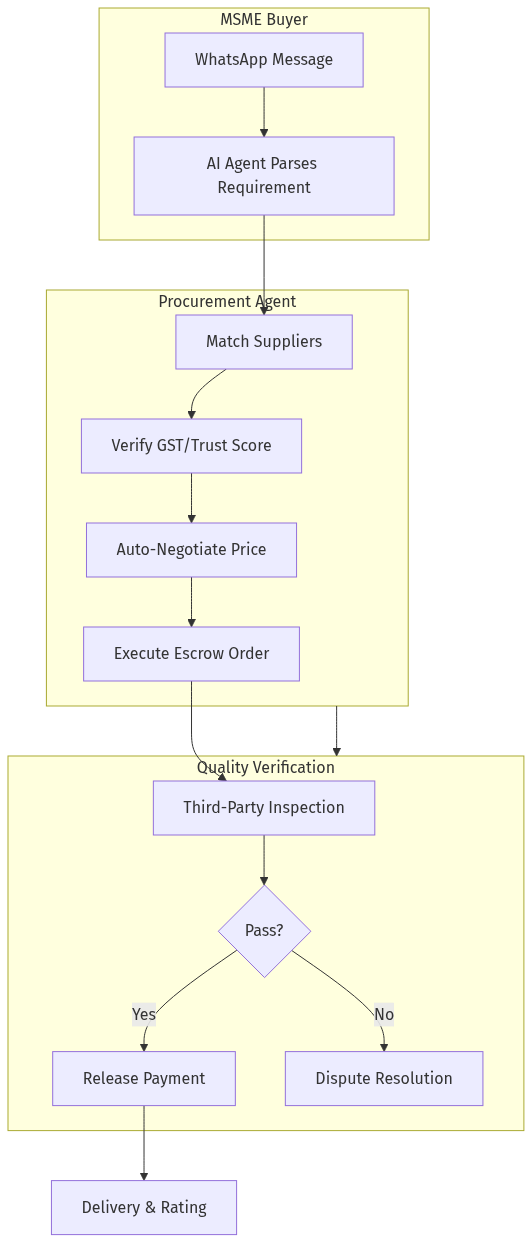
    An AI agent would:

  • Parse the unstructured requirement into structured specs
  • Query supplier databases for matching inventory
  • Verify supplier GST status, export history, rating
  • Negotiate price autonomously (with your max budget as anchor)
  • Execute order with escrow payment
  • Trigger quality inspection (third-party or AI vision)
  • Release payment on inspection pass
  • This isn't science fiction. It's an API orchestration problem that 2026 LLMs can solve.

    Falsification Test: Why Might This Fail?

    • Trust chicken-and-egg: Buyers won't pay without supplier rating; suppliers won't join without buyers
    • Quality can't be AI-verified yet — Physical inspection still needed for textiles/chemicals
    • Category complexity — Every vertical has different specs, standards, and jargon
    • Working capital: Escrow requires capital; financing is hard without credit history

    Steelman: Why Incumbents Win

    • Udaan has existing supplier relationships and logistics network
    • IndiaMART has traffic and SEO dominance
    • Amazon has fulfillment infrastructure
    • Banks have credit relationships
    The counter: None of them are building autonomous agents. They're still catalog businesses. The first mover on agentic procurement wins.
    7.

    Product Concept

    Core Product: MSME Procurement Agent

    A WhatsApp-first (India's UI) AI agent that:

  • Understands natural language procurement requests
  • Matches with verified suppliers
  • Negotiates autonomously within budget constraints
  • Escrows payment until quality verified
  • Tracks delivery and handles disputes
  • Key Features

    FeatureDescription
    Requirement NLPParse "I need 100 sheets of 18mm plywood" to {item, qty, specs, location}
    Supplier GraphGST + trade history + rating equals trust score per supplier
    Auto-NegotiationAgent negotiates price, MOQ, delivery terms
    Escrow EngineHold payment to inspect to release
    Quality AIImage-based defect detection for standardizable goods
    Credit LayerBuy-now-pay-later based on transaction history
    ---
    8.

    Development Plan

    PhaseTimelineDeliverables
    MVP8 weeksSingle category (e.g., steel/pipes), 50 suppliers, manual QC
    V112 weeks3 categories, AI negotiation, basic escrow
    V216 weeksMulti-category, quality AI, credit product
    ScaleQ3-Q41000+ suppliers, pan-India logistics

    First Category Selection

    Start with: Steel/Hardware
    • Specifications are standardized (IS marks)
    • Price transparency exists (steel rates are public)
    • High ticket equals high margin equals worth agent fee
    • Trust stakes are high equals escrow is valuable

    9.

    Go-To-Market Strategy

    1. Seed with Suppliers

    • Target: 50-100 steel/hardware wholesalers in one city (e.g., Mandi Gobindgarh, Punjab)
    • Offer: Guaranteed orders + faster payment
    • Channel: Direct sales, trade shows

    2. Acquire Buyers through WhatsApp

    • Target: Small fabrication shops, construction contractors
    • Offer: "Compare 5 quotes in 5 minutes"
    • Channel: WhatsApp groups, Google Ads, contractor associations

    3. Network Effects Loop

    More buyers leads to more orders leads to more supplier joins leads to better prices leads to more buyers.

    4. Geographic Expansion

    Start tier-2/3 towns where market visits are harder.


    10.

    Revenue Model

    StreamDescriptionTake Rate
    Transaction Fee% of order value2-5%
    Listing FeeSupplier visibilityRs 500-2000/month
    Financing MarginInterest on buy-now-pay-later12-18% APR
    Data RevenueMarket intelligence reportsSubscription

    Early Revenue: Transaction Fees

    LTV:CAC is favorable if supplier acquisition cost is less than first-year fees from that supplier.


    11.

    Data Moat Potential

    Over time, this platform accumulates:

    • Price benchmark data — Real transaction prices across locations
    • Supplier behavior — Delivery patterns, quality consistency, negotiation patterns
    • Buyer preferences — Price sensitivity, quality thresholds, loyalty
    • Logistics intelligence — Freight costs, transit times, route optimization
    This data becomes the reference price engine — the "true value" for any MSME procurement decision.
    12.

    Why This Fits AIM Ecosystem

    Vertical Integration Play

    This procurement agent can become the downstream layer for AIM.in's domain and content ecosystem:

    • Domain-powered: Use AIM.in's MSME domain data for supplier verification
    • Content-powered: Publish procurement guides leads to SEO traffic leads to buyer acquisition
    • WhatsApp-first: Use Bhavya's Kapso integration for conversational UI
    • Domain intelligence: Apply dom.to data for market mapping

    Long-term Vision

    AIM.in becomes the B2B operating system for Indian MSMEs — procurement, financing, logistics, and eventually inventory management.


    ## Verdict

    Opportunity Score: 8/10

    Why 8

    • Huge market: $1T+ addressable
    • Clear pain: Proven frictions documented across sources
    • AI timing right: LLMs can finally understand unstructured B2B queries
    • Moat potential: Transaction data compounds into pricing intelligence

    Why Not 10

    • Execution risk: Supplier acquisition is slow, hard B2B sales
    • Working capital: Escrow requires significant capital upfront
    • Trust chicken-and-egg: Classic marketplace cold-start

    Recommendation

    Start with one category in one geography. Prove the model. Then expand. The first-mover advantage in agentic procurement is real — if you can solve trust and get suppliers on platform, network effects take over.

    ## Sources


    Architecture Diagram
    Architecture Diagram