ResearchMonday, March 30, 2026

The $120 Billion Blind Spot: AI Agents for Restaurant Procurement in India

India's 3.5 million restaurants, dhabas, cloud kitchens, and catering businesses buy ingredients the same way they did in 1995 — through phone calls, WhatsApp messages, and early morning market visits. Every meal is a procurement gamble.

1.

Executive Summary

India's food service industry is a $120+ billion market operating with zero procurement infrastructure. Unlike the US (where Sysco serves 650k+ restaurants) or China (where Meituan connects millions of food businesses), Indian restaurants rely on fragmented local mandis, verbal negotiations, and trusted vendor relationships maintained through WhatsApp.

Small restaurants (the 95% of India's food service sector) spend 15-25% more on ingredients than they should, lose 8-12 hours weekly on procurement logistics, and have zero data on spending patterns. The opportunity isn't another B2B catalog — it's an AI procurement agent that understands what a restaurant needs, when they need it, and at what price.

This article explores why the restaurant supply chain is the most overlooked B2B opportunity in India.

2.

Problem Statement

The Zeroth Principle Question

What are we assuming that's wrong?

We assume restaurants "just need fresh ingredients." We assume procurement is a human skill. We assume local vendors are irreplaceable.

All wrong. Here's why:

Who Experiences the Pain

Primary victims: India's 3.5 million+ food service businesses:
  • Restaurants (3.2M registered, per FSSAI 2024)
  • Cloud kitchens (growing 40%+ annually)
  • Dhabas and road-side eateries (500k+)
  • Catering services (200k+)
  • Hostel/mess providers (100k+)
The pain map:
StakeholderPain PointTime Lost
Restaurant ownerMorning market visits (4-6 AM)2-3 hrs/day
ChefIngredient availability uncertaintyConstant stress
Purchase managerCalling 5+ vendors for quotes1-2 hrs/day
AccountantManual bill reconciliation10-15 hrs/week
OwnerNo visibility into procurement spendMonth-end surprise

The Four Frictions

FrictionWhat It Looks LikeCost
Price OpacityNo way to compare real prices across suppliers15-25% overpayment
Quality UncertaintyCan't verify freshness until deliveryWasted ingredients
Trust DeficitNew supplier = advance payment riskWorking capital trapped
Time SinkProcurement is a full-time job for small ops15-20 hrs/week
---
3.

Current Solutions

Medikabazaar (Now Medbazaar)

What they do: B2B marketplace for medical supplies, not food service. Not relevant.

Others (Competitive Landscape)

CompanyWhat They DoWhy They're Not Solving It
GroceryGPTAI ordering for restaurantsEarly stage, limited supplier network
JioMart FreshConsumer-focusedNot B2B restaurant supply
Country DelightDairy + essentialsLimited to specific categories
ShopKiranaKirana-focusedNot restaurant-focused
WhatsApp vendorsInformal supplyNo tech, no scale
The gap: No AI-native platform that acts as a procurement agent, not a catalog.
4.

Market Opportunity

Numbers That Matter

  • India food service market: $120+ billion (2025)
  • Annual growth: 18-20% CAGR
  • MSME restaurants: 3.2M+ establishments
  • Average procurement spend per restaurant: ₹8-15 Lakhs/year
  • Total addressable market: ₹45-60 trillion in ingredient purchases

Why Now

  • WhatsApp is the operating system — 90%+ of restaurants communicate via WhatsApp
  • UPI = frictionless payments — No cash, no bank delays
  • LLMs can parse natural language — "I need 20kg onions, 10kg tomatoes, deliver by 6 PM tomorrow" is actionable
  • Cold chain infrastructure emerging — Blinkit, Zepto prove last-mile can work
  • Restaurant margins are squeezed — 15-25% procurement savings = survival

  • 5.

    Gaps in the Market

    Anomaly Hunting: What Should Exist But Doesn't

  • No intelligent price discovery — "What's the fair price for 20kg tomatoes in Bangalore today?" has no answer
  • No autonomous quality verification — Can't ensure freshness before payment
  • No predictive ordering — AI doesn't know what restaurant needs based on menu + past consumption
  • No vendor network intelligence — No data on who's reliable, who's cheap, who's fast
  • No cross-category agent — Need separate vendors for produce, dairy, meat, dry goods
  • No waste prediction — AI can't optimize ordering to reduce spoilage

  • 6.

    AI Disruption Angle

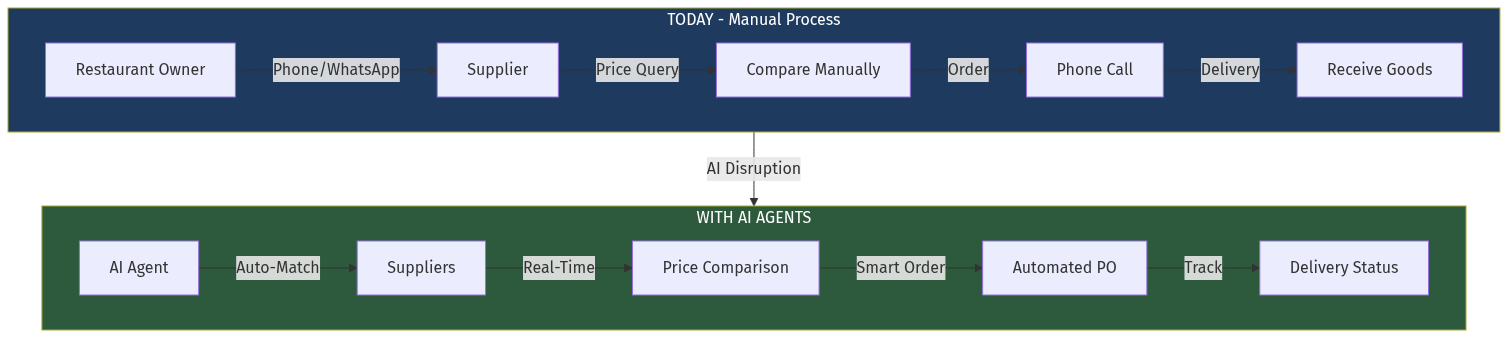
    The Agent Workflow

    AI Agent Procurement Flow
    AI Agent Procurement Flow
    How it works:
  • Natural Language Order — Restaurant owner says "need 50kg onions, 20kg tomatoes, 10kg potatoes, deliver tomorrow morning"
  • Agent Parses — LLM extracts items, quantities, delivery window
  • Supplier Query — Agent queries 5-10 suppliers for availability + price
  • Smart Match — Agent matches based on price, rating, distance, quality history
  • Order Execution — Agent creates PO, holds payment in escrow
  • Delivery Tracking — Agent tracks delivery, notifies on arrival
  • Quality Confirmation — Restaurant confirms quality via WhatsApp
  • Payment Release — Payment released to supplier
  • Friction Eliminated

    Old ProcessWith AI Agent
    Call 5 vendorsOne message to agent
    Compare prices manuallyAuto-ranked by price + quality
    Negotiate each timeAgent negotiates at scale
    Track delivery via callsAuto-tracking with updates
    Manual bill reconciliationAuto-generated spend reports
    ---
    7.

    Product Concept

    Core Features

  • WhatsApp-First Interface — No app needed. Order via WhatsApp voice note or text
  • Multi-Supplier Intelligence — Agent maintains relationships with 100+ verified suppliers
  • Price Discovery Engine — Real-time pricing for 500+ SKUs across categories
  • Quality Verification — Photo-based quality check, rating system
  • Predictive Ordering — AI suggests orders based on menu + consumption patterns
  • Escrow Payments — Pay only after quality confirmation
  • Credit Integration — BNPL based on transaction history
  • Data Moat

    • Every transaction creates data: what bought, at what price, from whom
    • 6 months = demand patterns per restaurant
    • 1 year = city-wide pricing intelligence
    • The data becomes the product

    8.

    Development Plan

    PhaseTimelineDeliverables
    MVP8 weeksWhatsApp agent, 50 suppliers, 100 SKUs, basic ordering
    V112 weeksPrice discovery, quality ratings, escrow payments
    V216 weeksPredictive ordering, BNPL, analytics dashboard
    Scale24 weeksMulti-city expansion, supplier network 500+

    Technology Stack

    • LLM: Claude/GPT-4 for natural language understanding
    • WhatsApp: Kapso API for messaging
    • Payments: UPI/Razorpay for escrow
    • Database: PostgreSQL + Vector DB for supplier intelligence

    9.

    Go-To-Market Strategy

    Phase 1: Cloud Kitchen Capture

  • Target 500 cloud kitchens in Bangalore, Hyderabad
  • Free onboarding with promise of "10% savings or nothing"
  • Direct sales through food park associations
  • Offer early access in exchange for feedback
  • Phase 2: Restaurant Network Effect

  • Expand to standalone restaurants
  • Build supplier network in parallel
  • Leverage cloud kitchen success stories for social proof
  • Introduce subscription model (₹2,999/month for unlimited AI agent queries)
  • Phase 3: City Dominance

  • Achieve 20% market share in target cities
  • Add predictive ordering (reduce waste by 30%)
  • Introduce BNPL (working capital for restaurants)
  • Replicate across Tier 1, then Tier 2 cities

  • 10.

    Revenue Model

    StreamDescriptionPotential
    Transaction Fee2-5% on successful orders₹50-100 Cr at scale
    Subscription₹2,999-9,999/month for premium features₹20-30 Cr ARR
    Supplier ListingSuppliers pay for premium visibility₹5-10 Cr ARR
    Data ServicesMarket intelligence reports₹5 Cr ARR
    BNPL InterestInterest on buy-now-pay-later₹10-20 Cr ARR
    ---
    11.

    Data Moat Potential

    What accumulates over time:
    • Price intelligence: Real-time pricing for every ingredient in every city
    • Supplier ratings: Quality, reliability, pricing scores
    • Demand patterns: What restaurants order, when, how much
    • Waste data: Spoilage rates by category, season, location
    • Payment history: Creditworthiness scoring for BNPL
    The moat: Once you have 2 years of data, no competitor can replicate your price discovery or predictive ordering accuracy.
    12.

    Why This Fits AIM Ecosystem

    This aligns perfectly with AIM's vision:

  • Vertical focus: Restaurant supply = specific vertical with clear pain
  • AI-native: Agent-based procurement, not catalog-based
  • WhatsApp-first: Matches Indian consumption patterns
  • Data moat: Creates compounding intelligence over time
  • B2B marketplace: Fits the core thesis
  • Offline to online: Takes informal supply chains digital
  • Potential domain: restaurantai.in, foodpro.in, supplykitchen.in

    ## Verdict

    Opportunity Score: 8/10
    FactorScoreRationale
    Market Size9/10$120B+ market, 3.5M+ businesses
    Problem Severity9/1015-25% overspend, 15-20 hrs/week lost
    AI Fit8/10LLMs can parse natural language + negotiate
    Moat Potential8/10Data compounding over time
    Go-to-Market7/10WhatsApp-first reduces friction
    Competition8/10No true AI agent solution exists

    Why Not 10/10

    • Restaurant margins are thin (high price sensitivity)
    • Quality verification is still partially manual
    • Supplier network building takes time
    • Food category has high volatility (prices change daily)

    The Bet

    Build an AI procurement agent that replaces the morning market visit with a WhatsApp message. Target cloud kitchens first (early adopters), expand to restaurants. The data moat is the long-term moat — every transaction makes the agent smarter.


    ## Sources