ResearchSaturday, March 28, 2026

The Commercial Kitchen Equipment Market in India Is Ripe for an AI Agent Marketplace

India's HoReCa sector is growing at 15% CAGR, yet 90% of commercial kitchen equipment purchases still happen via phone calls, WhatsApp, and manual tender processes. An AI-powered B2B marketplace can eliminate 3-5 days of procurement time and save buyers 15-25% on costs.

1.

Executive Summary

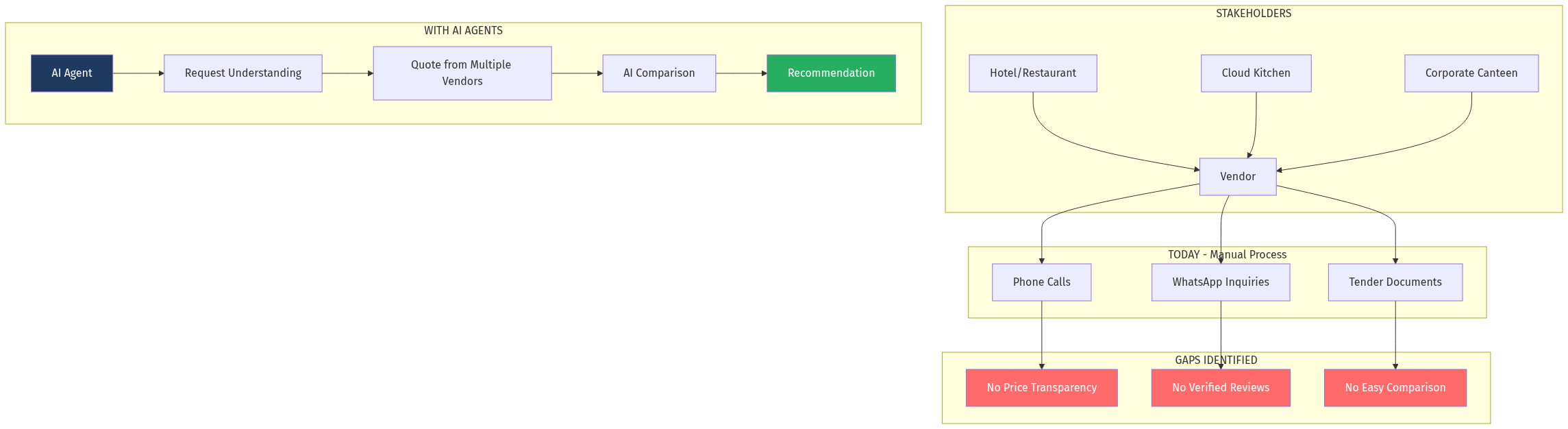
India's hotel, restaurant, and cloud kitchen sector represents a $50+ billion market growing at 15% annually. Yet the procurement of commercial kitchen equipment — from cooking ranges to refrigeration to ventilation systems — remains stubbornly manual. Buyers spend 3-5 days collecting quotes via phone calls and WhatsApp. Suppliers lose 40% of leads to follow-up gaps. No centralized catalog exists. No verified reviews. No price transparency.

This creates a clear opening for an AI agent-powered B2B marketplace where buyers describe their needs conversationally, and AI agents handle vendor matching, quote comparison, and procurement workflow automation.

The opportunity: Build a vertical marketplace for commercial kitchen equipment with AI agents that transacts on behalf of buyers and sellers.
2.

Problem Statement

Who Experiences This Pain?

  • Cloud kitchens (10,000+ in major cities) — Need equipment fast, minimal procurement expertise
  • Hotels (200,000+ properties) — Regular equipment upgrades, bulk purchases
  • Restaurants (500,000+ in India) — Infrequent but high-value purchases
  • Corporate canteens — Budget-conscious, need volume pricing
  • Hospitality institutes — Tender-based procurement, documentation heavy

What's Broken?

  • No centralized catalog — Every supplier maintains their own product list, often just WhatsApp images
  • Quote opacity — Prices vary 15-30% between suppliers for identical equipment
  • Trust deficit — No verified reviews, no quality certifications visible
  • Lead leakage — Suppliers receive inquiries but 40%+ never follow up properly
  • Logistics complexity — Equipment is heavy, installation requires technical skill

  • 3.

    Current Solutions

    CompanyWhat They DoWhy They're Not Solving It
    IndiaMARTGeneric B2B marketplaceNot kitchen-specific, no AI, overwhelming catalog
    TradeIndiaB2B directorySame as above — generic, no procurement workflow
    HotelKitchen.inKitchen equipment catalogNo AI, limited supplier base, no transaction
    KitchenStoryConsumer-focusedTargets home kitchens, not commercial
    ZecoCustom kitchen fabricationOne-off builds, not equipment marketplace
    Gap: None of these offer AI-agent-mediated procurement with automated quote comparison, vendor verification, or post-purchase support.
    4.

    Market Opportunity

    Market Size

    • India HoReCa market: $52 billion (2025), projected $85 billion by 2030
    • Commercial kitchen equipment: $8-10 billion annually
    • Average purchase cycle: 2-4 equipment purchases per establishment per year

    Growth Drivers

  • Cloud kitchen boom — 25% YoY growth in food delivery-only kitchens
  • Hotel infrastructure push — Tier 2/3 city hotel growth
  • Restaurant professionalization — Move from family-run to managed operations
  • GST compliance — Formalization driving documented purchases
  • Why Now

  • WhatsApp saturation — Buyers already comparing prices on WhatsApp; platform can intercept this flow
  • UPI for B2B — Payment infrastructure now supports high-value transactions
  • AI maturity — LLMs can handle complex procurement conversations
  • Trust layer emergence — Rating/review infrastructure from consumer internet now applicable to B2B

  • 5.

    Gaps in the Market

  • No conversational procurement — Buyers still explain requirements via phone
  • No verified supplier network — No standardized vetting of equipment sellers
  • No cross-supplier price comparison — Each supplier quotes in isolation
  • No installation service layer — Equipment delivery ≠ installation; multiple vendors needed
  • No post-purchase support marketplace — Maintenance, repairs, parts are fragmented
  • No financing/leasing option — High-capex purchases lack flexible payment options

  • 6.

    AI Disruption Angle

    How AI Agents Transform the Workflow

    Current Flow:
    Buyer (Phone/WhatsApp) → Call 5 suppliers → Get 5 quotes → Compare manually → Negotiate → Purchase
    AI Agent Flow:
    Buyer: "Need a 6-burner gas range, stainless steel, under 1.5 lakhs, delivery in Bangalore"
    AI Agent: [Interprets requirements → Matches 5 verified suppliers → Collects quotes → Compares specifications → Presents recommendation with price breakdown]

    Agent Capabilities Required

  • Intent understanding — Parse natural language equipment requirements
  • Specification mapping — Match buyer needs to supplier catalog fields
  • Quote aggregation — Collect and normalize quotes from multiple suppliers
  • Comparison engine — Side-by-side specs, price, delivery, warranty
  • Negotiation automation — Follow-up with suppliers, soft-negotiate pricing
  • Procurement workflow — Purchase order generation, payment facilitation
  • The Agent Transacts

    The key difference: AI agents don't just surface leads. They complete transactions. A buyer approves a recommendation, and the agent handles:

    • Purchase order generation
    • Payment orchestration
    • Delivery scheduling
    • Post-purchase issue resolution
    ---

    7.

    Product Concept

    Platform Name (Suggested)

    KitchenBureau or EquipMint

    Core Features

  • Conversational Procurement Interface
  • - Chat-based: "I need a commercial fryer for a cloud kitchen in Hyderabad" - Voice support for SMB owners who prefer talking
  • AI Requirement Parser
  • - Converts natural language to structured specs - Maps to supplier inventory taxonomies
  • Supplier Network
  • - Verified suppliers with business documents, GST, certifications - Rating system based on completed transactions - Geographic coverage for delivery/installation
  • Quote Engine
  • - Auto-distribute requirements to matching suppliers - Normalize quotes for comparison - Present decision-ready recommendations
  • Post-Purchase Suite
  • - Installation tracking - Warranty management - Maintenance request routing

    Revenue Model

    Revenue StreamDescription
    Commission5-8% on successful purchases
    Premium ListingsSuppliers pay for visibility ($50-200/month)
    Lead FeesQualified leads to suppliers (₹500-2000/lead)
    Installment Facilitation2-3% fee on EMI/lease transactions
    Maintenance ContractsMarketplace for service contracts
    ---
    8.

    Development Plan

    PhaseTimelineDeliverables
    Phase 1: Discovery6 weeksBuyer acquisition, supplier catalog, manual quote collection
    Phase 2: AI Integration8 weeksLLM-powered requirement parsing, supplier matching
    Phase 3: Transaction6 weeksPayment integration, PO generation, order tracking
    Phase 4: Scale12 weeksMulti-city expansion, supplier network growth, maintenance layer
    Total MVP Timeline: 6 months to transaction-ready platform
    9.

    Go-To-Market Strategy

    Supplier Side

  • Target: 50 verified suppliers in Bangalore, Hyderabad, Chennai
  • Channels: Trade shows (Food Hotel Asia India), industry associations (FHRAI), direct outreach
  • Incentive: Free listings for first 100 suppliers, commission-only model initially
  • Buyer Side

  • Target: Cloud kitchens (highest frequency buyers)
  • Channels: Zomato/Swiggy restaurant partners, food park operators, kitchen rental platforms
  • Incentive: Free procurement service for first 50 buyers
  • Early Traction Tactics

    • Partner with kitchen interior designers as referral partners
    • Attend hotel management institute placement drives
    • List on IndiaMART to capture existing demand, then migrate

    10.

    Data Moat Potential

    What proprietary data accumulates:
  • Supplier performance data — Delivery times, quality ratings, response rates
  • Price benchmarking — Historical pricing across categories and regions
  • Buyer behavior patterns — Purchase cycles, price sensitivity, brand preferences
  • Specification mappings — How buyers describe requirements vs. product categories
  • Maintenance records — Equipment failure rates, service intervals
  • Moat strength: Strong. The more transactions, the better the AI matching, creating a flywheel that incumbents cannot easily replicate.
    11.

    Why This Fits AIM Ecosystem

    This opportunity aligns with AIM.in's vision of structured B2B discovery:

  • Vertical specialization — Commercial kitchen equipment is a definable vertical with clear buyer segments
  • Agent-native workflow — Procurement is conversational, making it ideal for AI agent mediation
  • Repeat purchase potential — Equipment needs repeat as kitchens scale or replace worn items
  • Geographic expansion — Can start in one city, replicate to others methodically
  • Potential integration: As a vertical under AIM.in's B2B marketplace network, KitchenBureau could leverage:
    • AIM's domain portfolio for SEO
    • Cross-sell from restaurant management tools
    • Unified buyer account across verticals

    12.

    Steelman — Why Incumbents Might Win

  • IndiaMART network effect — Already has supplier relationships, just needs to add AI layer
  • Capital advantage — Can acquire or build AI capabilities faster than startups
  • Trust advantage — Buyers already trust established platforms for high-value transactions
  • Distribution leverage — Existing sales teams can push AI features to existing supplier base
  • Mitigation: IndiaMART's generic approach cannot win in verticals. Their marketplace is designed for lead capture, not transaction completion. A focused vertical player can out-execute on buyer experience.
    13.

    Pre-Mortem — Failure Modes

    Assume 5 well-funded startups failed here. Why?
  • Supplier chicken-and-egg — No buyers without suppliers, no suppliers without buyers
  • Trust failure — High-value transactions require in-person verification that takes time
  • Price war — Suppliers undercut each other, platform margins collapse
  • Category cyclicality — Kitchen equipment purchases are infrequent, making retention hard
  • Capital intensity — Building supplier network requires significant field sales investment
  • How to avoid:
    • Start in one geography with tight supplier density
    • Focus on cloud kitchens (higher frequency, easier to acquire)
    • Build trust layer with verified GST/documents before scaling

    ## Verdict

    Opportunity Score: 7.5/10

    This is a strong B2B marketplace opportunity with clear AI agent applicability. The fragmented supplier market, manual procurement process, and growing cloud kitchen segment create a favorable environment. The key is executing tight in one geography before expanding.

    Recommended action:
  • Validate with 20 suppliers and 50 buyers in Bangalore
  • Build minimum quote-aggregation workflow (human-in-loop initially)
  • Measure conversion: inquiry → quote → purchase completion rate
  • If unit economics work at 5% commission with ₹50,000 average order value, scale to Hyderabad and Chennai.


    ## Sources


    ## Diagram

    Market Architecture
    Market Architecture