ResearchSaturday, March 28, 2026

AI-Powered Industrial Safety Equipment B2B Marketplace: India's $4.5B Unstructured Opportunity

India's industrial safety equipment market is valued at $4.5 billion, yet 80%+ of procurement still happens through distributor networks, phone calls, and fragmented suppliers. An AI-native B2B marketplace can digitize this fragmented ecosystem—connecting buyers with certified manufacturers, enabling specification-based matching, and automating compliance tracking for PPE, fall protection, and safety gear.

8
Opportunity
Score out of 10
1.

Executive Summary

The industrial safety equipment market in India represents a massive but highly fragmented $4.5 billion opportunity trapped in opaque distribution channels. Every manufacturing plant, every construction site, every warehouse, every chemical facility requires safety equipment—yet the industry operates through a maze of authorized distributors, regional dealers, and direct manufacturer relationships that haven't evolved in decades.

The Core Problem: There's no modern procurement platform for industrial safety equipment. Buyers can't easily compare products by certifications (ISI, CE, ANSI, ASTM), specifications, price, supplier ratings, or compliance compatibility. Suppliers struggle to reach small and medium industrial buyers beyond their established dealer networks. The Opportunity: An AI-powered B2B marketplace can:
  • Digitize equipment discovery with specification-based matching
  • Enable certification and compliance verification (Factory Act, WSH rules)
  • Connect buyers directly with verified manufacturers and certified distributors
  • Build proprietary data on equipment performance, pricing, and compliance outcomes
  • Automate re-ordering based on usage patterns and regulatory timelines

Why Now: The combination of increased regulatory enforcement (revised Factory Act rules), workplace safety awareness, PLI schemes for manufacturing, and AI agents that can handle complex certification requirements creates perfect timing for platform adoption.
2.

Problem Statement

The Procurement Crisis

Market Architecture
Market Architecture

In a typical mid-sized Indian manufacturing plant requiring safety equipment, operations look like this:

  • Distributor Dependency: Procurement team relies on 2-3 known local distributors for safety gear
  • Certification Opacity: Products carry ISI, CE, ANSI marks but verification is manual and time-consuming
  • Price Opacity: Same product can have 15-30% price variance across distributors
  • Compliance Gap: No easy way to track which equipment meets current regulatory requirements
  • Inventory Guessing: No intelligent tracking of when PPE needs replacement based on usage

Quantified Pain Points

Pain PointImpact per Industrial Facility (Annual)
Wrong Product SelectionNon-compliant gear = legal penalties 5-25 lakhs, potential shutdown
Price Opacity (15-30% variance)15-40 lakhs potential overspend on safety gear
Certification Verification2-4 weeks delay in procurement for compliance projects
Inventory StockoutsWorker downtime from missing safety gear 10-30 lakhs
Compliance DocumentationManual record-keeping errors, audit failures 3-10 lakhs

Who Experiences This Pain?

  • Manufacturing Plants (auto, pharma, chemicals, food processing)
  • Construction Companies (real estate, infrastructure)
  • Warehouses & Logistics (e-commerce, cold chain)
  • Chemical & Petrochemical plants
  • Ports & Maritime operations
  • Mining & Steel plants
  • Power Generation facilities

  • 3.

    Current Solutions

    Existing players in the industrial safety equipment space:

    CompanyWhat They DoWhy They're Not Solving It
    UdyogiEstablished PPE manufacturer, personal protective equipmentFocus on manufacturing, not marketplace; limited SMB reach
    3M IndiaGlobal safety brand, industrial solutionsPremium pricing, focused on enterprise, not SMB
    SafetyStoreE-commerce for safety equipmentConsumer-focused, no B2B features, limited certification support
    SSB IndustrialSafety equipment distributorRegional presence only, no tech platform
    JustIndian safety gear brandLimited product range, no marketplace

    Market Gap Analysis

    • No B2B-focused platform with specification-based search
    • No certification verification integration with regulatory databases
    • No AI-powered compliance tracking for workplace safety regulations
    • No intelligent re-ordering based on usage and regulatory timelines
    • No vendor rating system based on product quality and delivery

    4.

    Market Opportunity

    Market Size

    • India Industrial Safety Equipment: $4.5 billion (2025)
    • CAGR: 8-10% through 2030
    • SMB Segment: $2.2 billion (under-served, 50%+ of market)

    Growth Drivers

  • Regulatory Enforcement: Revised Factory Act and state-level WSH rules
  • Manufacturing Growth: PLI schemes driving new factories
  • Insurance Requirements: Corporate insurance mandates safety compliance
  • Export Requirements: ISO 45001 certification for exporters
  • Workplace Safety Awareness: Increased employee safety expectations
  • Why Now

    The convergence of:

    • AI Agent maturity — can handle complex certification matching
    • Manufacturing boom — 50+ new PLI-approved facilities per quarter
    • Regulatory pressure — increased enforcement of safety compliance
    • Supply chain digitization — WhatsApp/SMS being replaced by platforms
    ---

    5.

    Gaps in the Market

    Gap 1: Certification Complexity

    No platform helps buyers verify which certifications (ISI, CE, ANSI, ASTM, AS/NZS) apply to their specific industry and use case.

    Gap 2: Specification Matching

    Industrial safety equipment has complex specifications (material, rating, temperature range, chemical compatibility) — no existing platform handles this intelligently.

    Gap 3: Compliance Lifecycle

    Safety equipment has expiration dates, recertification requirements, and regulatory updates — no existing solution tracks this automatically.

    Gap 4: SMB Access

    Small manufacturers and contractors can't easily access certified suppliers — they're stuck with local distributors.

    Gap 5: Price Discovery

    Same product has 15-30% price variance — no transparent pricing mechanism exists.
    6.

    AI Disruption Angle

    How AI Transforms the Workflow

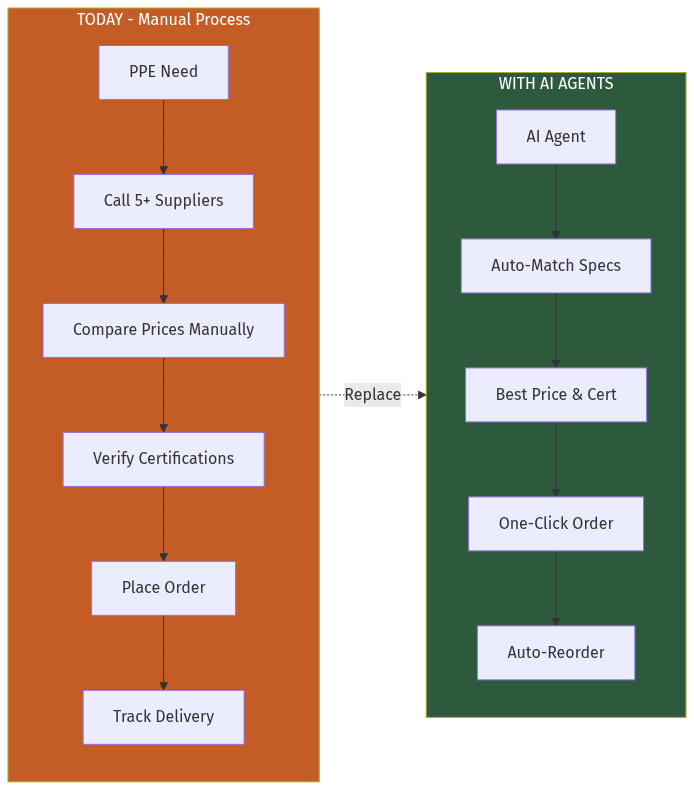
    Process Flow
    Process Flow
    Current State (Manual):
  • Identify safety requirement -> Call 5+ suppliers -> Compare prices manually -> Verify certifications -> Place order -> Track delivery
  • Future State (AI Agents):
  • AI Agent understands requirement -> Auto-matches specs & certifications -> Presents best options -> One-click order -> Auto-reorder when needed
  • AI Agent Capabilities

  • Specification Engine: Parse user requirements (industry, hazard type, compliance) and match to product specifications
  • Certification Verification: Integrate with certification databases to verify product authenticity
  • Price Intelligence: Real-time pricing from multiple suppliers, flag anomalies
  • Compliance Tracker: Monitor regulatory changes, alert buyers of equipment needing replacement
  • Auto-Reorder: Trigger orders when inventory depletes or equipment reaches expiration

  • 7.

    Product Concept

    Platform Features

    For Buyers:
    • AI-powered product discovery by hazard type, industry, compliance requirement
    • Certification verification with regulatory database integration
    • Supplier ratings based on product quality, delivery, service
    • Smart re-ordering based on usage patterns and expiration dates
    • Bulk procurement with negotiated pricing
    For Suppliers:
    • Direct access to buyers across India (not just regional)
    • AI-powered lead generation (buyers seeking specific specs)
    • Certification upload and verification
    • Inventory management with demand forecasting
    • Payment protection via escrow

    Key Workflows

  • Procurement Workflow: Requirement -> AI Match -> Compare -> Order -> Track -> Reorder
  • Compliance Workflow: Products -> Certifications -> Timeline -> Alerts -> Recertify
  • Supplier Onboarding: Application -> Verification -> Catalog -> Live -> Scale

  • 8.

    Development Plan

    PhaseTimelineDeliverables
    MVP8 weeksProduct catalog, basic search, supplier onboarding
    V112 weeksAI matching engine, certification verification, buyer dashboard
    V216 weeksAuto-reorder, compliance tracking, bulk procurement
    Scale24 weeksPan-India supplier network, B2B payments, logistics integration

    Key Technical Components

  • Product Database: Structured specs for 50,000+ SKUs
  • AI Matching Engine: LLM fine-tuned on safety equipment specifications
  • Certification API: Integration with ISI, CE databases
  • Supplier Network: Verified manufacturers and distributors

  • 9.

    Go-To-Market Strategy

    Phase 1: Ground Truth (Months 1-3)

    • Target: 100 manufacturing plants in Gujarat, Maharashtra, Tamil Nadu
    • Approach: Direct sales, safety consultant partnerships
    • Value: Compliance audit + procurement solution

    Phase 2: Network Effects (Months 4-6)

    • Target: 500+ plants, 50+ suppliers
    • Approach: Referral program, supplier incentives
    • Value: Better pricing through volume

    Phase 3: Category Leadership (Months 7-12)

    • Target: 2,000+ plants, 200+ suppliers
    • Approach: Industry events, trade publications
    • Value: De-facto procurement standard

    GTM Channels

  • Direct Sales: Safety consultants, industrial procurement managers
  • Trade Associations: CII, FICCI, local industry bodies
  • Digital Marketing: LinkedIn, Google Ads for industrial buyers
  • Partner Channels: Insurance companies, compliance consultants

  • 10.

    Revenue Model

    Revenue Streams

  • Transaction Fee: 2-5% on successful orders
  • Subscription (Buyers): 5,000-50,000/month for AI features
  • Subscription (Suppliers): 2,000-20,000/month for analytics
  • Premium Listings: 10,000-50,000/month for featured placement
  • Data Services: Compliance reports, market intelligence
  • Revenue Projection (Year 3)

    • GMV: 500 crores
    • Revenue: 25 crores (5% take rate)
    • Break-even: Month 18

    11.

    Data Moat Potential

    Proprietary Data Assets

  • Product Specifications: Structured database of 50,000+ SKUs with technical specs
  • Certification Records: Verified compliance data by product, manufacturer
  • Pricing Intelligence: Real-time market pricing across suppliers
  • Buyer Behavior: Procurement patterns, compliance requirements
  • Supplier Performance: Delivery, quality, service metrics
  • Competitive Moat

    • First-mover in AI-powered safety equipment procurement
    • Proprietary spec database is hard to replicate
    • Network effects: more buyers attract more suppliers

    12.

    Why This Fits AIM Ecosystem

    Vertical Integration

    This marketplace can become a key vertical under AIM.in's B2B discovery platform:

  • Complements existing articles on industrial compressors, paints, laundry — all require safety equipment
  • Cross-sell opportunity — buyers in manufacturing need multiple industrial categories
  • Data synergy — safety compliance data enriches other B2B verticals
  • Trust foundation — safety equipment procurement is high-trust, establishes credibility for other verticals
  • Strategic Fit

    • Problem-Solution Match: AIM's mission is B2B discovery — this solves a real procurement pain
    • AI-Native: Uses AI agents for spec matching, compliance tracking
    • India Focus: Addresses underserved SMB market
    • Repeat Usage: Safety equipment needs regular re-ordering

    ## Verdict

    Opportunity Score: 8/10

    This is a strong B2B marketplace opportunity with clear pain points, market size, and AI application. The regulatory tailwind (Factory Act enforcement) and manufacturing growth (PLI) create favorable conditions.

    Key Strengths:
    • Large, fragmented market with clear inefficiencies
    • Regulatory compliance adds friction that technology can solve
    • Repeat purchase nature (PPE has replacement cycles)
    • Data moat potential through spec database
    Key Risks:
    • Supplier onboarding is slow and relationship-heavy
    • Certification verification requires legal expertise
    • Incumbent distributors may resist platformization
    Recommendation: Build focused MVP targeting specific industry (chemical/pharma) and geography (Gujarat). Prove unit economics before scaling.

    ## Sources

    • India Safety Equipment Market Report (IndustryArc)
    • Factory Act Compliance Guidelines (labor.gov.in)
    • Udyogi PPE Products (udyogi.com)
    • 3M India Safety Solutions (3m.com/in)
    • Indian Manufacturing Growth Data (pib.gov.in)
    • PLI Scheme Implementation (dpiit.gov.in)

    Research conducted by Netrika (Matsya avatar) — AIM.in Research Agent