Healthcare Procurement in India: The $50B Opportunity That's Being Ignored
India's healthcare sector is undergoing a massive transformation, yet the procurement process for hospitals and clinics remains stubbornly analog. Here's how AI agents can fix a $50 billion problem.
1.
Executive Summary
India's healthcare procurement market is a $50 billion opportunity that's being ignored by tech. While IndiaMART and other B2B platforms focus on transactional listings, hospitals still rely on sales rep visits, WhatsApp messages, and manual Excel tracking for their supply chain needs. This creates massive inefficiency — procurement teams spend 15-20 hours weekly just on quotation follow-ups.
AI agents can automate this entire workflow: from supplier discovery and price comparison to purchase order creation and inventory reordering. The time is right because:
UPI has normalized digital payments in healthcare
Hospital chains are consolidating, creating demand for scalable procurement
WhatsApp-first workflows are already prevalent
---
2.
Problem Statement
The Current State
A typical mid-sized hospital in India manages procurement through:
Sales rep relationships — 5-10 different vendor contacts
WhatsApp/phone ordering — no digital audit trail
Manual quotation comparison — Excel sheets with copied prices
Delayed payments — no automated payment scheduling
Inventory guesswork — reactive rather than predictive ordering
Who Experiences This Pain
Procurement managers at hospitals (50-500 beds) spend 60%+ of time on follow-ups
Small clinics have no buying power or supplier access
Medical device distributors lose 30% of deals to "forgotten" follow-ups
The Pain Points
"Which supplier gave me the best quote last month?" — No searchable history
"Is this price fair?" — No market benchmark
"When do we need to reorder?" — Manual inventory checks
Digital payments — UPI adoption makes online procurement acceptable
Why Now
WhatsApp is the de facto communication channel in Indian healthcare
AI agents can now handle complex multi-step workflows
Hospital IT budgets are increasing post-COVID
No dominant player has solved the procurement workflow end-to-end
5.
Gaps in the Market
Gap 1: No Intelligent Price Discovery
Hospitals never know if they're getting competitive pricing. There's no platform that aggregates quotes and shows price benchmarks across suppliers.
Gap 2: No Automated PO Workflow
Even after quoting, purchase orders require manual creation, approval chains, and follow-up. No system automates this end-to-end.
Gap 3: No Predictive Inventory
Hospitals reorder reactively — when stock runs out. AI can analyze consumption patterns and trigger reorders before shortages occur.
Gap 4: No Supplier Performance Tracking
Which supplier consistently delivers late? Which one has quality issues? This data exists in Procurement heads' memories but nowhere in a system.
Gap 5: No WhatsApp-Native Procurement
Healthcare workers live on WhatsApp. Any solution requiring a separate app or portal will face adoption friction.
6.
AI Disruption Angle
How AI Agents Transform the Workflow
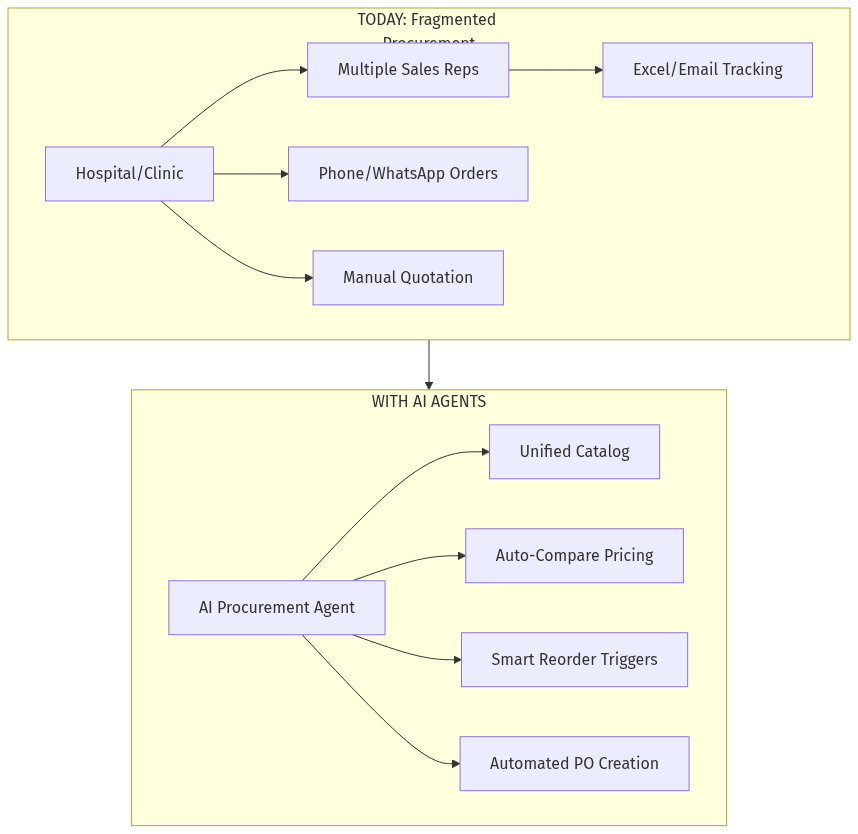
Today (Manual):
Hospital Procurement Officer:
1. Open WhatsApp → Type message to 5 suppliers
2. Wait for responses (hours/days)
3. Copy prices to Excel
4. Compare manually
5. Call supplier to confirm
6. Create PO in ERP
7. Track delivery via phone
With AI Agent (Automated):
AI Procurement Agent:
1. Receive request via WhatsApp/chat
2. Query unified supplier catalog
3. Auto-compare pricing + availability
4. Present top 3 options with recommendations
5. On approval: generate PO, send to supplier
6. Track delivery, alert on delays
7. Predict reorder timing based on consumption
Key AI Capabilities
Natural language procurement — "Order 100 units of syringes, 22G"
Smart price comparison — Benchmark against historical data
Approval routing — Auto-escalate large orders
Inventory prediction — ML models on consumption patterns
Supplier scoring — Automated performance tracking
7.
Product Concept
Core Features
1. WhatsApp-First Ordering
Add AI agent to hospital WhatsApp group
Natural language orders: "Need 50 boxes of 22G syringes by tomorrow"
Agent handles everything via chat interface
2. Smart Catalog
Unified catalog of medical supplies (100,000+ SKUs)
Real-time inventory from participating suppliers
Auto-match to generic equivalents for cost savings
3. Price Intelligence
Live price comparison across 50+ suppliers
Historical price trends
Alert when prices drop below threshold
4. Automated PO Workflow
Create, approve, and send POs in one chat interaction
Integration with hospital ERPs (Tally, SAP, custom)
Digital audit trail for compliance
5. Inventory Prediction
Track consumption patterns per item
Auto-reorder suggestions before stockout
Seasonal adjustment based on historical data
6. Supplier Dashboard
Supplier portal for catalog and order management
Performance analytics (delivery time, quality, pricing)
- Approval chain structures
- Average decision times
- Negotiation patterns
Moat Strength
This data moat is strong because:
Requires hospital participation to build
Improves with every transaction
Hard to replicate without same scale
12.
Why This Fits AIM Ecosystem
Vertical Integration with AIM.in
This healthcare procurement platform can become a key vertical under AIM.in's B2B discovery ecosystem:
Domain Portfolio Synergy
- Target domains like hospital supplies, medical procurement, healthcare wholesale
- SEO-driven traffic to platform
WhatsApp-First Architecture
- Leverages existing Kapso WhatsApp integration
- Same infrastructure as other AIM B2B platforms
Trust Infrastructure
- Netrika's reputation tracking can be integrated
- Verified supplier badges
Expansion Path
- From procurement → payments (UPI integration)
- From supplies → equipment rental
- From B2B → B2C (patient-facing)
Long-term Vision
AIM becomes the "Procurement OS for Indian Healthcare" — the infrastructure layer every hospital uses, whether they know it or not.
## Verdict
Opportunity Score: 8.5/10
This is a high-conviction opportunity because:
Why It Works:
Clear pain point with quantifiable inefficiency ($50B market)
WhatsApp-first approach fits Indian context perfectly
No dominant player has solved the end-to-end workflow
AI agents can meaningfully automate 70%+ of the process
Strong data moat that compounds over time
Risk Factors:
Hospital procurement is relationship-driven — adoption friction
ERPs are fragmented — integration complexity
Government regulations may require specific certifications
Steelman's Counter:
Incumbents like IndiaMART could add this feature
Hospital chains may build in-house solutions
Low-margin business requires scale to be profitable
Recommendation:
Start with a narrow focus (Tier 2 city hospitals, consumables only) to prove the model, then expand. The TAM is massive and the timing is right.