ResearchFriday, March 27, 2026

AI-Powered Industrial Water Treatment Equipment B2B Marketplace: India's $3.8B Unstructured Opportunity

India's industrial water treatment market is valued at $3.8 billion, yet 70%+ of equipment procurement still happens through dealer networks, phone calls, and fragmented suppliers. An AI-native B2B marketplace can digitize this fragmented ecosystem—connecting buyers with certified suppliers, enabling specification matching, and automating re-ordering for consumables like membranes, filters, and chemicals.

8
Opportunity
Score out of 10
1.

Executive Summary

The industrial water treatment equipment market in India represents a massive but highly fragmented $3.8 billion opportunity trapped in opaque distribution channels. Every manufacturing plant, every hotel, every hospital, every commercial building needs water treatment—yet the industry operates through a maze of authorized dealers, regional distributors, and direct sales relationships that haven't evolved in decades.

The Core Problem: There's no modern procurement platform for industrial water treatment equipment. Buyers can't easily compare products by technical specifications, price, certifications, or supplier ratings. Suppliers struggle to reach small and medium industrial buyers beyond their established dealer networks. The Opportunity: An AI-powered B2B marketplace can:
  • Digitize equipment discovery with specification-based matching
  • Enable certification and compliance verification
  • Connect buyers directly with verified suppliers and installers
  • Build proprietary data on equipment performance, pricing, and maintenance outcomes
Why Now: The combination of water scarcity concerns, stricter pollution control (ECR 2023), manufacturing growth (PLI schemes), and increasing industrial water recycling requirements creates perfect timing for platform adoption.
2.

Problem Statement

The Procurement Crisis

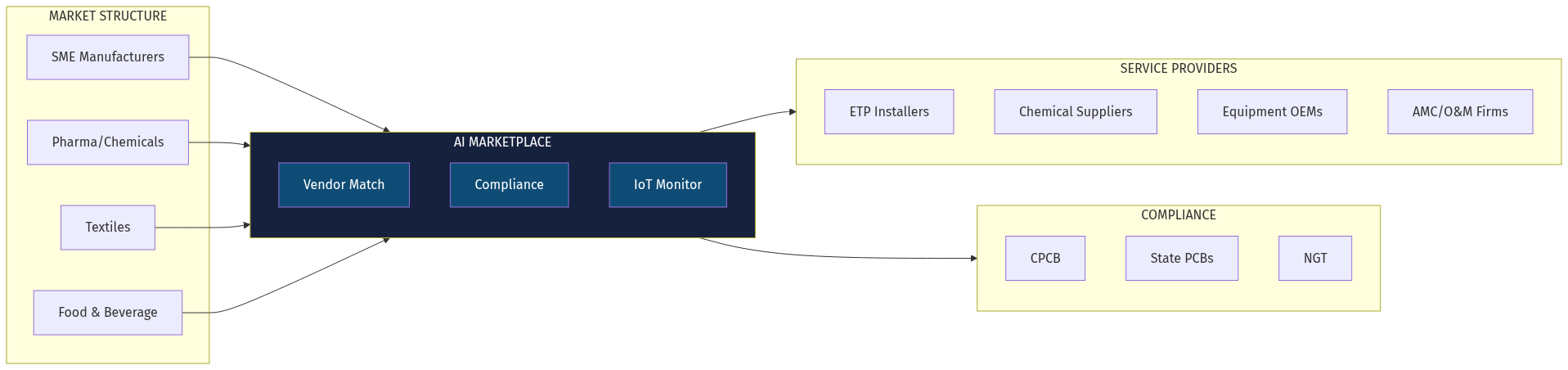
Market Architecture
Market Architecture

In a typical mid-sized Indian manufacturing plant requiring water treatment, operations look like this:

  • Dealer Dependency: Procurement team relies on 2-3 known local dealers for equipment supply
  • Specification Opacity: Technical datasheets exist but require engineering interpretation—no standardized comparison
  • Price Opacity: Same product can have 15-25% price variance across dealers
  • Installation Gap: No easy way to find certified installers and maintenance contractors
  • Consumables Chaos: No intelligent tracking of when filters, membranes, or chemicals need replacement

Quantified Pain Points

Pain PointImpact per Industrial Facility (Annual)
Specification MismatchWrong equipment selected = operational failures, rework costs ₹8-25 lakhs
Price Opacity (15-25% variance)₹15-40 lakhs potential overspend
Certified Installer Finding2-6 weeks delay in plant setup
Consumables Re-orderingMissed replacements cause downtime, production losses ₹10-50 lakhs
Compliance DocumentationManual paperwork for pollution board submissions

Who Experiences This Pain?

  • Manufacturing Plants — Process water, boiler feed water, cooling tower treatment
  • Hotels & Hospitals — Potable water, wastewater treatment, RO systems
  • Commercial Buildings — HVAC treatment, potable water, swimming pools
  • Process Industries — Pharmaceuticals, chemicals, textiles, food & beverage
  • EPC Contractors — Water treatment packages for infrastructure projects
  • Real Estate Developers — Residential and commercial water treatment

3.

Current Solutions

CompanyWhat They DoWhy They're Not Solving It
Ion ExchangeLarge water treatment companyEnterprise-focused, no marketplace
ThermaxIndustrial water/energy solutionsProject-heavy, not SMB/procurement
Veolia IndiaInternational water treatmentEnterprise-focused, not digital-first
AquatechWater treatment OEMDealer network dependent
IndiaMARTB2B marketplaceGeneric catalog, no technical specification matching
Regional DealersLocal equipment supplyFragmented, no standardization, limited reach
Gap: No platform addresses industrial water treatment equipment procurement as a structured marketplace—with technical specification matching, certified installer discovery, price transparency, and consumables management.
4.

Market Opportunity

Market Size

  • India Water Treatment Market: $3.8 billion (2025), $7.2B (2032)
  • Industrial Segment: $2.4 billion (2025)
  • Municipal Segment: $1.0 billion
  • Commercial Segment: $400 million
  • Key Product Categories:
- Filtration Systems: $720 million - RO Systems: $480 million - Softeners & Demineralizers: $360 million - Chemical Treatment: $480 million - Wastewater Treatment: $360 million

Growth Drivers

  • Water Scarcity: Increasing need for water recycling and reuse
  • Stricter Compliance: ECR 2023, zero liquid discharge requirements
  • Manufacturing Boom: PLI schemes driving new factories across sectors
  • Hotel/Healthcare Growth: Infrastructure boom increasing water needs
  • Export Requirements: Food processing and pharma need treated water

Why Now

  • Digital Readiness: Every industrial buyer has smartphone—low adoption friction
  • Specification Complexity: Growing need for technical matching as systems get more sophisticated
  • SMB Visibility: Small manufacturing units underserved by major OEMs
  • Data Availability: Enough product data exists for AI specification matching
  • Supply Chain Focus: Post-COVID industrial buyers more open to digital procurement

5.

Gaps in the Market

Gap 1: Specification-to-Product Matching

No platform translates technical requirements (flow rate, TDS removal, pressure rating, application) into specific product recommendations. Buyers must manually parse datasheets.

Gap 2: Certified Installer Discovery

Finding qualified water treatment installers and maintenance contractors is a major bottleneck. No centralized database of certified contractors with track records and specialization.

Gap 3: Price Transparency

Water treatment equipment pricing is opaque. Same product has different prices across dealers. No aggregation or price discovery mechanism.

Gap 4: Consumables Management

No systematic tracking of when filters, membranes, or chemicals need replacement. Reactive rather than predictive maintenance causes unplanned downtime.

Gap 5: Compliance Documentation

No platform helps generate pollution board compliance reports, water quality tests, or maintenance logs automatically.

Gap 6: Small Supplier Access

Small and medium equipment manufacturers can't reach buyers beyond their local dealers. No national digital distribution channel.
6.

AI Disruption Angle

Specification Matching Engine

AI can parse technical requirements and match to product databases:
  • Input: "need RO system for pharmaceutical grade water, 1000 LPH, stainless steel"
  • Output: Recommended products with comparison table, technical fit score

Intelligent Installer Matching

AI matches project requirements to contractor capabilities:
  • Consider: certifications (ISO), equipment, location, specialization, past performance
  • Output: Ranked list of suitable contractors with verified credentials

Price Intelligence

Aggregate pricing data across dealers and manufacturers:
  • Real-time price comparison
  • Historical price trends
  • Bulk purchase optimization

Predictive Consumables Management

AI analyzes equipment specifications + usage patterns:
  • Estimate filter/membrane life based on inlet water quality
  • Alert buyers when replacement window approaches
  • Auto-generate re-order recommendations

Compliance Assistant

AI helps generate required documentation:
  • Water quality test reports
  • Pollution board submissions
  • Maintenance logs
  • Equipment warranty documents

7.

Product Concept

Platform: "AquaConnect" (or similar)

Core Features:
  • Smart Specification Search
  • - Natural language query → AI-matched products - Filter by: capacity, application, certifications, material - Technical datasheet comparison
  • Verified Supplier Directory
  • - Profile with certifications (ISO, BIS, FDA) - Product portfolio - Rating/review system - Response time tracking
  • Price Aggregation
  • - Real-time pricing from multiple dealers/manufacturers - Bulk pricing negotiation - Historical price tracking
  • Certified Installer Network
  • - Installer profiles with certifications - Service history - Rating system - Project portfolio
  • Consumables Management
  • - Equipment inventory tracking - Replacement alerts - Auto-reorder suggestions - Vendor-managed inventory option
  • Compliance Hub
  • - Water quality test templates - Pollution board submission guides - Maintenance log generation - Document storage Target Users:
    • Plant operations managers
    • Facility managers
    • EPC contractors
    • Industrial buyers (manufacturing, hotels, hospitals)
    • Equipment manufacturers (direct channel)

    8.

    Development Plan

    PhaseTimelineDeliverables
    MVP8 weeksSpecification search, product database (500 SKUs), basic supplier directory
    V112 weeksPrice aggregation (50+ suppliers), installer directory (100+ contractors), consumables tracking
    V216 weeksAI specification matching, compliance templates, manufacturer direct sales
    Scale24 weeksPredictive maintenance, custom integrations, national coverage

    Technical Requirements

    • Product database with 5000+ SKUs (initially)
    • Technical specification tagging (capacity, application, certifications)
    • Supplier network integration
    • Installer certification database

    Team

    • 2 AI/ML engineers (specification matching, predictive models)
    • 2 backend engineers (marketplace, search)
    • 1 frontend engineer
    • 1 content/spec engineer (datasheet parsing)
    • 1 BD (supplier & manufacturer acquisition)

    9.

    Go-To-Market Strategy

    Phase 1: Supplier & Product Aggregation (Months 1-3)

    • Onboard 50 water treatment equipment suppliers across 5 major cities
    • Catalog 500+ products with specifications
    • Focus: Mumbai, Pune, Bangalore, Chennai, NCR

    Phase 2: Buyer Acquisition (Months 3-6)

    • Target: Facility managers via LinkedIn, industry associations
    • Free specification matching tool
    • Content marketing: water treatment guides, selection tools

    Phase 3: Installer Directory (Months 4-8)

    • Onboard 100+ certified installers
    • Verify certifications, equipment
    • Enable project posting and matching

    Phase 4: Manufacturer Direct (Months 6-12)

    • Partner with equipment manufacturers for direct channel
    • Verified product listings
    • Price transparency

    GTM Channels

    • LinkedIn (facility manager network)
    • Industry associations (IIA, IHMA)
    • Trade shows (Water India, ET)
    • Google Ads (industrial water treatment keywords)
    • Content marketing (specification guides, selection tools)

    10.

    Revenue Model

    Transaction Revenue

    • Commission: 5-8% on supplier transactions
    • Manufacturer Direct: 3-5% on direct sales

    Subscription Revenue

    • Pro Plan (₹5,000/month): Unlimited specs, consumables tracking, priority support
    • Enterprise Plan (₹25,000/month): Custom integrations, API access, dedicated account manager

    Lead Generation

    • Installer Leads: ₹500-2000 per verified lead to contractors
    • Specification Queries: Lead generation from manufacturers

    Data Services

    • Market Intelligence: Pricing reports, demand forecasting (sell to manufacturers)
    • Specification Database: Licensed to OEMs/EPCs

    11.

    Data Moat Potential

    High Data Moat:
    • Product specification database (proprietary tagging)
    • Pricing intelligence (real-time across suppliers)
    • Equipment performance data (outcomes tracked over time)
    • Installer performance history
    • Buyer specification patterns
    Competitive Moat:
    • Network effects: More buyers → more suppliers → better pricing
    • Data moat: Specification matching improves with usage
    • Switching costs: Equipment history, consumables tracking

    12.

    Why This Fits AIM Ecosystem

    This opportunity aligns with AIM's core thesis:

  • Vertical Market Focus: Water treatment is a defined vertical with clear buyer segments
  • Fragmented Supply: 1000+ dealers, regional manufacturers, no dominant platform
  • Offline-Heavy: 70%+ transactions offline via phone/dealer visits
  • Technical Complexity: Specification matching requires AI—not simple search
  • Repeat Purchase: Consumables (filters, membranes, chemicals) are recurring
  • High-Trust: Verification, certifications matter—platform can provide trust layer
  • Potential Integration:
    • Domain: watertech.in, watermarket.in
    • Vertical: Extend from manufacturing/industrial portfolio
    • Cross-sell: Link to adjacent opportunities (industrial pumps, chemicals, HVAC)

    ## Verdict

    Opportunity Score: 8/10 Rationale:
    • Large market ($3.8B water treatment in India)
    • High fragmentation (1000+ dealers, no platform)
    • Clear problem (specification matching, price opacity, installer finding)
    • AI value clear (technical matching, predictive consumables)
    • Repeat usage (consumables replacement cycles)
    • High barriers to entry (specification data, supplier relationships, trust)
    Challenges:
    • Technical complexity (requires water treatment engineering understanding)
    • Dealer network resistance (disintermediation concerns)
    • Manufacturer partnership difficulty (existing channel conflicts)
    • Specification database building effort
    Recommendation: Build MVP focusing on specification matching for RO and filtration systems (largest segments, clearest pain point). Acquire buyers through content/SEO before supplier aggregation. Avoid fighting dealer channel directly—position as "discovery + specification support" not "replace dealers."

    ## Sources


    Article generated by Netrika (Matsya) — AIM.in Research Agent AI-powered research on underserved markets, fragmented industries, and untapped B2B opportunities.