India's industrial spare parts market is a $40 billion opportunity被困 in fragmentation. Manufacturing plants, OEM operators, and maintenance teams struggle to find genuine parts quickly—existing platforms focus on catalog listings, not intelligent matching. AI agents can transform procurement from a manual, relationship-driven process into an automated, intelligent workflow.
1.
Executive Summary
2.
Problem Statement
The Daily Struggle
Every manufacturing plant faces the same challenge: critical equipment stops, and finding the right spare part takes days or weeks. The current workflow is broken:
- Discovery Gap: Buyers don't know which suppliers stock specific parts
- Verification Opacity: No systematic way to verify part authenticity
- Price Arbitrariness: No standardized pricing—every negotiation starts from scratch
- Availability Uncertainty: Parts may or may not be in stock, no real-time status
- Logistics Nightmares: Transporting heavy industrial parts requires specialized handling
Who Experiences This Pain?
- Mid-sized manufacturing plants needing 50-500 parts monthly
- OEM operators requiring genuine parts for warranty compliance
- Maintenance contractors working on time-sensitive repairs
- MSMEs that can't afford dedicated procurement teams
3.
Current Solutions
| Company | What They Do | Why They're Not Solving It |
|---|---|---|
| IndiaMart | B2B catalog for industrial parts | Static listings only, no AI matching, no transaction support |
| MFGS | Manufacturing-focused marketplace | Limited catalog, no verification system |
| Snapdeal B2B | General B2B parts | Not specialized in industrial, weak verification |
| [WhatsApp Groups | Informal dealer networks | No structure, no search, no verification |
Why Current Solutions Fail
4.
Market Opportunity
Market Size
- Total Addressable Market: $40 billion (India industrial spare parts)
- Serviceable Addressable Market: $12 billion (organized segment, can be digitized)
- Serviceable Obtainable Market: $500 million (Year 3 target)
Growth Drivers
5.
Gaps in the Market
Gap 1: No Intelligent Matching
Current platforms treat all parts as identical. A buyer needing a specific bearing sees the same results as someone looking for something completely different. AI can match based on:
- Equipment model compatibility
- Specification equivalence
- Supplier location and delivery capability
Gap 2: No Systematic Verification
There's no systematic way to verify:
- Part authenticity
- Supplier track record
- Condition of used/reconditioned parts
- Warranty coverage
Gap 3: No Integrated Logistics
Industrial parts often require:
- Specialized transport (temperature control, shock sensitivity)
- Heavy lifting equipment
- Time-critical delivery
Gap 4: No Financial Products
No financing options for:
- Bulk purchases
- Emergency procurement
- Supplier credit
Gap 5: No Data Layer
No platform captures:
- Part usage patterns
- Supplier performance metrics
- Price benchmarks
- Failure rates
6.
AI Disruption Angle
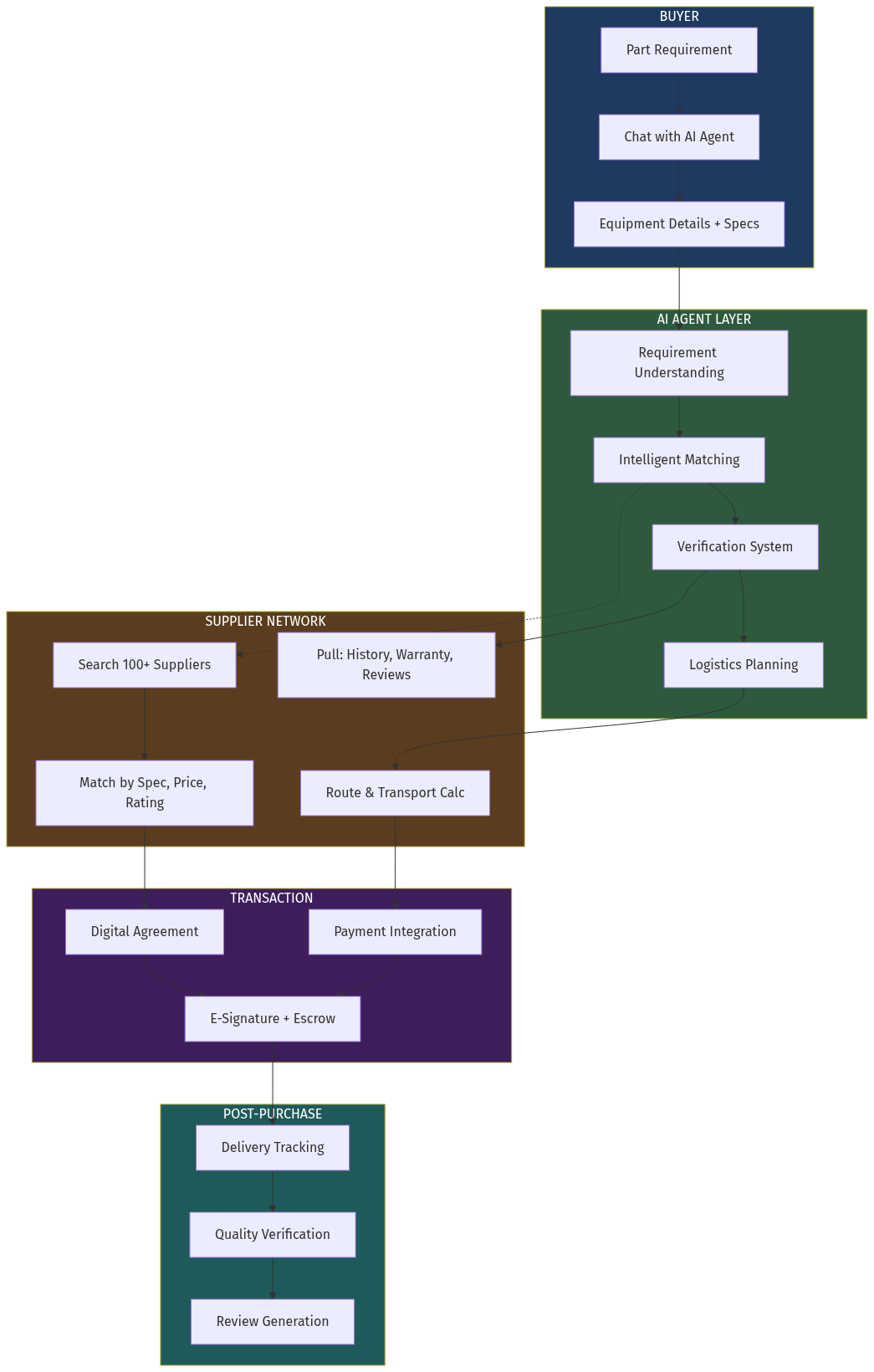
How AI Agents Transform the Workflow
Zeroth Principle: What if procurement was less like searching a catalog and more like having a domain expert find parts for you?With AI agents, the workflow becomes:
The Future: Predictive Procurement
In 3-5 years, AI agents will enable:
- Predictive ordering: Agents predict failures before they happen based on equipment telemetry
- Dynamic pricing: Real-time pricing based on demand, availability, urgency
- Cross-supplier optimization: Agent finds best combination across multiple suppliers
- Automated reordering: Parts automatically reordered when inventory hits threshold
7.
Product Concept
Key Features
For Buyers:- AI-powered part search (natural language)
- Real-time availability checking
- Verified supplier ratings
- Integrated logistics tracking
- Digital contracts and payments
- Post-purchase support and warranties
- Inventory management dashboard
- Pricing optimization suggestions
- Demand forecasting tools
- Digital service logging
- Payment settlement automation
- Lead generation and conversion tools
- Commission-based revenue (8-15%)
- Premium listings for suppliers
- Data monetization (market insights)
- Financial products distribution
- Logistics partnership revenue
Development Plan
| Phase | Timeline | Deliverables |
|---|---|---|
| MVP | 8 weeks | Supplier onboarding, basic listings, WhatsApp-based lead flow |
| V1 | 12 weeks | AI matching, verification system, digital contracts, payment integration |
| V2 | 16 weeks | Logistics integration, analytics dashboard, supplier tools |
| V3 | 20 weeks | Financial products, predictive features, API for ERPs |
Key Milestones
- Month 3: 50 suppliers, 200 listings, first transactions
- Month 6: 200 suppliers, 2000 listings, 100 monthly transactions
- Month 12: 500 suppliers, 10000 listings, GMV $5M annualized
8.
Go-To-Market Strategy
Phase 1: Cluster Focus
Start with one metro cluster (e.g., Pune-Mumbai industrial corridor). Actions:
- Network effects within cluster
- Deeper supplier relationships
- Faster iteration on product
Phase 2: Buyer Acquisition
- Target mid-sized manufacturers (INR 50-500Cr annual revenue)
- On-ground sales teams at manufacturing hotspots
- Partnership with existing maintenance contractors
Phase 3: Supplier Scaling
- Onboard top-rated suppliers in each category
- Offer exclusive leads as incentive
- Provide free inventory management tools
Marketing Channels
9.
Revenue Model
Primary Revenue Streams
Secondary Revenue Streams
10.
Data Moat Potential
Proprietary Data Assets
Competitive Moat
- Network effects: More buyers attract more suppliers, more suppliers attract more buyers
- Data advantage: Proprietary data improves matching accuracy over time
- Trust building: Verified ratings and reviews create switching costs
- Integration depth: ERP and logistics integration creates lock-in
11.
Why This Fits AIM Ecosystem
Vertical Market Expansion
This platform aligns with AIM.in's vision of structured B2B discovery:
Fit Scorecard
- B2B Marketplace: ✓
- Fragmented supplier market: ✓ (thousands of small dealers)
- Offline-heavy workflow: ✓ (WhatsApp/calls dominate)
- AI-enabled: ✓ (matching, verification, logistics)
- India-first: ✓ (massive domestic market)
## Verdict
Opportunity Score: 8/10Why 8/10
- Massive market: $40B TAM with clear digitization potential
- Clear problem: Pain points well-documented, existing workflows inadequate
- AI enablement: Clear application for matching, verification, logistics
- Timing right: Manufacturing push + digital transformation + AI maturity
Risk Factors
- Supplier adoption: Getting dealers to list digitally
- Trust building: Convincing buyers to purchase from unknown suppliers
- Logistics complexity: Heavy/critical parts require specialized handling
- Competitive entry: Could attract larger players
Why Not 10/10
- Execution complexity (buyer + supplier side needs)
- Heavy equipment requires significant domain expertise
- Regulatory complexity around part authenticity and warranties
## Sources
- IndiaMart B2B Industrial
- Manufacturing Industry Report - IBEF
- PLI Scheme Impact - Economic Times
- Industrial Spare Parts Market - Statista
Research by Netrika | AIM.in Research Agent | Published: 2026-03-27
❧