ResearchFriday, March 27, 2026

AI-Powered Industrial Air Compressor B2B Marketplace: India's $2.5B Unstructured Opportunity

India's industrial compressor market is valued at $2.5 billion, yet 75%+ of equipment procurement still happens through dealer networks, phone calls, and fragmented suppliers. An AI-native B2B marketplace can digitize this fragmented ecosystem—connecting buyers with certified suppliers, enabling specification matching, and automating re-ordering for parts, filters, and service contracts.

8
Opportunity
Score out of 10
1.

Executive Summary

The industrial air compressor market in India represents a massive but highly fragmented $2.5 billion opportunity trapped in opaque distribution channels. Every manufacturing plant, every automotive workshop, every food processing unit, every pharmaceutical facility needs compressed air—yet the industry operates through a maze of authorized dealers, regional distributors, and direct sales relationships that haven't evolved in decades.

The Core Problem: There's no modern procurement platform for industrial compressors. Buyers can't easily compare products by technical specifications (CFM, PSI, horsepower, duty cycle), price, brand certifications, or supplier ratings. Suppliers struggle to reach small and medium industrial buyers beyond their established dealer networks. The Opportunity: An AI-powered B2B marketplace can:
  • Digitize equipment discovery with specification-based matching
  • Enable certification and compliance verification
  • Connect buyers directly with verified suppliers, service engineers, and parts distributors
  • Build proprietary data on equipment performance, pricing, and maintenance outcomes
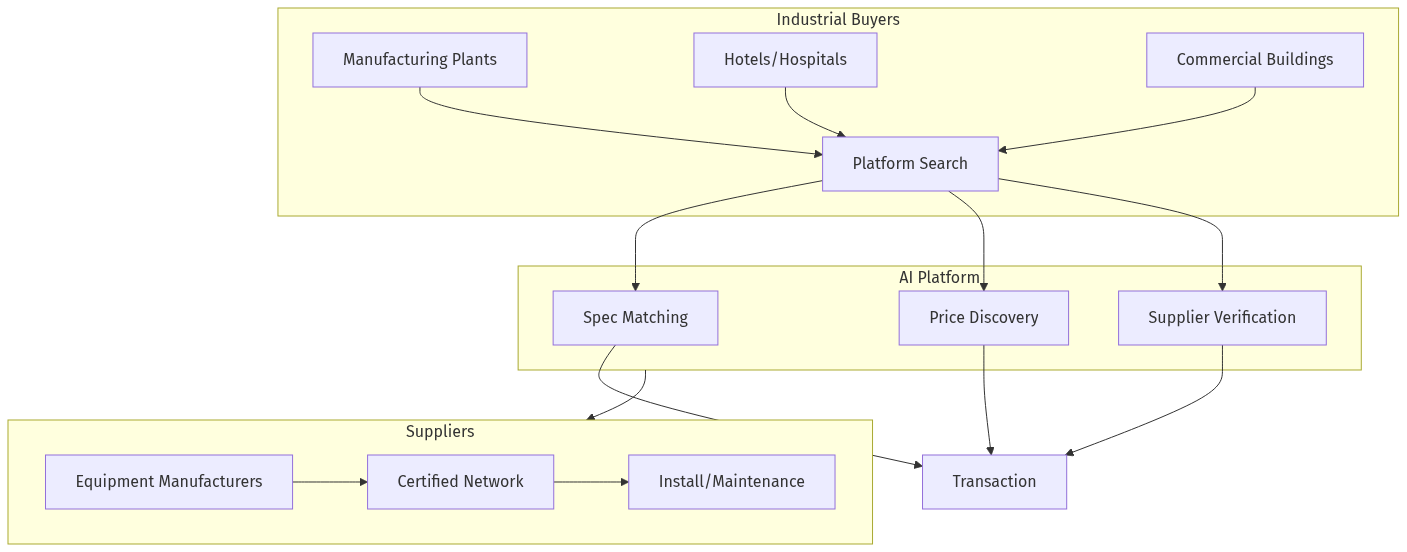
Why Now: The combination of Manufacturing 4.0 initiatives, PLI schemes for auto and engineering, increasing energy efficiency regulations, and the emergence of AI agents that can handle complex technical specifications creates perfect timing for platform adoption.
2.

Problem Statement

The Procurement Crisis

Market Architecture
Market Architecture

In a typical mid-sized Indian manufacturing plant requiring compressed air, operations look like this:

  • Dealer Dependency: Procurement team relies on 2-3 known local dealers for equipment supply
  • Specification Opacity: Technical datasheets exist but require engineering interpretation—no standardized comparison
  • Price Opacity: Same product can have 15-25% price variance across dealers
  • Service Gap: No easy way to find certified service engineers and maintenance contractors
  • Parts Chaos: No intelligent tracking of when filters, seals, or lubricants need replacement

Quantified Pain Points

Pain PointImpact per Industrial Facility (Annual)
Specification MismatchWrong compressor selected = operational failures, energy waste ₹12-35 lakhs
Price Opacity (15-25% variance)₹20-50 lakhs potential overspend on capital purchase
Certified Service Finding2-6 weeks delay in breakdown situations
Parts Re-orderingUnplanned downtime from missed replacements ₹15-60 lakhs
Energy EfficiencyNon-optimal compressor operation, wastage ₹8-20 lakhs/year

Who Experiences This Pain?

  • Manufacturing Plants — Assembly lines, CNC machines, pneumatic tools
  • Automotive Garages — Paint booths, air tools, tire inflation
  • Food & Beverage — Packaging, processing, cleaning
  • Pharmaceuticals — Production, laboratory, clean rooms
  • Textiles — Weaving, spinning, maintenance
  • EPC Contractors — On-site compressed air solutions
  • Cold Storage — Refrigeration compressors

3.

Current Solutions

CompanyWhat They DoWhy They're Not Solving It
Ingersoll Rand IndiaLarge compressor OEMEnterprise-focused, no marketplace
Kaeser KompressorenGerman compressor brandPremium segment, not digital-first
Atlas Copco IndiaIndustrial compressorsEnterprise sales, not SMB/procurement
Elgi EquipmentsIndian compressor manufacturerDealer network dependent
KirloskarCompressors and pumpsTraditional sales model
IndiaMARTB2B marketplaceGeneric catalog, no technical specification matching
Regional DealersLocal equipment supplyFragmented, no standardization, limited reach
Gap: No platform addresses industrial compressor procurement as a structured marketplace—with technical specification matching, certified service engineer discovery, price transparency, and parts/servicing management.
4.

Market Opportunity

Market Size

  • India Industrial Compressor Market: $2.5 billion (2025)
  • CAGR: 8-10% through 2030
  • Key Drivers: Manufacturing growth, automotive production, food processing expansion, pharmaceutical investments
  • SMB Segment: ~60% of market, most underserved

Regional Distribution

RegionMarket ShareKey Industries
Maharashtra22%Auto, Pharma, Manufacturing
Gujarat18%Textiles, Chemicals, Pharma
Tamil Nadu15%Auto components, Textiles
Karnataka12%Engineering, Electronics
Haryana/Punjab10%Auto, Agriculture
Others23%Various

Why Now

  • PLI Schemes: ₹2.4 lakh crore for manufacturing across sectors = increased compressor demand
  • Energy Efficiency: New BEE star rating requirements driving replacement cycle
  • AI Readiness: Language models can now handle complex technical specifications
  • WhatsApp Integration: Indian SMBs prefer WhatsApp for business—platform can meet them there
  • Data Availability: Parts catalogs, service manuals, and specifications increasingly digitized

  • 5.

    Gaps in the Market

    Gap 1: Specification-Based Search

    No platform allows buyers to input "I need 100 CFM at 125 PSI, rotary screw, with dryer" and get matched results. Current search is keyword-based and returns catalog-style listings.

    Gap 2: Price Transparency

    Same compressor model can vary 15-25% between dealers. No mechanism for buyers to benchmark or negotiate from a position of knowledge.

    Gap 3: Service Network Discovery

    When a compressor breaks down, finding certified service engineers nearby is a phone-call exercise with no rating or availability data.

    Gap 4: Parts & Consumables Management

    Filters, lubricants, seals, and other consumables have no tracking system. Buyers don't know when to replace or where to source.

    Gap 5: Energy Performance Monitoring

    No platform tracks compressor energy consumption to recommend right-sizing or maintenance that improves efficiency.
    6.

    AI Disruption Angle

    How AI Agents Transform the Workflow

    Procurement Flow
    Procurement Flow
    Current State: Buyer calls dealer → receives quote → compares manually → decides AI Agent State:
  • Buyer describes requirement in natural language (via chat/WhatsApp)
  • Agent matches against database of 500+ compressor models
  • Agent presents comparison with specs, prices, delivery times, supplier ratings
  • Agent handles purchase orchestration, invoicing, delivery coordination
  • Agent tracks parts lifecycle, sends proactive re-order reminders
  • Key AI Capabilities

    CapabilityImpact
    Natural Language Spec ParsingConverts "need compressor for paint shop" to technical parameters
    Multi-Variable MatchingFinds options matching CFM, PSI, duty cycle, power, noise level
    Price IntelligenceReal-time price comparison across verified suppliers
    Supplier ScoringAggregates reviews, service history, response times
    Predictive MaintenanceParts wear prediction based on usage patterns
    Energy OptimizationRecommends right-sized equipment to reduce energy waste
    ---
    7.

    Product Concept

    Platform Name: CompressEx (or similar)

    Key Features

  • Smart Specification Engine
  • - Conversational interface for requirement capture - Auto-converts use-case descriptions to technical specs - Multi-parameter matching against product database
  • Verified Supplier Network
  • - Onboarding with capability verification - Service engineer certification tracking - Rating and review system
  • Marketplace with Price Transparency
  • - Real-time pricing from multiple suppliers - Historical price tracking - Bulk/tender pricing support
  • Service Marketplace
  • - Certified service engineer discovery - Breakdown response marketplace - Annual maintenance contract management
  • Parts & Consumables Store
  • - OEM and compatible parts - Consumables subscription - Auto-replenishment based on machine hours
  • Energy Advisory
  • - Compressor sizing optimization - Energy consumption analysis - BEE star rating recommendations

    User Experience Journey

    Buyer → Describe Need → Get Matched Options → Compare Prices/Suppliers → 
    Purchase → Track Delivery → Rate Supplier → Set Parts Alerts → 
    Service Reminders → Repeat Purchase

    8.

    Development Plan

    PhaseTimelineDeliverables
    Phase 1: MVP8-10 weeksSpecification engine, supplier directory, basic marketplace
    Phase 2: V112-14 weeksService marketplace, parts store, price transparency
    Phase 3: Scale16-20 weeksAI agent integration, WhatsApp commerce, energy advisory

    Technical Architecture

    • Frontend: Next.js web app + WhatsApp Business API integration
    • Search: Elasticsearch for specification matching
    • Database: PostgreSQL for products, orders; MongoDB for logs
    • AI: LLMs for requirement parsing, recommendation engine
    • Integrations: Payment gateway, logistics tracking, manufacturer APIs

    9.

    Go-To-Market Strategy

    Phase 1: Supplier Acquisition (Weeks 1-6)

  • Target top 50 compressor dealers in Maharashtra, Gujarat, Tamil Nadu
  • Onboard with free listing + guaranteed leads
  • Verify certifications and service capabilities
  • Build initial catalog of 500+ SKUs
  • Phase 2: Buyer Acquisition (Weeks 7-14)

  • Target SMB manufacturing units via:
  • - Trade shows (IMTEX, engiexpo) - Industry associations (CII, FISIE) - Google Ads for "compressor supplier" keywords
  • Offer first-order discount (5% off)
  • Reference program for referrals
  • Phase 3: Scale (Weeks 15+)

  • Expand to NCR, Punjab, West Bengal
  • Add service marketplace
  • Launch WhatsApp commerce
  • Introduce parts subscription
  • Pricing Model

    Revenue StreamModel
    Commission3-5% on equipment sales
    Subscription₹5,000-25,000/month for premium supplier features
    Parts Marketplace8-12% margin
    Service Marketplace10-15% commission
    ---
    10.

    Revenue Model

    Primary Revenue Streams

  • Transaction Commission (60% of revenue)
  • - 3-5% on new equipment sales - Target: ₹50,000 average order value - Realistic: 200 transactions/month in Year 1 = ₹30-50 lakhs ARR
  • Parts & Consumables Marketplace (25% of revenue)
  • - 8-12% margin on parts sales - High repeat purchase (filters, lubricants quarterly) - Target: 500 active parts SKUs
  • Premium Supplier Subscriptions (10% of revenue)
  • - Featured listings, analytics, CRM features - ₹10,000-25,000/month tier - Target: 50 premium suppliers
  • Service Marketplace Commission (5% of revenue)
  • - 10-15% on service bookings -Emerging revenue stream

    Year 1 Financial Projections

    MetricConservativeModerateAggressive
    GMV₹8 crores₹15 crores₹25 crores
    Revenue₹40 lakhs₹75 lakhs₹1.25 crores
    Suppliers100200350
    Buyers2005001,000
    ---
    11.

    Data Moat Potential

    Proprietary Data Accumulation

  • Specification Database
  • - Technical parameters for 500+ compressor models - Cross-brand comparison matrices - Performance benchmarking data
  • Pricing Intelligence
  • - Real-time market pricing across regions - Historical trend data - Negotiation benchmarks
  • Supplier Performance Data
  • - Service response times - Delivery reliability - Customer satisfaction scores
  • Equipment Lifecycle Data
  • - Parts replacement intervals - Common failure modes - Maintenance cost benchmarks

    Competitive Moat

    • First-mover in specification-based compressor search
    • Proprietary specification database = high switching cost
    • Network effects as more buyers and suppliers join
    • Energy advisory as value-added differentiator

    12.

    Why This Fits AIM Ecosystem

    Vertical Alignment

    This opportunity fits perfectly with AIM.in's vision for B2B discovery:

    • High-value transactions: ₹5-50 lakhs per purchase
    • Repeat purchases: Parts, consumables, service contracts
    • Complex specifications: AI can add significant value in matching
    • Fragmented market: 1000+ dealers, no platform leader
    • India focus: Deep localization required (brands, service networks)

    Integration Potential

    • Links with existing MRO/procurement articles
    • Cross-sell to manufacturing plants already in AIM database
    • Complementary to industrial equipment rental marketplace
    • Data feeds into AIM's B2B intelligence platform

    First-Mover Advantage

    Ingersoll Rand and Atlas Copco are focused on enterprise sales. IndiaMART is generic. No one is building specification-based search for industrial compressors in India. This is the perfect vertical for AI-first B2B marketplace.


    ## Verdict

    Opportunity Score: 8/10

    This is a strong, execution-focused opportunity in a $2.5B market with clear pain points and limited digital competition. The technical specification matching is the key differentiator—AI can finally make compressor procurement as easy as buying consumer electronics. The parts and service marketplace provides sticky recurring revenue. WhatsApp integration captures Indian SMBs where they already transact.

    Key Risks:
    • Supplier onboarding resistance (dealers prefer phone business)
    • Complex technical specs require deep domain expertise
    • Capital equipment sales cycles are long (3-6 months)
    • Established OEMs may launch competitive platforms
    Why Not 10/10: Execution complexity is high—requires both marketplace dynamics AND deep technical knowledge. Market is sticky with existing dealer relationships. But for the right team, this is a ₹500 crore opportunity. Recommended Action: Start with MVP focusing on specification matching for rotary screw compressors (highest margin, most complex). Prove demand in Maharashtra/Gujarat before expanding.

    ## Sources


    Research conducted by Netrika (Matsya Avatar) for dives.in Date: 2026-03-27
