ResearchThursday, March 26, 2026

AI-Powered Pharma API Sourcing Platform — India's $15B Opportunity

India imports 70%+ of its Active Pharmaceutical Ingredients (APIs) from China. The government is actively pushing self-reliance (Atmanirbhar Bharat), but pharmaceutical companies still struggle with supplier discovery, quality verification, and price negotiation. This creates a massive opportunity for an AI-native B2B platform that transforms how APIs are sourced, verified, and procured.

8
Opportunity
Score out of 10
1.

Executive Summary

India's pharmaceutical industry is the third-largest in the world by volume, but it remains critically dependent on imported Active Pharmaceutical Ingredients (APIs). With imports worth $3-4 billion annually from China alone, and the government committing ₹20,000+ crore to boost domestic API manufacturing, the time is ripe for an AI-powered B2B marketplace that connects pharma companies with API suppliers—domestic and international—while automating quality verification, price discovery, and procurement workflows.

This platform addresses a fundamental pain point: finding the right API supplier at the right price with guaranteed quality, in an industry where regulatory compliance is non-negotiable and supply chain disruptions can halt production.

2.

Problem Statement

Who experiences this pain?
  • Generic pharma companies needing reliable API supplies at competitive prices for cost-sensitive markets
  • Contract manufacturing organizations (CMOs) sourcing APIs for formulation work
  • 中型 pharma companies looking to diversify suppliers beyond their existing network
  • New drug manufacturers entering the market without established supplier relationships
The pain:
  • Discovery is fragmented — No centralized database of API suppliers. Companies rely on trade shows, personal networks, and Google searches.
  • Quality verification is manual — Need to request samples, conduct tests, verify DMF (Drug Master File) status—process takes weeks.
  • Price discovery is opaque — No transparency on market rates. Negotiation happens via individual calls.
  • Regulatory compliance is complex — Need to verify USFDA/EMA/WHO-GMP certifications, regulatory status in multiple markets.
  • Supply chain is vulnerable — COVID showed the risk of single-source dependency on China.
  • Inventory management is reactive — No predictive visibility into supply shortages or price spikes.

  • 3.

    Current Solutions

    CompanyWhat They DoWhy They're Not Solving It
    IndiaMART (Pharma section)General B2B marketplaceNot specialized, no quality verification, no structured data
    ChemAnalystChemical pricing dataData only, no transaction capability
    **MoleculePharma supply chainFocus on logistics, not sourcing
    API database portalsDirectory listingsStatic lists, no AI matching, no procurement workflow
    Trade showsIn-person networkingInefficient, slow, limited to attendees
    The gap: No verticalized, AI-powered B2B marketplace specifically for pharmaceutical APIs that combines discovery + quality verification + price intelligence + procurement.
    4.

    Market Opportunity

    • Global API Market: $200+ billion (2025), growing at 6-8% CAGR
    • India API Import Dependence: 70%+ of APIs imported, primarily from China
    • Domestic API Market: $15+ billion by 2027 (India)
    • Government Push: ₹20,000+ crore PLI (Production Linked Incentive) scheme for API manufacturing
    • Why Now:
    - Geopolitical risk from China dependency is unacceptable - PLI creating new domestic manufacturing capacity - AI capabilities now sufficient for quality prediction and matching - Post-COVID supply chain visibility is a board-level priority
    5.

    Gaps in the Market

  • No structured API database — Thousands of API molecules, hundreds of suppliers, no unified catalog with specifications
  • Quality information asymmetry — Buyer can't easily verify supplier's regulatory status, DMF filings, manufacturing track record
  • Price opacity — No real-time market intelligence on API pricing across suppliers and regions
  • Fragmented procurement — Each purchase is a custom negotiation, no standardized terms
  • No predictive analytics — Can't anticipate supply disruptions or price spikes
  • Limited fintech integration — Letters of credit, payment terms, escrow not integrated
  • No AI-assisted formulation matching — Can't recommend alternative APIs or suppliers based on requirements

  • 6.

    AI Disruption Angle

    How AI agents can transform the workflow:
  • Intelligent Matching — AI matches buyer requirements (molecule, purity, quantity, timeline, budget) with supplier capabilities, using natural language queries
  • Quality Prediction — ML models predict supplier quality based on:
  • - Historical regulatory compliance data - DMF status and filing history - Manufacturing facility certifications - Customer review patterns
  • Price Intelligence — Continuous monitoring of:
  • - Global API price indices - Raw material costs - Currency fluctuations - Supply-demand signals
  • Regulatory Automation — AI assists in:
  • - Verifying certifications across markets - Flagging regulatory risks - Recommending compliance documentation
  • Inventory Forecasting — Predictive models for:
  • - Supply shortages - Price movement predictions - Alternative supplier recommendations during disruptions Future state: AI agents autonomously negotiate with suppliers, manage quality audits, and execute procurement within defined parameters.
    7.

    Product Concept

    Core Features

  • API Discovery Engine
  • - Search 10,000+ APIs by molecule, CAS number, therapeutic category - Natural language queries ("I need Metformin API for generic manufacturing") - Filter by purity, manufacturer, regulatory status, price range
  • Supplier Intelligence Dashboard
  • - Verified supplier profiles with certifications, facility details, capacity - Quality score based on regulatory history and peer reviews - Price benchmarks and trend charts
  • RFQ (Request for Quote) System
  • - Structured RFQ with specifications, quantity, timeline - Multiple supplier responses comparison - AI-recommended quotes based on requirements
  • Quality Verification Suite
  • - DMF status checker - Regulatory certification tracker - Sample request and test result management
  • Procurement Workflow
  • - Purchase order management - Payment integration (escrow, LC support) - Shipment tracking integration
  • Market Intelligence
  • - Price alerts for specific APIs - Supply shortage predictions - Alternative supplier recommendations

    User Experience

    • For Buyers: Dashboard showing active RFQs, recommended suppliers, price alerts
    • For Suppliers: Profile management, RFQ responses, order pipeline
    • For Both: AI assistant for queries, automated alerts, integrated messaging

    8.

    Development Plan

    PhaseTimelineDeliverables
    MVP8 weeksAPI database (5,000 molecules), supplier directory (200 suppliers), basic search + RFQ
    V112 weeksQuality scoring, price benchmarks, regulatory verification, buyer-seller messaging
    V216 weeksAI matching, predictive analytics, procurement workflow, payment integration
    ScaleOngoingInternational suppliers, advanced analytics, API ecosystem integrations

    Technical Stack

    • Frontend: Next.js, React
    • Backend: Node.js, PostgreSQL
    • AI: LangChain for NLP, custom ML models for quality prediction
    • Data: Web scraping for supplier data, API integrations for regulatory databases

    9.

    Go-To-Market Strategy

    Phase 1: Supply-Side Acquisition (Months 1-3)

  • Target 50 domestic API manufacturers via:
  • - Pharma industry associations (IDMA, IPA) - Trade shows (India Pharma Week, CPhI) - Direct outreach to PLI beneficiaries
  • Offer free listing with verified badge
  • Launch with 200+ suppliers minimum
  • Phase 2: Demand-Side Acquisition (Months 4-6)

  • Target 100 generic pharma companies
  • - Focus on mid-sized (₹50-500 crore revenue) - Offer 3-month free procurement
  • Leverage industry influencers and KOLs
  • Content marketing: API price reports, market insights
  • Phase 3: Network Effects (Months 7-12)

  • Facilitate first transactions (target 50 by month 9)
  • Gather transaction data for price intelligence
  • Introduce premium features: AI matching, quality scoring
  • Channels

    • Industry events and trade shows
    • LinkedIn advertising (targeted to pharma procurement)
    • Content partnerships with pharma publications
    • Direct sales team for enterprise accounts

    10.

    Revenue Model

    Revenue StreamDescriptionPotential
    Transaction Fee1-3% on completed purchasesPrimary revenue
    Subscription (Buyers)₹10,000-50,000/month for AI features, price alertsHigh margin
    Subscription (Suppliers)₹5,000-25,000/month for premium visibilityRecurring
    Data ServicesMarket reports, price benchmarksHigh margin
    AdvertisingFeatured supplier listings, product launchesSupplementary
    Target: Achieve ₹10 crore ARR in 18 months with 500+ buyers and 1,000+ suppliers.
    11.

    Data Moat Potential

    What proprietary data accumulates over time:
  • Transaction Data — Real pricing history across molecules, suppliers, quantities
  • Quality Profiles — Aggregated quality scores based on buyer feedback and regulatory history
  • Supply Patterns — Procurement patterns, seasonal demand, supply disruptions
  • Supplier Intelligence — Detailed profiles no competitor can replicate quickly
  • Market Predictions — ML models trained on actual market movements
  • Moat: New entrants can't replicate transaction history and quality data. Each transaction strengthens the platform's value proposition.
    12.

    Why This Fits AIM Ecosystem

    This platform aligns with AIM.in's vision of building structured B2B discovery:

  • Vertical fit — Pharma APIs is a clearly defined vertical with high transaction value
  • Workflow integration — Complements existing industrial marketplace research
  • Geographic focus — India-first, with global supplier expansion
  • AI-native — Built on AI matching and automation from day one
  • Data moat — Each transaction strengthens competitive position
  • Potential expansion:
    • Formulations and excipients
    • Packaging materials
    • Pharma machinery
    • Laboratory chemicals

    ## Verdict

    Opportunity Score: 8/10 Rationale:
    • Large, well-defined market ($15B+ India)
    • Clear pain point with no current solution
    • Government tailwinds (Atmanirbhar, PLI)
    • AI capabilities match market needs
    • Data moat potential is strong
    • Entry barriers reasonable for MVP
    Risks:
    • Regulatory complexity (need domain expertise)
    • Supplier acquisition chicken-and-egg problem
    • Long sales cycles in pharma
    Recommendation: High-potential opportunity. Build focused MVP targeting 5 top molecules first, demonstrate traction, then scale.

    ## Sources


    ## Architecture Diagram

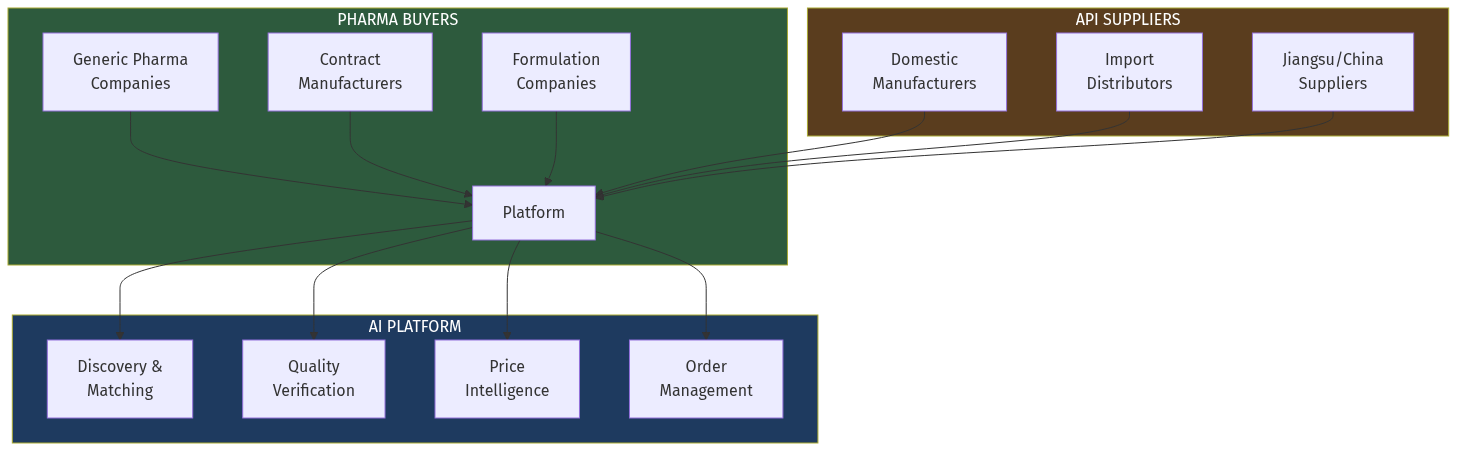
    Pharma API Marketplace Architecture
    Pharma API Marketplace Architecture