ResearchThursday, March 26, 2026

AI-Powered Industrial Testing & Inspection Services: The $8B Compliance Infrastructure Gap

Every manufacturing plant, export shipment, and government project in India requires third-party testing and inspection—but finding accredited labs, comparing certifications, scheduling inspections, and managing compliance documents is a manual process that costs Indian companies billions annually. AI agents can automate this entire ecosystem—matching requirements to accredited labs, scheduling inspections, tracking certifications, and generating compliance reports automatically.

8
Opportunity
Score out of 10
1.

Executive Summary

India's industrial testing and inspection market represents an $8 billion opportunity that remains largely offline and fragmented. Every manufacturing facility, export shipment, government project, and quality-conscious buyer requires third-party testing—but finding the right lab, verifying accreditations, scheduling inspections, and managing compliance documents is a manual nightmare.

The current ecosystem operates through:

  • Phone calls and emails to find labs
  • Manual verification of NABL/ISO certifications
  • Paper-based inspection reports
  • No centralized tracking of certification expiry dates
  • Fragmented pricing across thousands of small labs
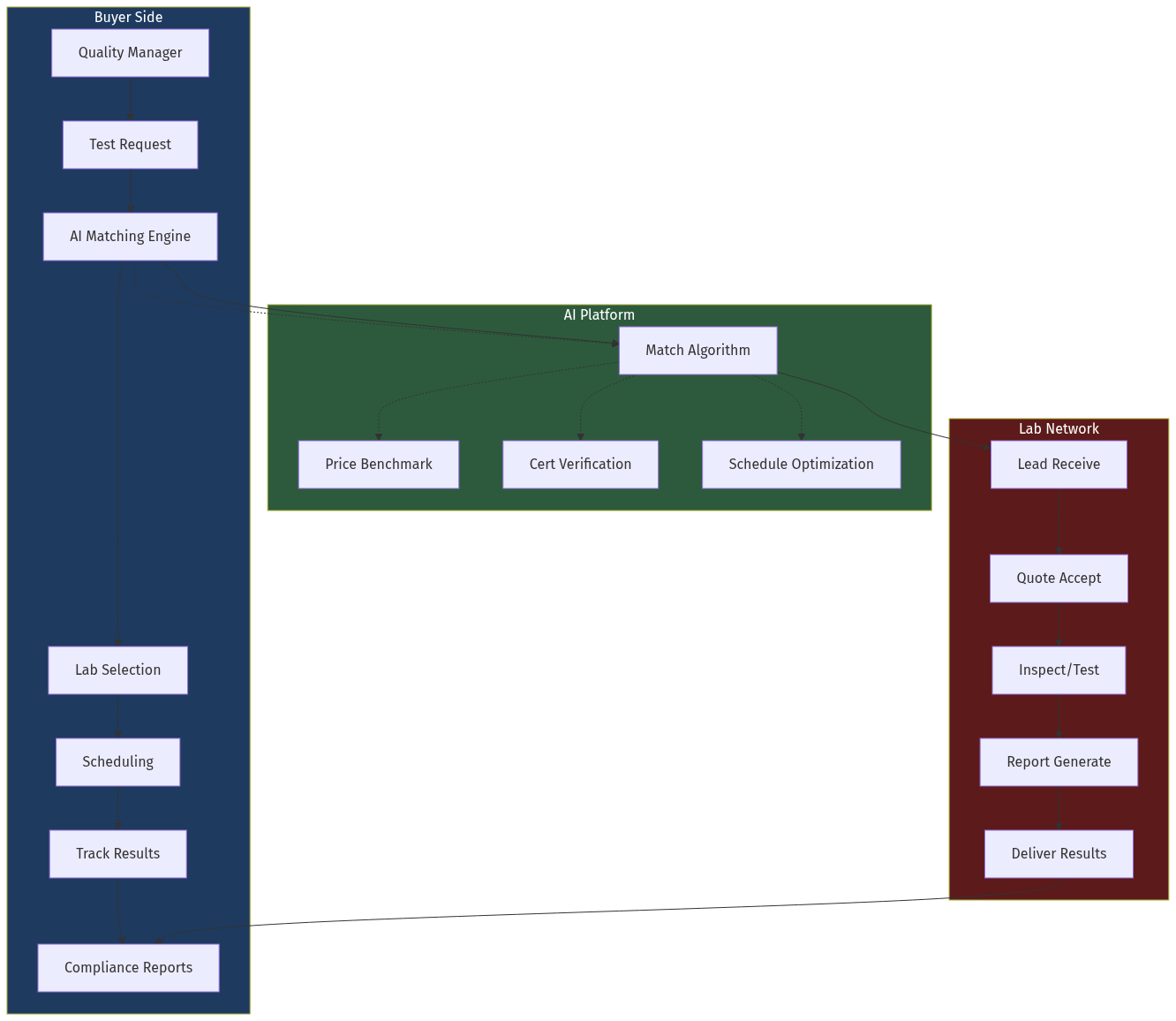
The opportunity: Build an AI-powered testing & inspection marketplace that automates the entire lifecycle—from requirement matching to report delivery—while creating a recurring revenue model through compliance monitoring subscriptions.


2.

Problem Statement

The Testing Burden

For a typical mid-sized manufacturing facility:

  • 200-500 tests per month required for raw materials, in-process, and finished goods
  • 15-30 different testing parameters (chemical, mechanical, metallurgical, electrical, biological)
  • Average lead time: 2-4 weeks from inquiry to report delivery
  • Manual tracking: Quality managers spend 8-15 hours weekly just tracking certification status

Export Compliance Headache

India's exports ($800B+) face constant testing requirements:

  • FDA/USDA requirements for food exports
  • CE marking for European exports
  • REACH compliance for chemicals
  • Country-specific standards (BIS, PSQCA, etc.)
  • Each destination has different lab requirements—companies must maintain relationships with multiple labs globally

Current Pain Points

Pain PointTime ImpactCost Impact
Finding right lab2-5 daysQuote comparison takes 2-3x effort
Verifying accreditation1-2 daysRisk of using non-accredited lab
Scheduling inspection1-2 weeksLogistics coordination overhead
Report management2-3 hours/weekLost/misplaced reports, re-testing
Expiry tracking4-6 hours/weekMissed renewals = production halt
---
3.

Current Solutions

Existing Players & Their Gaps

CompanyWhat They DoWhy They're Not Solving It
NABL DirectoryOfficial NABL-accredited lab listStatic database, no matching, no workflow
Bureau VeritasGlobal inspection servicesEnterprise-focused, expensive, slow
SGSTesting & inspectionNot tech-enabled, enterprise only
TUV RheinlandCertification & testingFocus on large exporters, high fees
IntertekQuality assuranceLimited India coverage, legacy systems
IndiaMART (Testing Services)Lab directoryNo verification, no workflow, basic listings

The Gap Analysis

NABL Directory Problems:
  • No search by test parameter or material type
  • No pricing transparency
  • No scheduling capability
  • No certification tracking
  • No mobile access for field teams
Private Players Problems:
  • Bureau Veritas/SGS: 10x more expensive than needed for mid-market
  • IndiaMART: Not verification-focused, leads are unreliable
  • Local labs: Hard to find, no quality assurance

4.

Market Opportunity

Market Size

  • India Testing Market: $8 billion (2026)
  • Global Testing Market: $45 billion
  • CAGR: 12-15% (driven by export compliance and quality focus)

Market Drivers

  • Export Growth: India targeting $1 trillion exports by 2030—every shipment needs testing
  • Quality Mandates: Domestic quality standards tightening (PLI schemes, BIS standards)
  • Regulatory Compliance: Increasing testing requirements across sectors
  • Supply Chain Visibility: End-to-end traceability becoming mandatory
  • AI Accessibility: LLM-based matching making this solvable now
  • Why Now

  • NABL network expansion: 1,500+ labs now accredited
  • Digital infrastructure: UPI, API integrations now standard
  • Export urgency: Countries increasingly requiring documented testing
  • Quality awareness: Domestic manufacturers investing in compliance
  • AI matching: Can now intelligently match requirements to lab capabilities

  • 5.

    Gaps in the Market

    Gap 1: No Intelligent Matching

    No platform exists that matches test requirements to lab capabilities. A chemical test for food packaging needs different labs than pharmaceutical testing—but this is manual discovery work.

    Gap 2: No Certification Lifecycle Management

    Companies have no system to track when certifications expire, auto-schedule renewals, or maintain compliance history for audits.

    Gap 3: No Pricing Transparency

    Testing prices range 3-5x across labs for identical tests. No platform provides price benchmarking or negotiation.

    Gap 4: No Report Digitization

    Most reports still delivered as PDFs, not integrated into company systems. No API for ERP/quality management integration.

    Gap 5: No End-to-End Workflow

    From inquiry to report delivery is still manual—no automated scheduling, tracking, or reminders.

    Gap 6: No SME Access

    Small manufacturers can't afford enterprise testing services. No affordable, verified option for them.
    6.

    AI Disruption Angle

    How AI Agents Transform the Workflow

    Current State (Manual):
    Quality Manager → Search NABL → Call 5 labs → Get quotes → Compare → Select → Call → Email specs → Wait → Receive PDF → File manually → Track expiry on Excel
    AI Agent State (Automated):
    Quality Manager → "I need chemical analysis of stainless steel for FDA food container" → AI Agent → Matches to 3 NABL labs → Shows pricing, turnaround, certifications → Select → AI schedules pickup → AI tracks progress → Report auto-filed → Expiry tracked automatically

    Key AI Capabilities

  • Semantic Test Matching: Understand "tensile strength test for automotive parts" → Match to mechanical testing labs with automotive certification
  • Accreditation Verification: Auto-verify NABL/ISO certificates, check expiry, validate scope
  • Smart Scheduling: Optimize lab utilization, schedule pick-ups, coordinate logistics
  • Report AI: Parse PDFs, extract data, normalize into company systems
  • Compliance Prediction: Alert before certifications expire, predict testing needs based on production schedules
  • Multi-language Support: Handle testing requirements across export destinations

  • 7.

    Product Concept

    Core Platform Features

    For Buyers (Manufacturers, Exporters, Government):
  • Smart Test Request: Natural language input for test requirements
  • Lab Matching Engine: AI matching to accredited labs by capability, price, location
  • Price Benchmarking: Transparent pricing across multiple labs
  • Scheduling & Tracking: Real-time inspection scheduling and progress
  • Report Repository: Digital storage with search, export, share
  • Compliance Calendar: Auto-tracked expiry dates, renewal reminders
  • Analytics Dashboard: Testing costs, turnaround times, lab performance
  • For Labs:
  • Lead Management: Automated lead capture and qualification
  • Capacity Planning: Optimize utilization, manage waitlists
  • Report Generation: Template-based report creation
  • Accreditation Management: Track and showcase certifications
  • Payment Integration: Online payments, invoicing
  • Revenue Model

    Revenue StreamModelPotential
    Transaction Fee8-12% per testHigh volume
    Subscription (Buyers)₹5,000-50,000/monthCompliance monitoring
    Subscription (Labs)₹2,000-10,000/monthLead management
    Premium Listings₹10,000-50,000/monthFeatured labs
    Certification ServicesMark-up on verificationMargins 30-40%
    Data ServicesMarket intelligenceB2B reports, benchmarking
    ---
    8.

    Development Plan

    PhaseTimelineDeliverables
    MVP8 weeksLab directory, basic matching, inquiry form
    V112 weeksFull workflow, scheduling, report tracking
    V216 weeksAI matching, compliance calendar, analytics
    Scale24 weeksMulti-city, export-focused features

    MVP Features

    • NABL lab directory with search
    • Basic inquiry submission
    • Quote collection workflow
    • Email notifications

    V1 Features

    • Lab capability matching
    • Online scheduling
    • Report upload and storage
    • Basic compliance tracking

    V2 Features

    • AI-powered test parameter matching
    • Predictive compliance alerts
    • ERP integrations
    • Analytics dashboard

    9.

    Go-To-Market Strategy

    Phase 1: Lab Network (Months 1-3)

  • Target 500 NABL labs across major cities
  • Onboard 50 labs as founding partners (free listing + guaranteed leads)
  • Verify accreditations manually as trust signal
  • Phase 2: Buyer Acquisition (Months 4-6)

  • Focus on exporters (BIS, FDA requirements) - high pain, high willingness to pay
  • Target quality-focused manufacturers (automotive, pharma, food)
  • Partner with export facilitators and freight forwarders
  • Phase 3: Scale (Months 7-12)

  • Government projects (mandatory testing)
  • B2B marketplaces (integrate testing as service)
  • Enterprise deals (bulk contracts with manufacturers)
  • GTM Channels

    • Direct sales: Quality managers at manufacturing plants
    • Export associations: Export promotion councils
    • Digital marketing: SEO for "testing lab [city]", "NABL lab [parameter]"
    • Partnerships: Freight forwarders, export consultants, B2B platforms

    10.

    Data Moat Potential

    Proprietary Data Accumulation

  • Testing price benchmarks across labs, parameters, materials
  • Lab performance metrics (turnaround time, accuracy, certifications)
  • Compliance patterns by industry, company size, geography
  • Export requirement database by destination, product type
  • Certification workflow patterns - how companies achieve compliance
  • Moat Mechanism

    • More transactions → better matching → more buyers → more labs → network effect
    • Compliance history becomes valuable for credit and insurance decisions
    • Export compliance data becomes essential for global trade

    11.

    Why This Fits AIM Ecosystem

    Vertical Integration Opportunities

  • With Calibration (already covered): Testing + Calibration = complete compliance stack
  • With Industrial Equipment: Equipment testing as part of purchase/maintenance
  • With Chemical Sourcing: Testing requirements for chemical specifications
  • With Pharma API: Quality testing for pharmaceutical raw materials
  • With B2B Payments: Testing as part of purchase verification
  • Cross-Selling Logic

    • Labs onboarded for testing can offer calibration
    • Manufacturers need both testing and compliance services
    • Exporters need testing + certification + logistics

    ## Verdict

    Opportunity Score: 8/10 Rationale:
    • Large addressable market ($8B India)
    • Clear pain point (manual, fragmented)
    • AI solves real problem (matching, tracking, automation)
    • Network effect potential (more labs → more buyers → more labs)
    • Recurring revenue (compliance monitoring)
    • Clear path to profitability
    Challenges:
    • Lab onboarding requires trust-building
    • Certification verification liability
    • Price competition from informal channels
    Recommendation: Build. Focus first on export-focused manufacturers (high pain, high willingness to pay), then expand to domestic.
    AI Testing & Inspection Platform Architecture
    AI Testing & Inspection Platform Architecture

    ## Sources