ResearchThursday, March 26, 2026

AI-Powered Industrial Chemical Sourcing Platform

Unlocking the $28B Indian chemical distribution market through intelligent agent-driven procurement. A fragmented, trust-dependent industry ripe for AI transformation.

8
Opportunity
Score out of 10
1.

Executive Summary

India's industrial chemical sourcing market is a $28 billion industry dominated by thousands of small, regional distributors operating largely through phone calls, WhatsApp messages, and manual paperwork. This creates massive inefficiencies: buyers spend weeks sourcing chemicals, suppliers lose deals due to poor visibility, and pricing remains opaque.

The opportunity: Build an AI-powered chemical sourcing platform where intelligent agents handle supplier discovery, price discovery, compliance verification, and order placement — reducing sourcing time from weeks to minutes.

Why Now:
  • GST implementation created tax transparency but increased compliance burden
  • WhatsApp commerce is prevalent but unscalable
  • AI agents can now handle complex B2B transactions with multiple variables
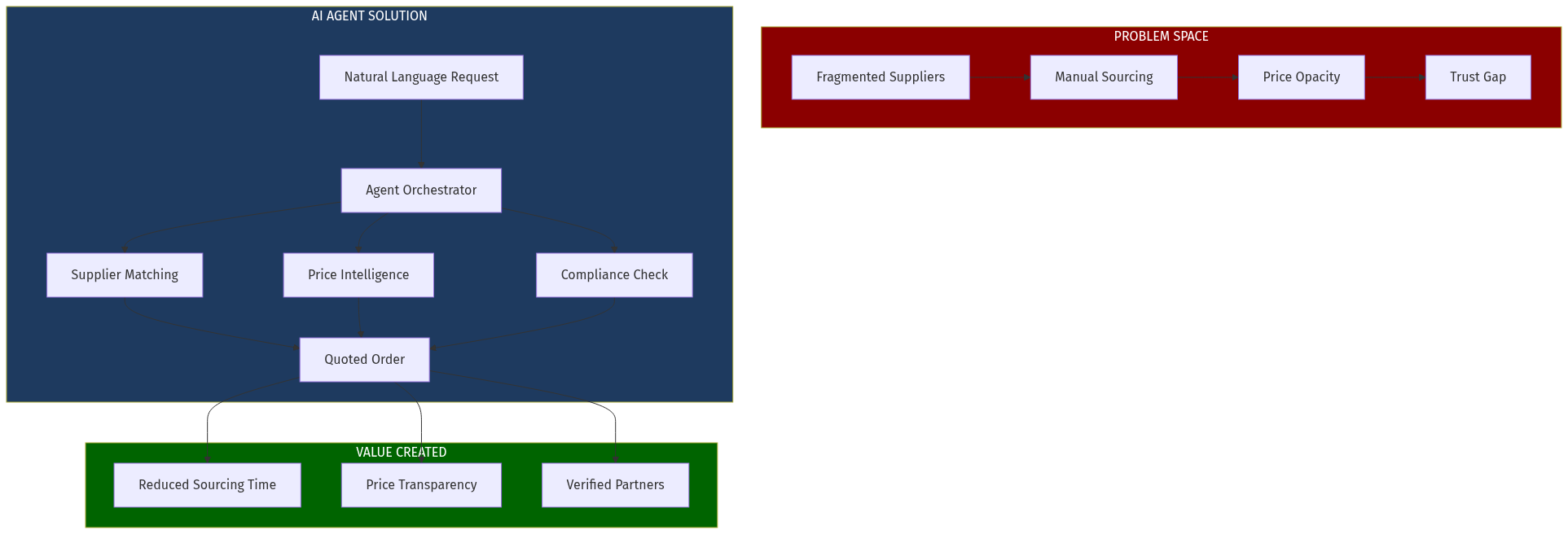
2.

Problem Statement

Who experiences this pain?
  • Manufacturing companies (mid-sized pharma, textiles, paints, adhesives) needing regular chemical supplies
  • Chemical traders sourcing products from multiple manufacturers
  • Export houses needing verified suppliers for international compliance
What's broken?
  • Supplier Discovery: No centralized database. Buyers rely on personal networks, trade shows, or Google searches
  • Price Discovery: No transparency. Prices vary 15-30% between suppliers for identical products
  • Quality Assurance: No systematic verification. Buyers rely on samples and trust
  • Compliance: Complex GST, environmental clearances, and safety certifications
  • Logistics: Hazardous material transport requires specialized handling
  • Payments: Credit terms vary wildly; no standardized B2B financing
  • Zeroth Principle Analysis: The fundamental assumption is that "chemical sourcing requires human relationship management." But what if the relationship is with the platform, not the supplier? The AI agent becomes the trusted intermediary, not the human sales rep.
    3.

    Current Solutions

    CompanyWhat They DoWhy They're Not Solving It
    ChemDekhoB2B chemical marketplaceLimited catalog, no AI agent features
    Chemicals4eE-commerce for industrial chemicalsConsumer-focused, not enterprise
    IndiaChemicalsDirectory + e-commerceStatic listings, no transaction handling
    Incentive Mapping:
    • Existing distributors profit from opacity — they control information flow
    • Chemical manufacturers prefer few touchpoints to reduce sales overhead
    • Large buyers have procurement teams; mid-market has none
    • This creates a structural gap where AI agents can add massive value

    4.

    Market Opportunity

    • Market Size: $28B (India), $380B (global specialty chemicals)
    • Growth: 12% CAGR for specialty chemicals in India
    • Addressable Segment: Mid-market manufacturers ($500K-$50M revenue) with limited procurement teams
    • Why Now:
    - UPI has normalized digital payments in B2B - LLMs can handle complex technical specifications - Trust infrastructure (escrow, ratings) is mature
    5.

    Gaps in the Market

  • No price transparency — buyers cannot compare real-time quotes
  • No supplier verification infrastructure — quality is assessed via samples
  • No compliance automation — GST, HSN codes, safety docs are manual
  • No credit marketplace — financing is relationship-based
  • No specification matching — CAS numbers, purity levels not standardized
  • No order tracking — logistics visibility is poor for hazardous goods
  • Anomaly Hunting:
    • Why hasn't anyone built this? Because chemical relationships are "trusted." But trust can be algorithmically verified through ratings, transaction history, and compliance records.
    • The market is highly fragmented — #1 player has <5% share. This suggests network effects haven't kicked in yet.

    6.

    AI Disruption Angle

    How AI Agents Transform the Workflow

    flowchart LR
        subgraph Traditional["TRADITIONAL"]
            A["Request via Phone/Email"] --> B["Sales Rep"]
            B --> C["Manual Quote"]
            C --> D["Negotiation"]
            D --> E["PO Created"]
        end
        subgraph Agent["WITH AI AGENTS"]
            F["Natural Language Request"] --> G["Procurement Agent"]
            G --> H["Multi-Supplier Query"]
            H --> I["Auto-Compare & Negotiate"]
            I --> J["Order Executed"]
        end
    What the Agent Does:
  • 理解需求: Parse chemical specifications (CAS, purity, quantity, delivery timeline)
  • Supplier Matching: Query database for verified suppliers matching requirements
  • Price Intelligence: Pull real-time pricing, identify arbitrage opportunities
  • Compliance Check: Verify GST registration, environmental clearances, transport licenses
  • Negotiation: Use historical transaction data to negotiate optimal terms
  • Order Execution: Create purchase orders, track fulfillment, manage payments
  • Future State: Buyer says "I need 500kg Sodium Lauryl Sulfate, Grade A, delivered to Mumbai in 2 weeks" → Agent returns verified quotes, executes order, tracks delivery.
    7.

    Product Concept

    Core Features

  • Chemical Knowledge Graph
  • - CAS number → supplier mapping - Substitutes and alternatives - Price history (6 months rolling)
  • AI Procurement Agent
  • - Natural language ordering - Auto-RFQ generation - Multi-supplier comparison
  • Supplier Verification Engine
  • - GSTIN verification - Factory inspection integration - Compliance doc vault
  • Logistics Tracker
  • - Hazmat-certified transporter network - Real-time location tracking - Delivery proof with photos
  • Financing Marketplace
  • - Credit assessment - Escrow payments - Net-30/60/90 terms
    8.

    Development Plan

    PhaseTimelineDeliverables
    MVP8 weeksProduct catalog, basic search, supplier directory
    V112 weeksAI agent for RFQ, price comparison, basic compliance
    V216 weeksLogistics integration, financing marketplace
    Scale24 weeksMobile app, WhatsApp integration, multi-city rollout

    Technical Architecture

    Architecture Diagram
    Architecture Diagram
    Components:
    • Frontend: Next.js web + WhatsApp Mini App
    • Backend: Node.js API + PostgreSQL
    • AI Layer: GPT-4 for specification parsing, custom models for price prediction
    • Data: Chemical knowledge graph (CAS → product → supplier)

    9.

    Go-To-Market Strategy

    Phase 1: Supply-Side Aggregation (Weeks 1-8)

  • Target 50 chemical distributors in Gujarat, Maharashtra
  • Onboard with product catalog + GST verification
  • Offer free listings, paid lead generation
  • Phase 2: Demand-Side Acquisition (Weeks 9-16)

  • Target mid-sized manufacturers via trade associations
  • Offer AI agent beta to 20 buyers
  • Collect feedback, iterate on specification matching
  • Phase 3: Network Effects (Weeks 17+)

  • Enable buyer reviews and ratings
  • Launch dynamic pricing features
  • Expand to industrial solvents, pigments, additives

  • 10.

    Revenue Model

    • Commission: 2-5% on successful transactions
    • Subscription: ₹5,000-50,000/month for procurement teams
    • Lead Generation: ₹500-5,000 per qualified lead to suppliers
    • Financing: Interest spread on B2B credit (collaborate with NBFCs)
    • Data: Anonymized market intelligence reports (enterprise tier)

    11.

    Data Moat Potential

    High. Over time, the platform accumulates:
    • Price intelligence: Historical transaction data — proprietary
    • Supplier ratings: Quality, delivery, compliance scores
    • Specification mapping: CAS-to-supplier relationships
    • Buyer behavior: Procurement patterns, seasonal demand
    This creates defensibility — new entrants cannot replicate the knowledge graph.
    12.

    Why This Fits AIM Ecosystem

    This aligns with AIM.in's vision of structured B2B discovery:

  • Vertical fit: Chemicals are high-trust, compliance-heavy, fragmented
  • Agent opportunity: Procurement is repetitive, specifiable, automatable
  • Market size: $28B India, clear need for transparency
  • Moat: Data network effects compound over time
  • Expansion: Can add adjacent categories (solvents, pigments, polymers)
  • Fits criteria:
    • ✅ B2B marketplace
    • ✅ Offline-heavy (distributors still use phone/WhatsApp)
    • ✅ Fragmented supplier market
    • ✅ Can benefit from AI agents

    ## Verdict

    Opportunity Score: 8/10 Strengths:
    • Clear problem, large market, strong AI fit
    • No dominant player — fragmented market
    • Data moat potential is significant
    Risks:
    • Regulatory complexity (hazardous chemicals, environmental clearances)
    • Trust-building with new buyers takes time
    • Need deep domain expertise for specification matching
    Recommendation: Build. Focus on specialty chemicals (not commodities) where margins support platform fees. Start with 2-3 chemical categories, perfect the agent workflow, then expand. Pre-Mortem (why this might fail):
    • Incumbents (existing distributors) block supply-side adoption
    • Compliance requirements too complex for MVP
    • Buyers prefer human relationships for high-value orders
    Mitigation: Partner with 2-3 established distributors early, build compliance engine incrementally, offer hybrid (human+AI) support initially.

    ## Sources