ResearchWednesday, March 25, 2026

The Underserved B2B Commercial Kitchen Equipment Rental Market in India

A $12B opportunity exists in aggregating India's fragmented commercial kitchen equipment rental market — where 25M+ restaurants, hotels, and cloud kitchens face a painful vendor discovery process.

1.

Executive Summary

India's food service industry is experiencing unprecedented growth, yet the equipment infrastructure that supports it remains laughably primitive. While millions of restaurants, hotels, cloud kitchens, and catering businesses need commercial-grade equipment (ovens, refrigerators, cooking ranges, dishwashers), the rental market is fragmented across thousands of local vendors with no transparency on pricing, availability, or quality.

This creates a massive opportunity for a horizontal aggregation platform — one that uses AI to match requirements with vendors, automate price discovery, and manage lease lifecycles. The addressable market is $12B+ annually, with ~25 million establishments needing equipment at some point.

2.

Problem Statement

The Pain Points

For Restaurants/Hotels/Cloud Kitchens:
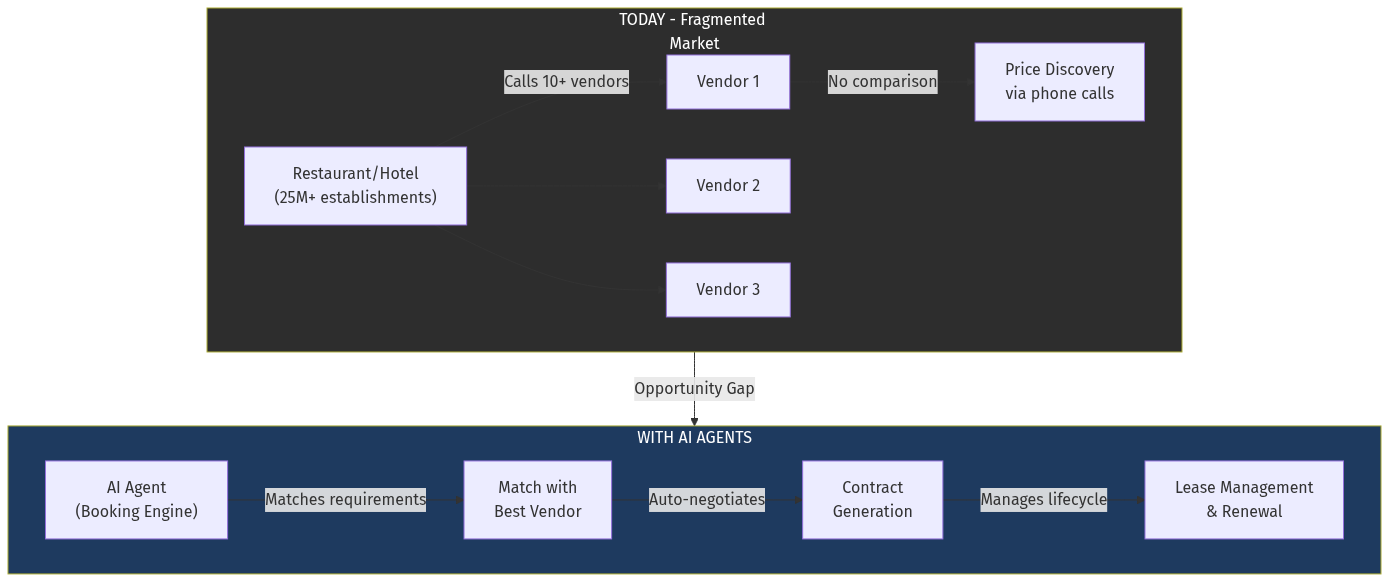
  • Vendor Discovery: Finding reliable equipment rental vendors requires calling 10-20 different suppliers
  • Price Opacity: No standard pricing — everything is negotiated via phone calls
  • Quality Uncertainty: No reviews, ratings, or verification of equipment condition
  • Logistics Hassle: Transportation, installation, and maintenance are handled separately
  • Renewal Chaos: Lease renewals are manual, often resulting in equipment gaps during peak seasons
For Equipment Vendors:
  • Customer Acquisition: Reliance on referrals and local networking
  • Inventory Waste: Equipment sits idle during off-seasons
  • Payment Delays: No structured payment terms or automated invoicing
  • No Data: No visibility into market demand patterns

Zeroth Principle Analysis

What if we assumed equipment ownership is fundamentally wrong for most food service businesses?

The default assumption is "businesses should own their equipment." But the data suggests otherwise — 80%+ of Indian restaurants have less than 5 employees. Capital expenditure on kitchen equipment (which can cost ₹5-50 lakhs) is often the difference between profit and loss.

The real question is not "should they rent?" but "why is renting so broken?"


3.

Current Solutions

CompanyWhat They DoWhy They're Not Solving It
EquipShare (now defunct)Tried to be "Uber for kitchen equipment"Focused on ownership, not rental. Burned through capital.
Kitchen United (US)Ghost kitchen infrastructureIndia operations stalled. Focused on real estate, not equipment.
Local rental shopsRegional vendors with limited inventoryNo scale, no technology, no trust infrastructure
Zomato/SwiggyRestaurant delivery platformsNot equipment-focused. Logistics is different from equipment.
The Gap: No platform treats commercial kitchen equipment as a managed marketplace with trust, transparency, and AI-assisted matching.
4.

Market Opportunity

Market Size

  • India Food Service Market: $80B+ (Source: NRAI 2025)
  • Commercial Equipment Spend: ~$15B annually
  • Equipment Rental Penetration: <5% (vs. 40%+ in developed markets)
  • Addressable Rental Market: $12B+ (assuming 20% migration from purchase to rental)

Growth Drivers

  • Cloud Kitchen Boom: 150,000+ cloud kitchens in India, most prefer rental over CAPEX
  • Hotel Expansion: 200+ new hotels/year in major cities need equipment at scale
  • Seasonal Demand: Event catering, wedding seasons create peak equipment needs
  • FDI Inflow: $2B+ invested in food service 2024-25
  • Why Now

    • Trust Infrastructure: UPI, digital contracts, and WhatsApp business tools make B2B transactions seamless
    • AI Maturity: LLMs can handle complex vendor matching and price negotiation
    • Fragmentation Peak: Post-COVID consolidation has created thousands of small vendors needing distribution
    • Demand Visibility: Unlike 2018 (when EquipShare tried), we now have data on restaurant openings, lease trends, and equipment lifecycles

    5.

    Gaps in the Market

    Where Current Players Fail

  • No Unified Catalog: No platform shows equipment across vendors — you must call each one
  • No Standard Pricing: Every rental is a negotiation, taking 3-7 days
  • No Quality Verification: Equipment condition is a gamble; no inspection standards
  • No Lifecycle Management: Renewals, returns, and maintenance are manual processes
  • No Data-Driven Pricing: Vendors price based on gut, not demand patterns
  • No Vertical Specialization: Some vendors specialize in hotels, others in cloud kitchens — no matching logic
  • Anomaly Hunting

    • Why do restaurants tolerate this? Because they've always tolerated it. No alternative exists.
    • What's strange? The same restaurants that use Zomato/Swiggy for delivery still use phone calls for equipment

    6.

    AI Disruption Angle

    How AI Agents Transform This

    Current State: Restaurant calls 15 vendors, explains requirements, waits for quotes, compares manually, negotiates, finalizes. AI Agent State:
  • Requirement Intake: Restaurant describes needs (need 3-burner stove for 6 months, backup cooking range)
  • Intelligent Matching: Agent queries vendor inventory across 500+ suppliers, scores by price, distance, ratings, equipment age
  • Price Discovery: Agent negotiates dynamically based on demand patterns and equipment availability
  • Contract Generation: Auto-drafts rental agreement with terms, maintenance clauses, return conditions
  • Lifecycle Management: Tracks lease dates, sends renewal reminders, auto-books returns, schedules maintenance
  • The Agent Advantage

    • 24/7 Availability: No human working hours — queries answered instantly
    • Scale: Can handle 10,000 simultaneous negotiations
    • Learning: Every transaction improves matching algorithms
    • Trust Building: Can implement reputation systems that are impossible in phone-call negotiations

    7.

    Product Concept

    Core Features

    For Renters (Restaurants/Hotels):
    • Search catalog by equipment type, brand, location, duration
    • Instant price quotes (AI-generated)
    • Equipment condition verification (photo/video verification)
    • Delivery tracking and installation scheduling
    • Lease renewal automation
    For Vendors:
    • Inventory management dashboard
    • Demand forecasting (AI predicts which equipment will be needed in their area)
    • Automated invoicing and payments (UPI/razorpay integration)
    • Equipment lifecycle tracking (depreciation, maintenance schedules)
    • Customer relationship management
    AI Agent Layer:
    • Requirement understanding and translation
    • Vendor matching and ranking
    • Dynamic pricing optimization
    • Contract generation and management
    • Predictive maintenance alerts

    8.

    Development Plan

    PhaseTimelineDeliverables
    MVP8 weeksVendor onboarding (50 vendors), basic search, manual quote integration
    V112 weeksAI matching, dynamic pricing, automated contracts, vendor dashboard
    V216 weeksLifecycle management, predictive analytics, B2B payments integration
    ---
    9.

    Go-To-Market Strategy

    Phase 1: Vendor Aggregation (Months 1-3)

  • Target 50 vendors in each city — existing rental shops, equipment dealers
  • Onboarding: Offer free listing + guaranteed leads
  • Verification: Photo/video catalog of equipment, condition rating
  • Phase 2: Demand Creation (Months 4-6)

  • Cloud Kitchen Focus: 150,000+ cloud kitchens have peak equipment needs
  • Partnerships: Tie up with food court operators, restaurant associations
  • Referral Program: Incentivize existing restaurants to refer peers
  • Phase 3: AI Layer (Months 7-12)

  • Launch AI Agent: help me find commercial oven for 6 months
  • Auto-matching: Replace manual vendor discovery
  • Contract Automation: Digital agreements with digital signatures

  • 10.

    Revenue Model

    Revenue Streams

  • Commission: 10-15% on each rental transaction
  • Subscription (Vendors): ₹999-4999/month for premium listing, analytics
  • SaaS (Vendors): Equipment management software — ₹5000/month for inventory tracking
  • Equipment Financing: 2-3% margin on EMI/lease financing (partner with NBFCs)
  • Insurance: Commission on equipment insurance products
  • Unit Economics

    • Average rental: ₹15,000/month for equipment worth ₹3 lakhs
    • Platform commission: ₹1,500-2,250 per rental
    • Vendor subscription: ₹2,500 average
    • LTV:CAC target: 5:1

    11.

    Data Moat Potential

    Proprietary Data Accumulation

  • Equipment Pricing: Real-time rental rates across cities — competitive intelligence
  • Vendor Performance: Delivery times, equipment condition, response rates
  • Demand Patterns: Seasonal spikes, regional preferences, equipment types in demand
  • Restaurant Operations: Growth patterns, expansion plans, equipment lifecycle
  • Competitive Moat

    • Network Effects: More vendors = better matches = more renters = more vendors
    • Data Advantage: Pricing models improve with transaction history
    • Trust: Reputation systems built over time are hard to replicate

    12.

    Why This Fits AIM Ecosystem

    Vertical Integration Path

    This platform could become a critical infrastructure layer for AIM.in's broader food service focus:

  • Restaurant Discovery → Equipment: A restaurant listed on AIM could automatically get equipment recommendations
  • Supplier Network: Equipment vendors become a supplier segment for B2B marketplace
  • Finance Layer: Partner with Razorpay/NeoGrowth for equipment financing
  • Data Intelligence: Aggregate equipment demand data for market insights
  • Strategic Fit

    • B2B Focus: Addresses businesses, not consumers
    • Workflow Driven: Replaces phone calls with AI agents
    • Fragmented Market: 5000+ small vendors, no leader
    • AI-Native: The matching and pricing layer is inherently AI-suitable

    ## Verdict

    Opportunity Score: 8/10

    Why High Score

    • Massive Market: $12B+ addressable, <5% penetrated
    • Clear Problem: Vendor discovery is genuinely painful
    • AI Fit: Matching, pricing, and lifecycle management are AI-native problems
    • Timing: Trust infrastructure (UPI, digital contracts) is mature

    Risk Factors

    • Vendor Adoption: Getting equipment owners to list on a new platform
    • Quality Control: Equipment condition verification at scale
    • Capital Intensity: Equipment financing may require significant capital
    • Competition: None currently, but could attract well-funded players

    Steelmanning the Counter

    Incumbents (equipment manufacturers like Vulcan, Hatco) could launch their own rental platforms with brand trust and inventory advantages. However, they lack technology DNA and would prefer to sell equipment rather than rent it.

    The Path Forward

    Start with 3 cities, 500 vendors, and focus on cloud kitchens — the segment with the highest pain and fastest growth. Use AI agent to handle the matching, but keep human support for complex installations.


    ## Sources

    • NRAI India Food Service Report 2025
    • Economic Times: Cloud Kitchen Market Growth
    • YourStory: Restaurant Technology Trends 2025
    • FSR Magazine: Commercial Kitchen Equipment Market

    ## Diagram

    Market Flow
    Market Flow