ResearchWednesday, March 25, 2026

AI-Powered Industrial Packaging Marketplace: The $12B Opportunity in India's Manufacturing Supply Chain

Every manufacturing plant, food processor, pharmaceutical company, and exporter in India depends on industrial packaging — yet 85% of procurement still happens through distributor relationships, phone calls, and WhatsApp groups. An AI-powered B2B marketplace can capture this $12 billion opportunity by automating supplier discovery, quality verification, price comparison, and recurring procurement workflows.

1.

Executive Summary

India's industrial packaging market represents a $12 billion opportunity that remains largely offline and fragmented. Every process industry — from FMCG and pharmaceuticals to chemicals, automotive, and exports — requires a constant supply of packaging materials: corrugated boxes, HDPE/PP bags, glass bottles, plastic containers, pouches, drums, and specialized packaging solutions.

Yet the procurement process remains manual, opaque, and relationship-dependent. Buyers struggle to find verified suppliers, compare prices across thousands of specifications, and ensure consistent quality. Suppliers, mostly SMBs, lack digital presence and rely on local networks for orders.

This creates a prime opportunity for an AI-powered B2B marketplace that can:

  • Digitize supplier discovery with quality certifications
  • Enable real-time price comparison across material types, sizes, and grades
  • Automate quality verification (FSSAI, ISO, FDA compliance)
  • Streamline recurring procurement with auto-reorder capabilities
  • Provide demand forecasting for seasonal industries
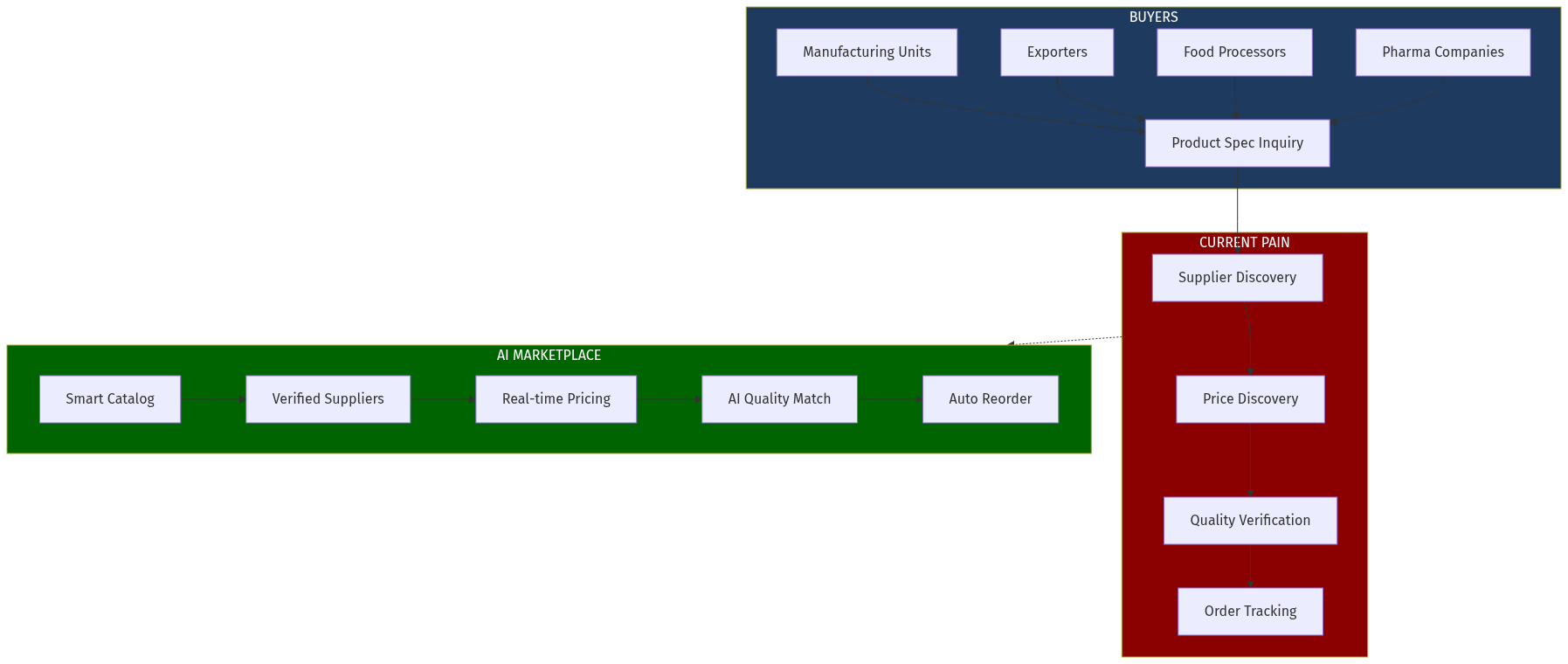
The market is fragmented across thousands of small manufacturers, lacks price transparency, and has no dominant digital player — making it ripe for AI disruption.


2.

Problem Statement

The Procurement Pain

For a typical manufacturing plant or food processing company, procuring industrial packaging involves:

  • Supplier Discovery: Procurement teams rely on personal networks, trade fairs, local distributors, or Google searches. There's no centralized database of verified packaging manufacturers.
  • Specification Complexity: Industrial packaging has thousands of SKUs:
  • - Corrugated boxes: 50+ flute combinations, sizes, burst strength ratings - Flexible packaging: Material (PE, BOPP, CPP), thickness, print quality - Rigid packaging: Material (PET, HDPE, Glass), capacity, closure type - Specialized: Anti-static, UV-resistant, food-grade, pharmaceutical-grade
  • Price Opacity: The same specification box can vary 30-60% between suppliers. No price benchmarks exist for custom specifications.
  • Quality Verification: Different industries require different certifications:
  • - Food: FSSAI, FDA - Pharma: USFDA, ISO 15378 - Exports: REACH, RoHS Verifying a supplier's credentials requires manual certificate checking.
  • Inventory Guessing: Plants don't know if a supplier has stock or needs manufacturing lead time. This causes production delays and rush order premiums.
  • Logistics Complexity: Heavy packaging (drums, bulk bags) requires specialized logistics. Tracking delivery is manual.
  • Who Faces This Pain?

    • FMCG Companies: High-volume corrugated boxes, flexible packaging, bottles
    • Pharmaceutical Companies: Blister packs, bottles, child-resistant packaging
    • Chemical & Petrochemical: Drums, IBCs, hazmat packaging
    • Food Processing: Food-grade bags, vacuum packs, temperature-controlled
    • Automotive: Parts packaging, returnable packaging
    • Exporters: Export-compliant packaging, labeling requirements
    • E-commerce: Corrugated boxes, poly mailers, void fill

    3.

    Current Solutions

    CompanyWhat They DoWhy They're Not Solving It
    IndiaMartGeneral B2B marketplaceNo specialization, no verification, no procurement workflow
    TradeIndiaB2B catalogListing-only, no transactions, limited supplier verification
    Packaging IndiaIndustry directoryStatic directory, no real-time pricing, poor UX
    UdaanB2B distributionFocus on FMCG/electronics, limited packaging depth
    Local distributorsRegional supplyLimited catalog, no technology, relationship-dependent

    What's Missing

    • Specialized Catalog: Industrial packaging has 50,000+ SKUs with complex specifications. Generic marketplaces can't handle the technical complexity.
    • Verified Supplier Network: No one verifies manufacturing capability, quality certifications, or delivery track record.
    • Price Transparency: No benchmark pricing exists for custom specifications.
    • Procurement Automation: Plants need recurring orders with auto-reorder, not one-time purchases.
    • Quality Compliance: No platform tracks FSSAI/USFDA certifications automatically.

    4.

    Market Opportunity

    Market Size

    SegmentEstimated Size (India)
    Corrugated & Paper Packaging$5.2 billion
    Flexible Packaging (Films, Pouches)$3.8 billion
    Rigid Packaging (Boxes, Containers)$1.8 billion
    Industrial Bags (HDPE, PP, jute)$1.2 billion
    Total$12.0 billion

    Growth Drivers

  • Manufacturing Growth: PLI schemes driving domestic manufacturing across sectors
  • E-commerce Expansion: 30% YoY growth in online retail driving packaging demand
  • Export Requirements: Growing exports require compliant packaging
  • Sustainability Push: Shift toward eco-friendly, recyclable packaging
  • Organized Retail: Modern retail requires standardized packaging
  • Why Now

  • Digital Maturity: Indian SMBs are now comfortable with online transactions (UPI, digital payments)
  • WhatsApp Integration: Suppliers already communicate via WhatsApp — integration enables seamless ordering
  • AI Capabilities: Natural language processing can handle complex technical specifications
  • No Incumbent: No dominant player in industrial packaging specifically
  • Supply Chain Focus: Post-COVID focus on resilient supply chains

  • 5.

    Gaps in the Market

    Gap 1: No Specialized Industrial Packaging Catalog

    Generic B2B marketplaces treat packaging like any other product. Industrial procurement requires:
    • Technical specifications (GSM, burst factor, puncture resistance)
    • Material certifications (FSSAI, ISO, FDA)
    • Custom print capabilities
    • Logistics requirements (stackability, palletization)
    Anomaly: Despite $12B market, no platform has captured even 1% of packaging procurement.

    Gap 2: No Verified Quality Network

    No platform verifies:
    • Manufacturing capability (machine types, capacity)
    • Quality certifications (ISO 9001, FSSAI, USFDA)
    • Delivery track record
    • Financial stability
    Incentive Mapping: Local distributors profit from information asymmetry. They control supplier relationships and mark up 15-25% without adding value.

    Gap 3: No Real-Time Pricing

    Pricing depends on:
    • Raw material costs (paper, plastic, aluminum)
    • Order volume
    • Customization (printing, die-cutting)
    • Logistics
    No platform aggregates this to provide benchmark pricing.

    Gap 4: No Auto-Reorder System

    Most plants order the same packaging recurring. No platform offers:
    • Usage tracking
    • Auto-reorder triggers
    • Demand forecasting
    • Vendor-managed inventory

    Gap 5: No Quality Compliance Automation

    Pharma and food companies need documented quality trails. No platform:
    • Tracks certification expiry dates
    • Alerts on compliance gaps
    • Provides audit trails

    6.

    AI Disruption Angle

    How AI Agents Transform the Workflow

    Current State (Manual):
    Buyer → Supplier Discovery (Google/Network) → Price Quote (Phone/Email) 
    → Quality Check (Manual) → Order → Delivery Tracking (Phone)
    Future State (AI-Powered):
    Buyer → AI Agent ("Find 1000 corrugated boxes 12x12x8, 32 ECT, food-grade") 
    → AI Matches Suppliers → AI Verifies Certifications → AI Compares Prices 
    → AI Places Order → AI Tracks Delivery → AI Auto-Reorders

    AI Agent Capabilities

  • Natural Language Procurement: "I need 5000 pharma-grade HDPE bottles, 100ml, white, with child-resistant cap, delivered to Pune by Friday"
  • Smart Matching: AI matches requirements to supplier capabilities:
  • - Material compatibility - Certification matching - Location/logistics - Capacity availability
  • Price Intelligence: Real-time price benchmarks based on:
  • - Raw material indices - Historical data - Volume discounts
  • Quality Compliance Agent: Auto-track certifications:
  • - Expiry alerts - Compliance gaps - Audit trail generation
  • Demand Forecasting: Predict reorder timing based on:
  • - Usage patterns - Seasonal variations - Supplier lead times
    7.

    Product Concept

    Platform Name: PackFlow.ai (or similar)

    Core Features

  • Smart Catalog
  • - 50,000+ SKUs with technical specifications - AI-powered search with specification matching - Comparison tools
  • Verified Supplier Network
  • - Supplier verification (machine, capacity, certifications) - Rating and review system - Performance tracking
  • Real-Time Pricing
  • - Dynamic pricing based on specs and volume - Price alerts for specifications - Benchmark analytics
  • Procurement Automation
  • - Recurring orders with auto-reorder - Usage analytics - Demand forecasting
  • Quality Compliance
  • - Certification tracking - Compliance alerts - Audit trail generation
  • Logistics Integration
  • - Freight comparison - Delivery tracking - Returns management

    User Flow

  • Buyer: Registers company → Creates specification → AI matches suppliers → Places order → Tracks delivery
  • Supplier: Registers company → Adds catalog → Receives inquiries → Quotes → Ships

  • 8.

    Development Plan

    PhaseTimelineDeliverables
    MVP8 weeksCatalog (5000 SKUs), Supplier directory (100 verified), Basic search
    V112 weeksReal-time pricing, Procurement workflow, Quality compliance
    V216 weeksAI matching, Auto-reorder, Demand forecasting
    V320 weeksLogistics integration, Analytics, Mobile app

    Technical Architecture

    Architecture Diagram
    Architecture Diagram

    Key Modules

  • Catalog Engine: SKU database with specifications
  • Supplier Portal: Supplier onboarding, catalog management
  • Procurement Engine: RFQ, ordering, payments
  • AI Matching: NLP-powered matching algorithm
  • Compliance Tracker: Certification management
  • Analytics: Spend analysis, market insights

  • 9.

    Go-To-Market Strategy

    Phase 1: Supplier Acquisition (Months 1-3)

  • Target Tier 2 cities: Ludhiana (packaging cluster), Rajkot, Chennai
  • Offline outreach: Trade fairs (IndiaPack, PACE), industry associations
  • Supplier incentives: Free listing, verified badge, priority in search
  • Referral program: Existing suppliers refer others
  • Phase 2: Buyer Acquisition (Months 4-6)

  • Target verticals: Pharma, FMCG, Chemicals (highest pain, highest willingness to pay)
  • Pilot programs: Free trials with 5 major buyers
  • Industry events: Trade publications, conferences
  • Content marketing: Case studies on procurement savings
  • Phase 3: Network Effects (Months 7-12)

  • Pull strategy: More buyers → better prices → more suppliers
  • Geographic expansion: Tier 1 cities → Tier 2 → Tier 3
  • Category expansion: Boxes → Flexible → Specialized
  • Sales Motion

    • Enterprise: Direct sales team, account-based selling
    • SMB: Self-serve, freemium, product-led growth

    10.

    Revenue Model

    Revenue Streams

  • Transaction Fee (Primary)
  • - 2-5% commission on orders - Tiered based on order value
  • Subscription (High-margin)
  • - Buyer Pro: $99-499/month for AI features, analytics - Supplier Pro: $49-199/month for premium placement, insights
  • Listing Fees
  • - Featured supplier listings - Featured products
  • Value-Added Services
  • - Quality certification verification ($50/audit) - Custom packaging design - Logistics financing

    Unit Economics

    • CAC: $150-300 per buyer, $50-100 per supplier
    • LTV: $5,000-15,000 (based on transaction volume)
    • Payback: 4-8 months

    11.

    Data Moat Potential

    Proprietary Data Accumulation

  • Price Intelligence: Historical transaction data → pricing benchmarks
  • Supplier Performance: Delivery times, quality scores → supplier ratings
  • Demand Forecasting: Usage patterns → predictive ordering
  • Specification Library: Technical requirements → product matching
  • Network Effects

    • More buyers → better pricing → more suppliers
    • More suppliers → better selection → more buyers
    • Data → AI capabilities → better matching → more users

    Defensibility

    • First-mover in specialized packaging
    • Proprietary data train AI models
    • Network effects create barriers to entry

    12.

    Why This Fits AIM Ecosystem

    Vertical Fit

    • B2B: Clear buyer-seller marketplace
    • Workflow: Procurement is pain point
    • Offline-heavy: 85% offline, ripe for digitization
    • Fragmented: 50,000+ suppliers, no dominant player
    • Recurring: Plants reorder same packaging regularly
    • AI-native: Complex specs ideal for AI matching

    Ecosystem Synergies

    • dives.in: Content for packaging industry
    • AIM.in: Vertical integration for manufacturing
    • WhatsApp: Supplier communication channel
    • Domain portfolio: packaging.in, boxes.in, industrialpackaging.in

    Similar to Existing Articles

    This follows the successful pattern of:
    • Industrial Valves & Fittings Marketplace
    • Industrial Fasteners Marketplace
    • Industrial Gases Marketplace
    • PPE Safety Equipment Marketplace
    All targeting underserved B2B verticals in India.

    ## Verdict

    Opportunity Score: 8.5/10

    Why 8.5

    • Large market: $12B India, $300B globally
    • High pain: Manual procurement, quality issues, price opacity
    • Clear fit: AI-native use case, perfect for AIM ecosystem
    • Timing: Digital maturity, no incumbent, supply chain focus

    Risks to Consider

    • Supplier adoption: Need to convince SMBs to list
    • Quality liability: Defective packaging causes buyer harm
    • Complex specs: Technical complexity in cataloging
    • Competition: IndiaMart, Udaan may expand

    What Would Prove This Wrong

    • Large platform (IndiaMart/Udaan) launches focused packaging vertical
    • Major buyer consolidates procurement directly with top suppliers
    • Industry association creates own digital platform

    Recommended Next Steps

  • Validate with 10 buyers: Survey procurement teams in pharma/FMCG
  • Map supplier clusters: Visit Ludhiana, Rajkot, Chennai packaging hubs
  • Build pilot catalog: 1000 SKUs from top 20 suppliers
  • Test AI matching: Prototype with 100 queries

  • ## Sources