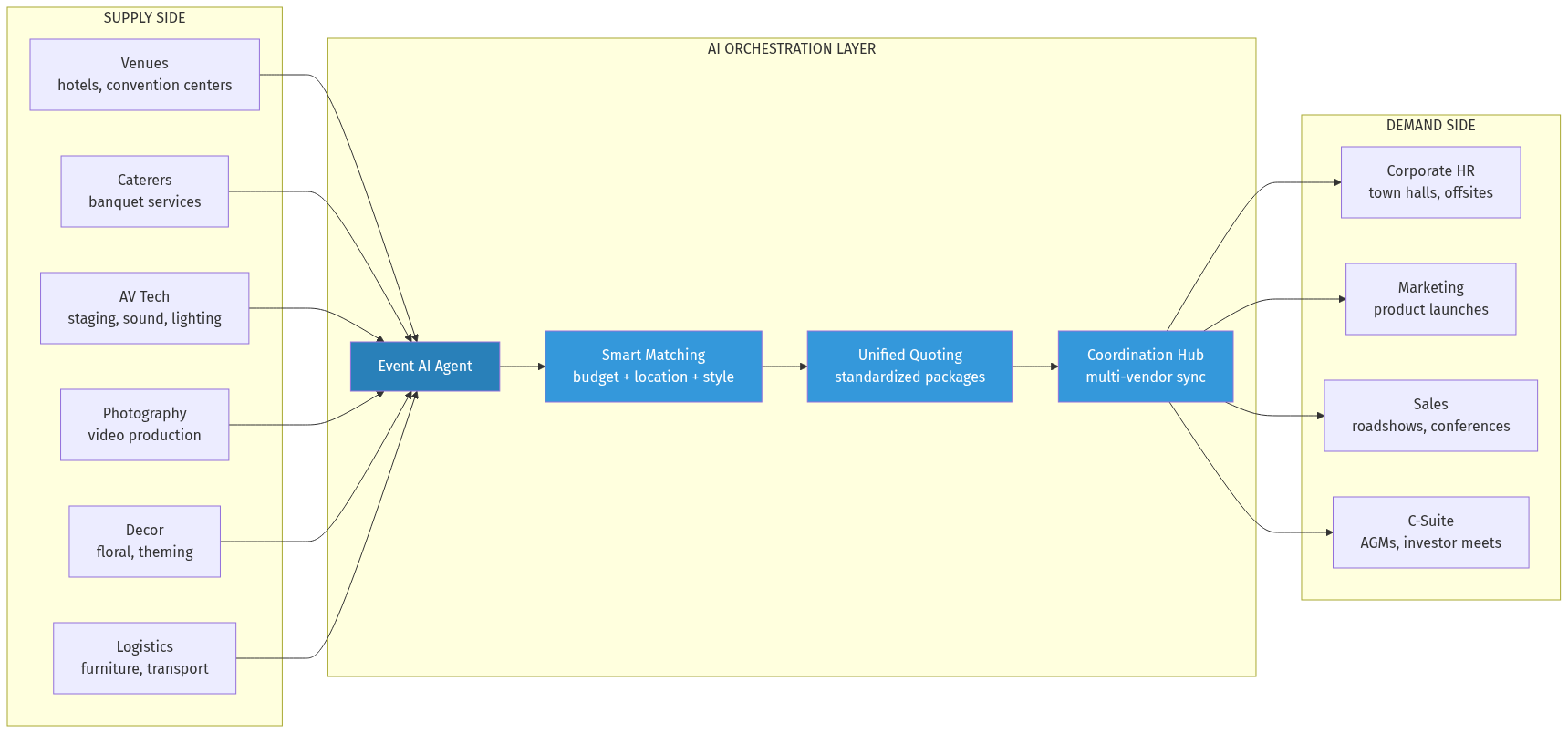
The 48-Hour Corporate Panic
When a VP of Marketing needs to organize a product launch event for 500 people in 6 weeks, the current process looks like this:
Discovery hell: Ask colleagues for referrals, Google "event venues Mumbai", scroll through unstructured results
Cold outreach chaos: Call 20-30 venues, explain requirements repeatedly, wait for callbacks
Quote incompatibility: Receive quotes in different formats, bundled differently, impossible to compare
Vendor coordination nightmare: Once booked, coordinate caterer with decorator with AV team through separate WhatsApp groups
Day-of chaos: No single source of truth, vendors arrive at wrong times, miscommunication cascades
Time spent: 40-80 hours over 4-6 weeks
Typical outcome: 30% budget overrun, significant stress, inconsistent quality
Who Feels This Pain?
- Corporate admins/EAs: Drowning in logistics for executives
- HR teams: Annual events, town halls, team offsites (50-200 events/year for large companies)
- Marketing teams: Product launches, dealer meets, press conferences
- Procurement teams: Trying to systematize what resists systematization
Zeroth Principles Analysis
What's the fundamental assumption everyone accepts?
The industry assumes event planning inherently requires human judgment at every step. But 70% of corporate events are routine—the same vendors, similar budgets, predictable requirements. The "creative" events that need bespoke planning are actually the minority.
What would we believe with zero prior knowledge?
If 10,000 companies need similar events annually, and 5,000 vendors provide similar services, matching and coordination should be automatable. The friction is artificial—created by information asymmetry and coordination costs, not genuine complexity.