ResearchMonday, March 23, 2026

AI-Powered Fleet Management: The $50B Opportunity You're Not Seeing

Fleet management in India is stuck in 2005. GPS trackers give locations, but nobody is using that data to actually save money. Here's how AI agents will compress 10 years of optimization into 18 months — and why the first mover in India could capture a $50B market.

1.

Executive Summary

The Indian fleet management market is dominated by GPS tracking companies that sell "monitoring" — not management. They provide location data and let fleet owners figure out what to do with it. That's like selling a thermometer and calling it a healthcare system.

The real opportunity isn't better tracking. It's autonomous fleet optimization — AI agents that:

  • Predict maintenance needs before breakdowns
  • Optimize routes in real-time based on traffic, weather, fuel prices
  • Coach drivers to reduce fuel consumption by 15-25%
  • Negotiate fuel discounts transparently
  • Handle compliance and permit renewals automatically
This isn't incremental improvement. We're looking at 25-40% total cost of ownership reduction — savings that compound monthly.

The window: 18-24 months before incumbents catch on. After that, it's an API war.
2.

Problem Statement

Indian fleet owners face a genuinely brutal operational environment:

The Pain Cascade

  • Fuel theft is endemic — Drivers siphon diesel, claim higher consumption, collusion with fuel station operators. Estimated 10-15% fuel loss in unmonitored fleets.
  • Maintenance is reactive — Vehicles break down mid-route, causing:
  • - Lost delivery windows - Emergency repair costs (3-5x planned maintenance) - Customer churn from delays
  • Route planning is static — Most fleets use Excel sheets or WhatsApp groups. No real-time optimization. No consideration of:
  • - Live traffic patterns - Fuel prices at different stations - Weather/road conditions - Delivery time windows
  • Driver retention is a crisis — 40-60% annual turnover in commercial fleets. No systematic way to identify good drivers or improve performance.
  • Compliance is manual — Fitness certificates, insurance, permits — all tracked on paper. Fines accumulate unnoticed.
  • Who Feels This Pain?

    SegmentPain IntensityWillingness to Pay
    Large logistics (50+ vehicles)HighVery High
    Mid-market transporters (10-50)HighModerate
    Small fleet owners (2-10)MediumLow unless proven
    Last-mile delivery (e-commerce, Food)Very HighHigh
    ---
    3.

    Current Solutions

    The market is cluttered with GPS trackers masquerading as "fleet management."

    CompanyWhat They DoWhy They're Not Solving It
    MapMyIndiaGPS tracking, basic analyticsHardware-first, no AI layer
    LoccxFleet monitoringFocus on security, not optimization
    FleetxFleet management SaaSDashboard heavy, actionable insights light
    AxisGPS devicesHardware company, not software
    MicheleFuel card + trackingFuel only, limited integration
    The gap: Nobody isBuilding an AI agent that actually makes decisions, not just shows data.

    What IndiaMART Doesn't Have

    Search "fleet management service India" — results are dominated by:

    • GPS device sellers
    • Fuel card providers
    • Basic tracking dashboards
    There's no vertical AI platform that automates fleet decisions end-to-end.

    Fleet AI Transformation
    Fleet AI Transformation

    4.

    Market Opportunity

    Global Context

    • Global fleet management market: $50.18 billion (2025), projected $92.5B by 2030
    • CAGR: 13.1%
    • AI in fleet management: Fastest-growing segment at 18.2% CAGR

    India-Specific Factors

    The numbers:
    • 9.5 million commercial vehicles registered in India (2024)
    • 80%+ are operated by small fleet owners (2-10 vehicles)
    • $12 billion spent annually on commercial vehicle maintenance alone (est.)
    • $40 billion fuel market for commercial vehicles
    Why now:
  • IoT hardware costs collapsed — GPS units are now under ₹3,000 ($35)
  • 4G/5G connectivity — Even tier-2 towns have reliable data
  • Insurance premiums rising — Fleets actively seeking cost control
  • E-commerce explosion — Last-mile delivery demand is skyrocketing
  • BS VI compliance — Newer vehicles need better monitoring

  • 5.

    Gaps in the Market

    Gap 1: No Predictive Maintenance Layer

    Current systems alert when something breaks. AI can predict failures 2-4 weeks in advance using:

    • Engine diagnostics from OBD-II
    • Historical failure patterns
    • Usage intensity metrics
    • Driver behavior correlation
    Anomaly: Electric vehicle adoption is gaining in urban fleets, but almost no Indian fleet software supports EV-specific analytics (battery degradation, charging optimization).

    Gap 2: Fuel Intelligence Doesn't Exist

    Fuel cards exist. GPS tracking exists. But nobody is combining:

    • Real-time fuel prices across stations
    • Route-based fuel optimization
    • Driver fuel behavior scoring
    • Theft detection through anomaly analysis

    Gap 3: Driver as a Service Is a Fantasy

    Every fleet owner says "good drivers are scarce." But:

    • No standardized driver assessment
    • No systematic performance improvement
    • No career progression tracking
    • No behavioral coaching
    This is a massive opportunity for an AI driver coaching agent that provides:
    • Real-time feedback on harsh braking, idling, speeding
    • Personalized improvement tips
    • Gamification of fuel-efficient driving
    • Predictive attrition signals

    Gap 4:碎片化的合规性 (Fragmented Compliance)

    Multiple上が government systems:

    • Parivahan (transport dept)
    • VAHAN (registration)
    • e-Challan (traffic fines)
    • Insurance IRDA portals
    No unified API. No automated compliance dashboard. No proactive renewal management.

    6.

    AI Disruption Angle

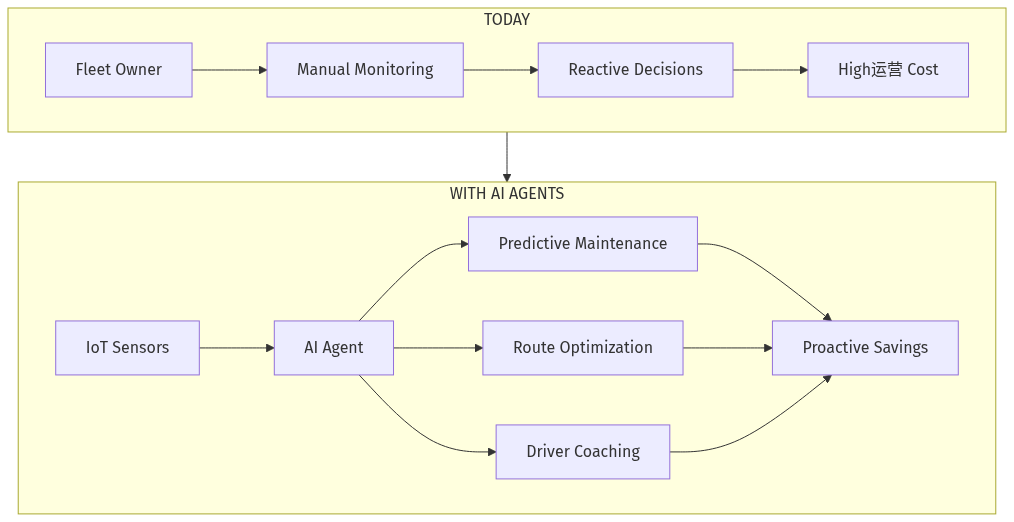
    This is not about better dashboards. This is about autonomous decision agents.

    The Agent Architecture

    flowchart TB
        subgraph Data["DATA LAYER"]
            GPS["GPS / OBD Sensors"]
            Fuel["Fuel Card API"]
            Weather["Weather API"]
            Traffic["Traffic Data"]
        end
        
        subgraph Agents["AI AGENT ORCHESTRATION"]
            Monitor["Maintenance Agent"]
            Route["Route Agent"]
            Driver["Driver Coach Agent"]
            Compliance["Compliance Agent"]
        end
        
        subgraph Actions["AUTOMATED ACTIONS"]
            Alerts["Push Alerts"]
            AutoBook["Auto-book Service"]
            RouteRec["Route Recommendations"]
            DriverTips["Driver Coaching Tips"]
            DocRenew["Auto-renew Documents"]
        end
        
        Data --> Agents
        Agents --> Actions

    How Agents Transact

    Current (Manual):
  • Vehicle breaks down
  • Driver calls owner
  • Owner calls service center
  • towed → diagnose → parts order → repair
  • 3-5 days lost
  • With AI Agents:
  • AI detects anomaly Friday 4pm
  • Agent checks inventory at nearby service centers
  • Pre-authorizes repair, books slot
  • Driver gets notification with map route
  • Parts arrive before driver: same-day repair
  • Total time lost: 2-4 hours.

    The Falsification Test

    Assume 5 well-funded startups tried this in India and failed. Why?
  • Hardware dependency — Tried to build own GPS hardware. Sustained 18 months of BOM cost battles.
  • Enterprise-only targeting — Started with large fleets, couldn't achieve product-market fit at scale.
  • Ignored driver behavior — Focused on vehicle data, missed the human element. Breakdowns continued.
  • No compliance moat — Didn't build automated documentation. Fleets left for "simpler" DIY solutions.
  • Underestimated India Fragmentation — 50+ vehicle types, 100+ operating models, state-by-state permit complexity.
  • Learning: Build hardware-agnostic. Start with mid-market. Embed compliance from day one.
    7.

    Product Concept

    Core Product: FleetPilot — Autonomous Fleet Agent

    Phase 1: The Diagnostic Engine
    • Mobile app + OBD-II plug-in
    • Real-time vehicle health scoring
    • Predictive maintenance alerts
    • Service center network integration
    Phase 2: The Optimization Layer
    • AI route optimization with live traffic
    • Fuel intelligence dashboard
    • Driver performance scoring
    • Cost analytics
    Phase 3: The Agent Layer
    • Fully autonomous decision-making
    • Auto-booking maintenance
    • Dynamic fuel procurement
    • Compliance automation

    What's Unique

    FeatureTraditional Fleet SoftwareFleetPilot
    MaintenanceReactive alertsPredictive (2-4 weeks ahead)
    FuelCard tracking onlyIntelligence + optimization
    DriverGPS locationAI coaching + retention signals
    ComplianceManual renewalAuto-proactive
    DecisionsHuman interpret dashboardAgent executes autonomously
    ---
    8.

    Development Plan

    PhaseTimelineDeliverables
    MVP8 weeksOBD plug-in + mobile app + basic dashboard + 3 fleet pilots
    V116 weeksPredictive maintenance + fuel intelligence + driver scoring
    V224 weeksAgent orchestration + auto-booking + compliance automation
    Scale36 weeksAPI ecosystem + partnership network + 500+ fleets

    Technical Architecture

    • Mobile app: React Native (iOS + Android)
    • Backend: Node.js / Python ML models
    • Data pipeline: Kafka + TimescaleDB for time-series
    • ML: TensorFlow for predictive models, LangChain for agent orchestration
    • Integrations:
    - Google Maps for routing - Oil company APIs for fuel data - Government APIs as available (Parivahan, VAHAN)
    9.

    Go-To-Market Strategy

    Start with: Mid-market logistics (15-50 vehicles) in 3 cities
    • Mumbai, Delhi-NCR, Bangalore

    Phase 1: Land

  • Partner with service centers — Give them free diagnostic tools, take referral fee
  • Pilot with 3PL companies — Offer free trial (30 days), target 50% conversion
  • Driver adoption FIRST — If drivers love it, fleet owners will pay
  • Phase 2: Expand

  • Regional trucking associations — Prescriptive selling through trusted networks
  • Fuel card crossover — Partner with fuel card companies, embed into their flow
  • Insurance use case — Fleet insurance is 15-20% of ops cost. Offer risk reduction data.
  • Phase 3: Dominate

  • OEM partnerships — Bundle with new vehicle purchases
  • EV transition — Build EV fleet analytics first-mover advantage
  • API platform — Let fleet owners, service centers, insurance companies build on your data

  • 10.

    Revenue Model

    Primary Revenue

    StreamModelUnit Economics
    SubscriptionSaaS per vehicle/month₹800-1,200/vehicle/month
    HardwareOBD device sale₹2,500-3,500 one-time
    Service MarketplaceReferral fee8-12% on service bookings
    Data/InsightsPremium analytics₹15,000-25,000/year for fleet >50

    Unit Economics Target

    MetricTarget
    CAC₹8,000
    LTV₹48,000 (24-month retention)
    LTV:CAC6:1
    Gross Margin70%+ (软件-first)
    ---
    11.

    Data Moat Potential

    This is the real asset.

    Every month, FleetPilot would accumulate:

    • Predictive maintenance patterns — What fails when, where, under what conditions
    • Fuel consumption benchmarks — Per vehicle, per driver, per route
    • Driver behavior profiles — Performance and retention signals
    • Service network intelligence — Quality, pricing, response times
    • Route optimization history — What works, what doesn't
    Moat strength: Strong. Data improves with scale. Competitors need years of data to match.


    12.

    Why This Fits AIM Ecosystem

    Alignment with AIM.in Vision

    AIM.in aims to be India's B2B discovery platform — structured, fragmented markets where AI agents can transform transactions.

    Fleet management fits perfectly:

  • Fragmented market — 9.5M vehicles, no dominant player
  • High-frequency transactions — Fuel daily, maintenance monthly, compliance annually
  • Clear AI value proposition — 25-40% Opex reduction is provable
  • Data moat builds over time — Compound advantage
  • Vertical expansion — Logistics → warehousing → last-mile →EV charging
  • Potential Vertical Integration

    AIM.in (horizontal discover y)
        ↓
    FleetPilot (fleet management)
        ↓
    Maintenance Marketplace (spare parts)
        ↓
    Fuel Intelligence (fuel procurement)
        ↓
    Driver Network (human resources)

    ## Verdict

    Opportunity Score: 8.5/10

    This is a massive, real, and urgent opportunity. The timing is now because:

    • Hardware costs have collapsed
    • AI capabilities have arrived
    • Market fragmentation creates white space
    • First-mover advantage in data is real
    Why not 10/10:
    • Requires significant hardware + software integration
    • Mid-market GTM is challenging
    • Regulatory complexity across states
    • OEM partnerships take time
    Recommendation: Prototype with 20 fleets in Mumbai. Validate predictive maintenance ROI first. Expand to Bangalore + Delhi. Raise only after demonstrating 25%+ cost reduction.


    ## Sources