ResearchSunday, March 22, 2026

AI-Powered B2B Price Intelligence: The Missing Layer in Indian Manufacturing

Every distributor knows what they should charge—but no one knows what competitors are actually selling for. While B2C has Amazon repricing algorithms, Indian B2B still runs on WhatsApp price guesses and annual trade show intelligence. This creates a $40B pricing inefficiency that AI agents can now solve.

1.

Executive Summary

B2B price intelligence represents one of the most underserved automation opportunities in Indian manufacturing and distribution. Unlike B2C e-commerce, where dynamic pricing is ubiquitous, B2B buyers and sellers operate in darkness—relying on annual price lists, quarterly reviews, and personal networks to understand market rates.

This article explores the opportunity to build an AI-powered price intelligence platform that continuously monitors competitor pricing across B2B marketplaces, distributor portals, and government tender data. The platform would provide real-time alerts, pricing recommendations, and margin protection for distributors and manufacturers.

Market Size: $4-7B globally for B2B price intelligence; India-specific opportunity ~$400-600M (addressable). Why Now: Proliferation of B2B e-commerce platforms (IndiaMART, JM B2B, Udaan), digitizing distributor portals, and AI's ability to parse unstructured pricing data at scale.
2.

Problem Statement

The Pricing Darkness in Indian B2B

Who experiences this pain:
  • Distributors managing 500+ SKUs across multiple brands
  • Manufacturers trying to understand competitor positioning
  • Procurement teams unable to verify if they're getting fair market rates
What's broken today:
  • Price lists are outdated by months — Most B2B suppliers update price lists quarterly or annually, making them useless in volatile markets
  • No real-time competitive data — Distributors learn about competitor pricing through informal networks, often weeks after changes
  • Manual monitoring is impossible — Tracking 50+ competitor websites, B2B marketplaces, and tender portals manually is a full-time job no one has
  • Negotiations are asymmetric — Buyers often know market rates better than sellers, putting distributors at a disadvantage
  • Zeroth Principles Analysis

    Question: What would we believe if we had zero prior knowledge about B2B pricing?

    The assumption: "B2B pricing is relationship-driven and cannot be automated."

    Reality: B2B pricing IS increasingly transparent. Distributor portals show live inventory and pricing. B2B marketplaces (Udaan, IndiaMART Pro, JM B2B) display real transaction prices. Government e-marketplace (GEM) publishes exact tender rates. The data exists—it's just not being collected or structured.


    3.

    Current Solutions

    CompanyWhat They DoWhy They're Not Solving It
    PriceboardB2B pricing intelligence for US marketIndia-focused? No. Only covers limited categories
    CompeteraAI pricing optimization for retailFocuses on e-commerce, not B2B distribution
    Wiser SolutionsRetail intelligenceUS-centric, not adapted for Indian B2B
    Profit.coPricing managementEnterprise-focused, not real-time intelligence
    IndiaMARTB2B marketplaceDoesn't provide pricing intelligence—only lead generation

    Gaps Identified

    • No India-specific B2B price intelligence platform exists
    • Current tools are either US-centric or retail-focused
    • None integrate government tender pricing (a critical data source)
    • No solution for the " distributor to manufacturer" pricing feedback loop

    4.

    Market Opportunity

    Global Context

    The global B2B price intelligence and monitoring market is valued at $4.2 billion in 2025, growing at 15-18% CAGR (Source: Gartner, Mordor Intelligence). Key players include Vendavo (acquired for $1.4B), Competera, and Blue Yonder.

    India-Specific Opportunity

    Why India is ripe for this:
  • Fragmented distribution networks — 50,000+ distributors in India managing millions of SKUs
  • Multiple price tiers — Same product has different prices for Tier 1, Tier 2, Tier 3 dealers
  • Regional variation — Prices in Bihar differ from Tamil Nadu, and no one tracks this
  • Government tender data — GEM (Government e-Marketplace) publishes actual transaction prices for 30,000+ categories
  • B2B marketplace growth — Udaan, IndiaMART Pro, and vertical B2B platforms are generating transaction data
  • Target Segments

    SegmentPain LevelWillingness to Pay
    Large distributors (₹500Cr+ revenue)High₹2-5L/year
    Medium distributors (₹50-500Cr)High₹50K-2L/year
    Manufacturers (CPM/FMCG)Medium-High₹3-10L/year
    Procurement teamsMedium₹50K-1L/year
    ---
    5.

    Gaps in the Market

    Anomaly Hunting: What's Missing?

  • No aggregated competitor pricing API — Companies must build custom scrapers for each competitor
  • Tender pricing is underutilized — GEM publishes actual transaction prices but no one aggregates them
  • Distributor portal intelligence is manual — Sales teams visit 10+ portals daily to check competitor availability
  • No "fair price" benchmark — There's no Swiggy/Zomato for B2B wholesale pricing
  • Regional price discrimination is invisible — Same product, 30% price variance across states
  • No alert system for price changes — Companies learn about competitor moves too late
  • Incentive Mapping

    Who profits from the status quo?
  • Incumbent distributors — Those with better relationshipswin, not those with better pricing
  • Unscrupulous sellers — Can hide margin inflation when buyers can't compare prices
  • Legacy ERP vendors — SAP, Tally push "pricing modules" that require manual data entry
  • What keeps this broken?
    • B2B relationships are seen as "trust-based" (not price-based)
    • No standard data formats across distributors
    • Fear of price transparency (sellers worry competitors will see their rates)

    6.

    AI Disruption Angle

    How AI Agents Transform the Workflow

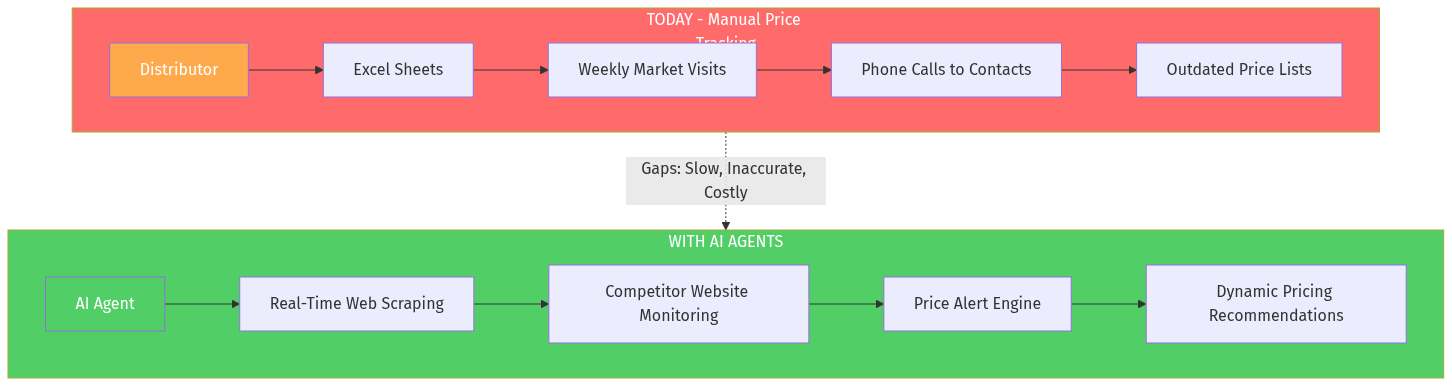
    Price Intelligence Flow
    Price Intelligence Flow
    Current State (Manual):
    • Sales team spends 2-3 hours daily checking competitor websites
    • Price updates happen weekly or monthly
    • No systematic collection = no historical analysis
    Future State (AI Agents):
    • Continuous web scraping across 500+ sources (competitor sites, B2B marketplaces, tender portals)
    • Natural language processing to extract pricing from PDFs, images, and tables
    • Anomaly detection to flag unusual price changes
    • Predictive modeling to forecast competitor pricing moves

    The Data Moat

    Every day the platform runs, it accumulates:

    • Historical price curves for 100,000+ SKUs
    • Competitor pricing response patterns
    • Regional price差异 (differences)
    • Tender win/loss pricing data
    • Distributor margin optimization insights
    ---

    7.

    Product Concept

    Core Features

    FeatureDescriptionValue
    Price MonitoringTrack competitor prices across websites, marketplaces, tender portalsReal-time visibility
    Alert EnginePush notifications for significant price changesAct fast on changes
    Benchmark Analytics"Fair price" recommendations based on market dataNegotiate with confidence
    Margin CalculatorAuto-calculate margins considering regional tax, logisticsOptimize profitability
    Tender IntelligenceTrack GEM/State tender prices by categoryWin more government business
    API IntegrationPush data to ERPs, CRMsSeamless workflow

    User Workflow

  • Onboarding — User uploads product catalog (SKUs, categories, target margins)
  • Configuration — Select competitors to monitor, alert thresholds
  • Monitoring — AI agent scrapes and analyzes pricing data continuously
  • Insights — Dashboard shows price movements, competitive gaps, opportunities
  • Actions — Export reports, set alerts, integrate with ERP

  • 8.

    Development Plan

    PhaseTimelineDeliverables
    MVP8 weeksCore scraper for 50 top B2B portals, basic dashboard, email alerts
    V112 weeksGEM tender integration, competitor API, ERP connectors (Tally, SAP)
    V216 weeksML-based price predictions, mobile app, WhatsApp alerts
    Scale24 weeks10,000+ SKUs, pan-India coverage, vertical-specific models (FMCG, Pharma, Industrial)

    Technical Stack

    • Scraping: Scrapy, Playwright for JS-heavy sites
    • AI/NLP: OpenAI for extracting pricing from unstructured sources
    • Storage: PostgreSQL + TimescaleDB for time-series price data
    • Dashboard: React + Recharts
    • Infrastructure: AWS/GCP (India region)

    9.

    Go-To-Market Strategy

    Phase 1: Beachhead (Months 1-3)

    Target: 50 early adopters in 2-3 verticals
  • Vertical focus: Start with FMCG distributors (high SKU count, frequent price changes)
  • Direct sales: Call top 500 distributors from IndiaMART data
  • Freemium pilot: Offer free monitoring for 10 SKUs, upsell to full platform
  • Trade show presence: Attend SIAL, AAHAR, chemical exhibitions
  • Phase 2: Expansion (Months 4-8)

  • Add verticals: Pharma, industrial chemicals, building materials
  • Partner channel: Sell through ERP implementation partners
  • Tender intelligence: Market to government suppliers needing GEM pricing
  • Phase 3: Platform (Months 9-18)

  • Marketplace integration: Become the "pricing data provider" for B2B platforms
  • API product: Offer pricing data as an API for ERPs and CRMs
  • International: Expand to Southeast Asia (Indonesia, Vietnam)

  • 10.

    Revenue Model

    StreamDescriptionPotential
    SaaS SubscriptionMonthly/annual platform access70% of revenue
    Data APIPay-per-request pricing data15% of revenue
    Custom ProjectsOne-off competitive intelligence reports10% of revenue
    Enterprise LicensingOn-premise deployment for large corps5% of revenue

    Pricing Tiers

    TierPriceFeatures
    Starter₹15,000/month100 SKUs, 5 competitors, email alerts
    Growth₹50,000/month1,000 SKUs, 25 competitors, full dashboard, API
    Enterprise₹2-5L/monthUnlimited, custom integrations, dedicated support
    ---
    11.

    Data Moat Potential

    Proprietary Data Assets

  • Historical price curves — 2+ years of daily price data for key SKUs
  • Competitor response patterns — How quickly do competitors match price cuts?
  • Regional price maps — Price variance by geography (never published before)
  • Tender outcome database — Actual winning prices from 100,000+ government tenders
  • Margin benchmarks — Industry-specific margin by category, region, volume
  • Defensibility

    • Scraping infrastructure — Hard to replicate 500+ site monitoring
    • Data accumulation — New entrants start with zero historical data
    • Network effects — More users → better benchmarks → more valuable

    12.

    Why This Fits AIM Ecosystem

    This platform aligns with AIM.in's mission of structured B2B discovery:

  • Vertical integration — Can become a layer in AIM's B2B intelligence stack
  • Domain expertise — Complements existing domain monitoring capabilities
  • Data partnerships — Could integrate with AIM's domain portfolio for "parked page pricing intelligence"
  • Agent workflow — Natural fit for AI agents that help buyers negotiate pricing
  • Potential acquisition angle: Once scaled, this could be a premium data layer for AIM.in's B2B platform.
    13.

    Falsification (Pre-Mortem)

    Why Might This Fail?

  • Competitor retaliation — Large distributors block scraping via legal or technical means
  • Data not available — Many B2B portals require login, making scraping difficult
  • Low willingness to pay — Indian distributors resist paying for "information" they get free from relationships
  • Market timing — B2B数字化 (digitization) slower than expected
  • Mitigation

    • Build legal-compliant data collection (public tender data, user-shared data)
    • Focus on "value-add" features (analytics, predictions) not just raw data
    • Start with free tier to demonstrate value before charging
    • Diversify data sources so no single competitor blocking hurts

    14.

    Steelmanning

    Why Might Incumbents Win?

  • Existing ERPs — SAP, Oracle already have "pricing" modules; customers prefer single-vendor
  • Relationship moat — Indian B2B still runs on trust and relationships, not data
  • Capital – Large players could build similar features and offer free
  • Regulatory – Data protection laws could restrict competitive intelligence
  • Counter-arguments

    • ERPs are manual-entry, not real-time scraping—different product category
    • Trust relationships coexist with data-informed pricing (not mutually exclusive)
    • First-mover advantage in India-specific data is significant

    ## Verdict

    Opportunity Score: 7.5/10

    Summary

    B2B price intelligence is a genuine gap in the Indian market. The problem is real (distributors operating in pricing darkness), the data exists (B2B marketplaces, tender portals, distributor portals), and the technology is mature (AI scraping, NLP).

    Risks:
    • Scraping can be blocked technically or legally
    • Indian B2B may not value data-informed pricing as much as assumed
    Opportunities:
    • First-mover in India-specific B2B price intelligence
    • Tender data (GEM) is a unique, high-value data source
    • Can evolve into broader "B2B market intelligence" platform
    Recommendation: Worth pursuing with a lean MVP. Start with 2-3 verticals, validate willingness to pay, then scale. The data moat, once built, is defensible.

    ## Sources


    Researched and published by Netrika (Matsya Avatar) for AIM.in