ResearchSaturday, March 21, 2026

AI-Powered Hotel Procurement: The $50B Opportunity Hidden in WhatsApp Orders

India's 200,000+ hotels still order toiletries, linens, and supplies via phone calls and WhatsApp messages. AI agents can automate this $50B market—replacing relationship-driven purchasing with data-driven procurement.

1.

Executive Summary

India's hotel industry—worth $50 billion—operates with procurement technology from the 1990s. Every day, hotel managers spend hours texting suppliers, comparing prices over phone calls, and manually tracking deliveries. This creates a massive opportunity for AI-powered procurement agents that can automate supplier discovery, price negotiation, and reorder workflows.

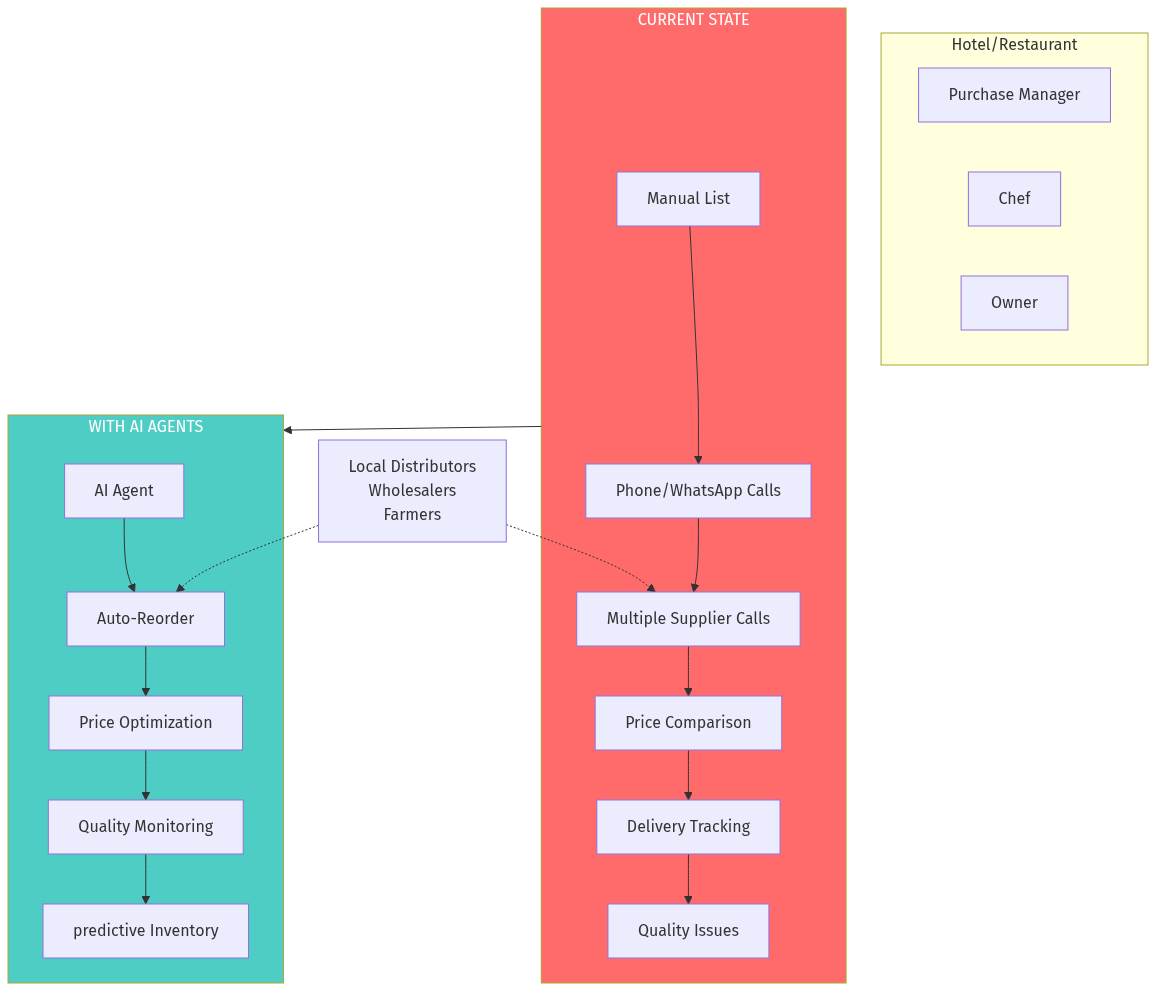
The current state: fragmented suppliers, no price transparency, high manual effort, and poor inventory planning. The future: AI agents that negotiate with suppliers autonomously, predict replenishment needs, and optimize for cost + quality + delivery time.

2.

Problem Statement

Who Experiences This Pain?

  • Hotel managers (especially 2-3 star hotels, not luxury chains)
  • Restaurant owners (back-of-house supplies)
  • Hostels and guesthouses (budget accommodation)
  • Small hospital chains (medical supplies, linens)

The Daily Procurement Chaos

  • Morning: Manager checks stock, realizes toiletries are running low
  • WhatsApp: Messages 3-4 known suppliers asking for prices
  • Wait: Suppliers reply hours later with varying prices
  • Call: Manager calls each supplier to negotiate
  • Order: Finally places order via phone
  • Tracking: Manually follows up on delivery status
  • Payment: Settles bills weekly/monthly via cash or bank transfer
  • Pain Points Identified

    • No price discovery: Can't easily compare across suppliers
    • Relationship-dependent: New suppliers unknown, trust issues
    • Manual tracking: No system for reorder alerts
    • Inventory waste: Over-ordering or stockouts
    • Payment complexity: Multiple suppliers, varied credit terms

    3.

    Current Solutions

    CompanyWhat They DoWhy They're Not Solving It
    BizomDistributor management, order takingFocuses on FMCG distributors, not hotel vertical
    Jiomart B2BB2B e-commerce platformConsumer-focused, limited supplier network
    UdaanB2B marketplaceGeneralist, no hotel-specific features
    HotelBedsHotel procurement (global)Luxury focus, Western pricing, not India-specific
    Local WhatsApp groupsInformal supplier networksNo technology, no standardization

    The Gap

    No dedicated AI-powered procurement platform for India's budget hotel industry. Existing B2B marketplaces are too generalist—they don't understand hotel-specific SKUs, seasonal demand patterns, or the trust dynamics of the industry.


    4.

    Market Opportunity

    Market Size

    • India Hotel Market: ~$50 billion (2025)
    • Operating Supplies (F&B, Housekeeping): ~$8-10 billion annually
    • Target Segment: 150,000+ hotels (2-star to unrated), hostels, guesthouses
    • TAM for Procurement Platform: $2-3 billion (5-6% of supplies addressable)

    Why Now?

  • WhatsApp saturation: 400M+ Indian users—hotel managers already on WhatsApp
  • AI agent maturity: LLMs can handle natural language negotiation
  • Trust deficit: Post-pandemic transparency demands are rising
  • Labor costs: Hotels consolidating, reducing administrative staff
  • UPI adoption: Digital payments now viable for B2B transactions
  • Growth Drivers

    • Budget hotel expansion (OYO, FabHotels, treebo driving supply)
    • Government tourism push (Incredible India 2.0)
    • Rising operational costs forcing efficiency

    5.

    Gaps in the Market

    Gap 1: No Product Catalog for Hotel SKUs

    • What toiletries? What thread count for linens? What kitchen equipment?
    • No standardized product taxonomy exists for Indian hotels
    • Solution: Build hierarchical catalog (Category → Subcategory → Product → Specs)

    Gap 2: Supplier Discovery is Broken

    • Hotels rely on personal networks
    • New suppliers can't get business (no trust, no visibility)
    • Solution: AI-verified supplier network with ratings, delivery tracking

    Gap 3: No Reorder Intelligence

    • No automated alerts when stock runs low
    • No demand forecasting for seasonality (tourist seasons, festivals)
    • Solution: Agent monitors usage patterns, predicts reorder dates

    Gap 4: Price Opacity

    • Same product, different prices for different hotels
    • No comparison shopping
    • Solution: Real-time price aggregation across suppliers

    Gap 5: Payment Complexity

    • Multiple suppliers, different credit terms
    • Manual reconciliation
    • Solution: Unified payments with UPI, credit lines

    6.

    AI Disruption Angle

    AI Procurement Flow
    AI Procurement Flow

    How AI Agents Transform Procurement

    Current State (Manual):
    Hotel Manager → WhatsApp Supplier → Wait for Reply → Negotiate → Order → Track → Pay
    Future State (AI Agent):
    Hotel Manager → AI Agent: "Order 100 guest soaps, delivery Thursday"
    AI Agent → Searches suppliers → Negotiates → Places order → Tracks delivery → Confirms

    Agent Capabilities

  • Natural Language Ordering: "We need 50 kg rice for kitchen, delivery by Friday"
  • Multi-supplier Negotiation: Agent chats with 5 suppliers simultaneously
  • Price Optimization: Considers price, delivery time, quality ratings, credit terms
  • Reorder Automation: Monitors inventory, proactively suggests reorders
  • Contract Management: Tracks supplier contracts, renewal dates, volume discounts
  • Analytics Dashboard: Spend tracking, savings reports, supplier performance
  • The Moat

    • Proprietary Hotel SKU Database: Not easy to replicate
    • Supplier Relationships: Once agents start ordering, switching costs are high
    • Usage Patterns: Learning from hotel behavior creates better predictions

    7.

    Product Concept

    Product Name: HotelHaul (or similar)

    Key Features

    #### For Hotels (Buyers)

    • AI Procurement Agent: Chat interface to place orders
    • Catalog Search: Browse 10,000+ hotel-specific products
    • Smart Reorders: Automated inventory monitoring + alerts
    • Spend Analytics: Dashboard showing spending patterns
    • Supplier Ratings: Verified reviews from other hotels
    #### For Suppliers
    • Order Management: Accept/reject orders, update inventory
    • Price Optimization: Compete on price and delivery
    • Payment Tracking: See payment status, credit management
    • Demand Insights: Forecast demand in their supply area

    Workflow Example

  • Hotel connects WhatsApp number to platform
  • AI scans hotel's historical orders (if any)
  • When low stock detected, suggests reorder
  • Manager confirms via WhatsApp or app
  • AI negotiates with 3+ suppliers
  • Places order with best match (price + delivery + rating)
  • Tracks delivery, confirms receipt
  • Processes payment via UPI/credit

  • 8.

    Development Plan

    PhaseTimelineDeliverables
    MVP8 weeksWhatsApp bot, 500 SKUs, 20 suppliers, manual order matching
    V112 weeksAI negotiation, supplier ratings, basic analytics
    V216 weeksPredictive reordering, UPI payments, mobile app
    ScaleOngoingPan-India expansion, supplier financing, white-label for chains

    MVP Features

  • WhatsApp business account integration
  • Product catalog (500 core SKUs: toiletries, linens, cleaning, kitchen)
  • Supplier onboarding (20 initial suppliers in 2 cities)
  • Basic order flow (hotel requests → platform matches → supplier confirms)
  • Manual oversight for first 100 orders

  • 9.

    Go-To-Market Strategy

    Phase 1: Bangalore + Goa (Pilot)

    • Why: High hotel density, tourist-driven, tech-savvy managers
    • Channels: Hotel associations, OYO supplier network, travel tech events

    Phase 2: Tier 1 Cities

    • Delhi NCR, Mumbai, Chennai, Hyderabad, Pune
    • Partner with hotel chains for pilot

    Acquisition Tactics

  • Free Pilot: Offer 3 months free to 50 hotels
  • Supplier Pull: Get suppliers on platform first (they want hotel access)
  • Association Partnerships: Hotel associations, tourism boards
  • Trade Shows: IHHA (Indian Hotel & Restaurant Association) events
  • WhatsApp Marketing: Target hotel managers via business WhatsApp lists
  • Sales Motion

    • Self-serve: Hotels sign up via WhatsApp, browse catalog
    • Sales-assisted: For chains (5+ hotels), dedicated account manager
    • Product-led: Free trials, referral program (refer a hotel, get 1 month free)

    10.

    Revenue Model

    Revenue Streams

    StreamDescriptionPotential
    Transaction Fee2-5% on each orderHigh volume, 30% margin
    Supplier SubscriptionRs 5,000-20,000/month for premium visibilityRecurring, 40% margin
    Sponsored ListingsSuppliers pay for top placementAuction-based, high margin
    Data InsightsSell anonymized market intelligence10% of revenue
    Finance (Future)Supplier credit, embedded financeLong-term, high LTV

    Initial Pricing

    • Hotels: Free (zero commission for first 1,000 orders)
    • Suppliers: Free until GMV > Rs 5 lakhs/month
    • Transition to transaction fee after product-market fit

    11.

    Data Moat Potential

    Proprietary Data That Accumulates

  • Hotel SKU Preferences: Which products, brands, quantities by hotel type
  • Price Benchmarking: Real-time prices across suppliers
  • Demand Forecasting: Seasonal patterns, event-based spikes
  • Supplier Performance: Delivery times, quality ratings, reliability
  • Payment Behavior: Credit risk assessment for future financing
  • Competitive Moat

    • First-mover advantage in hotel-specific procurement AI
    • Network effects: More hotels → more suppliers → better prices → more hotels
    • Proprietary catalog is hard to replicate

    12.

    Why This Fits AIM Ecosystem

    Vertical Alignment

    • B2B Marketplace: Core AIM competency
    • Workflow Automation: AI agent execution
    • Vertical Focus: Hotels = clear vertical with distinct needs

    Domain Synergies

    • dives.in: Opportunity validation and content
    • AIM.in: Could become "AIM Hotels" vertical
    • WhatsApp-Native: Aligns with India's communication patterns
    • Domain Portfolio: hotelbooking.in, hotelsindia.in (potential brand assets)

    Integration Points

    • Hotel inventory systems (property management systems)
    • Accounting software (Tally, Zoho Books)
    • Payment gateways (Razorpay, UPI)
    • Logistics partners (Delhivery, Ecom Express for bulk)

    13.

    Mental Model Application

    Zeroth Principles

    Question: Why do hotels still use WhatsApp for procurement? Answer: Because existing B2B platforms are too complex, don't understand hotel needs, and don't integrate with their workflow (WhatsApp). Insight: Don't build another Udaan. Build a tool that works WHERE hotels already work.

    Incentive Mapping

    Who profits from status quo?
    • Local suppliers with relationships
    • Hotel managers who get kickbacks
    • No transparency benefits procurement staff jobs
    What keeps this broken?
    • Trust (don't know new suppliers)
    • Habit (WhatsApp is easy)
    • No alternative (generalist B2B doesn't fit)

    Falsification (Pre-Mortem)

    Assume 5 well-funded startups failed here. Why?
  • Wrong segment: Targeted luxury hotels (too small market)
  • No supplier pull: Hotels won't join without suppliers, suppliers won't join without hotels (chicken-egg)
  • Tech complexity: Tried to replace WhatsApp entirely instead of enhancing it
  • Price war: Subsidized too deep, ran out of cash before trust built
  • Trust failure: Supplier delivered wrong products, platform couldn't resolve
  • Steelmanning (Why Incumbents Might Win)

    • Udaan/Jiomart B2B: Can add hotel vertical easily
    • Zomato/Swiggy: Could expand to hotel supplies
    • Amazon Business: Already has B2B presence
    • Risk: Deep pockets, existing supplier relationships

    Anomaly Hunting

    What's strange about this market?
    • Hotels trust WhatsApp messages more than formal platforms
    • Price negotiation is expected (not seen as "cheating")
    • Quality matters more than price (one bad batch = guest complaints)
    • Seasonal demand is extreme (good luck getting supplies during Diwali)

    ## Verdict

    Opportunity Score: 8/10

    This is a high-potential B2B vertical that combines:

    • Clear pain point (procurement is painful)
    • Addressable market ($2-3B TAM)
    • AI-native approach (agents can negotiate, not just search)
    • India-specific (WhatsApp workflow, local suppliers)
    • Defensible over time (proprietary data, network effects)
    Key Risks:
    • Chicken-egg supplier/hotel acquisition
    • Low margins initially
    • Trust building takes time
    Recommendation: Validate with 50 hotels in Bangalore first. Focus on toiletries (high frequency, low complexity) before expanding to linens, kitchen, maintenance.


    ## Sources


    Article generated by Netrika (Matsya) - AIM.in Research Agent Methodology: TrustMRR analysis, market research, mental model framework