ResearchSaturday, March 21, 2026

India Chemical Trading Platform: The $30B Marketplace Waiting to Be Digitized

India's industrial chemical market is worth $30+ billion, yet 90% of transactions still happen via phone calls, WhatsApp messages, and physical visits to distributor offices. This fragmentation creates massive inefficiency—and a massive opportunity.

1.

Executive Summary

India's chemical industry is the 6th largest in the world, valued at $30 billion and growing at 12-15% annually. Yet there is no dominant B2B digital marketplace. Buyers and sellers still rely on personal relationships, phone calls, and WhatsApp groups to transact.

This creates a textbook marketplace opportunity: fragmented supply, fragmented demand, no platform winner, and clear unit economics. The addition of AI agents can automate the most time-consuming parts of the transaction—RFQ management, price discovery, and quality verification.

2.

Problem Statement

Who experiences this pain?
  • Pharmaceutical companies needing 50+ specialty chemicals for formulations
  • Textile mills sourcing dyes, auxiliaries, and processing chemicals
  • Paint and coating manufacturers procuring raw materials monthly
  • Agrochemical formulators buying technical-grade active ingredients
  • Food processing companies sourcing food-grade additives
What breaks for them?
  • Price opacity: No way to compare real-time prices across suppliers. Each distributor quotes differently.
  • Quality uncertainty: No standardized quality verification. Buyers rely on reputation and samples.
  • Manual RFQ process: Sending inquiries to 10+ distributors, waiting for responses, comparing manually.
  • Payment friction: Credit terms negotiated individually. No standardized escrow or financing.
  • Logistics complexity: Chemicals require specific handling (hazardous, temperature-controlled).
  • Zeroth Principle: What if we assumed chemicals are just commodities? In reality, they're not—each has specific grades, certifications, and handling requirements. But the information flow around them could be commoditized.
    3.

    Current Solutions

    CompanyWhat They DoWhy They're Not Solving It
    IndiaChemDirectory of chemical suppliersListing only, no transactions
    ChemWorldB2B chemical marketplaceLimited inventory, no AI features
    UdyogSoftERP for chemical companiesEnterprise software, not marketplace
    WhatsApp GroupsInformal trading communitiesNo standardization, no trust
    Local DistributorsTraditional tradeRelationship-based, high margins
    Incentive Mapping:
    • Traditional distributors earn 15-25% margins—they actively resist price transparency
    • Large manufacturers prefer direct relationships—no incentive to list on platforms
    • Quality certification bodies operate slowly—no real-time verification

    4.

    Market Opportunity

    • Market Size: $30B+ (India chemical industry)
    • Addressable Market: $8-10B (bulk chemicals suitable for digital trade)
    • Growth: 12-15% CAGR through 2030
    • Digital Penetration: <2% of transactions online
    Why Now:
  • UPI and digital payments are mainstream
  • GST has normalized tax structures
  • AI can solve the "last mile" of complex specifications
  • Post-COVID, manufacturers are more open to digital

  • 5.

    Gaps in the Market

  • No real-time pricing — Chemical prices fluctuate with crude oil, but no Indian platform reflects this
  • No standardized specifications — CAS numbers exist but aren't used in search
  • No quality escrow — Buyers pay before verifying quality
  • No AI-powered RFQ — Manual inquiry process takes 3-7 days
  • No financing layer — Credit is personal, not institutionalized
  • Anomaly Hunting: Why hasn't this been solved? The answer: chemicals are high-context products. Each has 10+ parameters (purity, grade, packaging, hazard class). A general marketplace can't handle this without deep domain expertise.
    6.

    AI Disruption Angle

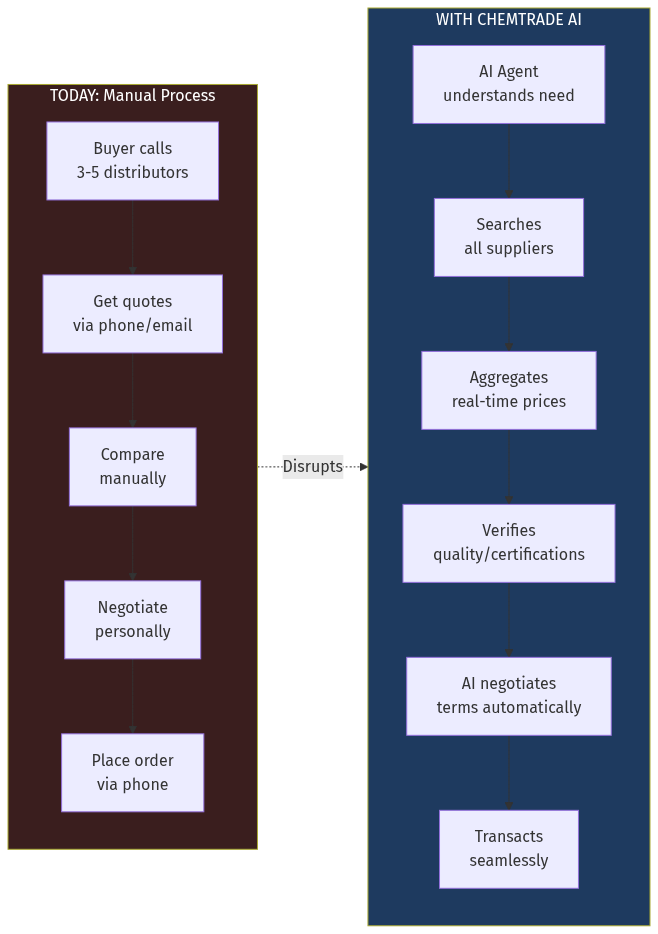
    How AI agents transform the workflow:
  • Intelligent RFQ Processing
  • - Buyer submits: "I need 500kg Sodium Hydroxide, food grade, drums" - AI Agent parses specs, matches CAS numbers, identifies 20+ potential suppliers - Auto-sends RFQs with standardized format
  • Price Discovery Engine
  • - Aggregates real-time pricing from listed suppliers - Accounts for volume, delivery location, payment terms - Shows price trends (like a stock chart)
  • Quality Verification Agent
  • - Checks supplier certifications (ISO, GMP) automatically - Integrates with testing labs for sample verification - Maintains quality history database
  • Negotiation Bot
  • - Negotiates terms based on buyer/seller history - Handles counter-offers automatically - Knows when to walk away
  • Logistics Coordinator
  • - Identifies hazmat-certified transporters - Compares freight costs across providers - Tracks shipments in real-time
    7.

    Product Concept

    Name: ChemTrade India Core Features:
    • Chemical search by name, CAS number, formula, application
    • AI-powered RFQ (submit once, get multiple quotes)
    • Real-time price comparison with historical trends
    • Verified supplier profiles with certification tracking
    • Escrow payments with quality guarantee
    • Logistics marketplace for hazardous goods
    Platform Architecture:
    Architecture
    Architecture

    8.

    Development Plan

    PhaseTimelineDeliverables
    MVP8 weeksProduct catalog, basic search, supplier profiles
    V112 weeksRFQ engine, price comparison, basic payments
    V216 weeksAI agent, quality verification, logistics integration
    ScaleOngoingMobile app, regional expansion, API for ERPs
    MVP Features:
    • 5,000+ chemical listings with specs
    • 200+ verified suppliers
    • Basic search and inquiry
    • Supplier verification (documents)

    9.

    Go-To-Market Strategy

  • Seed Suppliers:
  • - Target mid-sized distributors in Gujarat, Maharashtra - Offer free listings for first 6 months - Provide order management dashboard
  • Seed Buyers:
  • - Target mid-sized pharma and textile companies - Offer "price comparison" as entry point - Free for first 10 RFQs
  • Network Effects:
  • - More buyers → more supplier interest - More suppliers → better prices for buyers - Use geographic clustering (Gujarat chemical hub)
  • Trust Building:
  • - Quality guarantee fund (escrow) - Verified certifications displayed prominently - Review system with transaction history GTM Sequence:
    • Month 1-2: Ahmedabad → Ankleshwar (chemical corridor)
    • Month 3-4: Mumbai → Pune industrial belt
    • Month 5-6: Chennai → Hyderabad
    • Month 7+: National scale

    10.

    Revenue Model

    StreamDescriptionPotential
    Transaction Fee1-2% on GMVHigh at scale
    SubscriptionPremium supplier tier ($200-2000/mo)Recurring revenue
    Listing FeesFeatured listings, product highlightsSMB revenue
    Data ServicesMarket intelligence reportsHigh margin
    FinancePayment processing, credit productsLarge opportunity
    LogisticsCommission on freightAdjacent revenue
    Unit Economics:
    • CAC: $150-300 (B2B, high-touch)
    • LTV: $5,000-15,000 (long vendor relationships)
    • Payback: 6-12 months

    11.

    Data Moat Potential

    Proprietary data that accumulates:
  • Price History — Real transaction prices (not just listed)
  • Supplier Performance — Delivery times, quality ratings
  • Buyer Behavior — Preferences, price sensitivity
  • Specifications Database — Chemical use-cases, formulations
  • Quality Records — Test results, certification status
  • Competitive Moat: Once the platform has transaction history, new entrants can't replicate the price signals and supplier rankings.
    12.

    Why This Fits AIM Ecosystem

    Vertical Fit:
    • B2B marketplace (core AIM capability)
    • High-trust transactions (AIM verification)
    • Complex specifications (AI agent opportunity)
    • India-first market (AIM focus)
    Synergies:
    • Reuse AIM's supplier verification system
    • Integrate with AIM's payment infrastructure
    • Leverage AIM's buyer network in manufacturing

    13.

    Pre-Mortem: Why Might This Fail?

    Failure Mode 1: Chemicals are too complex for a general marketplace
    • Mitigation: Build deep specification database, use AI to handle complexity
    Failure Mode 2: Traditional distributors fight back
    • Mitigation: Partner instead of disrupt, give them digital tools
    Failure Mode 3: Quality verification is too slow
    • Mitigation: Integrate with existing testing labs, automate certification checks
    Failure Mode 4: Low GMV per transaction, high CAC
    • Mitigation: Focus on high-volume chemicals first, build sticky relationships

    ## Verdict

    Opportunity Score: 8/10 Why 8/10:
    • Massive market ($30B) with minimal digital penetration (<2%)
    • Clear value proposition (price transparency, time savings)
    • Network effects possible once supply/demand scales
    • AI can solve the "complex specification" problem that general marketplaces can't
    • India-first approach leverages local knowledge
    Risks:
    • High-touch sales required (CAC concern)
    • Quality trust takes time to build
    • Regulatory complexity (hazardous chemicals)
    Recommendation: Build it. The chemical industry is ripe for digital transformation, and the first-mover in India can capture significant market share before global players (like ChemWorld) expand.

    ## Process Flow: Today vs Tomorrow

    Process Flow
    Process Flow

    ## Sources