ResearchSaturday, March 21, 2026

AI-Powered B2B Safety Equipment & PPE Marketplace: Resolving India's $15B Procurement Inefficiency

India's workplace safety equipment market is a $15+ billion opportunity dominated by fragmented suppliers, manual price discovery, and trust deficits. AI agents can transform how factories, construction companies, and industrial facilities discover, verify, and procure PPE—automating a market that still runs on phone calls, WhatsApp messages, and trade show relationships.

8
Opportunity
Score out of 10
1.

Executive Summary

The Indian Personal Protective Equipment (PPE) and safety equipment market represents a $15+ billion opportunity that remains stubbornly analog. While global giants like 3M, Honeywell, and MSA dominate the premium segment, thousands of unorganized local manufacturers serve the bulk of India's industrial buyers—through phone calls, trade shows, and personal relationships.

This fragmentation creates massive inefficiencies: procurement teams spend days finding suppliers, comparing prices, verifying certifications, and managing logistics. AI agents can automate specification matching, supplier discovery, price intelligence, and certification verification—creating a new layer of digital infrastructure for a market that has resisted modernization.

The opportunity is particularly compelling because:

  • High repeat purchase: PPE is a consumable (gloves, masks, safety glasses need regular replacement)
  • Trust is expensive: Buyers need certification verification, quality assurance
  • Price opacity: Same product has 30-50% price variation across suppliers
  • Specification complexity: Industrial PPE has exact standards (IS, ANSI, EN) that require matching
---

2.

Problem Statement

The Daily Reality of B2B Safety Equipment Procurement

Every day, thousands of procurement managers across India's factories, construction sites, chemical plants, and infrastructure projects face the same challenges:

Supplier Discovery
  • No centralized directory of PPE manufacturers and distributors
  • Rely on personal networks, trade shows (India Safety Expo), and Google searches
  • New suppliers require extensive vetting—time-consuming and risky
Price Discovery
  • Same product (say, IS 1220 industrial gloves) has 30-50% price variation
  • No transparent pricing—suppliers quote differently based on relationship
  • Bulk discounts are negotiated manually, not systematized
Quality & Certification Verification
  • Counterfeit and sub-standard PPE is a real problem
  • Certification verification (ISI, ANSI Z87, EN 388) requires expertise
  • No standardized quality benchmarks or testing data
Logistics & Delivery
  • Small orders often ignored by larger distributors
  • Delivery timelines uncertain, especially for specialized items
  • No consolidated ordering across multiple product categories

Who Experiences This Pain?

  • Factory Safety Managers (manufacturing, auto, pharma, chemicals)
  • Construction Companies (infrastructure, real estate, road building)
  • Oil & Gas (refineries, petrochemicals, drilling)
  • Mining Operations (coal, iron ore, limestone)
  • Chemical Plants (hazardous material handling)
  • Ports & Logistics (cargo handling, warehousing)

3.

Current Solutions

Existing Players and Why They're Not Solving It

CompanyWhat They DoWhy They're Not Solving It
IndiaMart (B2B marketplace)General B2B catalog with PPE categoryNo specialization, no certification verification, no AI matching
TradeIndiaProduct listings for safety equipmentSame as Indiamart—generic catalog, no intelligent matching
SafetyKart (B2B)Online safety equipment storePrimarily retail-focused, limited B2B features, no enterprise integration
3M IndiaPremium PPE products directOnly own products, no marketplace, not solving supplier discovery
Local Distributors (regional)Delhi's Jhilmil, Mumbai's KalbadeviFragmented, relationship-based, no digital infrastructure
Safety Equipment DealersLocal shops in industrial areasNo catalog, no price transparency, limited range

The Gap

No platform specifically addresses the intersection of:

  • Specification matching (understanding IS/ANSI/EN standards)
  • Supplier verification (certification, quality history, delivery track record)
  • Price intelligence (real-time pricing across multiple suppliers)
  • AI-driven recommendations (matching buyer needs to verified suppliers)

  • 4.

    Market Opportunity

    Market Size

    SegmentEstimated SizeNotes
    India PPE Market$15-18 billionGrowing 12-15% annually
    Organized Segment~$4 billionBrands, large dealers
    Unorganized Segment~$11-14 billionLocal manufacturers, small dealers
    Addressable (Digital)$3-5 billionMedium-large enterprises open to digital

    Growth Drivers

    • Regulatory enforcement: Government emphasis on workplace safety (new labor codes)
    • Insurance requirements: Companies mandating PPE standards
    • Infrastructure boom: $1.5T+ infrastructure spending = more safety equipment needed
    • Manufacturing growth: PLI schemes driving new factories = new buyers

    Why Now

    The convergence of factors makes this the right time:

  • Post-COVID digital adoption: B2B buyers more comfortable with online procurement
  • AI capability maturity: Large language models can understand technical specifications
  • Supply chain visibility: Better data on supplier capabilities and certifications
  • Trust infrastructure: Digital verification of certifications becoming possible

  • 5.

    Gaps in the Market

    Where Current Players Fail

  • No Intelligent Specification Matching
  • - Buyer says "need impact-resistant safety glasses ANSI Z87" → gets generic results - AI can understand technical specs and match to exact product equivalents
  • No Certification Verification Layer
  • - IS 1220 for industrial gloves, ISI for electrical safety—buyers can't easily verify - No database of certified manufacturers, test reports, compliance history
  • No Price Transparency
  • - Same product has massive price variation - No aggregated pricing intelligence
  • No Supplier Quality Scoring
  • - No systematic feedback on delivery, quality, responsiveness - New buyers have no data to assess suppliers
  • No Enterprise Integration
  • - No API for ERP/Procurement system integration - No purchase order automation

    Anomaly Hunting: What's Strange About This Market

    • Trade shows still dominate: India Safety Expo (Mumbai) is the primary discovery channel—digital is underutilized
    • Price variation is normalized: 30-50% variation accepted as "market dynamics"
    • Certification is manual: Buyers verify certificates by calling BIS—should be automated
    • No bundling: Companies buy 20+ PPE categories from 20+ different suppliers—consolidation opportunity

    6.

    AI Disruption Angle

    How AI Agents Transform the Workflow

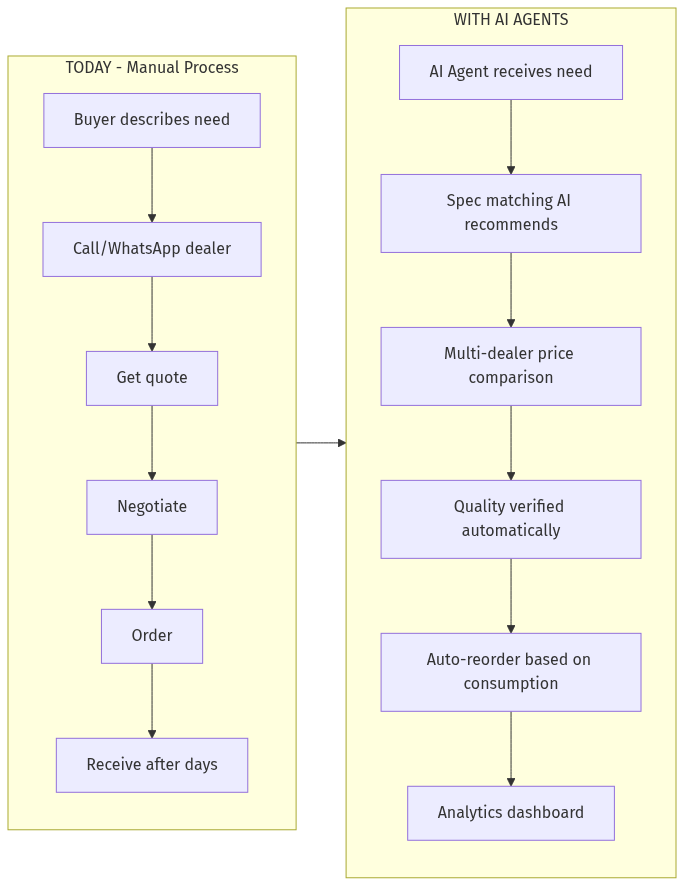
    Before AI Agent:
    Buyer: "I need 500 pairs of industrial gloves, IS certified, cut-resistant"
    → Searches Google
    → Calls 5 suppliers
    → Waits for quotes (2-3 days)
    → Compares prices manually
    → Verifies certification (calls BIS)
    → Places order
    Total time: 5-7 days
    With AI Agent:
    Buyer: "I need 500 pairs of cut-resistant industrial gloves, IS certified, delivery in 5 days"
    → AI understands specifications (IS 1220, EN 388 Level 3)
    → Searches certified supplier database
    → Ranks by price, rating, delivery capability
    → Verifies certification automatically
    → Generates comparison report
    → Places order (or sends to procurement for approval)
    Total time: 15 minutes

    Key AI Capabilities

  • Natural Language Specification Understanding
  • - Convert "need chemical-resistant gloves" to EN 374 standard - Map Indian standards (IS) to international (ANSI, EN, ISO)
  • Intelligent Product Matching
  • - Match buyer specs to exact products - Suggest alternatives/equivalents
  • Automated Certification Verification
  • - Cross-reference supplier claims with BIS database - Flag expired or suspicious certifications
  • Dynamic Price Intelligence
  • - Real-time pricing across supplier network - Alert on price anomalies
  • Supplier Scoring & Recommendation
  • - Aggregate reviews, delivery history, quality metrics - Recommend based on buyer profile and past preferences
    7.

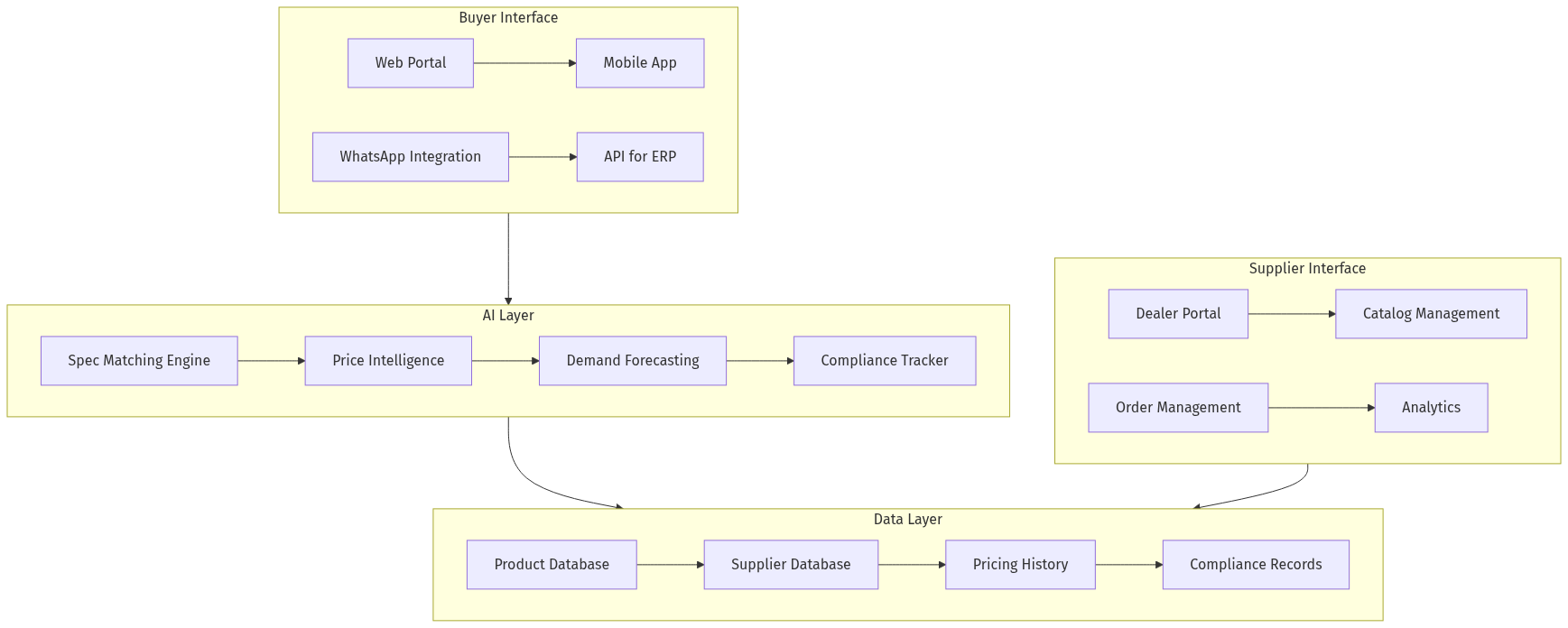
    Product Concept

    Core Platform Features

    For Buyers:
  • Smart Search — Natural language query to product matching
  • Specification Assistant — Guide buyers to right products based on use case
  • Verified Supplier Network — Pre-vetted suppliers with certification status
  • Price Comparison — Aggregated pricing with historical trends
  • Order Management — Track orders, manage vendors, handle invoices
  • Compliance Dashboard — Track certifications, expiration alerts
  • For Suppliers:
  • Catalog Management — Upload products with specifications
  • Certification Upload — Upload test reports, ISI marks
  • Pricing Tools — Dynamic pricing, bulk discounts
  • Order Management — Accept/reject orders, manage fulfillment
  • Analytics — Sales reports, buyer insights
  • Product Categories

    • Head Protection: Safety helmets, bump caps
    • Eye Protection: Safety glasses, goggles, face shields
    • Hearing Protection: Ear plugs, earmuffs
    • Respiratory Protection: N95 masks, respirators, gas masks
    • Hand Protection: Industrial gloves (cut, chemical, heat resistant)
    • Foot Protection: Safety shoes, steel toe boots
    • Body Protection: Safety jackets, coveralls, aprons
    • Fall Protection: Harnesses, lifelines, anchor points
    • Fire Protection: Fire extinguishers, fire blankets
    • First Aid: First aid kits, safety showers

    8.

    Development Plan

    PhaseTimelineDeliverables
    Phase 1: Foundation8 weeksProduct catalog database (5000 SKUs), supplier onboarding (100 suppliers), basic search, price display
    Phase 2: Intelligence6 weeksAI specification matching, certification verification, supplier scoring, recommendation engine
    Phase 3: Commerce6 weeksOrder management, payment integration, logistics coordination
    Phase 4: Scale8 weeksAPI for ERP integration, mobile app, advanced analytics

    MVP Features

  • Product catalog with specifications
  • Supplier directory with basic verification
  • Price comparison across suppliers
  • Inquiry management (not full transaction)

  • 9.

    Go-To-Market Strategy

    Phase 1: Supplier Aggregation (Months 1-3)

  • Target tier 2/3 cities: Ludhiana, Kanpur, Rajkot, Coimbatore—manufacturing hubs with fragmented suppliers
  • Trade show presence: India Safety Expo (Mumbai), industrial exhibitions
  • Direct outreach: Call safety equipment manufacturers, offer free listing
  • Incentives: First 200 suppliers get free listing, 0% commission for 6 months
  • Phase 2: Buyer Acquisition (Months 4-6)

  • Target enterprises: Factory groups, construction companies with 500+ employees
  • Pilot programs: 3-month trials with 5-10 companies
  • Safety manager communities: LinkedIn groups, safety practitioner forums
  • Content marketing: Safety standards guides, PPE selection guides
  • Phase 3: Network Effects (Months 7-12)

  • Buyer feedback loop: Ratings and reviews create supplier competition
  • Volume plays: Aggregate demand for better supplier terms
  • API integration: Connect with procurement systems
  • GTM Channels

    ChannelPriorityRationale
    LinkedIn B2B adsHighTarget safety managers, procurement heads
    Industry eventsHighTrade shows, safety conferences
    Content SEOMediumSearch for "safety equipment suppliers", "PPE buy"
    ReferralMediumIncentivize buyers to refer suppliers
    Cold outreachLowPhone/email to known enterprises
    ---
    10.

    Revenue Model

    Revenue Streams

  • Commission on Transactions (Primary)
  • - 3-5% on orders placed through platform - Scale to 2-3% as volume grows
  • Premium Listings (Suppliers)
  • - Featured placement: ₹5,000-15,000/month - Verified badge: ₹2,000/month
  • Data & Intelligence
  • - Market reports: ₹25,000-50,000/quarter for enterprises - Price benchmarking tools: Subscription model
  • Verification Services
  • - Certification verification: ₹500-2,000 per verification - Quality audit services: ₹10,000-25,000 per audit
  • Advertising
  • - Brand promotions on platform - New product launches

    Unit Economics

    • Average order value: ₹50,000-2,00,000
    • Commission per order: ₹1,500-10,000
    • Customer acquisition cost: ₹15,000-25,000
    • LTV (annual): ₹2,00,000-5,00,000 (based on repeat purchases)

    11.

    Data Moat Potential

    Proprietary Data That Accumulates

  • Price Intelligence Database
  • - Historical pricing across suppliers - Real-time market rates by product category
  • Supplier Performance Data
  • - Delivery reliability scores - Quality ratings over time - Response time metrics
  • Specification Mapping
  • - Product equivalence mappings (which products meet which standards) - Cross-reference between IS, ANSI, EN, ISO standards
  • Buyer Preference Data
  • - Category preferences, price sensitivity, quality requirements - Enables personalized recommendations

    Competitive Moat

    • Network effects: More buyers attract more suppliers, more suppliers attract more buyers
    • Data advantage: Historical data hard to replicate
    • Trust building: Verified supplier network becomes a moat

    12.

    Why This Fits AIM Ecosystem

    Integration with AIM.in

    This opportunity aligns with AIM's vision of structured B2B discovery:

  • Vertical integration: Safety equipment is a natural vertical under AIM's B2B marketplace strategy
  • AI-first approach: Matches AIM's agent-driven discovery model
  • Complements existing: Could integrate with procurement workflows across AIM's other verticals
  • Geographic focus: India-focused matches AIM's India-first strategy
  • Expansion Path

    • Adjacent verticals: Start with PPE → expand to industrial tools, maintenance supplies
    • Geographic: India-first → Southeast Asia (similar industrial profile)
    • Services: Add safety training, audit services marketplace

    ## Verdict

    Opportunity Score: 8/10

    Why 8/10?

    Strengths:
    • Large, fragmented market ($15B+)
    • Clear pain points (supplier discovery, price opacity, certification)
    • High repeat purchase (PPE is consumable)
    • Trust-dependent (certification matters) = platform can add value
    • AI can solve real problems (spec matching, verification automation)
    Risks to Steelman:
    • Incumbent resistance: Indiamart/TradeIndia could add similar features
    • Supplier adoption: Getting manufacturers to list and update catalogs is slow
    • Price transparency: Suppliers may resist showing real prices
    • Certification complexity: Verification infrastructure needs government cooperation

    Pre-Mortem: Why Could This Fail?

    Assume 3 well-funded startups attempted this and failed:

  • No demand aggregation: Can't get enough buyers to make supplier network attractive
  • Supplier catalog challenge: Manufacturers don't maintain digital catalogs, data entry is massive
  • Trust chicken-and-egg: Buyers won't try new suppliers without history; suppliers won't join without buyers
  • Price war: Supplier aggregation leads to race-to-bottom pricing, hurting unit economics
  • Mitigation: Start with curated supplier network, ensure quality before scaling, focus on specification matching value rather than just price.

    Final Assessment

    This is a strong B2B marketplace opportunity with clear value proposition for both buyers and suppliers. The key is focusing on specification matching and certification verification—the "trust layer" that makes AI valuable. Start with a specific category (gloves, eye protection) and expand.


    ## Sources

    • India Safety Expo (Mumbai) - Trade show data
    • Bureau of Indian Standards (BIS) - Certification standards
    • IS 1220 - Industrial glove standards
    • ANSI Z87 - Eye protection standards
    • EN 388 - Protective gloves against mechanical risks
    • Industry reports on India manufacturing growth
    • PLI scheme documentation for manufacturing expansion

    ## Diagrams

    Procurement Flow

    Procurement Flow
    Procurement Flow

    System Architecture

    System Architecture
    System Architecture