ResearchFriday, March 20, 2026

AI-Powered Construction Materials B2B Marketplace: India's $150B Opportunity

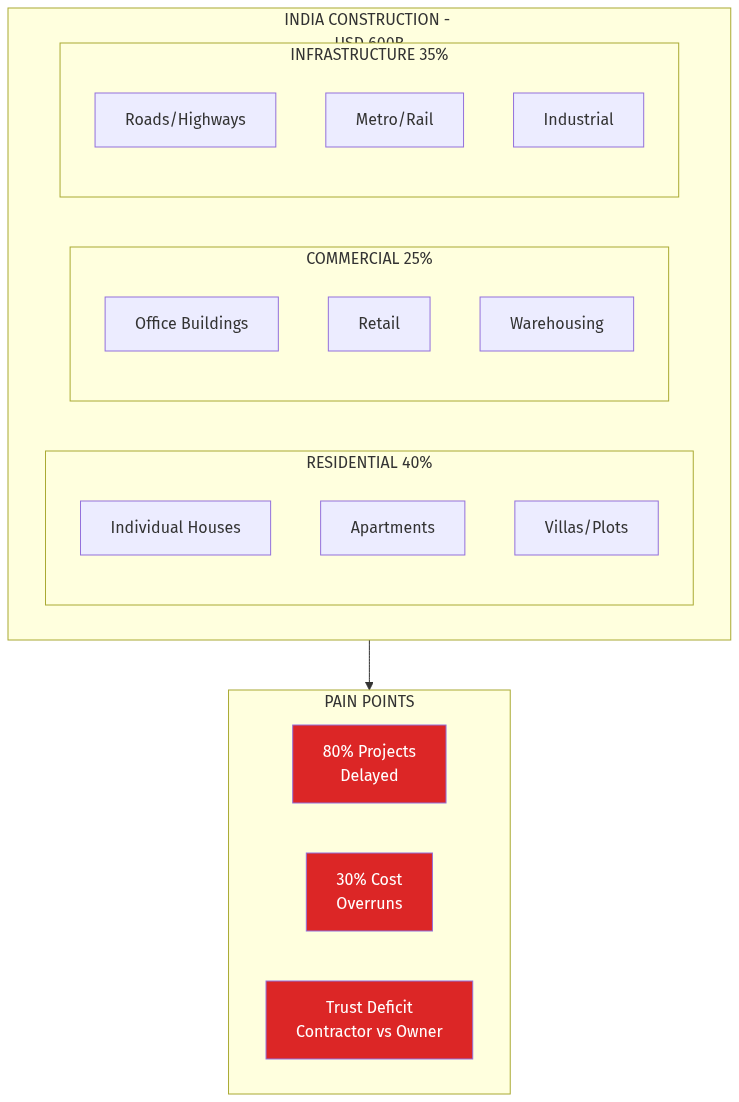
The construction industry contributes 9% of India's GDP and yet transacts almost entirely through phone calls and WhatsApp. A $150B+ market remains stubbornly offline — ripe for AI agent transformation.

1.

Executive Summary

India's construction materials market represents one of the largest unorganized B2B sectors in the country — valued at over $150 billion annually. Yet fewer than 3% of transactions happen digitally. This creates a massive opportunity for an AI-powered B2B marketplace that can automate supplier discovery, price intelligence, quality verification, and logistics coordination.

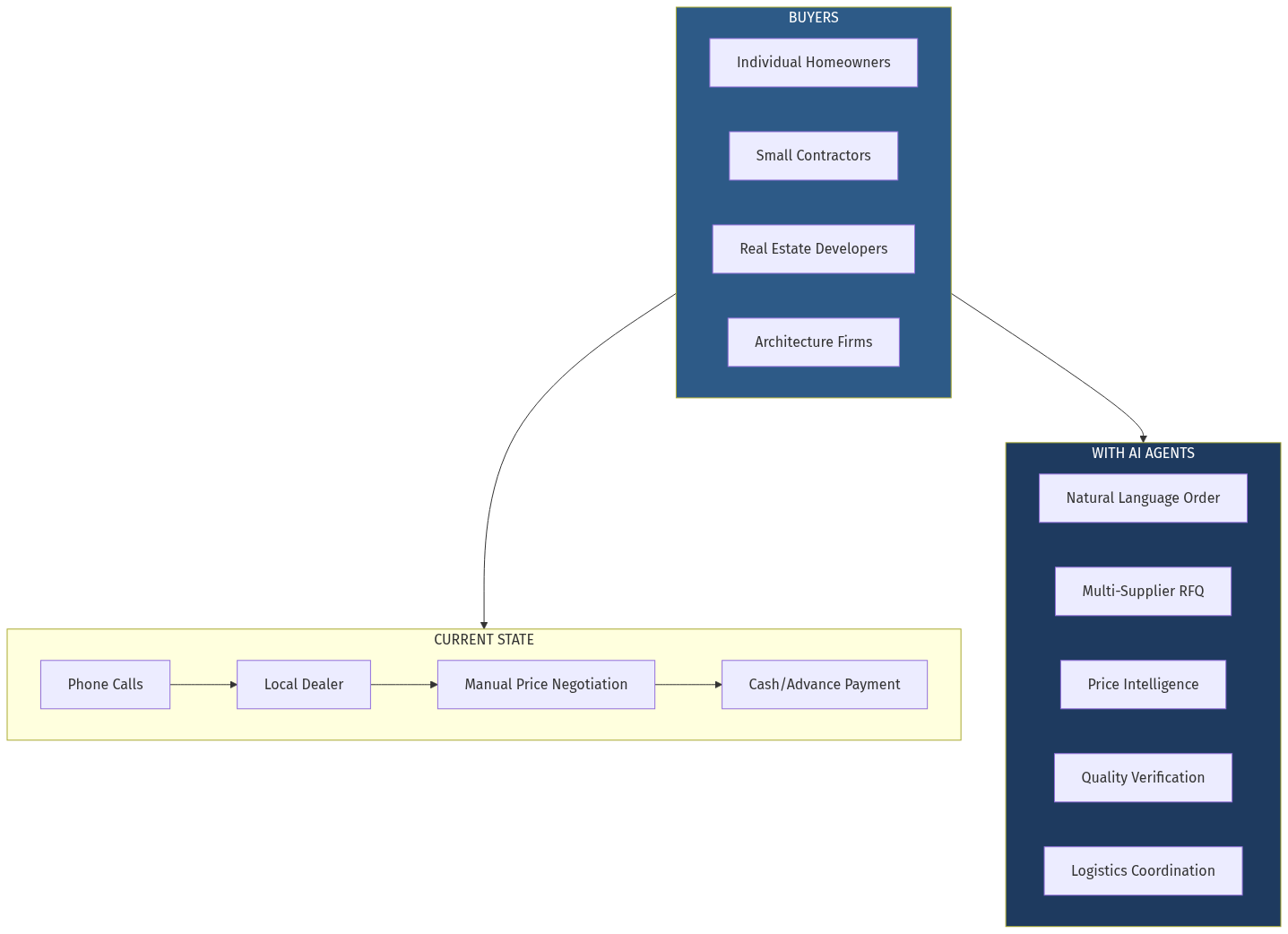
The current buyer experience is broken: contractors call 5-10 dealers to compare prices, builders rely on trusted local suppliers without visibility into alternatives, and individual homeowners have zero negotiating power. AI agents can transform this by handling natural language procurement requests, instantly querying multiple suppliers, verifying product quality through image recognition, and coordinating deliveries — all through simple chat.

This article analyzes the market structure, identifies key gaps, and proposes an AI-first approach that could capture significant share of this fragmented, high-volume market.
2.

Problem Statement

Who experiences this pain?

Small Contractors (70% of market)
  • No access to pan-India pricing
  • Depend on 2-3 local dealers
  • Cannot negotiate on price or payment terms
  • 10-15 hours/week spent on procurement calls
Real Estate Developers
  • Need consistent quality across projects
  • Struggle with supplier reliability across cities
  • Manual tracking of deliveries and payments
  • No standardized pricing benchmarks
Individual Homeowners
  • Zero market visibility
  • At mercy of local dealers
  • Cannot verify product quality
  • No recourse for late deliveries or substandard materials
Architecture/Interior Firms
  • Need multiple material options for client presentations
  • Time-intensive supplier research
  • No unified procurement workflow

The Core Friction

The fundamental problem is information asymmetry + transaction friction. Buyers don't know what fair prices are, can't easily compare alternatives, and face high transaction costs for each purchase. Meanwhile, suppliers compete on relationships rather than price transparency.


3.

Current Solutions

PlatformWhat They DoWhy They're Not Solving It
IndiaMARTGeneric B2B listingsNo transaction layer, no price discovery, no AI features
TradeIndiaCatalog browsingSearch is keyword-based, no intelligence
UltraTech Cement (B2B portal)Single-brand orderingOnly one brand, no marketplace
Builders4UProject managementFocuses on project coordination, not procurement
Brick&BoltContractor marketplaceFocuses on contractor discovery, not materials
Key Gap: No platform combines:
  • Multi-supplier price comparison
  • AI-powered natural language ordering
  • Quality verification (images, certifications)
  • Logistics coordination
  • Payment/credit facilities
Market Structure
Market Structure

4.

Market Opportunity

Market Size

  • India Construction Materials: $150B+ annually (2025)
  • Cement alone: $12B
  • Steel: $25B+
  • Bricks & aggregates: $18B
  • Paint: $8B
  • Tiles & ceramics: $10B+

Growth Drivers

  • Housing demand: 2.5 crore homes planned by 2025 under PMAY
  • Commercial construction: 800+ million sq ft of commercial space by 2025
  • Infrastructure push: $1.4T national infrastructure pipeline
  • Urbanization: 40% of India will be urban by 2030
  • Why Now

  • Smartphone penetration: 90%+ of contractors use WhatsApp daily
  • UPI infrastructure: Digital payments are normalized
  • AI capability leap: LLMs can handle complex procurement conversations
  • Trust building: Post-pandemic digital adoption accelerated
  • Supply chain focus: Government pushing for materials traceability

  • 5.

    Gaps in the Market

    Gap 1: No Price Transparency

    • No platform shows real-time pricing from multiple suppliers
    • Buyers must call each dealer individually
    • Price varies 15-30% between suppliers for same product

    Gap 2: Quality Verification is Manual

    • No standardized quality grading
    • Buyers rely on physical inspection or trust supplier reputation
    • No image-based quality AI available

    Gap 3: Fragmented Suppliers

    • 50,000+ cement retailers alone
    • Steel distribution is highly regional
    • No pan-India supplier network with unified inventory

    Gap 4: Logistics is Broken

    • Materials delivery is separate from purchase
    • No integrated logistics tracking
    • Last-mile delivery unreliable, especially for bulk materials

    Gap 5: Payment Terms are Opaque

    • Credit availability unclear
    • No digital credit facilities
    • Cash on delivery dominant

    Gap 6: No AI Ordering

    • No natural language procurement possible
    • Must specify exact SKUs, quantities, grades
    • No smart suggestions based on project requirements

    6.

    AI Disruption Angle

    How AI Agents Transform the Workflow

    Current (Manual):
    Buyer → Calls 5 dealers → Waits for quotes → Negotiates → Chooses → Orders → Follows up delivery → Pays
    Time: 2-5 days per order
    With AI Agents:
    Buyer: "Need 50 bags of PPC cement for my house in Nagpur, delivery by March 25"
    Agent: *Queries 20 suppliers, compares prices, verifies stock, checks delivery availability*
    Agent: "Here are 3 options: Supplier A at ₹380/bag (delivery March 24), B at ₹375 (March 26), C at ₹370 (March 28)"
    Buyer: "Go with A"
    Agent: *Orders, coordinates logistics, tracks delivery, handles payment*
    Time: 5 minutes

    Key AI Capabilities

  • Natural Language Procurement
  • - Understands loose requirements ("strong cement for foundation") - Maps to specific products/grades - Handles variations in product names
  • Multi-Supplier RFQ Automation
  • - Simultaneously queries dozens of suppliers - Normalizes pricing across different pack sizes - Factors in delivery costs
  • Image-Based Quality Verification
  • - Upload photo of material for AI quality check - Compare against standard specifications - Detect defects or inconsistencies
  • Smart Recommendation Engine
  • - Suggest alternatives based on project type - Recommend quantity based on area/structure - Factor in location-specific availability
  • Logistics Coordination
  • - Integrate with truck booking platforms - Track deliveries in real-time - Handle split deliveries across suppliers
  • Credit Assessment
  • - Analyze transaction history for creditworthiness - Offer buy-now-pay-later based on trust score - Digital invoicing and payment tracking
    7.

    Product Concept

    BuildMart AI — The Construction Materials Intelligence Platform

    Core Product: AI-powered B2B marketplace for construction materials with agent-based procurement.

    Key Features

  • Agent Ordering Interface
  • - Chat-based ordering ("I need materials for a 2000 sq ft roof") - Voice input for hands-free ordering on-site - WhatsApp integration for existing user behavior
  • Smart Catalog
  • - 50,000+ SKUs across cement, steel, bricks, sand, paint, tiles - AI tagging for product variants - Specification-based search (not just keyword)
  • Price Intelligence
  • - Real-time pricing from 500+ verified suppliers - Historical price trends - Bulk discount negotiation automation
  • Quality Hub
  • - AI image verification for materials - Supplier quality ratings - Certification verification (ISI marks, etc.)
  • Logistics Integration
  • - Integrated truck booking - Delivery tracking - Multi-location delivery coordination
  • Trade Finance
  • - Digital credit facilities - Net payment terms (30/60/90 days) - Invoice factoring

    User Flow

    Procurement Flow
    Procurement Flow

    8.

    Development Plan

    Phase 1: MVP (8-12 weeks)

    • Deliverables:
    - WhatsApp-based ordering interface - Catalog with top 5 categories (cement, steel, bricks, sand, paint) - 50 verified suppliers in 3 cities (Delhi, Mumbai, Bangalore) - Basic price comparison - Manual order fulfillment

    Phase 2: V1.0 (12-16 weeks)

    • Deliverables:
    - AI agent with NLP capabilities - Expanded catalog (10 categories, 10,000+ SKUs) - 200+ suppliers across 10 cities - Image-based quality verification (beta) - Basic logistics integration

    Phase 3: Scale (16-24 weeks)

    • Deliverables:
    - Pan-India presence (30+ cities) - Trade finance offerings - Advanced AI recommendations - API for contractor/builder software integration
    9.

    Go-To-Market Strategy

    Step 1: Supplier Acquisition (Weeks 1-4)

    • Target: 50 verified suppliers in pilot city
    • Approach: Direct sales team, trade shows, existing dealer networks
    • Incentive: Free listing + guaranteed order volume

    Step 2: Buyer Acquisition (Weeks 4-8)

    • Target: 500+ small contractors
    • Approach:
    - WhatsApp marketing (contractors already on WhatsApp) - Contractor associations partnerships - Construction material WhatsApp groups
    • Incentive: Price comparison (save 10-15% vs current)

    Step 3: City Expansion (Months 4-8)

    • Expand to 5 major cities
    • Replicate supplier + buyer acquisition playbook
    • Build city-specific pricing intelligence

    Step 4: Category Expansion (Months 8-12)

    • Add: aggregates, concrete, timber, steel structural
    • Partner with manufacturers for exclusive offerings

    Key Partnerships

    • Cement manufacturers (Ambuja, UltraTech, ACC) — supplier deals
    • Steel manufacturers (Tata, JSW, SAIL) — direct distribution
    • Construction associations — buyer acquisition
    • Logistics platforms (Porter, TruckSuvidha) — delivery integration
    • Banks/NBFCs — trade finance

    10.

    Revenue Model

    Revenue Stream 1: Transaction Commission (Primary)

    • Model: 2-5% commission on GMV
    • Take rate: 2% on cement (low margin), 5% on tiles (high margin)
    • Potential: At 1% market capture = $1.5M revenue annually

    Revenue Stream 2: Subscription for Suppliers

    • Model: ₹5,000-25,000/month for premium features
    • Features: AI matching, priority listing, analytics
    • Target: 500 suppliers @ ₹10K avg = ₹5Cr ARR

    Revenue Stream 3: Trade Finance Interest

    • Model: 1-2% interest spread on buy-now-pay-later
    • Target: ₹50Cr disbursed @ 15% annualized = ₹75L interest

    Revenue Stream 4: Logistics Markup

    • Model: 5-10% margin on logistics coordination
    • Target: ₹100Cr logistics GMV @ 7% = ₹7Cr revenue

    Revenue Stream 5: Data/Intelligence Products

    • Model: Market price reports, supplier insights
    • Target: B2B subscriptions to construction companies

    11.

    Data Moat Potential

    Proprietary Data Accumulation

  • Price Intelligence Data
  • - Real transaction prices across 50,000+ SKUs - Historical pricing trends by city/season - Competitor pricing intelligence - Moat: Extremely valuable for procurement optimization
  • Supplier Performance Data
  • - Delivery reliability scores - Quality consistency metrics - Payment behavior analysis - Moat: Quality-based ranking is proprietary
  • Buyer Behavior Data
  • - Purchase patterns by project type - Price sensitivity analysis - Category affinity - Moat: Enables personalized recommendations
  • Quality Image Dataset
  • - Material defect images - Quality grading labels - Moat: Training data for AI quality verification

    Why This Creates Defensibility

    • New entrants cannot replicate real transaction data
    • Network effects: more buyers → more suppliers → better prices → more buyers
    • AI models improve with usage, creating compounding advantage
    • Trust building takes time — first-mover advantage in specific cities

    12.

    Why This Fits AIM Ecosystem

    Vertical Integration with AIM.in

    AIM.in's vision is to be India's largest structured B2B discovery platform. A construction materials marketplace directly aligns:
  • Category expansion: From "finding suppliers" to "transacting with suppliers"
  • Data integration: Leverage existing domain data from AIM's crawler
  • Agent deployment: Netrika's AI agents can manage supplier communications
  • Trust layers: AIM's company verification can feed into supplier trust scores
  • Cross-Sell Opportunities

    • Real estate developers on AIM → construction materials procurement
    • Architecture firms on AIM → materials sourcing
    • Contractors on AIM → project materials AI assistant
    • B2B payment → integrate with AIM's payment terms intelligence

    Replication Potential

    Once proven for construction, the model can replicate to:

    • Automotive parts (spare parts marketplace)
    • Electronics components (B2B electronics sourcing)
    • Agriculture (farm inputs marketplace)
    • Healthcare (medical equipment, already covered in other dives)
    ---

    ## Verdict

    Opportunity Score: 8.5/10

    Why High Score

  • Massive TAM: $150B+ market with <3% digitization
  • Clear pain point: Everyone complains about procurement complexity
  • AI-native approach: Large language models can handle the complexity
  • WhatsApp-first: Users already on platform, no adoption friction
  • Network effects: Winner takes most in regional markets
  • Risk Factors

  • Supplier onboarding: Getting suppliers to list and price competitively
  • Logistics complexity: Bulk materials delivery is capital intensive
  • Trust building: New platform, no transactions = chicken and egg
  • Margin pressure: Low margins in commodities
  • Recommendation

    Build a WhatsApp-first AI procurement agent for construction materials. Start with one category (cement) in one city, prove unit economics, then expand. The market is too large to ignore and the timing is right — AI agents can finally handle the complexity that made this market resistant to previous digitization attempts.

    The key insight: contractors don't want another app. They want to message someone (or something) on WhatsApp and get materials delivered. An AI agent that lives in WhatsApp is the natural interface for this market.


    ## Sources