ResearchSunday, March 1, 2026

AI-Powered Freight Audit & Payment: The $2B Invoice Intelligence Opportunity in Logistics

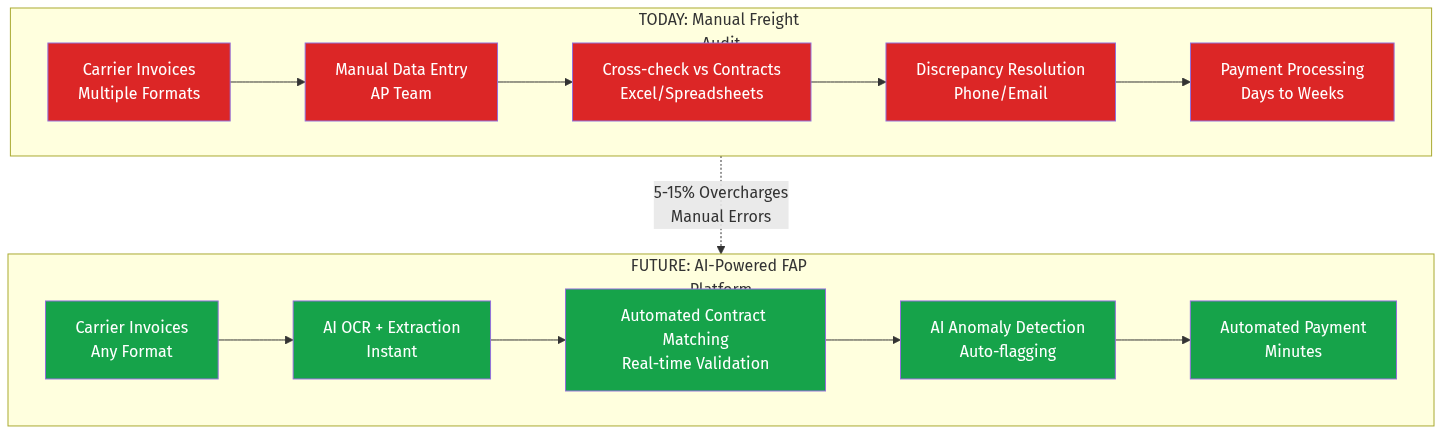
Every freight invoice carries hidden errors. 5-15% of logistics spend leaks through duplicate charges, misapplied rates, and missed discounts. Legacy audit systems built in the 1950s-1990s can't keep pace. The next generation of AI-powered FAP platforms will turn invoice validation from cost center to profit engine.

1.

Executive Summary

The freight audit and payment (FAP) market is experiencing a fundamental disruption. Valued at $1 billion in 2025 and projected to reach $1.9 billion by 2030, this traditionally fragmented industry is ripe for AI-native reinvention.

The opportunity: Build an AI-first freight audit platform that achieves 99%+ touchless invoice processing, real-time anomaly detection, and automated carrier dispute resolution—targeting the $180+ trillion in annual B2B payments where logistics represents a significant slice. Why now: LLMs can now parse complex rate tariffs and contracts instantly. Machine learning models detect billing anomalies humans miss. The legacy players (some founded before computers existed) operate on business models incompatible with modern AI efficiency.
Freight Audit AI Transformation

2.

Problem Statement

What's Broken Today

Applying Zeroth Principles: The fundamental axiom of freight invoicing is that carriers bill correctly and shippers pay what they owe. But this assumption is demonstrably false—industry data shows 5-15% of all freight invoices contain errors that favor the carrier.

The pain manifests at multiple levels:

For Shippers:
  • Average enterprise processes 50,000+ freight invoices monthly across 100+ carriers
  • Each invoice requires manual cross-checking against contracts, BOLs, PODs, and tariffs
  • AP teams spend 70% of time on exception handling, not strategic work
  • Invoice discrepancies take 15-45 days to resolve through phone/email
  • Hidden costs compound: duplicate bills, wrong rate applications, unapplied volume discounts
For Finance Teams:
  • No visibility into transportation spend until month-end close
  • Impossible to forecast logistics costs accurately
  • Carrier negotiations based on incomplete data
  • Compliance risk from unverified accessorial charges
For Carriers:
  • Payment delays strain cash flow
  • Dispute resolution is adversarial and time-consuming
  • Good carriers subsidize bad actors' billing errors

Who Experiences This Pain Most

SegmentPain IntensityCurrent Solution
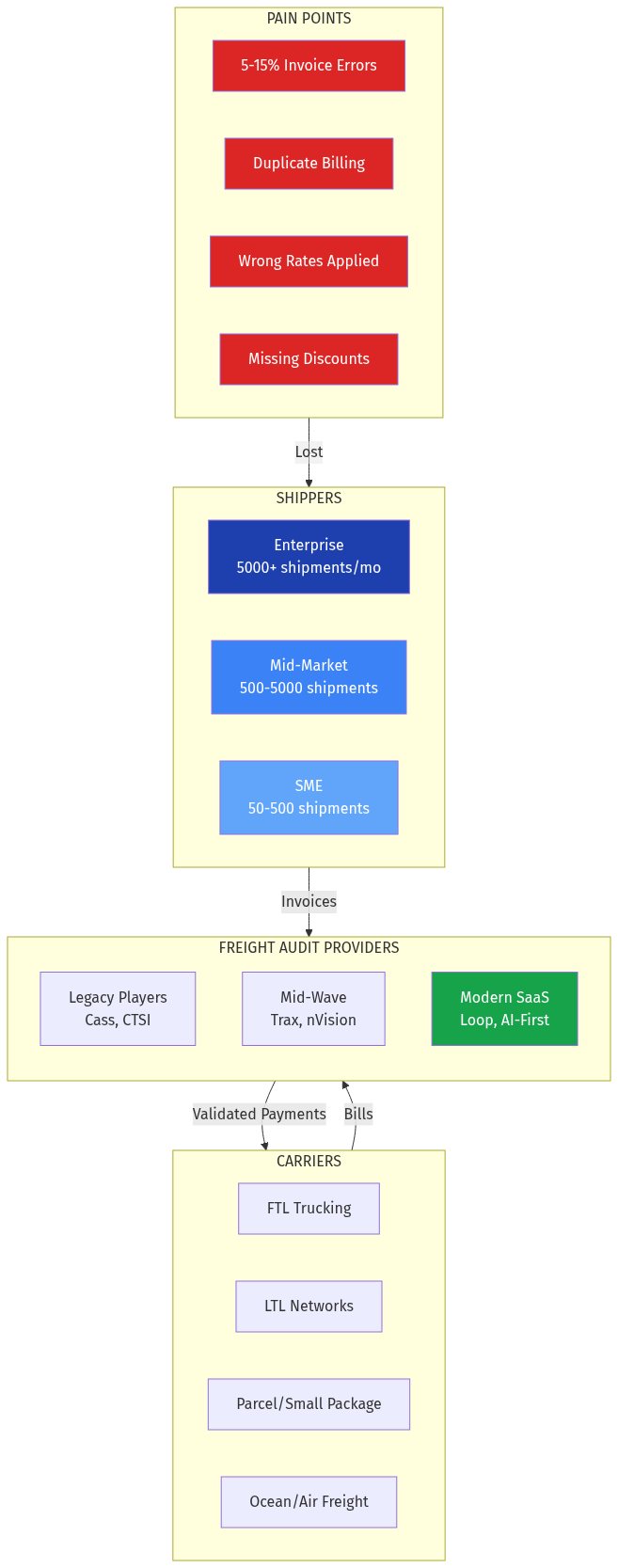
Enterprise (5000+ shipments/mo)MediumLegacy FAP providers + manual teams
Mid-Market (500-5000)HighSpreadsheets + partial automation
SME (50-500)ExtremeManual AP, no audit capability
3PLsHighFragmented systems per client
The paradox: SMEs leak the highest percentage of spend to invoice errors but can least afford existing audit solutions.
3.

Current Solutions

Applying Incentive Mapping: The legacy FAP market operates on a perverse incentive—providers profit from finding errors, not preventing them. The more complex and error-prone the invoicing ecosystem, the more valuable audit services become. This creates little incentive to actually fix the root cause.
CompanyFoundedWhat They DoWhy They're Not Solving It
Cass Information Systems1906Full-service FAP, utility billsLegacy tech, enterprise-only pricing, slow implementation
CTSI-Global1955Transportation analytics + FAPConsulting-heavy model, not self-serve
Trax Technologies1993Global FAP + business intelligenceComplex implementation, 6-12 month onboarding
nVision Global1992Multi-mode FAP + TMSTraditional service model, limited AI
Intelligent Audit1996Parcel-focused auditNarrow mode coverage, not AI-native
Loop2021AI-powered SaaS FAPNorth America only, limited modes
Blume Global1994TMS + FAP integratedHeavy TMS lock-in required

The Legacy Model Problem

Applying Distant Domain Import (from SaaS disruption): The FAP industry mirrors where accounting software was before Xero/QuickBooks disrupted it—dominated by consultants, complex implementations, and per-transaction pricing that punishes growth.

Legacy providers typically:

  • Charge per invoice processed (incentivizes complexity)
  • Require 6-18 month implementations
  • Need dedicated client teams for exception handling
  • Operate on 1990s-era rule engines, not ML
  • Bundle FAP with unnecessary consulting services
Loop (2021) represents the modern approach: SaaS pricing, fast implementation, and claims 99% touchless approval. But they're North America-only and limited to parcel/LTL/TL. The global, multi-modal opportunity remains open.

4.

Market Opportunity

Freight Audit Market Structure

Market Size

MetricValueSource
Global FAP Market (2025)$970M - $1.2BMordor Intelligence, SkyQuest
Projected (2030)$1.89B14.2% CAGR
Global B2B Payments (2026)$150-180 TrillionIndustry estimates
Freight as % of GDP8-10%World Bank
Invoice Error Rate5-15%Industry benchmarks
Recoverable Overcharges Annually$15-50BCalculated

Geographic Distribution

RegionMarket ShareGrowth RateOpportunity
North America38%ModerateMature, competitive
Europe28%HighRegulatory push, fragmented
Asia Pacific24%FastestUnderserved, fragmented logistics
Rest of World10%EmergingGreenfield

Why Now

Applying Anomaly Hunting: Several converging signals indicate the market is ready:
  • LLM Capability Jump (2024-2026): Models can now parse unstructured contracts, tariff documents, and accessorial schedules that previously required human experts
  • OCR Accuracy Threshold Crossed: Modern document AI achieves 99%+ accuracy on freight invoices
  • Real-time Payment Rails: Instant payment infrastructure makes same-day carrier payment viable
  • Enterprise AI Adoption: CFOs now expect AI in finance workflows; the "AI premium" has inverted to "AI expectation"
  • Supply Chain Complexity Surge: Post-pandemic nearshoring and multi-carrier strategies mean more invoices, more complexity

  • 5.

    Gaps in the Market

    Applying Anomaly Hunting + Steelmanning: Current solutions fail in predictable ways:

    Gap 1: SME Accessibility

    Legacy FAP requires 5-figure annual minimums. SMEs shipping 100-500 parcels monthly have no viable audit option. This is the long-tail goldmine.

    Gap 2: Multi-Modal Intelligence

    Most platforms specialize in parcel OR truckload OR ocean. Global shippers need unified audit across all modes with a single contract repository.

    Gap 3: Proactive vs. Reactive

    Current systems audit invoices after receipt. AI should predict billing anomalies before invoices arrive based on shipment data and carrier patterns.

    Gap 4: India/APAC Native

    India's logistics market is 70% road freight, massively fragmented (thousands of small truckers), with paper-heavy invoicing. No serious AI FAP player exists locally.

    Gap 5: Carrier Collaboration

    Current model is adversarial: shipper audits, disputes, carrier defends. A collaborative model with shared incentives would reduce disputes 80%+.

    Gap 6: Integration Depth

    Most FAP platforms require CSV uploads or basic API. Modern enterprises need native ERP/TMS/WMS connectors that work in minutes, not months.
    6.

    AI Disruption Angle

    Applying Distant Domain Import (from AlphaFold/DeepMind): Just as AlphaFold disrupted protein folding by replacing heuristic search with deep learning, AI-native FAP can replace rules-based audit with learned invoice understanding.
    AI Platform Architecture
    AI Platform Architecture

    AI Capabilities That Change Everything

    1. LLM Contract Parsing
    • Ingest any carrier contract (PDF, Word, email thread)
    • Extract rate structures, accessorials, fuel surcharge formulas, discount tiers
    • Build queryable contract knowledge base in minutes vs. weeks of manual setup
    2. Multimodal Invoice Understanding
    • OCR + layout understanding for any invoice format
    • Extract line items, charges, reference numbers without templates
    • Handle handwritten PODs and non-standard formats
    3. Anomaly Detection at Scale
    • Train on millions of validated invoices to understand "normal"
    • Flag statistical outliers: unusual charges, rate deviations, pattern breaks
    • Learn shipper-specific patterns (this carrier always overbills fuel, that lane has weight discrepancies)
    4. Automated Dispute Generation
    • When anomaly detected, auto-generate carrier dispute with evidence
    • Reference specific contract clauses, historical patterns, industry benchmarks
    • Track dispute resolution, learn from outcomes
    5. Predictive Invoice Validation
    • Given shipment data (origin, destination, weight, service), predict expected invoice
    • Flag discrepancies the moment invoice arrives, not after manual review
    • Alert on missing invoices before they become aged receivables

    The 99% Touchless Target

    Modern AI FAP should achieve:

    • 90% invoices auto-approved without human review
    • 9% flagged for quick human confirmation
    • 1% genuine disputes requiring carrier communication
    This inverts the current reality where 70%+ of AP time goes to exception handling.


    7.

    Product Concept

    Core Platform: InvoiceIQ (Working Name)

    Mission: Make freight invoice processing as reliable as credit card processing.

    Key Features

    Invoice Ingestion Engine
    • Email forwarding ([email protected])
    • Direct carrier API connections (FedEx, UPS, XPO, etc.)
    • EDI/AS2 for enterprise carriers
    • Mobile scan for paper invoices
    • Bulk PDF upload
    Contract Intelligence
    • Upload contracts, amendments, rate tariffs
    • LLM extracts all pricing elements automatically
    • Version control with change detection
    • Expiration alerts and renewal reminders
    Audit Engine
    • Real-time validation against contracts
    • Multi-layer anomaly detection (rules + ML + LLM reasoning)
    • Duplicate detection across time windows
    • Accessorial verification against service proofs
    Payment Orchestration
    • Approve-and-pay workflow
    • Multi-currency support
    • Virtual card issuance for rebates
    • Carrier payment scheduling optimization
    Analytics Dashboard
    • Spend visibility by carrier, lane, mode, BU
    • Error rate trends and carrier scorecards
    • Savings attribution (recovered + avoided)
    • Benchmarking against anonymized network

    Pricing Model

    TierVolumePriceTarget
    Starter<500 invoices/mo$299/mo flatSME
    Growth500-5000$0.30/invoiceMid-market
    Enterprise5000+Custom + % savingsLarge shippers
    3PL White-LabelUnlimitedRevenue shareLogistics providers
    Key insight: Flat pricing for SMEs eliminates fear of volume-based billing that kept them from auditing. Enterprise gets aligned incentives through savings share.
    8.

    Development Plan

    PhaseTimelineDeliverables
    MVP12 weeksEmail ingestion, OCR, basic rule-based audit, Stripe payments, single-mode (parcel)
    V1+8 weeksLLM contract parsing, anomaly detection ML, carrier API integrations (top 5), multi-mode
    V2+12 weeksPredictive validation, automated disputes, ERP connectors (SAP, Oracle, NetSuite), India localization
    Scale+16 weeks3PL white-label, carrier portal, payment optimization, international payments

    Technical Stack (Opinionated)

    • Backend: Node.js/Bun + PostgreSQL + Redis
    • AI/ML: OpenAI GPT-4o for contract parsing, fine-tuned anomaly detection model, Claude for dispute generation
    • Document AI: Google Document AI + custom LayoutLM for invoice extraction
    • Payments: Stripe Treasury + Mercury for embedded finance
    • Infrastructure: Fly.io/Railway for fast iteration, Cloudflare for global edge

    9.

    Go-To-Market Strategy

    Applying Second-Order Thinking: If we succeed with SMEs first, what happens next?

    Phase 1: SME Land-and-Expand (Months 1-6)

  • Target Shopify Plus merchants doing 1000+ orders/month
  • Free 30-day audit of existing invoices (show immediate savings)
  • Integration with Shopify Shipping Dashboard
  • Referral program: $100 credit per referral
  • Content marketing: "Hidden fees your 3PL won't tell you about"
  • Phase 2: Mid-Market Climb (Months 6-12)

  • Partner with 3PLs who serve mid-market (ShipBob, Deliverr alumni)
  • White-label offering for logistics consultants
  • CFO-focused ROI calculator and case studies
  • Integration with NetSuite, QBO
  • Industry events: CSCMP, Parcel Forum
  • Phase 3: Enterprise Wedge (Months 12-24)

  • Land single BU or region within Fortune 500
  • Prove value, expand to additional modes/regions
  • Compliance certifications (SOC 2 Type II, ISO 27001)
  • Dedicated customer success and implementation
  • India-Specific GTM

  • Partner with logistics aggregators (Delhivery, Shiprocket, Porter)
  • Target e-commerce brands (D2C boom = shipping pain)
  • WhatsApp-native onboarding for trucking invoices
  • Local payment rails (UPI for carrier payments)

  • 10.

    Revenue Model

    Revenue Streams

    StreamDescriptionMargin
    SaaS SubscriptionMonthly/annual platform access85%+
    Transaction Fees% of payments processed40-60%
    Savings Share% of recovered overcharges100% incremental
    Payment FloatInterest on funds held pre-paymentVariable
    Data ProductsAnonymized benchmarking, rate intelligence90%+

    Unit Economics Target

    MetricTarget
    CAC$500 (SME), $15K (Enterprise)
    LTV$6,000 (SME), $200K+ (Enterprise)
    LTV:CAC12:1
    Gross Margin80%+
    Net Revenue Retention120%+

    Revenue Projection (Illustrative)

    YearARRCustomersNotes
    Y1$500K500 SME, 20 mid-marketProduct-market fit
    Y2$3M2000 SME, 100 mid-market, 10 enterpriseScale SME, prove enterprise
    Y3$12M5000 SME, 300 mid-market, 50 enterpriseCategory leadership
    ---
    11.

    Data Moat Potential

    Applying First Principles + Second-Order Effects:

    Proprietary Data Accumulation

  • Contract Repository
  • - Every contract parsed builds understanding of carrier pricing patterns - Rate intelligence: "FedEx is 12% cheaper than UPS on this lane for this weight band" - Negotiation leverage for customers
  • Invoice Corpus
  • - Millions of validated invoices train anomaly detection - Pattern recognition: "This carrier always inflates dimensional weight" - Network effects: more invoices = better detection = more customers
  • Outcome Data
  • - Which disputes win vs. lose - Carrier behavior patterns by region/service/season - Payment timing optimization
  • Benchmarking Database
  • - Anonymous spend comparisons across similar shippers - "Your parcel spend is 8% above median for your volume" - Advisory services and rate negotiation support

    Defensibility Over Time

    Year 1: Product superiority (AI accuracy) Year 2: Data network effects (more customers = better models) Year 3: Ecosystem lock-in (ERP integrations, workflows) Year 4: Category definition (become the "Stripe of freight payments")
    12.

    Why This Fits AIM Ecosystem

    Applying Systems Thinking:

    Strategic Alignment

  • B2B DNA: Pure B2B play with enterprise expansion path
  • Workflow Automation: Replaces manual AP processes with AI
  • AI-Native: Not AI-enhanced legacy; built on AI from day one
  • India Opportunity: Massive fragmented logistics market, no incumbent
  • Revenue Model Alignment: SaaS + transaction fees = predictable + scalable
  • Cross-Portfolio Synergies

    AIM VerticalSynergy
    Manufacturing ProcurementSame buyers, adjacent workflow
    MRO/Spare PartsFreight audit for inbound shipments
    Industrial ServicesService invoice audit extension
    Chemical/Pharma DistributionComplex multi-modal shipping

    Platform Potential

    A freight audit engine could expand to:

    • Utility bill audit (telecom, energy—Cass already does this)
    • General AP automation (any invoice type)
    • Carrier TMS (flip from shipper tool to carrier tool)
    • Logistics financing (invoice factoring with validated data)
    ---

    ## Verdict

    Opportunity Score: 8.5/10

    Pre-Mortem Analysis (Why This Could Fail)

    Applying Falsification:
  • Loop wins SME before we launch: First-mover in modern FAP, well-funded. Counter: They're North America parcel-only; global multi-modal remains open.
  • Enterprise sales cycles kill runway: 12-18 month sales cycles drain capital. Counter: Start with SME self-serve, prove value, enterprise follows.
  • Carrier backlash: Major carriers refuse API access to disruptive audit platforms. Counter: Work with carriers on collaborative model; they benefit from faster accurate payments.
  • AI accuracy plateau: 95% accuracy sounds good but 5% errors at scale means operational chaos. Counter: Human-in-loop for edge cases; continuous model improvement.
  • Payments regulation: Cross-border payment licensing is complex. Counter: Partner with embedded finance providers (Mercury, Stripe Treasury).
  • Steelmanning the Opposition

    Why incumbents might win:
    • Cass has 118 years of carrier relationships and trust
    • Trax has the global footprint and enterprise contracts
    • Switching costs are real—ERP integrations are sticky
    • Enterprises prefer "nobody got fired for buying IBM" safety
    Counter-argument: Every wave of technology disruption sees incumbents dismiss new entrants until it's too late. The AI capability gap is real and widening. A startup building today has access to AI that legacy players can't retrofit into 1990s architectures.

    Final Assessment

    The freight audit and payment market exhibits classic disruption conditions:

    • ✅ Large, growing market ($1B+ → $2B+)
    • ✅ Fragmented incumbents with legacy tech
    • ✅ Clear technology inflection point (AI/ML)
    • ✅ Underserved segments (SME, APAC)
    • ✅ Strong unit economics potential
    • ✅ Natural data moat accumulation
    • ✅ Platform expansion optionality
    Recommendation: Strong opportunity for AI-native vertical SaaS play. Start with SME parcel audit in India/North America, prove AI superiority, expand to mid-market and enterprise. The winner in this space will process $100B+ in freight payments annually within a decade.


    ## Sources