ResearchSunday, March 1, 2026

AI Expert Network Intelligence: The $4B Knowledge Marketplace Ripe for Disruption

The expert network industry — connecting investors, consultants, and corporations with on-demand human expertise at $1,000-1,500 per hour — is facing an existential reckoning. AI research agents can now synthesize 80% of typical expert insights in seconds, at 1/50th the cost. This isn't incremental improvement; it's structural disruption of a $4 billion market.

9
Opportunity
Score out of 10
1.

Executive Summary

Expert networks have been the secret weapon of private equity firms, hedge funds, and strategy consultants for two decades. Need to understand hospital purchasing behavior before a healthcare acquisition? GLG connects you with a former hospital CFO at $1,200/hour. Evaluating a SaaS company's churn? AlphaSights schedules a call with a churned customer within 48 hours.

But this human-first model has a fundamental problem: it doesn't scale, it's expensive, and 80% of the insights could be synthesized from existing data by AI systems that didn't exist three years ago.

The AlphaSense-Tegus merger ($930M, 2024) signals industry consolidation. Incumbents are bolting on AI. But the real opportunity is building AI-native expert intelligence from scratch — combining knowledge graphs, LLM synthesis, real-time data, and optional human validation into a 10x better, 50x cheaper research experience.

2.

Problem Statement

Who Experiences the Pain?

Private Equity Analysts run 50-100 expert calls per deal, spending $50,000-150,000 on primary research alone. Each call requires scheduling, compliance checks, note-taking, and synthesis. A single deal might take 200+ analyst hours just on expert coordination. Consulting Associates at McKinsey or Bain conduct 20-30 expert interviews per engagement. The partner bills the client $500,000 for the project; $75,000 goes to expert networks. Associates spend 40% of their time on call logistics, not insight generation. Corporate Strategy Teams at Fortune 500 companies need market intelligence before entering new markets or making acquisitions. They either pay GLG prices or rely on outdated secondary research. Only 15% of India's 63 million MSMEs use any professional consulting — cost is the primary barrier. Investment Analysts at hedge funds face compliance nightmares. Every expert call carries insider trading risk. The 2011-2013 SEC crackdowns on expert networks created elaborate compliance theater: chaperoned calls, MNPI disclaimers, trading restrictions. The friction is enormous.

Applying Zeroth Principles

The fundamental axiom of expert networks is: "Human experts possess unique knowledge that can only be extracted through conversation."

But is this still true?

  • Expert call transcripts are being recorded and sold as data products (Tegus has 100,000+ transcripts)
  • Public company information is increasingly structured and searchable
  • AI models trained on industry-specific corpora can answer 80% of "expert" questions
  • The remaining 20% (truly proprietary insights) could be captured with different incentive models
The axiom is crumbling. Most expert calls are extracting contextual knowledge that exists elsewhere — they're just convenient aggregation.
3.

Current Solutions

CompanyWhat They DoWhy They're Not Solving It
GLG900,000+ expert network, full-service matching, $1,050/hour averageStill human-first; AI bolted on; expensive; compliance burden unchanged
AlphaSightsPremium C-suite access, 24-48 hour matching, $1,350/hourQualitative only; no AI-native search; opacity in pricing via credits
AlphaSense + Tegus$4B combined entity; AI search over transcripts, filings, newsGreat for secondary research; doesn't replace primary expert conversations
Third BridgeIn-depth interview forums, sector coverageSame fundamental model; layering AI on legacy architecture
GuidepointHealthcare and life sciences specializationNiche strength but same structural problems

Incentive Mapping: Who Profits from the Status Quo?

Expert Network Firms capture 20-30% margins on every call. They've built moats around compliance infrastructure and expert databases. AI disruption threatens their core revenue model. Human Experts earn $100-1,000+/hour for phone calls. Many are executives who view this as easy money. They have no incentive to help automate themselves away. Compliance Departments at investment firms have built entire teams around expert call monitoring. Automated AI research with no human-to-human contact reduces their scope (and headcount justification). The feedback loop: High expert call costs → Only large firms can afford primary research → Smaller funds/companies rely on inferior secondary research → Information asymmetry persists → Large firms justify the spend.
4.

Market Opportunity

Market Size

  • Global Expert Network Market: $4.4 billion (2026), growing at 15-16% CAGR
  • U.S. dominance: ~55% of global spend
  • Consulting segment: 50% of revenue
  • Private equity/capital markets: 42-44% of revenue
  • Corporate adoption growing: 45% of clients by count are now corporate (not just financial buyers)

Growth Projections

YearMarket SizeGrowth Driver
2024$3.8BPost-COVID normalization
2026$4.4-4.7BPE deal flow recovery, AI adoption
2030$8-10BCorporate mainstream adoption
2035$12-17BHybrid AI-human models dominant

Why Now?

  • LLM capability inflection: GPT-4 and Claude 3 can synthesize expert-level analysis from corpus data
  • Transcript corpus availability: 100,000+ expert call transcripts exist as training data
  • Real-time data integration: Company filings, news, social signals can be processed instantly
  • Cost pressure: PE firms squeezed on fees are questioning $150K+ per-deal research costs
  • Compliance burden: AI-first research eliminates insider trading risk vectors
  • Market Structure
    Market Structure

    5.

    Gaps in the Market

    Applying Anomaly Hunting

    What's Strange: The expert network industry has consolidated (AlphaSense-Tegus merger) but hasn't fundamentally innovated the delivery model. They're still selling human hours, just with better matching and transcript archives. What's Missing:
  • No AI-First Expert Simulation: No platform can answer "What would a hospital CFO say about purchasing behavior?" by synthesizing from training data, rather than scheduling a call.
  • No Vertical Expert Intelligence: GLG covers "everything" — healthcare, tech, industrials. But a platform trained deeply on automotive supply chain procurement would outperform generic networks for that vertical.
  • No SME-Accessible Pricing: At $1,000+/call, expert networks are inaccessible to 99% of businesses. A $50-200 AI research query opens a massive new market.
  • No Confidence-Scored Outputs: Current AI tools give answers without calibration. Expert networks give human authority. The gap: AI that says "I'm 85% confident based on 47 corroborating sources, but here's what I don't know."
  • No Proactive Intelligence: Expert networks are reactive (client requests a call). AI could proactively surface "Your portfolio company's main competitor just changed suppliers based on procurement chatter."

  • 6.

    AI Disruption Angle

    The Transformation

    Architecture
    Architecture
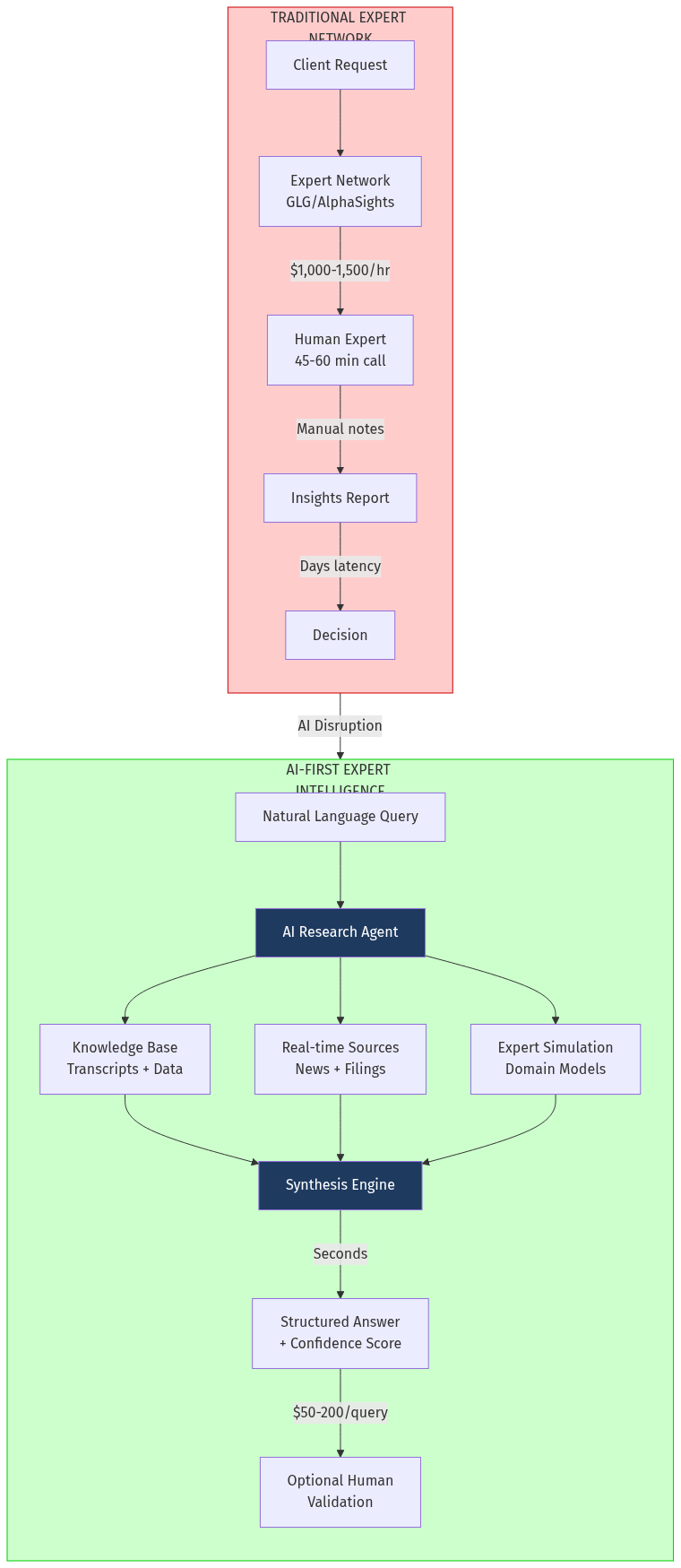
    Traditional Flow (Today):
    • Client submits request → Expert network searches database → Compliance screening → Expert accepts → Call scheduled → 45-60 min call → Manual notes → Insights delivered
    • Time: 2-5 days
    • Cost: $1,000-1,500
    AI-Native Flow (Tomorrow):
    • Client asks natural language question → AI research agent queries knowledge base + real-time sources → Synthesizes answer with confidence scores → Returns structured insight with source citations → Optional: Triggers human expert validation for low-confidence areas
    • Time: 30 seconds to 5 minutes
    • Cost: $50-200

    Distant Domain Import: Gaming Matchmaking

    Consider how gaming platforms like Riot (League of Legends) match players. They don't manually schedule matches — they use skill-based rating systems, real-time availability, and preference algorithms.

    Expert networks still manually match: "Client X needs a hospital CFO with Medicare experience." An AI system could:

    • Understand the underlying question (not just the expert type)
    • Search existing answers in transcript corpus
    • Identify knowledge gaps that genuinely require human input
    • Route only the irreducible 20% to human experts

    What Changes When Agents Transact

    When AI agents autonomously conduct due diligence:

  • Speed: Agents can synthesize 100 "expert perspectives" in minutes
  • Consistency: Every query gets the same rigorous synthesis methodology
  • Compliance: No MNPI risk because no human-to-human information transfer
  • Cost: 50-100x reduction enables new use cases (SME market entry)
  • Coverage: AI can "consult" across industries simultaneously

  • 7.

    Product Concept

    Core Features

    1. Expert Simulation Engine
    • Train domain-specific models on expert call transcripts, industry publications, and structured data
    • Generate "synthetic expert" responses to common questions
    • Confidence scoring: "This answer draws from 47 expert transcripts with 89% consistency; 2 contradictory viewpoints flagged"
    2. Real-Time Intelligence Layer
    • Continuous ingestion: SEC filings, news, job postings, patent filings, supplier databases
    • Event detection: "Hospital X just hired a new CFO from Competitor Y"
    • Trend synthesis: "3 experts in Q4 2025 mentioned pricing pressure from AI diagnostic tools"
    3. Knowledge Graph Navigation
    • Connected entities: Companies ↔ People ↔ Products ↔ Events ↔ Insights
    • Traversable queries: "Show me how Tesla's battery supplier changes affected European automotive OEMs"
    4. Human Expert Routing (Fallback)
    • AI identifies knowledge gaps: "I can't answer this from existing sources"
    • Matches to human experts only when AI confidence < threshold
    • Captures new insights back into knowledge base (with expert consent)
    5. Compliance Automation
    • No MNPI risk for AI-generated responses
    • Audit trail: Every source cited, every inference logged
    • Integration with firm compliance systems

    User Experience

    Query: "What are hospital CFOs' top 3 concerns about AI diagnostic tools, and how does this affect purchasing cycles?" Response (30 seconds):
    SYNTHESIS (Confidence: 87%)
    
    Based on 31 expert call transcripts (2024-2026) and 147 news sources:
    
    1. INTEGRATION BURDEN (mentioned by 71% of healthcare executives)
       - EHR compatibility remains the primary blocker
       - IT departments understaffed for AI deployment
       
    2. LIABILITY UNCERTAINTY (mentioned by 58%)
       - No clear FDA guidance on AI diagnostic liability
       - Malpractice insurers haven't priced AI-assisted diagnosis
       
    3. ROI SKEPTICISM (mentioned by 45%)
       - Vendors claim 30% efficiency gains; realized gains closer to 8-12%
       - Physician adoption rates lower than projected
    
    PURCHASING CYCLE IMPACT:
    Average RFP-to-deployment extended from 9 months (2022) to 14 months (2025)
    
    ⚠️ LOW CONFIDENCE AREA: Specific pricing sensitivity data sparse
    → Recommend human expert call with radiology department head ($400/hr available in 24h)
    
    SOURCES: [31 citations expandable]

    8.

    Development Plan

    PhaseTimelineDeliverables
    MVP12 weeksVertical-specific knowledge base (choose: Healthcare OR Industrial OR Tech); Basic query interface; 10 beta customers
    V124 weeksMulti-vertical coverage; Real-time data integration; Confidence scoring; Human expert fallback routing
    V240 weeksProactive intelligence alerts; Custom model fine-tuning per client; Enterprise SSO + compliance integration
    Scale52+ weeksAPI platform for embedding; White-label for consulting firms; Agentic workflows

    Technical Stack

    • Knowledge Base: Vector DB (Pinecone/Weaviate) + Graph DB (Neo4j)
    • LLM Layer: Claude/GPT-4 for synthesis; domain-fine-tuned models for verticals
    • Real-Time Ingestion: Firehose from SEC EDGAR, news APIs, web scrapers
    • Expert Network Integration: Inex.one API for human fallback routing
    • Compliance: Full audit logging; SOC 2 from day one

    9.

    Go-To-Market Strategy

    Beachhead: Private Equity Mid-Market

    Why PE:
    • High pain (50-100 calls per deal at $100K+)
    • Sophisticated buyers who understand AI value
    • Word-of-mouth network effects
    Initial Motion:
  • Target 10 mid-market PE firms ($500M-5B AUM)
  • Offer free pilot on one active deal (benchmark vs. GLG spend)
  • Success metric: 70%+ cost reduction with equivalent insight quality
  • Publish case study; PE network spreads word
  • Expansion Sequence

    SegmentTimingApproach
    Mid-market PEMonths 1-6Direct sales, deal pilots
    Strategy consultingMonths 6-12Partner with boutiques lacking GLG budgets
    Corporate strategyMonths 12-18Land-and-expand from PE portfolio companies
    SME marketMonths 18-24Self-serve product at $99-199/month

    India-Specific Play

    Only 15% of India's 63 million MSMEs use professional consulting. An AI expert network at ₹5,000-20,000/month (vs. ₹50,000+ for human consultants) opens a massive underserved market.

    Vertical entry points:

    • Automotive supply chain (Maruti, Tata ecosystem)
    • Pharmaceutical manufacturing (API exports)
    • IT services (competitive intelligence for mid-tier firms)
    ---

    10.

    Revenue Model

    Pricing Structure

    TierPriceIncludes
    Query$50-200/queryAI synthesis; confidence scoring; source citations
    Pro$999/month50 queries; custom alerts; API access
    Enterprise$5,000-20,000/monthUnlimited queries; custom model training; human expert credits
    PlatformRevenue shareWhite-label for consulting firms; API for applications

    Unit Economics

    • AI Query Cost: ~$2-5 (LLM inference + data retrieval)
    • Gross Margin on Query: 90%+
    • Human Expert Fallback: Pass-through + 15% margin
    • Target Blended Margin: 75%

    Comparison to Incumbents

    ModelGLGAI Expert Intelligence
    Per-call cost$1,050$50-200 (AI) / $400+ (human fallback)
    Speed2-5 days30 seconds (AI) / 24h (human)
    Compliance burdenHighLow (AI) / Standard (human)
    ScalabilityLinearExponential
    ---
    11.

    Data Moat Potential

    What Accumulates

  • Query Corpus: Every question asked reveals what buyers need to know. This is strategic intelligence about PE deal flow and corporate priorities.
  • Synthesis Feedback: When users say "this answer was helpful" or "this missed the mark," the model improves. Network effects.
  • Proprietary Expert Insights: Human experts who validate AI outputs create new training data. Unlike GLG (who owns the transcript), experts could be compensated via royalties.
  • Industry Knowledge Graphs: Entity relationships (companies ↔ people ↔ products) become more accurate with every query.
  • Vertical Fine-Tuning: A model trained on 10,000 healthcare procurement queries will outperform generic models 5x.
  • Defensibility

    • Data network effects: More queries → better answers → more queries
    • Switching costs: Enterprise clients integrate into workflows
    • Trust accumulation: Consistent quality builds brand (like Bloomberg Terminal)

    12.

    Why This Fits AIM Ecosystem

    Strategic Alignment

    AIM.in Vision: Help buyers DECIDE, not just DISCOVER.

    Expert network intelligence is exactly this. When a manufacturing procurement head evaluates suppliers, they need:

    • Technical specifications (structured data — AIM core)
    • Market context (which suppliers are gaining/losing share?)
    • Expert perspective (what do industry veterans think about this supplier?)
    AI expert intelligence becomes the "context layer" that transforms AIM from a supplier directory into a decision platform.

    Integration Points

  • Supplier Intelligence: AI-generated insights on any supplier in the AIM database
  • Industry Reports: Automated "state of the market" content for verticals
  • Procurement Advisory: AI consultant for SME buyers who can't afford McKinsey
  • Synergies

    • AIM's supplier database = training data for manufacturing expert models
    • Expert network revenue = high-margin upsell on AIM subscriptions
    • Shared go-to-market in Indian manufacturing/industrial verticals

    ## Verdict

    Opportunity Score: 9/10

    Pre-Mortem: Why This Could Fail

  • Incumbents move faster than expected: AlphaSense is already integrating AI; if they nail the hybrid model, new entrants face uphill battle
  • Expert reluctance: Human experts may refuse to contribute to systems that automate them away
  • Accuracy concerns: One high-profile wrong answer in a PE deal could destroy trust
  • Regulatory uncertainty: SEC could extend MNPI rules to AI-generated insights derived from expert transcripts
  • Steelmanning the Opposition

    Why incumbents might win:
    • GLG has 20 years of expert relationships and compliance infrastructure
    • Trust matters enormously in high-stakes decisions; "I talked to a human" has psychological weight
    • Enterprise sales cycles favor known vendors

    Counter-Arguments

    • Incumbents are optimizing for call volume; AI disrupts the metric itself
    • Trust can be built through transparency (full source citations, confidence scores)
    • Mid-market and SME segments are underserved; incumbents won't cannibalize

    Final Assessment

    The expert network industry is a $4 billion market built on a 20-year-old model: humans scheduling calls with humans. AI research agents can deliver 80% of the value at 2% of the cost.

    The question isn't whether AI will disrupt expert networks — it's who builds the AI-native alternative. AlphaSense is bolting AI onto legacy architecture. The opportunity is to build from first principles: knowledge graphs, LLM synthesis, real-time data, confidence scoring, and human fallback only where AI genuinely can't answer.

    For AIM.in, this is a natural extension: from supplier discovery to supplier intelligence to market intelligence. The data moat compounds. The margin profile is exceptional. And the underserved SME market in India alone represents a $5B advisory market that's never had access to "expert" insights.

    Recommendation: Build a vertical AI expert network starting with manufacturing/industrial (AIM's core) and expand to healthcare, tech, and financial services.

    ## Sources