ResearchSaturday, February 28, 2026

AI-Powered SMB Commercial Insurance Underwriting: The $922 Billion Opportunity in Automated Risk Intelligence

Commercial insurance underwriting for small and medium businesses remains trapped in the 1990s—brokers email PDFs, underwriters spend 40% of their time on data entry, and quotes take 8+ days. AI agents are about to compress this entire workflow into minutes, creating a massive opportunity for platforms that can automate risk assessment at scale.

1.

Executive Summary

The global commercial insurance market stands at $922 billion in 2025, projected to reach $1.35 trillion by 2030 at a 10% CAGR. Yet the SMB segment—small businesses seeking general liability, property, cyber, and workers' compensation coverage—remains dramatically underserved due to the economics of manual underwriting.

The core problem: It costs carriers the same to underwrite a $5,000 premium small business policy as a $500,000 enterprise account. Traditional underwriters spend 30-40% of their time on administrative tasks, leaving only ~30% for actual risk assessment. The result? SMBs face 8-12 day quote-to-bind cycles, complex applications, and coverage gaps. The AI opportunity: Autonomous AI agents can handle document ingestion, risk classification, appetite matching, and quote generation in minutes instead of days. Early movers like Next Insurance ($4B valuation), Cowbell ($208M raised), and NeuralMetrics are proving the model, achieving 60-99% faster quotes and 3-5% loss ratio improvements.

This represents a rare convergence: a trillion-dollar market, clear workflow automation potential, and proven AI capabilities—yet incumbent carriers are still wrestling with legacy systems. The window is open.

2.

Problem Statement

What's Broken Today?

The SMB Insurance Paradox:
  • 30 million small businesses in the US alone need commercial coverage
  • Yet brokers deprioritize SMB accounts (low premiums, high effort)
  • 42% of SMB owners find commercial insurance "complex and lengthy"
  • Underwriters spend 3+ hours daily on data entry, not risk analysis
Applying Zeroth Principles: Before accepting that commercial underwriting requires human judgment, we must question the axioms: Why does underwriting take 8 days? Not because of complex risk analysis—that's actually fast. The bottleneck is data: gathering it, normalizing it, re-keying it across siloed systems. Strip away the administrative scaffolding, and the actual underwriting decision can be made in minutes. Why do brokers exist in SMB insurance? Historically, to aggregate demand and navigate complexity. But if an AI can instantly match risk profiles to carrier appetite, the broker's value proposition erodes. The question isn't "how do we help brokers?" but "what replaces them?"

The Manual Process Breakdown

StageCurrent StateTime SpentPain Point
Submission IntakePDF/email parsingHours12+ document formats
Data EntryManual re-keying3+ hours/day30-40% of underwriter time
Risk ClassificationHuman judgmentVariableInconsistent decisions
Appetite MatchingManual carrier checksHours-daysSiloed systems
Quote GenerationSpreadsheet models1-3 daysErrors, version control
BindingPaper/wet signaturesDaysBack-and-forth delays
Total: 8 days submission-to-quote, 12+ days quote-to-bind
3.

Current Solutions

The Competitive Landscape

CompanyWhat They DoFundingWhy They're Not Solving It
Next InsuranceAI-powered SMB insurance carrier$1.1B+ ($4B valuation)Full-stack carrier—competes with incumbents rather than enabling them
CowbellAI cyber insurance for SMEs$208M (Series C)Cyber-only; doesn't address general commercial lines
VouchTech company insurance$231M ($550M valuation)Niche focus on startups/tech, not broad SMB
NeuralMetricsAI underwriting workbenchEarly stageAugments existing workflows rather than replacing them
CoalitionCyber + commercial insurance$755MCyber-centric; expensive for micro-SMBs
Applying Incentive Mapping: Who profits from the status quo?
  • Large brokers benefit from complexity—it justifies their commissions
  • Legacy carriers have sunk costs in existing systems and agent networks
  • Consulting firms profit from multi-year digital transformation projects
  • Re-insurers prefer the risk characteristics of manually underwritten books
  • The incumbents have structural reasons to drag their feet. This creates space for insurgents.


    4.

    Market Opportunity

    Market Size and Growth

    • Global Commercial Insurance: $922-935 billion (2025) → $1.35-1.68 trillion by 2030-2034
    • US Commercial Insurance: $271.93 billion (2025) → $416.83 billion by 2035 (5.47% CAGR)
    • SMB Segment: Estimated 25-35% of commercial market = $230-330 billion globally

    The "Why Now?" Moment

    Applying Distant Domain Import: What other industries solved similar problems? Consumer lending: Automated decisioning transformed personal loans from 2-week processes to instant approval. Companies like Upstart proved AI could underwrite risk better than humans for standard cases. Freight brokerage: Digital brokers like Convoy and Uber Freight automated matching, pricing, and capacity—same structural problem as insurance (matching supply/demand with risk assessment). Real estate: Automated valuation models (AVMs) replaced human appraisers for standard properties. Underwriters still handle edge cases.

    The pattern: AI handles the 80% of standard cases instantly, humans handle the 20% of complex exceptions. Commercial insurance is ripe for the same transformation.

    Technological Enablers (2024-2026):
    • LLMs that can parse unstructured broker submissions with 95%+ accuracy
    • Computer vision for document verification and fraud detection
    • API ecosystems connecting carrier systems (finally)
    • Embedded insurance infrastructure enabling distribution anywhere

    5.

    Gaps in the Market

    Where Current Players Fail

    Applying Anomaly Hunting: What's strange about this market?
  • The Build vs. Buy Gap: Next Insurance built a full-stack carrier ($1B+ capital required). NeuralMetrics sells point solutions. There's no "Stripe for commercial insurance"—a platform layer enabling any carrier or MGA to deploy AI underwriting instantly.
  • The Data Standardization Problem: Every carrier has different appetite guides, classification codes, and data schemas. No one has built the canonical data model that translates between all of them.
  • The Distribution Disconnect: Brokers control 59% of commercial distribution but lack tools to instantly match SMB clients to the best carrier. They're still emailing multiple markets manually.
  • The Embedded Opportunity: Vertical SaaS platforms (payroll, accounting, POS) have direct access to SMB data but can't easily activate insurance products.
  • The India/Emerging Market Vacuum: SMB commercial insurance in India is largely offline, relationship-driven, and massively underserved. The same AI stack built for US markets applies globally.
  • The Conspicuous Absence

    Why isn't there a platform that:

    • Ingests any broker submission format (PDF, email, API)
    • Normalizes data to a universal schema
    • Matches against multiple carrier appetites simultaneously
    • Returns ranked quotes in real-time
    • Handles binding documentation automatically
    This doesn't exist because incumbents have no incentive to build it (it disintermediates their manual processes), and startups have focused on becoming carriers themselves rather than enabling the ecosystem.


    6.

    AI Disruption Angle

    How AI Agents Transform the Workflow

    SMB Insurance Underwriting Flow
    SMB Insurance Underwriting Flow
    The AI Agent Stack:
    AgentFunctionTechnologyImpact
    Document AgentParse any submission formatOCR + LLM extractionEliminates 3+ hours/day data entry
    Classification AgentNAICS/SIC coding, industry classificationMulti-model ensembleConsistent, instant classification
    Risk AgentAnalyze exposures, flag red flagsPredictive models + RAGBetter loss ratios
    Appetite AgentMatch against carrier rulesRules engine + MLMulti-market quotes in seconds
    Quote AgentGenerate pricing, termsActuarial models + AI60-99% faster quotes
    Binding AgentHandle documentation, signaturesWorkflow automationSame-day bind
    Real-World Results (from existing deployments):
    • NeuralMetrics: 95% first-upload document success rate
    • Next Insurance: Minutes to quote vs. days
    • Cowbell: 3-5% loss ratio improvement from AI risk selection

    The Agentic Future

    By 2028, commercial insurance will operate as agent-to-agent transactions:

  • SMB's accounting software identifies insurance need (new employee, new equipment, new location)
  • Embedded agent assembles application data automatically from business systems
  • Underwriting agents at multiple carriers receive structured submission
  • Quote agents return competitive offers in seconds
  • Business owner reviews AI-summarized options, clicks to bind
  • Claims agents continuously monitor for risk changes, adjust coverage
  • The human underwriter becomes a supervisor for complex cases, not a processor of routine submissions.


    7.

    Product Concept

    "Underwrite.ai" — The AI Insurance Platform

    Vision: The operating system for AI-powered commercial underwriting, enabling any carrier, MGA, or embedded partner to deploy instant SMB insurance. Core Components:
  • Universal Intake Engine
  • - Accepts any format: PDF, email, API, voice, images - LLM-powered extraction to canonical schema - 95%+ accuracy with human-in-loop for exceptions
  • Risk Intelligence Hub
  • - Real-time business data enrichment (firmographics, financials, news) - Predictive risk scoring across lines - Fraud detection and consistency checks
  • Carrier Marketplace
  • - Standardized appetite APIs for participating carriers - Real-time multi-market quoting - Capacity matching for hard-to-place risks
  • Embedded Insurance SDK
  • - White-label components for SaaS platforms - Pre-fill from existing business data - In-app quoting and binding
  • Agent Workspace
  • - Dashboard for human underwriters/brokers - AI recommendations with explanations - Exception handling workflows

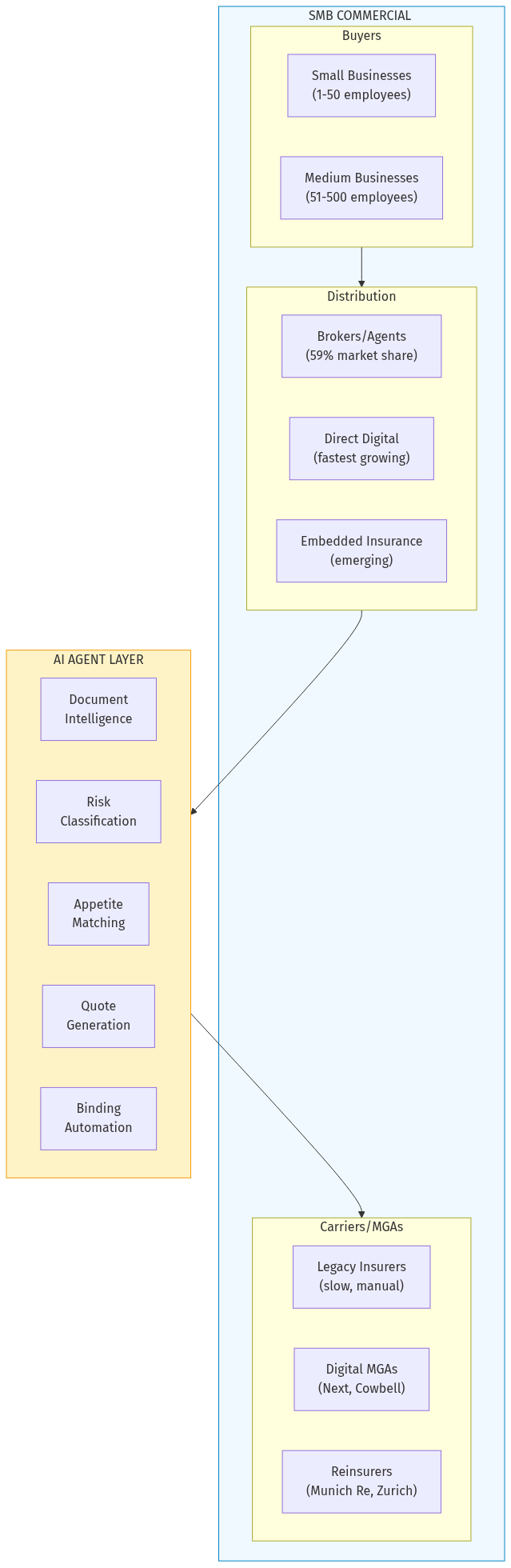
    Architecture

    SMB Insurance Market Structure
    SMB Insurance Market Structure

    8.

    Development Plan

    PhaseTimelineDeliverablesInvestment
    Phase 1: FoundationMonths 1-4Universal intake engine, risk classification agents, 3 carrier integrations$500K
    Phase 2: PlatformMonths 5-8Carrier marketplace, multi-line quoting (GL, BOP, WC), broker dashboard$1M
    Phase 3: EmbeddedMonths 9-12SDK for SaaS platforms, API-first distribution, 10+ carrier partnerships$2M
    Phase 4: ScaleYear 2National carrier coverage, specialty lines, international expansion (India)$5M+
    Technical Stack:
    • LLMs: Claude/GPT-4 for document understanding, fine-tuned models for classification
    • OCR: AWS Textract + custom models for insurance documents
    • Data: Clearbit, D&B, public records for enrichment
    • Infrastructure: Cloud-native, event-driven architecture for real-time processing

    9.

    Go-To-Market Strategy

    Beachhead: Specialty MGAs

    Why start here?
    • MGAs are more agile than large carriers
    • They have binding authority but lack tech infrastructure
    • Premium per policy often higher (specialty lines)
    • Successful MGA deployments create carrier reference cases

    Expansion Playbook

  • Months 1-6: Sign 3-5 MGAs for pilot deployments
  • - Target: Cyber, professional liability, contractor specialty - Prove 50%+ efficiency gains
  • Months 6-12: Launch broker-facing marketplace
  • - Let brokers submit once, get quotes from multiple MGAs - Drive volume through better service
  • Year 2: Embedded partnerships
  • - Integrate with payroll (Gusto, ADP) for workers' comp - Partner with accounting (QuickBooks, Xero) for BOP - API distribution through vertical SaaS
  • Year 3: Direct carrier relationships + India expansion
  • - Large carrier partnerships (Liberty Mutual, Hartford, etc.) - Replicate model for Indian SMB market (greenfield)

    Key Partnerships to Pursue

    • MGAs: Coalition, Corvus, Kinsale
    • Brokers: Hub International, AssuredPartners (mid-market)
    • Embedded: Gusto, Toast, Shopify
    • Reinsurers: Munich Re, Swiss Re (capacity)

    10.

    Revenue Model

    Multi-Stream Monetization

    Revenue StreamModelPotential
    Platform SaaS$5K-50K/month per MGA/carrierPredictable, high margin
    Transaction Fees1-3% of premium on platform quotesScales with volume
    Data ServicesRisk data/enrichment APIsAdditional margin
    Embedded LicensingRevenue share with SaaS partnersDistribution leverage
    Commission CaptureBecome digital MGA on own paperHighest margin, highest risk
    Unit Economics (at scale):
    • Average SMB commercial premium: $2,500/year
    • Platform transaction fee (2%): $50/policy
    • Volume at 100K policies: $5M/year transaction revenue
    • Plus SaaS subscriptions: $2M/year
    • Target gross margin: 80%+

    Path to Profitability

    • Year 1: $500K revenue (pilots + early SaaS)
    • Year 2: $3M revenue (marketplace launch)
    • Year 3: $10M+ revenue (embedded + direct)
    • Break-even: Month 30-36

    11.

    Data Moat Potential

    Proprietary Data Accumulation

    Every transaction builds defensibility:
  • Submission Data: Millions of broker submissions reveal what information is actually predictive of risk vs. noise. Train models that outperform actuarial tables.
  • Matching Data: Which carriers accept which risks creates a proprietary appetite map. No carrier would share this; you build it from transaction flow.
  • Outcome Data: Track quote-to-bind conversion, claims frequency, loss ratios. Create feedback loops that improve pricing accuracy over time.
  • Cross-Carrier Insights: See pricing variations across the market. Identify mispriced risks or capacity gaps.
  • SMB Business Intelligence: Understand which industries are growing, contracting, changing risk profiles—valuable beyond insurance.
  • Network Effects

    • More carriers → better quotes for brokers → more brokers → more carriers (classic marketplace dynamic)
    • More data → better models → better risk selection → better loss ratios → more carrier interest
    • More embedded partners → more origination data → better pre-fill → higher conversion
    Applying Second-Order Thinking: If this succeeds, what happens next?
    • Traditional brokers lose leverage; consolidation accelerates
    • Carriers become "capacity providers" while platforms own distribution
    • Insurance becomes embedded everywhere—invisible, instant, automatic
    • Underwriting talent shifts from "processors" to "exception handlers" to "AI trainers"

    12.

    Why This Fits AIM Ecosystem

    Strategic Alignment with AIM.in

    AIM's thesis: Help buyers DECIDE through structured data and AI-powered discovery.

    Commercial insurance is a perfect fit:

  • Fragmented Market: Thousands of carriers, millions of SMBs, no central discovery
  • High-Trust Transaction: Buyers need confidence in coverage adequacy
  • Data-Rich Decision: Multiple variables (coverage limits, deductibles, exclusions, price)
  • Repeat Purchase: Annual renewals create recurring revenue
  • WhatsApp-Native: Indian SMBs already request insurance quotes via WhatsApp
  • AI Agent Enablement: Perfect use case for autonomous transaction agents
  • Potential Integration

    • AIM Discovery: Business searching for insurance sees instant quotes
    • AIM Agents: Autonomous agents handle inquiry → quote → bind → service
    • AIM Data: Business profiles on AIM pre-populate insurance applications
    • AIM Trust: Verified business credentials reduce underwriting friction

    India Market Opportunity

    India's commercial insurance market is largely offline:

    • Dominated by PSU insurers (ICICI, HDFC, etc.)
    • Broker relationships control access
    • Digital infrastructure exists (Aadhaar, UPI) but unused for commercial lines
    • Same AI stack applies; execution adapts to market
    First-mover advantage: Build the AI underwriting platform in the US, expand to India where incumbents are even slower.


    ## Mental Models Applied

    Falsification (Pre-Mortem): Why might this fail?
  • Carriers refuse to integrate: They're notoriously slow adopters. Mitigation: Start with MGAs who are more agile.
  • Regulatory barriers: Insurance is heavily regulated. Mitigation: Work with existing licensed entities, not against regulators.
  • Loss ratio blowup: AI models misjudge risk. Mitigation: Human-in-loop for edge cases; gradual rollout.
  • Next Insurance wins everything: Full-stack model captures the market. Mitigation: Be the platform, not the carrier; enable everyone else.
  • Data moat never materializes: Carriers build competing solutions. Mitigation: Move fast, sign exclusive partnerships, lock in distribution.
  • Steelmanning: Why might incumbents win?
    • They have actuarial data spanning decades; startups have years
    • They have regulatory relationships and licenses
    • They have distribution (captive agents, broker networks)
    • They have capital for underwriting risk
    Counter: Incumbents have all these advantages—yet still haven't solved SMB efficiency. The assets become liabilities (legacy systems, conflicted distribution, organizational inertia). Speed and focus beat resources and history.

    ## Verdict

    Opportunity Score: 8.5/10 Why high:
    • $920B+ market with clear inefficiency
    • Proven AI capabilities (Next, Cowbell validating the model)
    • Platform opportunity—be the rails, not just a carrier
    • Strong unit economics at scale
    • Data moat potential
    Why not higher:
    • Insurance is notoriously slow to change
    • Regulatory complexity varies by state/country
    • Carrier integration requires relationship-building (not just tech)
    • Capital requirements if pursuing MGA model
    Recommendation: Strong opportunity for an AI-first team with insurance domain expertise. The beachhead strategy (MGAs → brokers → embedded → carriers) provides a realistic path to scale without requiring massive capital upfront.

    The window is open. Next Insurance proved the model works at the carrier level. The platform layer—enabling the entire ecosystem to operate with AI—remains unbuilt.


    ## Sources