ResearchSaturday, February 28, 2026

AI Pharmaceutical Distribution Intelligence: B2B Wholesaler Supply Chain Automation

India's $53 billion pharmaceutical distribution market operates through 800,000+ fragmented retail outlets with multi-layered wholesaler chains. AI agents can transform this chaotic network into an intelligent, predictive distribution system—reducing stockouts by 75%, eliminating expiry waste, and ensuring 100% drug authentication.

1.

Executive Summary

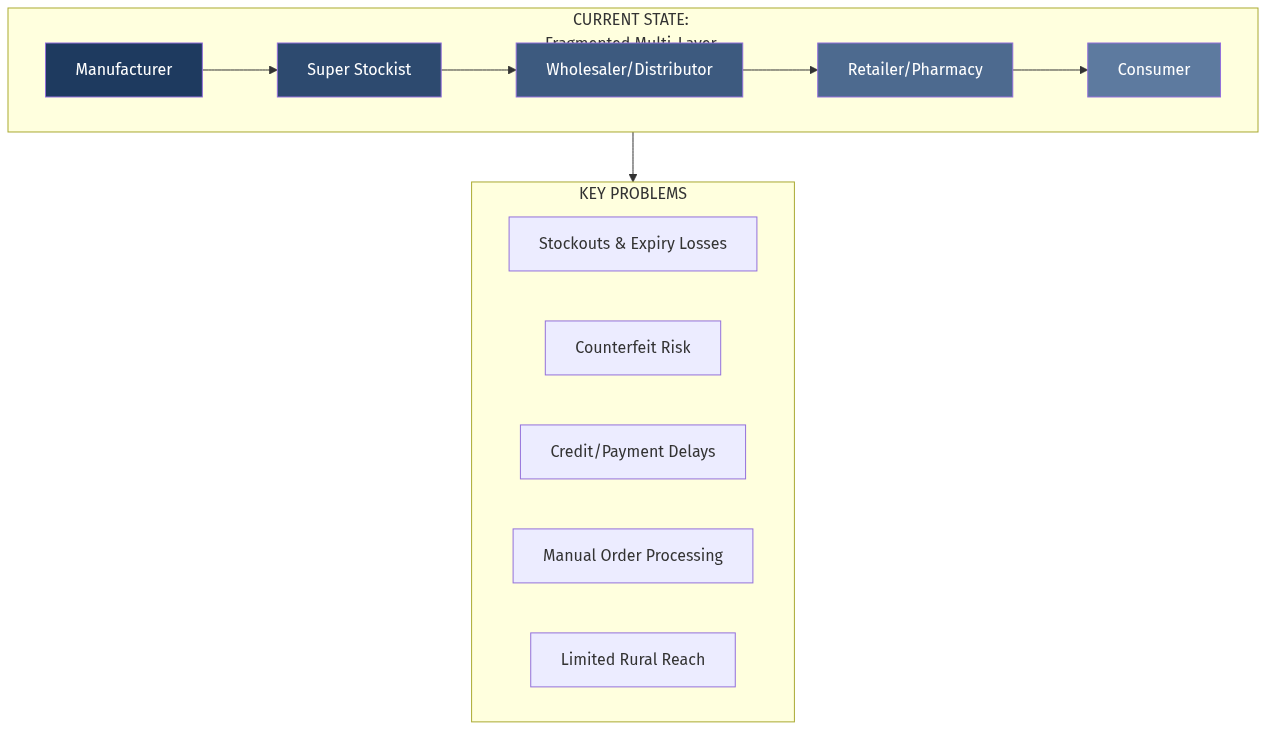
India's pharmaceutical distribution is a $53+ billion market growing at 11.6% CAGR, yet operates on archaic multi-layer channels: Manufacturer → Super Stockist → Wholesaler → Retailer → Consumer. This fragmentation creates endemic problems—stockouts of essential medicines, 3-5% annual expiry losses, counterfeit infiltration, and credit bottlenecks.

AI-powered distribution intelligence represents a transformational opportunity. By applying predictive demand forecasting, real-time inventory optimization, and blockchain-verified authentication, an AI platform can serve as the "central nervous system" for India's pharma supply chain—creating a winner-takes-most B2B marketplace while accumulating irreplaceable distribution data.

Opportunity Score: 8.5/10 — Massive TAM, clear pain points, proven AI applications, but requires significant capital for network effects.
2.

Problem Statement

Who Experiences This Pain?

Retail Pharmacies (800,000+ outlets)
  • Stock 2,000-5,000 SKUs with unpredictable demand patterns
  • Face 15-20% stockout rates on essential medicines
  • Lose 3-5% revenue annually to expired inventory
  • Juggle 8-15 different wholesaler relationships manually
  • No visibility into what's available across the distribution network
Wholesalers/Distributors (65,000+ entities)
  • Operate on razor-thin 2-4% margins
  • Carry significant credit risk (30-60 day payment cycles)
  • Cannot predict retailer demand accurately
  • Struggle with counterfeits entering supply chain
  • Manual order processing via phone/WhatsApp
Manufacturers (3,000+ companies)
  • Limited visibility into actual retail demand
  • Distribution decisions based on stale data
  • Cannot efficiently reach Tier 3-4 markets
  • Rely on field salesforce for order collection

The Zeroth Principles Question

"Why does pharmaceutical distribution require 4-5 intermediary layers when we have digital rails?"

The conventional answer is "credit extension and last-mile logistics." But this axiom deserves questioning. The real function of each layer:

  • Super Stockists: Banking (credit to wholesalers) + bulk breaking
  • Wholesalers: Banking (credit to retailers) + local delivery
  • The actual need: Credit, inventory risk absorption, and delivery
AI can unbundle these functions—providing instant credit decisions via transaction data, optimizing inventory placement algorithmically, and aggregating delivery efficiently. The multi-layer structure exists because of information asymmetry, not logistics requirements.


3.

Current Solutions

CompanyWhat They DoWhy They're Not Solving It
SaveoB2B pharma marketplace for retailersFocus on order aggregation, limited AI/prediction; still requires manual stock decisions
PharmEasy B2BWholesale supply + B2C pharmacyB2B is secondary to consumer business; not solving wholesaler efficiency
MedkartGeneric medicine retail chain + franchiseRetail-focused; B2B is franchise model, not marketplace
Udaan PharmaGeneral B2B marketplace with pharma verticalHorizontal platform; lacks pharma-specific intelligence
StockAreaFulfillment/warehousing for pharmaLogistics layer only; no demand intelligence

Gap Analysis

None of the current players have built:

  • Predictive demand forecasting at SKU-store level
  • Expiry risk scoring and automated redistribution
  • Real-time counterfeit detection via serialization integration
  • Credit intelligence based on transaction patterns
  • Unified inventory visibility across the distribution network

  • 4.

    Market Opportunity

    Market Size:
    • Indian pharmaceutical market: $53.29 billion (2025)$92.32 billion (2030)
    • Distribution/wholesale layer: ~15-20% of market value = $8-10 billion TAM
    • SaaS + transaction fees addressable: $500M-800M annually
    Growth Drivers:
    • 11.6% CAGR through 2030
    • Government push for generic medicines (Jan Aushadhi)
    • Rising chronic disease prevalence (diabetes, cardiovascular)
    • Rural market expansion (currently underserved)
    Why Now: Applying Market Timing Evaluator recipe:
  • Emergence Detection: Three converging factors:
  • - UPI/digital payments normalized even for small retailers - GST created unified transaction data trail - Government mandating drug serialization (track-and-trace)
  • Prior Failures: Earlier attempts (2015-2019 era) failed because:
  • - No digital payment infrastructure at retail level - Pre-GST fragmented taxation made pricing opaque - No serialization mandate for traceability
  • Recent Signal: Mankind Pharma's AI supply chain reduced stockouts by 75% (2025), proving the technology works at scale in Indian pharma context.

  • 5.

    Gaps in the Market

    Anomaly Hunting Results

    "What's surprising about this market that doesn't fit?"
  • The Expiry Paradox: 3-5% of inventory expires while stockouts exist simultaneously. This is pure information asymmetry—drugs sitting unsold in one warehouse while pharmacies 50km away face shortages.
  • The Credit Bottleneck: Wholesalers extend 30-60 day credit but have no data-driven way to assess retailer risk. Result: either over-conservative (limiting supply) or losses to defaults.
  • The Counterfeit Blind Spot: Government mandated serialization exists, but no platform aggregates this data for supply chain authentication at scale.
  • The Rural Desert: 70% of population, 30% of pharmaceutical distribution. Not a logistics problem—it's a demand prediction problem. No one knows what rural PHCs actually need.
  • The Generic Gap: Generic medicines are 80% cheaper but only 20% of market. Distribution doesn't incentivize generics (lower absolute margins), despite being identical chemically.

  • 6.

    AI Disruption Angle

    Distant Domain Import: What Can We Learn?

    Applying structural parallels from other industries: From Logistics (Flexport/Uber Freight):
    • Real-time pricing and capacity matching
    • Aggregated demand signals for supply optimization
    • Platform becomes "operating system" for fragmented operators
    From Fintech (Khatabook/OkCredit):
    • Digital ledger creates credit data exhaust
    • Transaction history enables instant credit decisions
    • SMBs adopt when value is immediate (credit access)
    From Agriculture (DeHaat/Ninjacart):
    • Perishable inventory management parallels expiry risk
    • Demand aggregation enables direct sourcing
    • Quality assurance via standardization

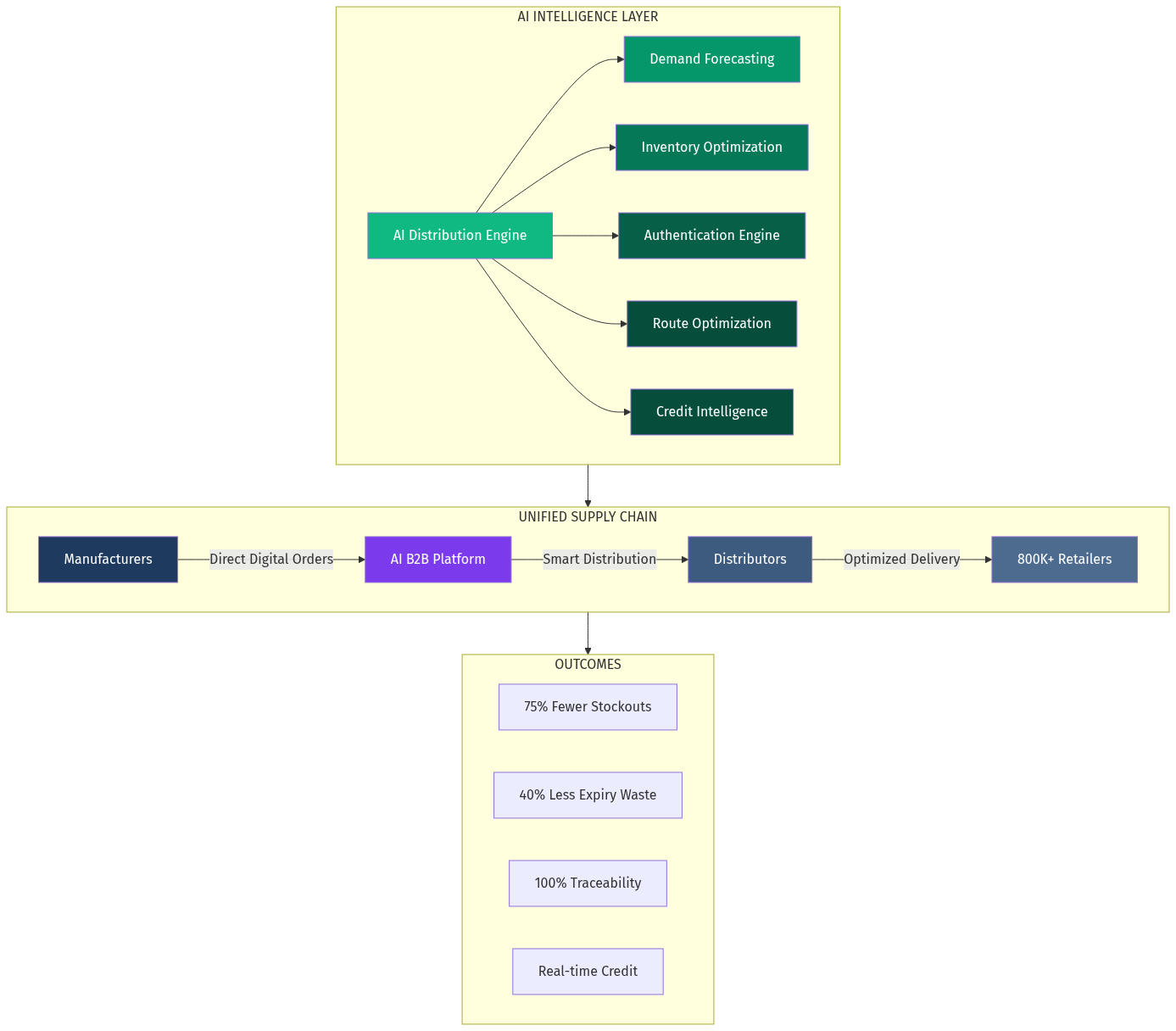
    The AI Agent Architecture

    AI Distribution Architecture
    AI Distribution Architecture
    Core AI Capabilities:
  • Demand Forecasting Agent
  • - SKU-level prediction using: sales history, seasonal patterns, disease outbreaks, local demographics - Incorporates weather, festivals, health camps as demand signals - Accuracy target: 85%+ at weekly level, 70%+ at daily level
  • Inventory Optimization Agent
  • - Real-time reorder point calculation - Cross-network redistribution recommendations - Expiry-risk scoring with markdown/transfer suggestions
  • Authentication Agent
  • - Serialization verification at each transaction - Anomaly detection for suspicious supply patterns - Recall management automation
  • Credit Intelligence Agent
  • - Transaction-based creditworthiness scoring - Dynamic credit limits based on payment behavior - Early warning for default risk
  • Route Optimization Agent
  • - Multi-stop delivery planning - Cold chain compliance monitoring - Demand clustering for efficient fulfillment
    7.

    Product Concept

    Platform Vision: "The Central Nervous System of Pharma Distribution"

    Current State vs AI-Enabled
    Current State vs AI-Enabled
    For Retailers:
    • Single app to order from any wholesaler/manufacturer
    • AI-powered reorder suggestions (never run out, never over-stock)
    • Real-time alternative suggestions for out-of-stock SKUs
    • Instant credit access based on transaction history
    • One-tap verification of drug authenticity
    For Wholesalers:
    • Demand prediction dashboard across retailer network
    • Automated order aggregation and fulfillment routing
    • Credit risk scoring for each retailer
    • Expiry alert system with redistribution suggestions
    • WhatsApp-native ordering interface for tech-shy retailers
    For Manufacturers:
    • Real-time demand visibility down to retail level
    • Direct-to-retailer pilot programs for new launches
    • Distribution gap identification
    • Recall management with full traceability

    Core Features

  • Unified Catalog: 100,000+ SKUs with real-time availability across network
  • Smart Cart: AI suggests order quantities based on consumption patterns
  • Expiry Exchange: Marketplace for near-expiry inventory (discounted redistribution)
  • Credit Wallet: Instant credit with transparent terms, auto-debit on payment cycle
  • Auth Chain: End-to-end drug authentication via serialization scanning

  • 8.

    Development Plan

    PhaseTimelineDeliverables
    MVP12 weeksRetailer ordering app + wholesaler dashboard; basic demand analytics; pilot in 1 city (Hyderabad/Vizag)
    V124 weeksAI demand forecasting; credit scoring module; expand to 3 cities; 500+ retailers
    V240 weeksManufacturer integration; authentication module; expiry exchange; 5,000+ retailers
    Scale52+ weeksPan-India expansion; cold chain integration; API for third-party logistics

    Technical Architecture

    • Frontend: React Native (retailers), Next.js (wholesaler dashboard)
    • Backend: Node.js/Python microservices
    • AI/ML: Time-series forecasting (Prophet/LSTM), credit scoring (XGBoost)
    • Data: PostgreSQL (transactions), Redis (real-time), BigQuery (analytics)
    • Integration: GST API, UPI rails, serialization databases

    9.

    Go-To-Market Strategy

    Phase 1: Wholesaler-Led Acquisition (Months 1-6)

  • Target Top 50 Wholesalers in launch city
  • - Value proposition: "Get AI-powered demand prediction free—we make money on retailer acquisition" - Provide demand dashboard + credit scoring free for early adopters
  • Onboard Their Retailer Networks
  • - Wholesalers introduce platform to their existing retailers - Initial incentive: Better credit terms for platform orders
  • Build Transaction Density
  • - Minimum 70% order digitization before expanding geographically

    Phase 2: Manufacturer Pull (Months 6-12)

  • Approach Generic Manufacturers First
  • - Offer: "Direct visibility into retail demand + pilot direct-to-pharmacy programs" - Revenue share on incremental distribution
  • New Launch Distribution
  • - Premium placement fees for new product launches - AI-targeted retailer recommendations based on likely demand

    Phase 3: Network Effects (Months 12+)

  • Cross-Network Inventory
  • - Enable retailers to see inventory across multiple wholesalers - Platform becomes "search engine" for pharmaceutical availability
  • Expiry Exchange Marketplace
  • - Near-expiry medicines traded at discount - Platform takes transaction fee
    10.

    Revenue Model

    Primary Revenue Streams:
    StreamModelPotential
    Transaction Fee0.5-1% of GMVAt ₹1,000 Cr GMV → ₹5-10 Cr annual
    Credit Interest Spread2-3% over cost of capitalSignificant at scale
    Manufacturer ServicesDemand insights, launch support₹50L-2Cr per manufacturer
    Premium FeaturesAdvanced analytics, priority supportSaaS upsell
    Expiry Exchange5% transaction feeUnique marketplace
    Unit Economics Target:
    • Retailer CAC: ₹500-1,000 (via wholesaler network)
    • Retailer LTV: ₹5,000-10,000 (3-year horizon)
    • Take rate: 1-2% blended
    • Gross margin: 60%+ (SaaS-like at scale)

    11.

    Data Moat Potential

    What Proprietary Data Accumulates?

  • Demand Intelligence
  • - SKU-level demand curves across 800,000+ retail points - Seasonal patterns, local disease correlations - Price elasticity data for thousands of products
  • Credit Graph
  • - Payment behavior of every retailer - Creditworthiness scores unavailable elsewhere - Early warning signals for distress
  • Supply Chain Map
  • - Real-time inventory positions across the network - Lead times, reliability scores for every node - Counterfeit incident database
  • Alternative Data Value
  • - Pharmaceutical manufacturers would pay premium for demand insights - Insurance companies interested in drug consumption patterns (anonymized) - Government health agencies need stockout/availability data

    Defensive Moat

    After 2-3 years:

    • Demand prediction models trained on billions of transactions
    • Credit scores for 100,000+ retailers
    • Network effects: more retailers → better prediction → more retailers
    • Switching costs: integrated with retailer workflows, credit dependency
    ---

    12.

    Why This Fits AIM Ecosystem

    Strategic Alignment:
  • B2B Marketplace DNA: AIM's core thesis is structured B2B discovery and transactions. Pharma distribution is a massive, fragmented B2B market awaiting digitization.
  • AI-Native Opportunity: This isn't adding AI to an existing product—it's building distribution infrastructure that's fundamentally impossible without AI (real-time demand prediction, automated credit, authentication).
  • India-First Market: Global pharma logistics players don't understand India's multi-layer distribution. This requires ground-up building with local context.
  • Data Moat Alignment: AIM's competitive advantage is accumulating structured data about Indian B2B transactions. Pharma distribution creates extremely valuable data.
  • Cross-Vertical Potential: The AI distribution intelligence built for pharma can extend to:
  • - FMCG distribution - Agricultural inputs - Auto spare parts - Building materials

    ## Verdict

    Pre-Mortem: Why Would This Fail?

    Applying Falsification via Pre-Mortem:
  • Regulatory Risk: Drug distribution licenses are complex. Platform model might face regulatory scrutiny.
  • - Mitigation: Position as technology layer, not distributor. Never take inventory ownership.
  • Wholesaler Resistance: Existing wholesalers may see platform as threat to their margins.
  • - Mitigation: Start with wholesaler value (demand intelligence), not disintermediation.
  • Credit Risk Concentration: If platform extends credit, defaults could be catastrophic.
  • - Mitigation: Partner with NBFCs for credit; platform provides data, not capital.
  • Cold Chain Complexity: Many medicines require temperature control—platform can't ignore logistics.
  • - Mitigation: Initially focus on ambient-storage medicines (80% of market).

    Steelmanning: Why Might Incumbents Win?

    Building strongest opposing case:
    • Udaan has scale: Already has pharma vertical, merchant network, and credit infrastructure
    • PharmEasy has brand: Consumer trust could translate to B2B
    • Wholesalers have relationships: 30-year relationships won't switch overnight for 1% savings
    Counter-argument: Incumbents are not building AI-native. Udaan is horizontal (no pharma specialization). PharmEasy is consumer-focused. Neither has SKU-level demand prediction or expiry optimization. The AI layer is the moat, not the marketplace mechanics.

    Final Assessment

    Opportunity Score: 8.5/10
    FactorScoreNotes
    Market Size9/10$50B+ and growing 11%+ annually
    Problem Severity9/10Endemic stockouts, expiry losses, counterfeits
    AI Applicability9/10Proven demand forecasting, clear use cases
    Competitive Gap7/10Some players exist but no AI-native solution
    Execution Complexity6/10Multi-sided marketplace, regulatory navigation
    Capital Requirements6/10Significant for credit, network building
    AIM Fit9/10Perfect alignment with B2B marketplace thesis
    Recommendation: Strong opportunity for AI-native B2B marketplace. Requires patient capital and wholesaler-first strategy. The data moat potential is exceptional—whoever builds the "demand intelligence layer" for Indian pharma distribution owns an irreplaceable asset.

    ## Sources