B2B MarketplaceSaturday, February 28, 2026

AI-Powered Industrial Water Treatment Chemicals Procurement: The $1.8B Market Running on WhatsApp

India's industrial water treatment chemicals market will hit $1.8 billion by 2033, yet procurement remains shockingly manual — WhatsApp orders, paper invoices, and zero traceability. With ZLD mandates tightening and 30-50% of wastewater still unrecycled due to compliance failures, an AI-connected procurement platform could transform how 500,000+ factories source $1B+ in chemicals annually.

1.

Executive Summary

India's industrial water treatment chemicals market generated $1.05 billion in 2024 and is projected to reach $1.8 billion by 2033 — a 7.3% CAGR driven by Zero Liquid Discharge (ZLD) mandates, urbanization, and industrial expansion.

Yet the market structure is a paradox: sophisticated chemical engineering meets primitive procurement. Factories still order coagulants and biocides via WhatsApp messages to local distributors. Invoicing is manual. Compliance documentation is assembled retroactively from scattered logs. Payment cycles stretch 60-90 days.

The opportunity is a full-stack AI procurement platform that connects IoT-enabled smart dosing systems to an intelligent supplier marketplace, generating automatic reorders, optimized pricing, and audit-ready compliance trails. Think "Stripe for water chemicals" — where every dose is tracked, every purchase is optimized, and every regulatory report is auto-generated.


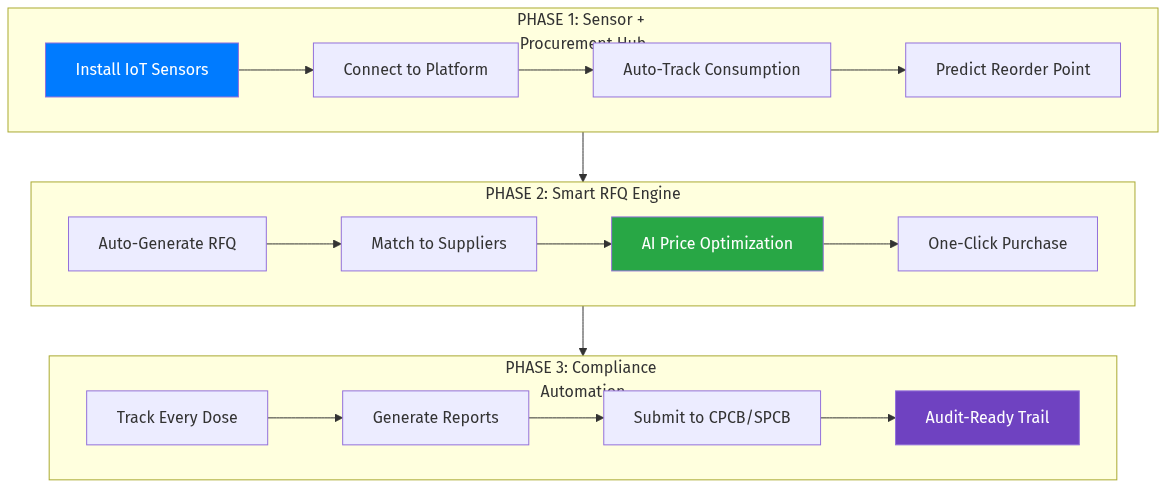
Architecture Diagram

2.

Problem Statement

The Manual Procurement Nightmare

India has 53+ Common Effluent Treatment Plants (CETPs) and hundreds of thousands of industrial facilities requiring water treatment chemicals for:

  • Boiler water treatment
  • Cooling tower management
  • Reverse osmosis systems
  • Effluent treatment plants (ETPs)
  • Zero Liquid Discharge (ZLD) systems
Yet procurement remains fragmented:

Pain PointImpact
WhatsApp/phone ordersNo audit trail, pricing inconsistency, stockouts
Manual invoicing60-90 day payment cycles, cash flow strain
No dosing integrationOverdosing wastes 30%+ chemicals; underdosing causes compliance failures
Paper compliance logsScramble before audits, risk of fines
Geographic fragmentationDifferent suppliers per region, no price benchmarking

Applying ZEROTH PRINCIPLES

Before building, we must question the axioms:

Assumed axiom: "Water treatment chemicals are commodities — price is the only differentiator." Challenge: This isn't true. The right chemical formulation for specific water TDS levels, just-in-time delivery, and integrated compliance documentation are massive value-adds that local distributors provide poorly. A commodity view ignores the service layer that creates lock-in and margin opportunity. Reframed axiom: Water treatment procurement is a compliance-critical workflow where chemicals are inputs but reliability, traceability, and regulatory alignment are the actual products.
3.

Current Solutions

Major Players

CompanyWhat They DoWhy They're Not Solving Procurement
Nalco Water (Ecolab)Full-service chemical provider, 8.5% market shareVertically integrated; doesn't enable multi-supplier procurement
Thermax LtdChemicals + equipment manufacturerProduct-focused, not procurement platform
Ion Exchange IndiaResins, chemicals, turnkey plantsSales-driven model, no marketplace dynamics
IndiaMARTGeneral B2B directoryLead generation only; no transaction layer, no compliance
ChemSol/Local distributorsRegional chemical supplyWhatsApp-based, no tech integration

Applying INCENTIVE MAPPING

Who profits from the status quo?
  • Local distributors profit from information asymmetry — they know local pricing, suppliers don't know competitor prices
  • Large chemical companies profit from long-term contracts that lock in buyers regardless of consumption optimization
  • Compliance consultants profit from manual audit preparation chaos
  • Feedback loops maintaining current behavior:
    • Buyers stick with known suppliers because switching costs (relationship, credit terms) are high
    • Suppliers have no incentive to provide dosing optimization — overdosing means more sales
    • Compliance remains manual because digital audit trails would expose inefficiencies

    4.

    Market Opportunity

    Market Size

    MetricValue
    India Water Treatment Chemicals Market (2024)$1.05 billion
    Projected Market (2033)$1.81 billion
    CAGR7.3%
    Ion Exchange Resins Segment (2024)$197 million
    Number of CETPs in India53+
    Estimated industrial facilities needing water treatment500,000+

    Why Now?

  • ZLD Mandates Tightening: CPCB and SPCBs are enforcing Zero Liquid Discharge across textiles, pharma, tanneries, and chemicals. Non-compliance means shutdown.
  • Smart Dosing Technology Maturing: IoT sensors can now track real-time consumption with 95%+ accuracy. The i-DOSE system demonstrates 30% chemical savings through predictive dosing.
  • Digital India Infrastructure: UPI, GST e-invoicing, and API-first compliance systems (CPCB portals) enable end-to-end digitization.
  • India+1 Manufacturing Surge: PLI schemes and China de-risking are driving industrial capacity expansion — all needing water treatment.
  • Geographic Hotspots

    RegionIndustry ClustersZLD Pressure
    GujaratChemicals, Pharma, TextilesVery High
    MaharashtraChemicals, Pharma, AutoHigh
    Tamil NaduTextiles, Auto, ElectronicsHigh
    TelanganaPharma, IT manufacturingMedium-High
    KarnatakaElectronics, PharmaMedium
    Market Structure
    Market Structure

    5.

    Gaps in the Market

    Applying ANOMALY HUNTING

    What's strange about this market?
  • Smart dosing exists but doesn't connect to procurement. Companies like Aqua-Chem offer i-DOSE systems that optimize chemical feed — but the data sits in silos. Nobody is using consumption data to trigger automatic reorders or RFQs.
  • $1B+ market with no vertical marketplace. IndiaMART lists thousands of chemical suppliers but offers no transaction layer, no compliance integration, no consumption tracking. Pure lead-gen in a market demanding workflow automation.
  • Compliance is the biggest cost, not chemicals. A ZLD violation can shut down a factory. Yet compliance documentation is an afterthought — assembled manually before audits from scattered WhatsApp chats and Excel sheets.
  • 30-50% wastewater still unrecycled despite ZLD mandates. This isn't a technology gap — it's an execution gap. Operators lack real-time visibility into chemical efficacy and procurement efficiency.
  • No credit infrastructure for chemical procurement. Unlike equipment financing, working capital for recurring chemical purchases is relationship-based, not data-driven.
  • The Convergence Gap

    Nobody is connecting:

    • IoT dosing dataProcurement automationCompliance reporting
    This is the whitespace.


    6.

    AI Disruption Angle

    Applying DISTANT DOMAIN IMPORT

    What other industry solved this? Industrial gas procurement (covered earlier): Linde and Air Liquide use telemetry to monitor cylinder levels and auto-schedule refills. The chemical industry hasn't adopted this for water treatment. Fleet fuel management: Platforms like Fleetx track every liter of fuel, benchmark consumption, and detect anomalies. Water treatment chemicals are equally trackable but remain manual. Agriculture input procurement: DeHaat and AgroStar bundle advisory + input sales, using farmer data to optimize recommendations. The same model applies: dosing advisory + chemical sales.

    The AI Agent Opportunity

    Current StateAI-Enabled State
    Manual reordering when tanks are lowPredictive reorder based on consumption patterns
    Price negotiation via phoneAI-optimized RFQ to multiple suppliers with dynamic pricing
    Paper compliance logsAuto-generated reports from dosing data
    Reactive troubleshootingAnomaly detection flags dosing inefficiencies before failures
    Supplier relationships based on trustData-driven supplier scoring on price, quality, delivery

    Agent Workflow Vision

    Sensor detects chemical level at 20%
    ↓
    AI predicts 5-day runway based on production schedule
    ↓
    Auto-generates RFQ to 3 pre-qualified suppliers
    ↓
    Evaluates bids on price + delivery time + quality history
    ↓
    Issues PO with integrated payment
    ↓
    Logs delivery, updates compliance dashboard
    ↓
    Generates monthly CPCB/SPCB reports automatically

    7.

    Product Concept

    Core Platform Components

    1. Sensor Integration Layer
    • Connect to existing smart dosing systems (i-DOSE, SCADA)
    • Retrofit IoT sensors for legacy systems ($200-500/unit)
    • Real-time consumption tracking at chemical tank level
    2. AI Procurement Engine
    • Predictive reorder algorithms based on consumption + production schedules
    • Multi-supplier RFQ automation
    • Dynamic pricing optimization using market data
    • Supplier quality scoring from delivery + product performance data
    3. Supplier Marketplace
    • Onboard verified suppliers (GST, FSSAI, quality certifications)
    • Real-time inventory and pricing from suppliers
    • Regional fulfillment optimization
    • Embedded credit/payment facilitation
    4. Compliance Dashboard
    • Auto-generate CPCB/SPCB reports
    • Track ZLD metrics (recovery rate, chemical consumption per KL)
    • Audit trail for every dose and purchase
    • Alert system for anomalies indicating compliance risk
    Product Flow
    Product Flow

    8.

    Development Plan

    PhaseTimelineDeliverables
    MVP8 weeksSensor integration + manual RFQ workflow for 5 pilot factories in Gujarat
    V112 weeksAuto-RFQ engine, supplier onboarding (20 suppliers), basic compliance reports
    V216 weeksPredictive reordering, AI price optimization, CPCB report automation
    V324 weeksEmbedded payments, credit facilitation, multi-state expansion

    Tech Stack

    • IoT: MQTT protocol, LoRaWAN for remote sites
    • Backend: Node.js/Python, PostgreSQL, TimescaleDB for time-series
    • AI: Consumption prediction (Prophet/LSTM), Price optimization (RL-based)
    • Compliance: Integration with CPCB/SPCB portals via official APIs
    • Payments: Razorpay for transactions, partnership with NBFC for credit

    9.

    Go-To-Market Strategy

    Phase 1: Gujarat Pilot (Months 1-4)

  • Partner with 2-3 smart dosing equipment providers (sensor install base)
  • Target 20 factories in Ankleshwar/Vapi chemical clusters
  • Offer free compliance dashboard as hook
  • Onboard 10 regional chemical suppliers
  • Phase 2: Network Effects (Months 5-8)

  • Introduce transaction-based model (% of GMV)
  • Launch supplier quality ratings visible to buyers
  • Add predictive reorder feature
  • Expand to Maharashtra (Tarapur, Chembur)
  • Phase 3: Credit + Scale (Months 9-12)

  • Launch embedded working capital for suppliers
  • Partner with industry associations (CII, FICCI chemical chapters)
  • Integrate with major ERP systems (SAP, Tally)
  • Target 500 factories, $5M GMV run-rate
  • Channel Strategy

    ChannelRole
    Equipment OEMsSensor install base, bundled offering
    Industry associationsCredibility, event presence
    Compliance consultantsReferrals (revenue share)
    Direct salesTop 50 chemical-intensive factories
    ---
    10.

    Revenue Model

    Revenue StreamModelTarget
    Transaction fee1.5-2.5% of GMVPrimary revenue
    Supplier SaaS₹10,000-50,000/month for premium listing + analytics₹5L MRR by Month 12
    Sensor hardwareCost + 20% margin (optional retrofit)Break-even
    Credit facilitation1% of loan disbursed (NBFC partnership)Upside
    Compliance reports₹2,000/report for premium auditsSupplement

    Unit Economics Target

    • Buyer CAC: ₹15,000 (1 month of transactions covers)
    • Supplier CAC: ₹5,000 (SaaS revenue recovers in 2 months)
    • GMV per factory: ₹50,000-2,00,000/month (depending on size)
    • Target take rate: 2% blended

    11.

    Data Moat Potential

    Proprietary Data Assets

  • Consumption patterns by industry vertical — What chemical combinations work for specific water TDS levels in textiles vs. pharma?
  • Supplier performance data — Delivery times, quality consistency, pricing trends across regions
  • Compliance benchmarks — What does "good" look like for ZLD compliance in each industry?
  • Predictive models — Consumption forecasting accuracy improves with scale, creating switching costs
  • Network Effects

    • More buyers → Better pricing negotiation power → More suppliers want to join
    • More transaction data → Better AI recommendations → Higher buyer retention
    • More compliance data → Regulatory credibility → Industry association partnerships

    12.

    Why This Fits AIM Ecosystem

    This opportunity aligns perfectly with AIM.in's thesis:

    AIM PrincipleApplication
    Structured B2B discoveryVerified supplier profiles with quality scores, not just listings
    AI-first workflowsPredictive procurement, not passive marketplace
    Regulatory moatCompliance automation creates stickiness regulators appreciate
    Repeat transactionsChemicals are consumables — monthly GMV per buyer
    Offline-first IndiaWhatsApp notifications + basic feature phones for plant operators

    Portfolio Synergy

    • Cross-sell with industrial MRO (spare parts for dosing equipment)
    • Bundle with calibration services (sensors need periodic calibration)
    • Extend to adjacent chemicals (boiler chemicals, HVAC treatment)

    ## Verdict

    Applying PRE-MORTEM: Why Would This Fail?

  • Supplier resistance: Large players (Nalco, Thermax) may refuse to join a transparent marketplace that commoditizes their pricing. Mitigation: Start with tier-2/3 suppliers hungry for visibility.
  • Buyer inertia: Factory managers have 20-year relationships with distributors. Mitigation: Compliance automation is the wedge — nobody likes audit scrambles.
  • Sensor retrofit complexity: Legacy systems may resist integration. Mitigation: Partner with equipment OEMs for bundled offering.
  • Regulatory uncertainty: CPCB/SPCB may change reporting formats. Mitigation: Modular compliance engine, stay close to regulators.
  • Applying STEELMANNING: Why Incumbents Might Win

    Best case for Nalco/Thermax: They bundle chemicals + equipment + IoT + compliance into a turnkey "Water-as-a-Service" offering, locking out third-party procurement platforms. Counter-argument: This requires vertical integration that conflicts with their sales-driven culture. They optimize for chemical volume, not customer efficiency. A neutral platform that helps buyers reduce chemical consumption is structurally misaligned with their incentives.

    Bayesian Confidence

    FactorEvidence StrengthConfidence Impact
    Market size ($1.8B by 2033)High (multiple research reports)+15%
    Pain points (WhatsApp ordering)High (direct supplier quotes)+20%
    ZLD regulatory pressureHigh (government mandates active)+15%
    No existing marketplaceHigh (search confirms)+20%
    Smart dosing maturityMedium (emerging, not ubiquitous)+10%
    Buyer willingness to switchMedium (inertia risk)-10%
    Opportunity Score: 8.5/10

    This is a large, growing market with acute pain points, regulatory tailwinds, and no credible tech-enabled solution. The primary risks are execution (supplier onboarding, sensor integration) rather than market validity. First-mover with a compliance-first wedge can build defensible data moats.


    ## Sources