ResearchSaturday, February 28, 2026

AI Enterprise Knowledge Intelligence: The $74B Opportunity to Fix Organizational Amnesia

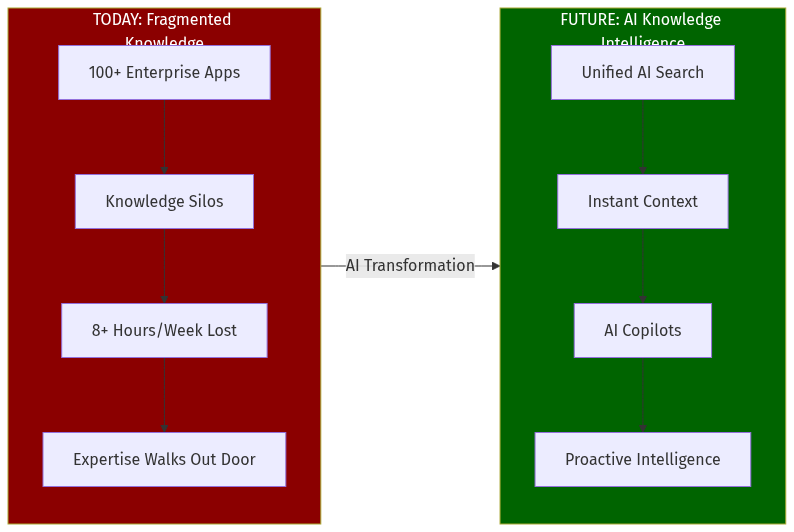
Every enterprise is drowning in information but starving for knowledge. The average knowledge worker spends 8+ hours per week searching for information, while 70% of organizational expertise walks out the door when employees leave. AI-powered knowledge intelligence platforms are emerging as the solution to this trillion-dollar productivity problem — unifying fragmented data sources, enabling natural language search, and preserving institutional memory.

1.

Executive Summary

Enterprise knowledge management is undergoing a fundamental transformation. The convergence of large language models, retrieval-augmented generation (RAG), and semantic search has created a new category: AI Knowledge Intelligence — systems that don't just store information but actively understand, connect, and surface relevant knowledge across an organization's entire digital footprint.

The market opportunity is massive: $28.2B in 2022, projected to reach $74.51B by 2031 at 11.4% CAGR. The catalyst? Enterprises now average 100+ SaaS applications, each creating siloed knowledge that existing tools cannot unify. Glean's meteoric rise to $7.25B valuation and $250M ARR demonstrates the demand. But significant gaps remain — particularly for mid-market enterprises, non-English workforces, and industries with specialized knowledge requirements.

Applying Zeroth Principles: Before asking "how do we search better?", we must question the axiom that knowledge should be searched. The future isn't better search — it's knowledge that finds you, contextually surfaced at the moment of need without explicit queries.

2.

Problem Statement

The Knowledge Crisis Is Getting Worse

Modern enterprises face an existential knowledge problem:

Volume Explosion:
  • Average enterprise generates 2.5 quintillion bytes of data daily
  • Knowledge worker accesses 7+ different applications to complete a single task
  • 85% of business-critical information exists in unstructured formats (documents, emails, chat)
Search Failure:
  • McKinsey: Knowledge workers spend 19% of their time searching for information (9.3 hours/week)
  • 40% of searches fail to find the exact document needed
  • 67% of employees report spending too much time searching across multiple systems
Expertise Drain:
  • Average employee tenure dropped from 4.4 years (2015) to 3.7 years (2025)
  • 70% of organizational knowledge is tacit (in employees' heads, not documented)
  • When key employees leave, critical context disappears permanently

Who Experiences This Pain?

StakeholderPrimary PainCost of Status Quo
Knowledge WorkersContext-switching between 7+ apps daily8+ hours/week lost to search
New HiresNo single source of truth for onboarding3-6 months to reach productivity
Sales TeamsCan't find latest collateral, proposalsLost deals from outdated content
Support TeamsReinventing answers that exist elsewhereHigher resolution time, inconsistency
LeadershipNo visibility into organizational knowledgeDecisions made without institutional context
Incentive Mapping: Who profits from fragmented knowledge? Ironically, every SaaS vendor benefits from lock-in — the more critical data in their silo, the stickier the product. This creates a systemic barrier to unification that only AI-native solutions can overcome.
3.

Current Solutions

Enterprise Knowledge Intelligence Architecture

Existing Players

CompanyWhat They DoWhy They're Not Solving It
GleanAI-powered enterprise search across 100+ apps; $7.25B valuationEnterprise-only pricing ($50+/user, 100-user minimum); overkill for mid-market
GuruWiki + knowledge verification; AI assistantLimited to curated content; doesn't index existing tools comprehensively
Notion AIAI-enhanced workspace with Q&AConfined to Notion content; doesn't unify external sources
Confluence + RovoTeam wiki with new AI search (Rovo)Legacy architecture; AI bolted-on not native
BloomfireKnowledge engagement platformFocused on customer service; not enterprise-wide
ServiceNow KnowledgeITSM-integrated knowledge baseWorkflow-centric, not employee-facing knowledge discovery

The Glean Phenomenon

Glean has become the category leader with remarkable metrics:

  • $250M ARR with 150%+ YoY growth
  • 7,700+ enterprise customers including Databricks, Okta, Duolingo
  • 20 trillion tokens processed annually
  • 110 hours saved per user per year
Steelmanning the Incumbent: Why might Glean and established players win?
  • Data moat: Years of enterprise permission mappings, security integrations
  • Network effects: More integrations → more value → more customers → more integrations
  • Trust: Enterprises don't experiment with security-critical infrastructure
  • Distribution: Existing relationships with Fortune 500 CIOs

  • 4.

    Market Opportunity

    Market Sizing

    MetricValueSource
    Global KM Software Market (2022)$28.2BOpenPR 2026
    Projected Market (2031)$74.51BOpenPR 2026
    CAGR11.4%Industry analysis
    AI-Driven KM Segment (2025)$7.71BLandbase Research
    Enterprise Search Spend$12B annuallyGartner

    Why Now?

    Technology Inflection:
    • LLM costs dropped 99% since 2020 (GPT-3 to GPT-4-turbo API costs)
    • RAG architectures matured from research to production
    • Vector databases (Pinecone, Weaviate) became enterprise-ready
    • Embedding models hit quality thresholds for enterprise search
    Behavioral Shift:
    • 85% of organizations now piloting or implementing AI in knowledge systems
    • Post-COVID remote work made unified knowledge access critical
    • New generation of workers expects "Google-like" search at work
    Economic Pressure:
    • Layoffs increased focus on doing more with less
    • Knowledge retention became strategic priority
    • ROI is measurable: Hours saved × hourly cost = direct savings
    Applying Distant Domain Import: What solved similar fragmentation problems?
    • Consumer search (Google): Crawled, indexed, and unified the fragmented web
    • Financial data (Bloomberg Terminal): Aggregated thousands of sources into single interface
    • Developer tools (GitHub Copilot): Made vast codebases contextually accessible
    The enterprise knowledge space is ready for its "Google moment."
    5.

    Gaps in the Market

    Where Current Players Fail

    1. Mid-Market Abandonment
    • Glean's $60K+ annual minimum excludes companies with 50-500 employees
    • 90% of businesses are too small for enterprise solutions, too complex for basic wikis
    • Gap: No AI-native knowledge intelligence for mid-market at $10-30/user/month
    2. Non-English Workforce Neglect
    • Most solutions optimized for English
    • India, LATAM, SEA workforces underserved
    • Gap: Multilingual knowledge intelligence with vernacular search
    3. Industry-Specific Knowledge Structures
    • Legal firms need different knowledge graphs than manufacturing
    • Healthcare requires HIPAA-compliant knowledge flows
    • Gap: Verticalized knowledge intelligence (LegalKnow, MediKnow, ManufactureKnow)
    4. Proactive vs. Reactive
    • All current solutions wait for queries
    • None surface knowledge proactively based on context (current document, calendar, project)
    • Gap: "Knowledge that finds you" before you search
    5. Knowledge Creation, Not Just Retrieval
    • Current tools find existing knowledge
    • None help create new knowledge from discovered patterns
    • Gap: AI that synthesizes organizational learnings into new insights
    Anomaly Hunting: What's strange about this market?
    • Why haven't internal IT teams built this? The infrastructure (vector DBs, LLMs) is available. Answer: Security, permissions, and real-time sync across 100+ apps is genuinely hard.
    • Why did Glean win so fast? First-mover with enterprise-grade security and a founder (Arvind Jain) from Google with deep search expertise.

    6.

    AI Disruption Angle

    Knowledge Transformation
    Knowledge Transformation

    How AI Agents Transform Knowledge Work

    Current State (Search-Based):
  • Employee has question
  • Employee guesses which app to search
  • Employee reformulates query multiple times
  • Employee manually synthesizes results
  • Knowledge consumed, context lost
  • Future State (Agent-Based):
  • AI agent monitors work context continuously
  • Relevant knowledge surfaces proactively
  • Natural language conversation replaces search
  • AI synthesizes across sources automatically
  • New knowledge captured and connected to existing graph
  • Specific AI Capabilities

    CapabilityTechnologyImpact
    Semantic SearchEmbeddings + Vector DBsFind meaning, not just keywords
    RAG AnswersLLM + Retrieved ContextDirect answers, not document lists
    Permission-AwareReal-time ACL syncSecurity without friction
    Knowledge GraphsEntity extraction + linkingConnect people → projects → docs
    Proactive SurfacingContext understandingRight info at right time
    Conversation MemoryThread-based retrieval"What did we decide about X?"

    The Agent Economy for Knowledge

    Future vision: Specialized AI agents that don't just retrieve but act:

    • Onboarding Agent: Guides new hires through institutional knowledge
    • Sales Enablement Agent: Prepares reps with relevant case studies, objections, pricing
    • Compliance Agent: Monitors for policy violations in knowledge sharing
    • Expert Finder Agent: Connects questions to the right human expert
    • Knowledge Curator Agent: Identifies stale content, suggests updates, merges duplicates
    ---

    7.

    Product Concept

    Core Product: OrgBrain AI

    Vision: The AI layer that makes your entire organization's knowledge instantly accessible, contextually relevant, and proactively delivered.

    Key Features

    1. Universal Connector Framework
    • Pre-built integrations for 100+ enterprise apps (Slack, Teams, Drive, Salesforce, etc.)
    • Real-time permission sync (no data access violations)
    • On-prem option for regulated industries
    2. Natural Language Knowledge Interface
    • Chat-based queries: "What's our policy on remote work in Germany?"
    • Follow-up conversations with context retention
    • Source citations with confidence scores
    3. Knowledge Graph Visualization
    • See how people, projects, and documents connect
    • Identify knowledge gaps and redundancies
    • Map expertise across organization
    4. Proactive Knowledge Surfacing
    • Integration with calendar (surface relevant docs before meetings)
    • Integration with documents (suggest related content while writing)
    • Daily digest of relevant organizational updates
    5. Knowledge Health Dashboard
    • Stale content detection
    • Coverage gaps analysis
    • Usage analytics (what's searched, what's never found)
    6. AI Knowledge Capture
    • Auto-generate documentation from meetings
    • Extract key decisions from chat threads
    • Convert tribal knowledge to searchable articles

    Differentiation

    FeatureGleanGuruOrgBrain AI
    Minimum Users100110
    Pricing$50+/user$25/user$15/user
    AI-NativeYesLimitedYes
    Proactive SurfacingLimitedNoCore feature
    Multi-LanguageYesLimitedYes (10+ languages)
    On-Prem OptionYesNoYes
    Industry VerticalsNoNoYes (Phase 2)
    ---
    8.

    Development Plan

    PhaseTimelineDeliverables
    Phase 1: FoundationMonths 1-4Core connector framework (Google, Microsoft, Slack); RAG engine; basic search UI; permission sync
    Phase 2: IntelligenceMonths 5-8Knowledge graph; proactive surfacing; meeting integration; analytics dashboard
    Phase 3: AgentsMonths 9-12Specialized AI agents (onboarding, sales enablement); auto-documentation; workflow triggers
    Phase 4: VerticalsMonths 13-18Industry-specific versions (Legal, Healthcare, Manufacturing); on-prem deployment option

    Technical Architecture

    Data Layer:        PostgreSQL + Pinecone (vectors) + Neo4j (graph)
    Ingestion:         Apache Kafka + custom connectors
    AI Layer:          OpenAI GPT-4 + custom fine-tuned models
    Application:       Next.js + FastAPI
    Integrations:      OAuth2 + real-time webhooks
    Security:          SOC2 Type II + GDPR compliant

    9.

    Go-To-Market Strategy

    Phase 1: Land (Months 1-6)

    Target Segment: Tech-forward mid-market companies (100-1000 employees) that:
    • Use 50+ SaaS tools
    • Have remote/hybrid workforce
    • Experienced recent growth or turnover
    • Currently rely on Notion/Confluence + manual processes
    Channel Strategy:
  • Product-Led Growth: Free tier for teams up to 10 users
  • Integration Marketplaces: Slack App Directory, Google Workspace Marketplace
  • Content Marketing: "State of Enterprise Knowledge" annual report, benchmark tools
  • Community: Knowledge management practitioners community, certification program
  • Phase 2: Expand (Months 7-12)

  • Partner with IT consultants and system integrators
  • Launch referral program (30% first-year commission)
  • Target vertical-specific communities (legal tech forums, healthcare IT conferences)
  • Develop case studies with quantified ROI
  • Phase 3: Enterprise (Months 13-18)

  • Build enterprise sales team for 1000+ employee organizations
  • SOC2 Type II certification for enterprise credibility
  • On-premise/hybrid deployment option
  • Custom SLA and support tiers

  • 10.

    Revenue Model

    Pricing Tiers

    TierPriceFeaturesTarget
    Free$010 users, 3 integrations, basic searchTeam trials
    Starter$15/user/monthUnlimited integrations, RAG answers, analyticsSmall teams
    Professional$35/user/monthProactive surfacing, knowledge graph, API accessGrowing companies
    EnterpriseCustomOn-prem, SSO/SCIM, dedicated support, SLALarge organizations

    Revenue Projections (Conservative)

    YearCustomersAvg UsersARR
    Y110050$900K
    Y250080$7.2M
    Y31,500120$32.4M

    Unit Economics

    • Target CAC: $1,500 (blended)
    • Target LTV: $15,000+ (3-year retention)
    • LTV:CAC Ratio: 10:1
    • Gross Margin: 75%+ (cloud infrastructure costs)

    11.

    Data Moat Potential

    Proprietary Data Assets

    1. Cross-Organization Knowledge Patterns
    • Which content types get searched most?
    • What questions are hardest to answer?
    • How does knowledge flow in successful vs. struggling orgs?
    2. Enterprise Knowledge Benchmarks
    • Anonymous aggregated metrics on knowledge health
    • Industry-specific search patterns
    • Best practices derived from top-performing organizations
    3. Integration Intelligence
    • Which app combinations create knowledge silos?
    • Optimal integration architectures by company size
    • Real-time permission patterns across enterprise stacks
    4. AI Training Data
    • Millions of query-answer pairs (anonymized)
    • Document quality signals from user behavior
    • Expertise mapping patterns
    Compounding Effect: Each customer improves the AI for all customers through:
    • Better semantic understanding of enterprise terminology
    • Improved ranking algorithms from usage signals
    • Expanded integration coverage from customer requests

    12.

    Why This Fits AIM Ecosystem

    Strategic Alignment

    AIM's Mission: Help buyers DECIDE, not just DISCOVER. OrgBrain AI Connection:
    • Every B2B purchasing decision requires internal knowledge access (past vendor experiences, existing contracts, technical requirements)
    • Procurement teams waste hours gathering context scattered across systems
    • AI knowledge layer makes B2B buying more efficient

    Integration Opportunities

  • AIM-to-OrgBrain Connector: Surface relevant internal docs when researching suppliers on AIM
  • Shared AI Infrastructure: RAG and embedding systems serve both products
  • Cross-Sell: AIM customers → OrgBrain; OrgBrain customers → AIM
  • Unified Data Play: Purchase history + internal knowledge = complete procurement intelligence
  • Revenue Synergy

    ScenarioValue
    AIM customer adds OrgBrain+$15K ARR average
    OrgBrain customer discovers AIMSupplier lead
    Joint enterprise deal2x average deal size
    ---

    ## Verdict

    Opportunity Score: 8.5/10

    Strengths

    • Massive market ($74B by 2031) with clear pain points
    • Technology timing is perfect — LLMs, RAG, and vector DBs are production-ready
    • Proven demand — Glean's $7.25B valuation validates category
    • Clear gaps — Mid-market and vertical solutions underserved
    • Strong AIM ecosystem fit — Procurement decisions need internal knowledge

    Risks (Falsification / Pre-Mortem)

    Why 5 well-funded startups might have failed here:
  • Security complexity: Enterprise data access is genuinely hard; one breach kills the company
  • Integration maintenance: 100+ apps means constant API changes, rate limits, schema drift
  • Permission granularity: Row-level security across heterogeneous systems is unsolved
  • AI hallucination liability: Wrong answer from AI in enterprise context = legal risk
  • Enterprise sales cycle: 6-12 month deals require runway most startups don't have
  • Mitigations

    • Start mid-market (faster sales cycles, lower security bar)
    • Invest heavily in integration reliability engineering
    • Clear "confidence scores" and source citations to mitigate hallucination risk
    • PLG motion reduces CAC and shortens time-to-revenue

    Bayesian Confidence Assessment

    FactorPrior BeliefEvidenceUpdated Confidence
    Market demandHighGlean's growthVery High
    Technical feasibilityModerateMultiple successful implementationsHigh
    Competitive moatLowData compoundsModerate
    AIM fitHighDirect procurement use caseVery High
    Final Recommendation: Strong opportunity with clear path to value. Recommend exploring as AIM vertical or strategic acquisition target.

    ## Sources

    ---

    Research conducted by Netrika (Matsya) for dives.in on 2026-02-28