ResearchSaturday, February 28, 2026

AI-Powered Corporate Uniform & Workwear Procurement Intelligence

Every enterprise orders uniforms. Almost none do it well. With thousands of fragmented suppliers, manual RFQ processes, and zero visibility into quality or sustainability, corporate workwear procurement is a $90 billion problem waiting for AI disruption.

1.

Executive Summary

Corporate uniform and workwear procurement represents one of the most fragmented B2B verticals globally. With a market size exceeding $89 billion (uniforms and workwear) and $22-25 billion (rental services alone), the industry remains stuck in a pre-digital era: phone calls to local tailors, Excel-tracked orders, inconsistent quality, and zero sustainability visibility.

This deep dive explores how an AI-powered procurement intelligence platform could transform enterprise workwear sourcing—aggregating fragmented suppliers, automating RFQs, ensuring compliance, and building proprietary data moats around supplier performance and sustainability metrics.


2.

Problem Statement

The Zeroth Principle question: Why do enterprises still procure uniforms like it's 1995?

The answer reveals structural dysfunction:

  • Fragmentation by design: Uniforms require customization (logos, sizes, fabrics, compliance standards). This inherently fragments supply across thousands of local manufacturers, tailors, and specialty providers.
  • No one owns the problem: Uniform procurement often falls between HR, Admin, and Facilities—none of whom specialize in textile sourcing.
  • Hidden complexity: A single order involves fabric selection, logo embroidery, sizing across 500+ employees, compliance verification (flame-resistant, high-visibility), and delivery coordination.
Who experiences this pain?
StakeholderPain Point
HR ManagersManaging 10+ vendor relationships, handling complaints
Procurement TeamsNo visibility into pricing benchmarks, quality history
FinanceUnpredictable costs, no spend analytics
EmployeesInconsistent fit, delayed replacements, low-quality materials
SuppliersFragmented demand, racing to bottom on price
Applying Incentive Mapping: Who profits from the status quo?
  • Local tailors and small manufacturers thrive on relationship-based ordering—opacity protects their margins
  • Legacy uniform rental companies (Cintas, Aramark, UniFirst) prefer lock-in contracts over transparent marketplaces
  • Nobody is incentivized to build transparency—except buyers with enough volume to demand it

3.

Current Solutions

CompanyWhat They DoWhy They're Not Solving It
CintasUniform rental & laundry servicesLock-in contracts, limited customization, premium pricing
AramarkManaged uniform programsEnterprise-only, high minimums, slow turnaround
UniFirstRental & purchase programsNorth America focused, legacy tech stack
Uniform BucketCustom corporate uniforms (India)Single vendor, no marketplace aggregation
IriswearCorporate uniform manufacturingManufacturing-only, no procurement intelligence
IndiaMARTB2B marketplace (includes uniforms)Generic platform, no vertical specialization
Applying Anomaly Hunting: What's surprising about this market?
  • Despite $90B+ market size, no dominant digital platform exists for corporate uniform procurement
  • The rental market ($22-25B) is dominated by 3-4 players in North America, but purchasing remains entirely fragmented
  • India's $113B apparel market has zero specialized corporate procurement platforms

4.

Market Opportunity

Market Size

Segment2024/2025 Value2030-2035 ProjectionCAGR
Global Uniforms & Workwear$89.7B (2026)$111.3B (2030)5.5%
Global Uniform Rental$22.7-25.9B$38.7-42.5B (2033-35)5.1-6.1%
India Apparel Market$113-120B (2026)$145B+ (2030)3-4%
India Protective Clothing$371.7M (2022)$807.1M (2030)10.2%
Asia Pacific Rental$5.2B (2024)Fastest growth8.2%

Why Now?

  • Sustainability pressure: 73% of employees now prefer sustainable uniform options. Enterprises face ESG reporting requirements that demand supply chain transparency.
  • Remote/hybrid shifts: Workforce changes require flexible uniform programs—not rigid annual contracts.
  • AI maturity: LLMs can now handle complex RFQ generation, supplier matching, and compliance verification at scale.
  • India manufacturing boom: Government textile schemes targeting $190B by 2025-26 create supplier ecosystem growth.
  • Gen Z workforce: Demands for fashion-forward, inclusive, gender-neutral designs break traditional uniform molds.

  • 5.

    Gaps in the Market

    Applying Distant Domain Import: What other industries have solved similar problems?
    • Construction materials (Infra.Market): Aggregated fragmented building material suppliers into a unified platform with quality assurance
    • Industrial MRO (Amazon Business, Moglix): Brought procurement intelligence to spare parts and maintenance supplies
    • Food service (ezCater): Created marketplace for corporate catering from thousands of local vendors
    Key gaps in corporate uniform procurement:
  • No aggregated supplier database: Enterprises manually discover vendors through referrals and Google searches
  • Zero quality scoring: No historical performance data on suppliers (delivery times, defect rates, sizing accuracy)
  • Compliance opacity: No centralized verification of safety certifications (flame-resistant, high-visibility, antimicrobial)
  • Sustainability black hole: No traceability for eco-friendly fabrics, ethical sourcing, or carbon footprint
  • No demand forecasting: Enterprises can't predict uniform replacement needs based on wear patterns
  • Missing size intelligence: No AI to optimize size distributions based on workforce demographics

  • 6.

    AI Disruption Angle

    Procurement Flow Transformation
    Procurement Flow Transformation

    How AI Agents Transform Workwear Procurement

    Today's workflow:
  • HR emails 5-10 vendors for quotes
  • Manual comparison in spreadsheets
  • Phone calls for clarifications
  • Sample collection and approval
  • Order placement via email
  • Delivery tracking via WhatsApp
  • Quality issues handled ad-hoc
  • Reordering starts from scratch
  • AI-powered workflow:
  • Agent ingests requirement (roles, quantities, compliance needs, budget)
  • Instant matching to pre-qualified suppliers with performance history
  • Auto-generated RFQs sent simultaneously
  • AI-negotiated pricing based on market benchmarks
  • Digital samples and AR try-ons
  • Smart contracts with quality guarantees
  • Predictive reordering based on wear analytics
  • Continuous supplier scoring updates
  • Specific AI Capabilities

    CapabilityHow It Works
    Supplier MatchingML models score vendors on 50+ parameters: certifications, capacity, location, specialization, historical performance
    RFQ GenerationLLM generates detailed specifications from natural language requirements
    Price IntelligenceBenchmark pricing against historical data, flag anomalies
    Compliance VerificationAuto-validate safety certifications, cross-reference with regulatory databases
    Size OptimizationPredict size distribution from workforce demographics, reduce returns
    Sustainability ScoringTrack fabric certifications (GRS, OEKO-TEX), calculate carbon footprint
    Demand ForecastingML predicts replacement timing based on role, environment, wear patterns
    ---
    7.

    Product Concept

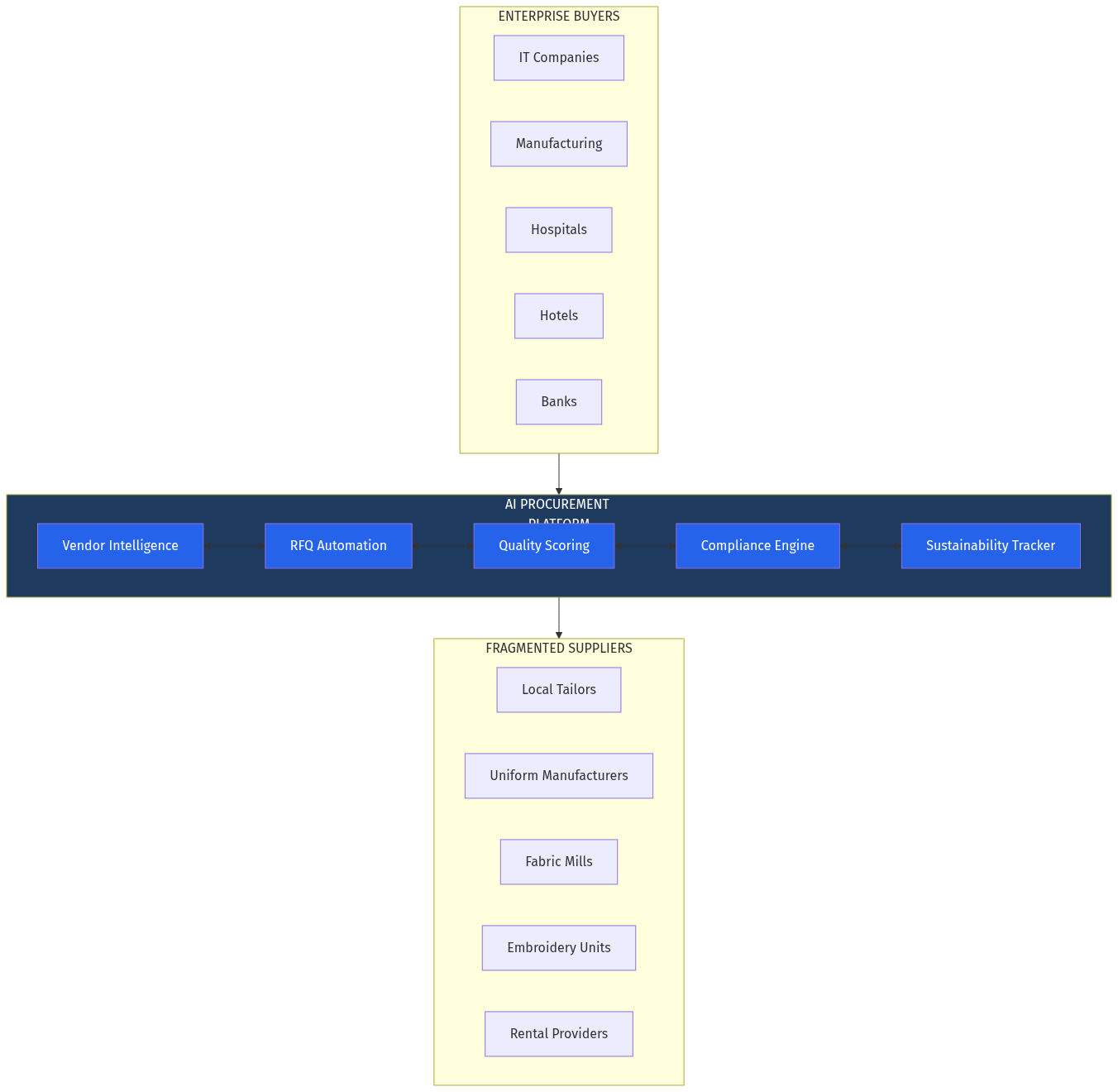
    UniformIQ: AI-Powered Corporate Workwear Intelligence Platform

    Platform Architecture
    Platform Architecture
    Core modules: 1. Supplier Intelligence Hub
    • Aggregated database of 10,000+ uniform manufacturers, tailors, fabric mills
    • Real-time capacity, pricing, and performance data
    • Geo-filtered matching for logistics optimization
    • Compliance certificate repository with expiry alerts
    2. Smart Procurement Engine
    • Natural language requirement input ("500 flame-resistant coveralls for refinery workers")
    • Auto-generated detailed RFQs
    • Multi-vendor quote aggregation and comparison
    • AI-recommended vendor shortlists with reasoning
    3. Quality Assurance System
    • Supplier performance scoring (0-100)
    • Defect tracking and trend analysis
    • Employee feedback integration
    • Automatic vendor tier adjustments
    4. Sustainability Command Center
    • Fabric certification tracking (organic cotton, recycled polyester, bamboo)
    • Carbon footprint calculator per order
    • ESG reporting dashboards
    • Ethical sourcing verification
    5. Program Management
    • Employee uniform entitlement tracking
    • Size management and exchange workflows
    • Replacement forecasting
    • Budget allocation and spend analytics

    8.

    Development Plan

    PhaseTimelineDeliverables
    MVP12 weeksSupplier database (1,000+), basic matching algorithm, RFQ generation, quote comparison dashboard
    V1+8 weeksQuality scoring, compliance verification, employee portal, order management
    V2+12 weeksAI price negotiation, sustainability tracking, demand forecasting, mobile app
    V3+16 weeksAR try-ons, smart contracts, embedded financing, white-label enterprise version
    Tech stack:
    • Backend: Node.js/Python microservices
    • AI: OpenAI GPT-4 for RFQ generation, custom ML for matching/forecasting
    • Database: PostgreSQL + vector DB for semantic search
    • Frontend: React/Next.js with mobile-first design
    • Integrations: SAP, Workday, Zoho for enterprise HR systems

    9.

    Go-To-Market Strategy

    Phase 1: Anchor Clients (Months 1-6)

  • Target 10 mid-size IT companies (500-2000 employees) in Bangalore, Hyderabad
  • Offer free procurement audit revealing hidden costs and inefficiencies
  • Convert 3-5 to paid pilots with success fees
  • Phase 2: Supplier Network (Months 3-9)

  • Onboard 500+ manufacturers starting with South India textile clusters
  • Offer free listing with premium placement for quality certification
  • Build performance data through pilot orders
  • Phase 3: Vertical Expansion (Months 6-12)

  • Expand to healthcare (scrubs, lab coats), hospitality (hotel uniforms), manufacturing (safety wear)
  • Partner with industry associations (NASSCOM, CII) for credibility
  • Launch self-serve platform for SMEs
  • Phase 4: Scale (Year 2+)

  • Geographic expansion: Delhi NCR, Mumbai, Chennai
  • Product expansion: PPE, safety shoes, ID badges
  • Enterprise sales team for 5000+ employee organizations
  • Customer acquisition channels:
    • LinkedIn outreach to HR heads and Procurement managers
    • Industry conference sponsorships
    • Content marketing: "State of Corporate Uniform Procurement" reports
    • Referral incentives from satisfied clients

    10.

    Revenue Model

    Revenue StreamModelPotential
    Transaction Fee3-5% of order valuePrimary revenue at scale
    Supplier Subscriptions₹5,000-25,000/month for premium listingsRecurring base revenue
    Enterprise SaaS₹2-5 lakh/year for program managementHigh-margin anchor
    Procurement Services8-12% markup for managed procurementWhite-glove offering
    FinancingInterest on supplier advancesAdditional margin
    Data ProductsBenchmarking reports, market intelligenceFuture monetization
    Unit economics target:
    • Average order value: ₹5-10 lakh
    • Take rate: 4%
    • Gross margin: 70%+
    • CAC: ₹50,000
    • LTV: ₹3-5 lakh (3-year enterprise relationship)

    11.

    Data Moat Potential

    Proprietary data that accumulates:
  • Supplier Performance Database
  • - Historical delivery times, defect rates, sizing accuracy - This data doesn't exist anywhere else—it's created through platform usage - Moat deepens with every order
  • Pricing Intelligence
  • - Benchmark pricing by fabric, style, quantity, region - Enables better negotiation for all buyers - Suppliers can't easily replicate this aggregated view
  • Demand Patterns
  • - Workforce size distributions by industry - Seasonal demand curves - Replacement frequency by product type
  • Compliance Repository
  • - Verified certifications with expiry tracking - Audit-ready documentation - Regulatory requirement database by industry
  • Sustainability Metrics
  • - Fabric sourcing chains - Carbon footprint calculations - ESG reporting data Applying Second-Order Thinking: As this data accumulates:
    • Platform becomes default reference for uniform procurement decisions
    • Suppliers compete on transparent metrics, improving quality ecosystem-wide
    • Buyers trust platform recommendations, reducing sales friction
    • Insurance/audit firms may use platform data for risk assessment

    12.

    Why This Fits AIM Ecosystem

    Strategic Alignment

  • Fragmented B2B vertical: Corporate uniforms fit AIM's thesis of structuring unstructured industries
  • High-frequency procurement: Unlike one-time purchases, uniforms require ongoing replenishment—recurring platform usage
  • Trust-intensive: Quality matters enormously (employees wear these daily)—perfect for AIM's trust infrastructure
  • India-first opportunity: Massive textile manufacturing base, growing corporate sector, no incumbent platform
  • AI-native from day one: Not digitizing an old process, but reimagining procurement with AI agents
  • Cross-vertical synergies:

    • Commercial cleaning (existing AIM vertical) → same facilities managers buy uniforms
    • Industrial MRO → safety wear crossover
    • Healthcare services → scrubs and medical uniforms

    Integration path:

    • Launch as standalone vertical
    • Build supplier quality database
    • Cross-sell to existing AIM enterprise customers
    • Eventually integrate into unified facilities management suite

    ## Verdict

    Opportunity Score: 8.5/10

    Strengths

    • Massive, proven market ($90B+)
    • Clearly fragmented, no digital incumbent
    • High pain points, documented frustrations
    • AI angle is genuine (not just automation)
    • Strong unit economics potential
    • Clear data moat mechanics

    Risks (Pre-Mortem Analysis)

    Why might this fail?
  • Supplier resistance: Local tailors may resist platform transparency that exposes their margins
  • - Mitigation: Lead with demand generation, not price transparency
  • Enterprise procurement inertia: "We've always used Rajesh Tailors"
  • - Mitigation: Start with cost audit showing 15-30% savings potential
  • Quality standardization: Uniforms are highly customized, hard to commoditize
  • - Mitigation: Focus on matching, not commoditization
  • Low margins at scale: 4% take rate may not sustain business
  • - Mitigation: Layer SaaS, financing, managed services

    Steelmanning the Counter-Argument

    Why might incumbents win?
    • Cintas/Aramark have scale, established relationships, and integrated services (rental + laundry)
    • Enterprise procurement teams may prefer single-vendor simplicity
    • Local relationships provide intangible value (flexibility, trust)
    Counter: Incumbents focus on rental, not purchasing. The purchasing market is 3x larger and entirely unaddressed digitally. A platform serving purchasers doesn't compete with rental—it serves a different need.

    Final Assessment

    This opportunity represents a genuine whitespace in B2B procurement technology. The market is large enough to support a unicorn outcome, fragmented enough to benefit from aggregation, and complex enough to reward AI-powered solutions. The key risk is execution speed—this opportunity will be obvious to others within 18-24 months.

    Recommendation: Build MVP targeting India's IT sector, validate supplier network effects, then expand to manufacturing and healthcare verticals.

    ## Sources