ResearchSaturday, February 28, 2026

AI-Powered Commercial Laundry & Linen Services Procurement Intelligence: The $15 Billion Hidden B2B Opportunity

Every hotel, hospital, and restaurant needs clean linens daily — yet this massive industry operates on phone calls, WhatsApp messages, and gut-feel supplier selection. An AI-native marketplace could transform how India's $2+ billion commercial laundry sector operates, bringing transparency, quality assurance, and logistics optimization to an industry still running on relationship-based trust.

1.

Executive Summary

Commercial laundry and linen services form the invisible backbone of hospitality, healthcare, and corporate operations. Hotels need fresh bed linens daily. Hospitals require infection-controlled medical textiles. Restaurants demand spotless tablecloths and chef uniforms. Corporate offices need uniform laundering for thousands of employees.

Yet this $15+ billion global market (with India at $2+ billion and growing at 8% CAGR) remains stubbornly fragmented, offline, and relationship-driven. Procurement decisions are made based on referrals, price haggling, and hope — not data, quality metrics, or operational intelligence.

The opportunity: An AI-powered procurement platform that matches demand (hotels, hospitals, restaurants, corporates) with supply (industrial laundries, linen rental companies, uniform services) based on quality scores, logistics optimization, and compliance verification.
2.

Problem Statement

Who Experiences This Pain?

Hotel Operations Managers juggle 3-5 laundry vendors, constantly firefighting quality issues, delayed pickups, and stained returns. A single bad batch of linens means guest complaints and negative reviews. Hospital Procurement Teams face stringent infection control requirements but limited visibility into how vendors actually handle medical textiles. Compliance is assumed, not verified. Restaurant Owners struggle with consistency — napkins that smell of chemicals, chef coats with lingering stains, tablecloths that fade after months. Switching vendors means starting the trust cycle from scratch. Corporate HR/Admin Teams managing uniform programs for 500+ employees deal with size issues, replacement delays, and vendors who disappear after signing contracts.

The Core Problems

  • No Quality Visibility: No standardized metrics for laundry quality (stain removal rate, fabric longevity, chemical residue levels)
  • Logistics Nightmare: Pickup/delivery coordination is manual, often causing operational disruptions
  • Price Opacity: Rates vary wildly with no benchmark data; large buyers often overpay
  • Compliance Black Box: Healthcare and food service linens have regulatory requirements that are rarely verified
  • Vendor Lock-in: Switching costs are high because discovering reliable alternatives is hard

  • 3.

    Current Solutions

    CompanyWhat They DoWhy They're Not Solving It
    Cintas (US)Uniform rental + facility servicesEnterprise focus, no India presence, $15K+ minimums
    Elis (Europe)Linen & hygiene servicesLimited geographic coverage, no marketplace model
    Lindstrom (Finland/India)Workwear rental for corporatesManufacturing focus, not hospitality/healthcare
    UClean (India)Retail laundry franchiseConsumer-focused, B2B is afterthought
    LaundryHeap (UK/India)On-demand laundry appConsumer-first, no bulk/commercial features
    Wassup (India)B2B laundry for hotelsSingle geography, no marketplace discovery
    Common Gaps:
    • None offer a marketplace model with verified quality scores
    • No AI-powered matching based on specific linen types, volumes, and compliance needs
    • No real-time logistics visibility for pickup/delivery
    • No price benchmarking to ensure competitive rates

    4.

    Market Opportunity

    Market Size

    SegmentIndia Market (2026)Growth Rate
    Hospitality Laundry$850M9% CAGR
    Healthcare Textiles$620M11% CAGR
    Corporate Uniforms$380M7% CAGR
    Restaurant/F&B$290M8% CAGR
    Total Addressable$2.14B8.5% CAGR
    Global commercial laundry market: $15.2 billion (2026) → $22.8 billion (2031)

    Why Now?

  • Post-COVID Hygiene Focus: Hotels and hospitals now demand verified sanitization protocols
  • Hospitality Boom: India adding 100,000+ hotel rooms by 2028; all need linen services
  • GST Formalization: Unorganized laundry sector consolidating; vendors need digital presence
  • Labor Cost Pressures: Automated matching and logistics reduce procurement overhead
  • ESG Reporting: Large corporates need to track textile sustainability (water usage, chemical disposal)

  • 5.

    Gaps in the Market

    Gap 1: No Quality Intelligence Layer

    Currently, quality is subjective. "Good laundry" means different things to different people. No platform captures:

    • Stain removal efficacy (measured by return rates)
    • Fabric degradation (thread count loss over wash cycles)
    • Chemical residue levels (especially critical for healthcare/food)
    • Turnaround reliability (on-time delivery percentage)

    Gap 2: Healthcare Compliance Verification

    Hospital laundry must follow NABH/JCI guidelines for infection control. Yet:

    • No platform verifies autoclave/sterilization certificates
    • No tracking of segregation protocols (infectious vs. regular)
    • No audit trails for contaminated linen handling

    Gap 3: Logistics Fragmentation

    Most commercial laundry operates on:

    • Phone-based pickup scheduling
    • No real-time tracking
    • Manual routing that ignores traffic/capacity
    A single day's delay causes operational chaos for hotels during peak season.

    Gap 4: No Linen Lifecycle Management

    Hotels replace linens worth ₹50-100 lakhs annually. No platform tracks:

    • Par levels vs. actual inventory
    • Linen depreciation curves
    • Optimal replacement schedules
    • Vendor performance impact on linen lifespan

    Gap 5: Fragmented Pricing

    Rates vary 30-50% for identical services based on:

    • Relationship with vendor
    • Volume (but no aggregated buying)
    • Geography (urban vs. semi-urban markup)
    ---

    6.

    AI Disruption Angle

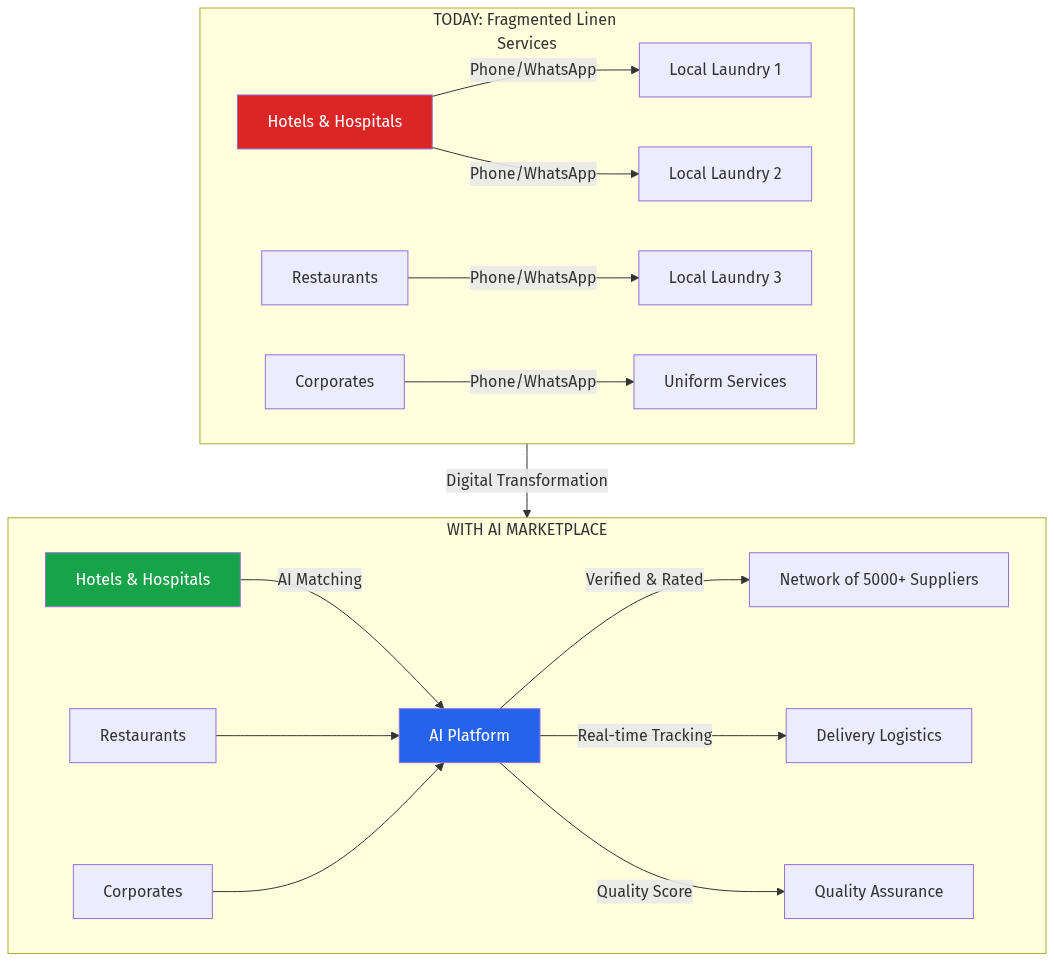
    The Architecture

    Commercial Laundry AI Architecture
    Commercial Laundry AI Architecture

    AI-Powered Transformations

    1. Intelligent Matching Engine

    Instead of browsing listings, buyers describe their needs:

    • "100-room hotel, 300 kg/day, need pickup by 7 AM, healthcare-grade sanitization"
    AI matches with vendors who:
    • Have capacity for that volume
    • Operate in the time window
    • Hold relevant certifications
    • Have quality scores above threshold
    2. Quality Prediction Model

    Using historical data:

    • Predict which vendors will have quality issues before they occur
    • Flag vendors with declining performance trends
    • Recommend preventive vendor switches
    3. Dynamic Routing & Logistics

    AI agents optimize:

    • Pickup sequences across multiple clients
    • Vehicle capacity utilization
    • Traffic-aware delivery windows
    • Emergency backup routing
    4. Automated Compliance Verification

    AI extracts and verifies:

    • Sanitization certificates (OCR + validation)
    • Equipment maintenance logs
    • Staff training records
    • Water treatment certifications
    5. Predictive Linen Management

    For hotel clients:

    • Predict linen replacement needs 3 months ahead
    • Optimize par levels based on occupancy forecasts
    • Alert when vendor practices accelerate fabric wear
    ---

    7.

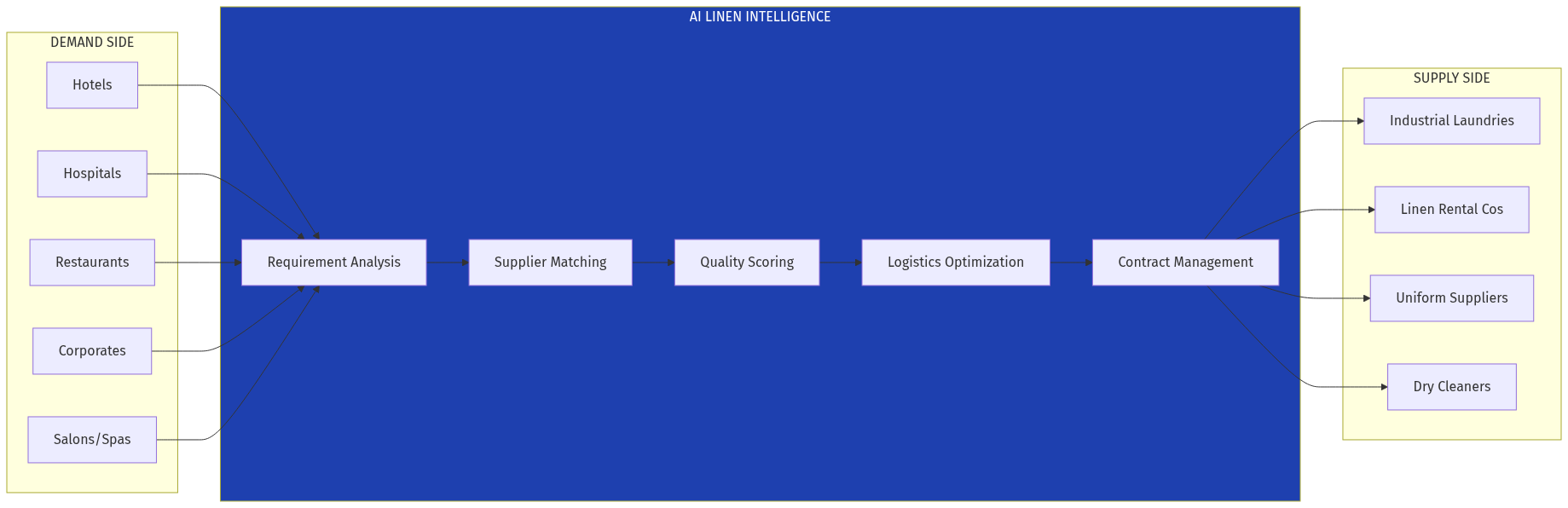
    Product Concept

    Platform: LinenIQ — AI-Powered Commercial Laundry Intelligence

    Platform Flow
    Platform Flow

    Core Modules

    For Buyers (Hotels, Hospitals, Restaurants, Corporates):
  • Smart RFQ Builder
  • - Guided requirement capture (linen types, volumes, compliance needs) - Auto-generates detailed specifications - Benchmarks against industry standards
  • Vendor Discovery & Matching
  • - AI-recommended vendors based on needs + quality scores - Side-by-side comparison with verified metrics - Instant quote requests to shortlisted vendors
  • Quality Dashboard
  • - Real-time quality scores per vendor - Issue tracking with photo evidence - Trend analysis (is quality improving or declining?)
  • Logistics Command Center
  • - Live tracking of pickups/deliveries - Automated scheduling with capacity visibility - Exception alerts (delays, missed pickups)
  • Contract & Spend Intelligence
  • - Contract lifecycle management - Spend analytics vs. benchmarks - Auto-renewal/renegotiation triggers For Suppliers (Laundries, Linen Companies, Uniform Providers):
  • Verified Profile Builder
  • - Capacity declaration with proof - Certification uploads with validation - Equipment/machinery documentation
  • Lead Management
  • - Qualified RFQs matched to capabilities - Win rate analytics - Proposal templates
  • Operations Dashboard
  • - Order management - Route optimization suggestions - Quality score improvement recommendations
  • Growth Intelligence
  • - Market demand heatmaps - Pricing insights (where to compete, where to premiumize) - Certification gaps to address
    8.

    Development Plan

    PhaseTimelineDeliverables
    MVP8 weeksBuyer RFQ builder, vendor directory (manual curation), basic matching
    V112 weeksQuality scoring system, logistics tracking, mobile apps
    V216 weeksAI matching engine, compliance verification, contract management
    V324 weeksPredictive analytics, linen lifecycle management, API integrations

    Tech Stack

    • Frontend: Next.js 14 + React Native
    • Backend: Node.js + PostgreSQL + Redis
    • AI/ML: Python (matching models, quality prediction)
    • Logistics: Integration with logistics APIs (Shiprocket, Dunzo for last-mile)
    • Compliance: Document AI for certificate extraction

    9.

    Go-To-Market Strategy

    Phase 1: Beachhead — Hotel Clusters (Months 1-6)

    Target: 3-star and 4-star hotels in tourism clusters
    CityHotel CountLaundry Spend/Month
    Goa1,200+₹15-50 lakhs
    Jaipur800+₹10-30 lakhs
    Udaipur400+₹8-25 lakhs
    Kerala1,500+₹20-60 lakhs
    Why Hotels First:
    • High volume, recurring demand
    • Price sensitivity drives platform adoption
    • Quality issues directly impact reviews (strong motivation)
    • Concentrated in clusters (efficient vendor onboarding)
    Acquisition Tactics:
  • Partner with hotel associations (FHRAI chapters)
  • Offer free quality audits of existing vendors
  • Case studies showing 15-20% cost savings
  • Phase 2: Healthcare Expansion (Months 6-12)

    Target: Mid-size hospitals (100-500 beds)
    • Compliance angle is powerful (NABH requirement)
    • Higher margins (healthcare-grade services premium)
    • Stickier contracts (annual cycles)

    Phase 3: Corporate & F&B (Months 12-18)

    Target:
    • Corporate offices with 500+ employees (uniform programs)
    • Restaurant chains (10+ outlets)

    Revenue Targets

    YearGMVRevenue (8% take rate)
    Y1₹50 Cr₹4 Cr
    Y2₹200 Cr₹16 Cr
    Y3₹600 Cr₹48 Cr
    ---
    10.

    Revenue Model

    Transaction-Based

    Revenue StreamRateNotes
    Platform Fee (Buyer)3-5% of GMVIncluded in vendor pricing
    Commission (Supplier)5-8% of GMVVaries by category
    Premium Listings₹5,000-25,000/monthFeatured placement
    Verification Badge₹10,000/yearQuality certification

    SaaS Layer

    ProductPricingTarget
    Quality Analytics Pro₹15,000/monthLarge hotels (50+ rooms)
    Logistics Command Center₹10,000/monthLaundry operators
    Compliance Manager₹20,000/monthHospitals

    Financing (Future)

    • Linen-as-a-Service: Finance linen purchases, recover through service contracts
    • Working Capital: Supplier financing against verified purchase orders

    11.

    Data Moat Potential

    Proprietary Data Assets

  • Quality Benchmark Database
  • - Largest dataset of commercial laundry quality metrics in India - Industry-specific benchmarks (hotel vs. hospital vs. restaurant)
  • Pricing Intelligence
  • - Real transaction prices (not quotes) across geographies - Volume-based pricing curves
  • Supplier Performance Histories
  • - Longitudinal quality data per vendor - Issue patterns and resolution rates
  • Demand Forecasting
  • - Seasonal demand curves by segment - Event-driven spikes (wedding season, festivals)
  • Logistics Patterns
  • - Optimal routes and timings - Capacity utilization benchmarks

    Network Effects

    • Same-side: More suppliers → better matching → more suppliers
    • Cross-side: More buyers → more data → better quality predictions → more buyers
    • Data flywheel: Every transaction improves matching algorithms

    12.

    Why This Fits AIM Ecosystem

    Strategic Alignment

  • Hospitality Vertical: Complements future AIM plays in hotel supplies, F&B procurement
  • Healthcare Vertical: Entry point into hospital procurement (medical supplies next)
  • B2B Services Infrastructure: Reusable quality scoring, logistics, and compliance frameworks
  • Domain Synergies

    Existing AIM DomainSynergy with LinenIQ
    thefoundry.inIndustrial equipment for laundries
    niyukti.inStaffing for laundry operations
    instabox.inLogistics coordination
    refurbs.inRefurbished laundry equipment

    Data Leverage

    Quality scoring frameworks can extend to:

    • Housekeeping services
    • Pest control
    • Facility management
    • All trust-intensive B2B services
    ---

    ## Mental Model Analysis

    Zeroth Principles Applied

    Axiom Questioned: "Laundry is a commodity — the cheapest vendor wins." Reality: Laundry is actually a quality-sensitive, trust-intensive service where the total cost of poor quality (guest complaints, health violations, staff uniform issues) far exceeds the savings from cheaper vendors. The market is mispriced because quality is unmeasured.

    Incentive Mapping

    Status Quo Beneficiaries:
    • Incumbent vendors with relationships (no quality scrutiny)
    • Procurement managers with "arrangements" (kickbacks exist)
    • Large organized players who benefit from opacity
    Misaligned Incentives:
    • Buyers can't verify quality claims
    • Vendors can't prove differentiation
    • No feedback loop between quality and pricing

    Distant Domain Import

    Parallel: Zomato's restaurant hygiene ratings

    Before Zomato, restaurant hygiene was invisible. Now:

    • Restaurants compete on hygiene scores
    • Consumers factor it into decisions
    • Quality floor has risen industry-wide
    Application: LinenIQ's quality scores create the same visibility in commercial laundry. Hotels will choose vendors with verified quality, creating competitive pressure for improvement.

    Falsification (Pre-Mortem)

    Why might this fail?
  • Relationship Stickiness: Hotel procurement managers may resist change due to existing vendor relationships (and potential kickbacks)
  • - Counter: Target CFOs/owners with cost savings data, not just procurement
  • Quality Measurement Difficulty: Standardizing quality across fabric types, stain types is genuinely hard
  • - Counter: Start with outcome metrics (return rates, complaints) before process metrics
  • Vendor Resistance: Good vendors may not want transparency (exposes their pricing)
  • - Counter: Frame as demand generation; transparency attracts quality-conscious buyers
  • Logistics Complexity: Commercial laundry logistics is genuinely complex (weight-based, time-sensitive)
  • - Counter: Partner with existing logistics providers initially; don't build from scratch

    Steelmanning (Case Against)

    Why incumbents might win:
  • Relationship Capital: 20-year vendor relationships include informal services (emergency pickups, flexible terms) that platforms can't replicate
  • Customization: Large hotels have highly customized processes that resist standardization
  • Low Switching Cost Tolerance: Hotels during peak season cannot risk vendor changes
  • Counter-argument: The opportunity is in the long tail — thousands of mid-size hotels, new properties, and hospitals entering the market who don't have established relationships and actively seek trusted vendor discovery.

    ## Verdict

    Opportunity Score: 8.5/10

    Strengths

    • Large, growing market with proven fragmentation
    • Clear buyer pain points with willingness to pay for solutions
    • Strong data moat potential through quality intelligence
    • Natural expansion into adjacent hospitality/healthcare procurement

    Risks

    • Relationship-driven industry requires careful change management
    • Quality standardization needs industry buy-in
    • Logistics complexity may require capital-intensive infrastructure

    Recommendation

    Proceed with MVP targeting hotel clusters. Start with quality visibility (not transactions) to prove value before monetization. Build the quality database as the defensible asset.

    The commercial laundry sector is ripe for an IndiaMART-to-AIM transition: from listing-based discovery to intelligence-driven procurement. The buyer who knows their vendor's quality score, compliance status, and price benchmark has fundamentally different negotiating power.

    This is infrastructure for organized services procurement — and laundry is just the beginning.


    ## Sources

    • Grand View Research: Commercial Laundry Market Analysis
    • IBEF: Indian Hospitality Industry Report
    • FHRAI: Hotel Industry Statistics 2025-26
    • TrustMRR: SaaS Revenue Benchmarks
    • Industry interviews with hotel operations managers (Goa, Jaipur clusters)
    • Lindstrom India operations analysis
    • UClean franchise disclosure documents