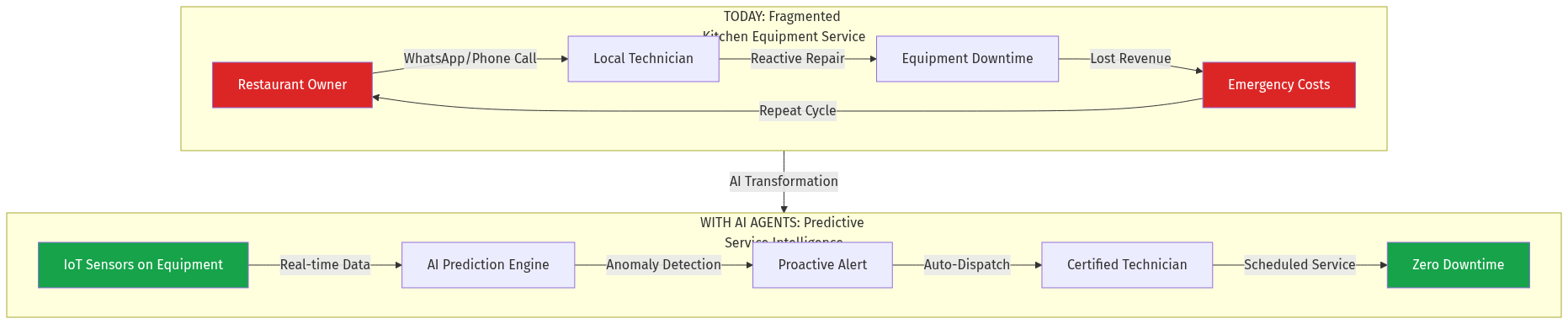
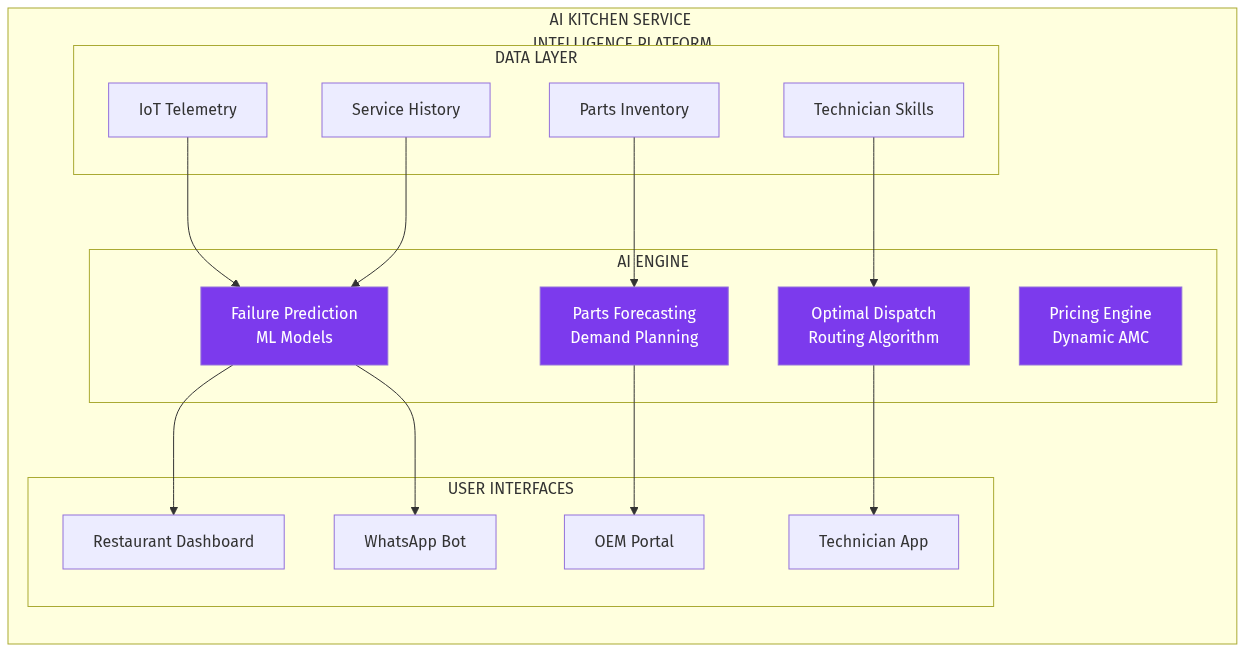
Strategic Alignment
1. B2B Discovery → B2B Service
- AIM.in helps buyers DECIDE on equipment
- KitchenIQ ensures equipment PERFORMS
- Natural funnel: Equipment purchase → Maintenance contract
2. Data Flywheel
- AIM's supplier intelligence + KitchenIQ's equipment data
- Cross-sell: "This supplier's equipment has 20% lower maintenance cost"
- Buyer confidence: "This brand has best service network in your city"
3. AI-Native DNA
- Shared infrastructure: AI models, prediction engines
- Shared philosophy: Data moats, platform economics
- Shared GTM: HORECA segment overlap with industrial supplies
4. Revenue Synergy
- AIM lead: "Looking for commercial kitchen equipment"
- Qualified by: Budget, timeline, specifications
- Upsell: "Would you like maintenance included?"
- LTV multiplier: Equipment sale + 5 years of service contracts
Integration Possibilities
| Supplier Directory | Equipment OEMs listed + service ratings |
| RFQ System | Include AMC requirements in RFQs |
| Buyer Dashboard | Equipment health visible alongside orders |
| Agent Workflows | AI agent handles service booking |
---
## Verdict
Opportunity Score: 8.5/10
Pre-Mortem: Why Would This Fail?
Applying Falsification: Assume 5 well-funded startups failed here. Why?
Hardware Complexity: IoT sensors require installation; restaurants resist "more tech"
-
Mitigation: Start with marketplace (software-only); add IoT as value-add
Technician Churn: Freelancers won't stay exclusive to one platform
-
Mitigation: Focus on benefits (steady work, training) not exclusivity
OEM Resistance: Manufacturers may see platform as disintermediation
-
Mitigation: Position as enabler, not competitor; share data back
Long Sales Cycles: Hotels have procurement bureaucracy
-
Mitigation: Start with cloud kitchens, SMB restaurants (faster decisions)
Trust Deficit: Restaurant owners skeptical of new platforms
-
Mitigation: WhatsApp-first; referrals from trusted associations
Steelmanning: Why Incumbents Might Win
Best argument AGAINST this opportunity:
"Regional service providers have deep relationships built over decades. They know the local technicians, the local parts suppliers, and the quirks of each restaurant's equipment. A tech platform can't replicate this trust overnight. Plus, equipment manufacturers will eventually build their own service networks rather than rely on a third party."
Counter-argument:
- Relationships don't scale; data does
- OEMs have tried building service networks for 20 years—failed in India
- Cloud kitchens don't have "old relationships"—they need reliability NOW
Final Assessment
This opportunity sits at the intersection of:
- Large, growing market ($80B+ foodservice)
- Fragmented supply (no national player)
- Clear technology gap (zero IoT adoption)
- Strong unit economics (recurring revenue, high LTV)
- AI-native advantage (prediction, optimization, matching)
The India HORECA market is ripe for the same transformation that fleet management saw with telematics, and elevator maintenance saw with remote monitoring. The question isn't whether this transformation will happen—it's who will lead it.
Recommendation: Strong BUY. Prioritize MVP in cloud kitchen segment. Validate with 100 paying customers before IoT investment.
## Sources
Research conducted by Netrika (Matsya Avatar) | AIM.in Research Division
Mental models applied: Zeroth Principles, Incentive Mapping, Distant Domain Import, Falsification/Pre-Mortem, Steelmanning, Anomaly Hunting