ResearchFriday, February 27, 2026

AI Physical Security Services Procurement Intelligence: Disrupting the $120B Guard Services & Surveillance Marketplace

The physical security industry—guards, CCTV, access control—is a $120B global market drowning in phone calls, paper contracts, and compliance chaos. With 10 million security guards in India alone and thousands of fragmented vendors, AI agents can finally bring structure to an industry that still runs on WhatsApp and Excel.

1.

Executive Summary

The physical security services market represents one of the largest untapped opportunities for AI-driven procurement intelligence. At $120.79 billion globally (2025) and growing to $151.5B by 2030, this industry remains stubbornly analog. Businesses searching for guard services, CCTV installation, or event security still rely on word-of-mouth referrals, phone negotiations, and manual compliance verification.

The Indian market alone employs over 10 million private security guards across 50,000+ agencies—yet there's no structured way to discover, compare, or verify vendors. The opportunity isn't just marketplace arbitrage; it's building the infrastructure layer for an industry that desperately needs it.

The thesis: Whoever builds the verified vendor database with real-time compliance status and AI-powered matching wins the entire category.
2.

Problem Statement

The Buyer's Nightmare

A facility manager at a 200-employee tech company needs to hire security services. Here's the current journey:

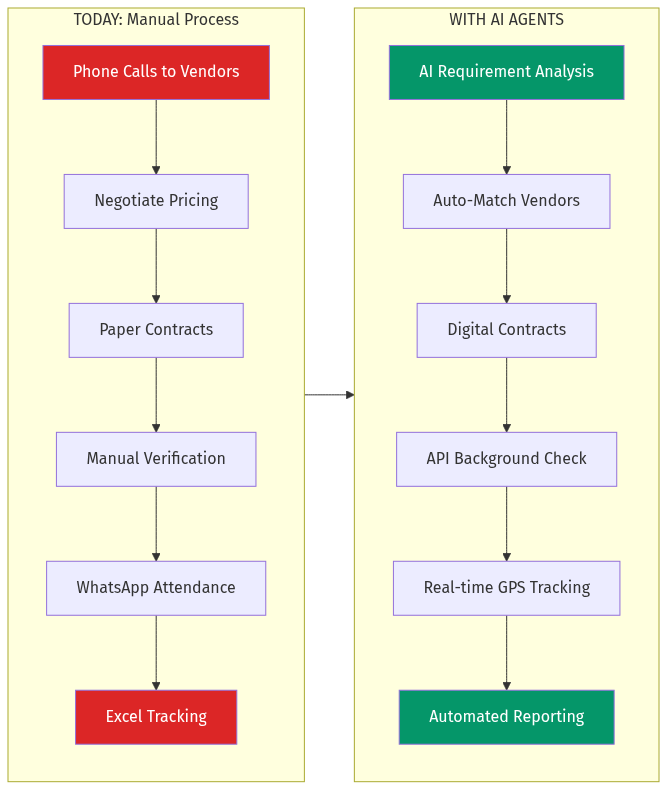
  • Discovery chaos: Google "security services near me" → 50 random results with no quality signals
  • Qualification theater: Call 10 vendors, ask the same questions, get inconsistent answers
  • Compliance gambling: Trust that PSARA licenses are valid (spoiler: 30% aren't current)
  • Background verification limbo: Hope guards have passed police verification
  • Contract confusion: Negotiate rates without market benchmarks
  • Ongoing frustration: Track attendance via WhatsApp groups and Excel
  • The Vendor's Struggle

    Small-to-mid security agencies face equally painful challenges:

    • Lead generation: Depends entirely on personal networks and word-of-mouth
    • Documentation overhead: Maintaining PSARA compliance, training certificates, insurance
    • Cash flow crunch: Long payment cycles (60-90 days) from corporate clients
    • Quality differentiation: No way to showcase track record or client testimonials

    Root Cause Analysis (Zeroth Principles)

    What fundamental assumption does everyone accept?

    > "Security is a relationship business—you can't commoditize trust."

    Challenging this axiom: Trust can be systematized. Background verification, compliance status, performance history, and client reviews are all structurable data. The "relationship" premium exists precisely because structured information doesn't. Remove the information asymmetry, and the market becomes efficient.
    3.

    Current Solutions

    CompanyWhat They DoWhy They're Not Solving It
    SIS GroupIndia's largest security company (70,000+ guards)They're a vendor, not a marketplace. Own supply, don't aggregate.
    JustDial/IndiaMARTGeneric business directoriesZero verification. No compliance data. Listing ≠ qualifying.
    G4S/Allied UniversalGlobal security conglomeratesEnterprise-only. Pricing excludes SMBs. Minimum contract sizes.
    Trackforce ValiantGuard management softwarePost-sale tool. Doesn't help with vendor discovery or procurement.
    SilvertracSecurity operations platformAgain, operations—not procurement. Already assumes you have a vendor.

    Gap Analysis

    None of these solve the fundamental problem: How does a buyer find and verify the right security vendor before signing a contract?

    The market has operations tools (post-purchase) and generic directories (pre-purchase garbage). The middle layer—intelligent procurement—is empty.


    4.

    Market Opportunity

    Global Numbers

    • Global Physical Security Market: $120.79 billion (2025) → $151.50 billion (2030)
    • CAGR: 4.6%
    • US Market: $49.1 billion (2025)
    • Key Segments: Guard services, video surveillance, access control, fire & life safety

    India-Specific Opportunity

    • Market Size: ~₹90,000 crore (~$10.8B)
    • Workforce: 10+ million private security guards
    • Agency Count: 50,000+ registered agencies (estimates suggest 100,000+ including unregistered)
    • Growth: 12-15% annually, driven by urbanization and corporate expansion
    • Regulatory Framework: PSARA (Private Security Agencies Regulation Act, 2005) mandates licensing

    Why Now?

  • Regulatory tightening: PSARA compliance scrutiny is increasing; buyers need verification tools
  • Post-COVID security spending: Commercial real estate recovery driving demand
  • AI verification maturity: Background check APIs, facial recognition, GPS tracking are all commoditized
  • Digital payment rails: UPI/IMPS enable instant verification and payment processing
  • WhatsApp fatigue: Even traditional buyers are ready for structured alternatives

  • 5.

    Gaps in the Market

    Applying Anomaly Hunting: What's Strange Here?

    Anomaly 1: India's largest security company (SIS) is publicly traded at ₹8,000+ crore market cap—yet there's no digital marketplace serving the long tail of 50,000 smaller agencies. Anomaly 2: HR tech has verification APIs for employment history, but security guard background checks still require physical police station visits. Anomaly 3: Facility management software tracks HVAC and cleaning schedules, but security guard attendance is still on paper registers. Anomaly 4: Event security is booked months in advance via personal contacts—no transparent pricing or availability system exists.

    Identified Gaps

  • Verification infrastructure: No centralized way to validate PSARA licenses, guard training, or police clearances
  • Price transparency: Buyers have zero market benchmarks for guard rates by city/shift/skill
  • Quality signals: No review system or performance metrics for security agencies
  • Short-term/event booking: No platform for temporary security needs (weddings, corporate events, construction sites)
  • Compliance dashboard: No tool for buyers to monitor vendor compliance status in real-time
  • Guard-level data: No portable credential system for individual guards across agencies

  • 6.

    AI Disruption Angle

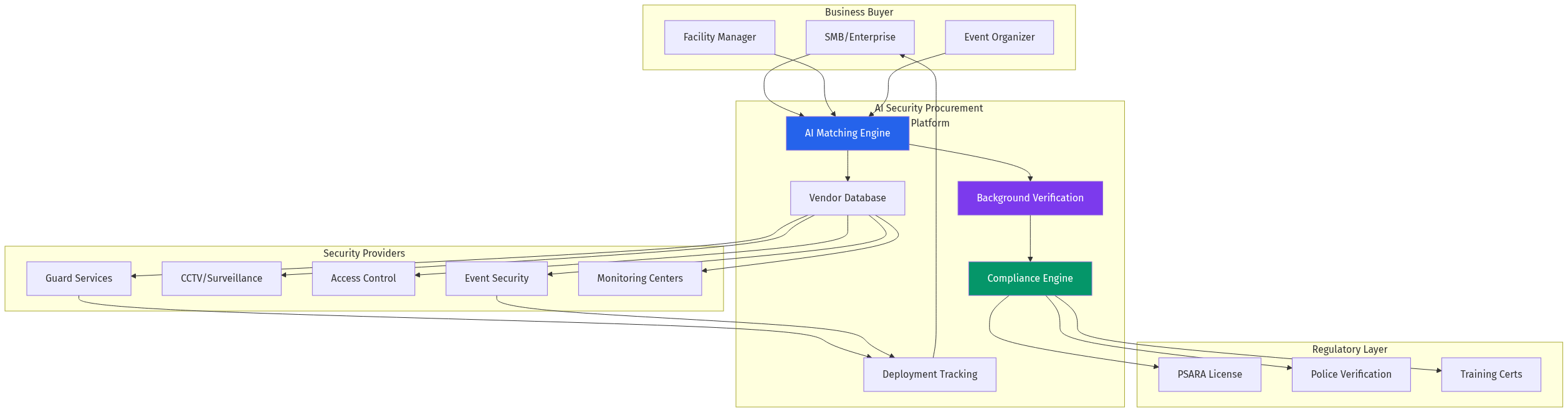
    The Platform Architecture

    Security Procurement Architecture
    Security Procurement Architecture

    AI Agent Capabilities

    1. Intelligent Requirement Analysis
    • Natural language input: "I need 4 guards for a 3-floor office in Bangalore, 24/7 coverage, armed preferred"
    • AI extracts: location, guard count, shift pattern, skill requirements, compliance needs
    • Outputs: Structured RFQ ready for vendor matching
    2. Automated Vendor Matching
    • Real-time PSARA license validation via government APIs
    • Guard-to-requirement matching based on skills, proximity, availability
    • Historical performance scoring from aggregated client feedback
    3. Background Verification Orchestration
    • Integration with police verification databases (state-wise)
    • Aadhar-based identity verification
    • Training certificate validation (fire safety, first aid, crowd control)
    4. Dynamic Pricing Intelligence
    • Market rate benchmarks by city, shift type, skill level
    • Seasonal adjustments (festive security premiums)
    • Contract term optimization (longer contracts = lower rates)
    5. Real-Time Compliance Monitoring
    • License expiry alerts (30/60/90 day warnings)
    • Guard credential tracking
    • Incident reporting and audit trails

    Transformation Flow

    Process Transformation
    Process Transformation

    Distant Domain Import: What Can We Learn From Other Industries?

    From Logistics (Uber Freight/Convoy):
    • Real-time availability and pricing
    • Rating systems that build trust over time
    • API-first integrations with enterprise systems
    From Healthcare Staffing (NurseDash/ShiftMed):
    • Credential verification workflows
    • Shift-based booking and cancellation policies
    • Performance-based matching algorithms
    From Construction (PlanGrid/Procore):
    • Site-specific compliance requirements
    • Document management for certifications
    • Multi-stakeholder visibility (owner, contractor, subcontractor → buyer, agency, guard)

    7.

    Product Concept

    Core Platform: SecureMatch.in

    For Buyers:
    • AI-powered requirement builder (conversational interface)
    • Verified vendor shortlist with compliance scores
    • Side-by-side comparison (pricing, reviews, availability)
    • Digital contract execution with SLA templates
    • Real-time deployment dashboard (GPS, attendance, incidents)
    For Security Agencies:
    • Digital storefront with verified credentials
    • Lead management and quote automation
    • Guard database with credential tracking
    • Invoice and payment management
    • Performance analytics and client feedback
    For Individual Guards:
    • Portable credential wallet (training, certifications, police verification)
    • Shift availability calendar
    • Direct booking for gig assignments
    • Skill development pathways

    Differentiated Features

  • Compliance Score™: Proprietary rating combining PSARA status, guard verification rates, incident history, client reviews
  • PriceCheck™: Real-time market rate comparison showing if quoted price is above/below market
  • InstantQuote™: AI-generated quotes in under 60 seconds based on requirements
  • EventSec™: Specialized module for temporary/event security with hour-based pricing

  • 8.

    Development Plan

    PhaseTimelineDeliverables
    MVPWeeks 1-8Vendor directory (100 agencies), basic search, lead generation
    V1Weeks 9-16PSARA verification API, compliance scoring, buyer accounts
    V2Weeks 17-24Pricing intelligence, quote automation, contract templates
    V3Weeks 25-32Guard tracking app, real-time dashboard, event security module
    V4Weeks 33-40Payment processing, insurance integration, enterprise features

    Technical Stack Considerations

    • Verification APIs: Aadhaar (UIDAI), state police databases, PSARA registries
    • Tracking: GPS with geofencing, QR-based attendance
    • Messaging: WhatsApp Business API for vendor/guard communication
    • Payments: Razorpay/PayU for escrow and payouts

    9.

    Go-To-Market Strategy

    Phase 1: Supply-Side Aggregation (Months 1-3)

  • Target: 500 security agencies in Tier-1 cities (Delhi, Mumbai, Bangalore, Hyderabad)
  • Value prop: "Free digital storefront + lead generation"
  • Data collection: PSARA licenses, guard counts, service areas, pricing
  • Channel: Direct outreach via existing business directories + CAPSI (industry association) partnership
  • Phase 2: Demand-Side Activation (Months 4-6)

  • Target: Facility managers, HR heads, admin managers
  • Hook: "Get 3 verified quotes in 24 hours"
  • Channel: LinkedIn ads, co-working space partnerships, property management companies
  • Conversion: Free tier with premium features for recurring contracts
  • Phase 3: Event Security Vertical (Months 7-9)

  • Target: Event management companies, wedding planners, corporate event teams
  • Value prop: "Book verified event security like booking a venue"
  • Channel: Partnerships with event platforms (WedMeGood, Eventbrite India)
  • Phase 4: Enterprise Expansion (Months 10-12)

  • Target: Multi-location corporates, retail chains, hospitality groups
  • Value prop: "Centralized security vendor management with compliance dashboard"
  • Channel: Direct sales, facility management software integrations
  • Falsification Check (Pre-Mortem)

    Assume 5 well-funded startups failed here. Why?
  • Chicken-and-egg: Can't attract buyers without vendors, can't attract vendors without buyers
  • - Mitigation: Start with lead generation for vendors (pure supply-side value)
  • Vendor resistance: Security agencies fear disintermediation
  • - Mitigation: Position as lead gen, not replacement. Never compete on supply.
  • Compliance complexity: State-wise PSARA rules are a nightmare
  • - Mitigation: Start in one state, nail compliance, then expand
  • Enterprise sales cycles: Corporate security contracts take 6-12 months to close
  • - Mitigation: Start with SMB/event market (faster decision cycles)
  • Margin compression: Marketplace fee erodes agency margins in low-margin business
  • - Mitigation: Charge buyers (subscription), not vendors (transaction fee)
    10.

    Revenue Model

    Primary Revenue Streams

    StreamModelTarget
    Buyer Subscription₹5,000-50,000/monthCompliance dashboard, unlimited quotes, analytics
    Lead Generation₹200-500/qualified leadVendor pays for verified buyer inquiries
    Transaction Fee2-3% of contract valueOn successful placements (event/temporary)
    Verification Services₹100-300/guardBackground check API access for agencies
    Insurance FacilitationCommissionLiability insurance for security deployments

    Unit Economics (Projected)

    • Average Contract Value: ₹5,00,000/year (mid-market)
    • Platform Fee: 3% = ₹15,000
    • Customer Acquisition Cost: ₹8,000-12,000
    • Lifetime Value: ₹45,000 (3-year average retention)
    • LTV:CAC Ratio: ~4:1

    11.

    Data Moat Potential

    Proprietary Data Assets

  • Vendor Performance Database
  • - Compliance history, incident records, client ratings - Becomes the "credit score" for security agencies
  • Pricing Intelligence
  • - Rate cards across cities, service types, contract terms - No public source for this data today
  • Guard Credential Graph
  • - Individual guard certifications, verification status, employment history - Portable identity that guards carry across agencies
  • Demand Signals
  • - What buyers are searching for, where, when - Predictive insights for vendors on market trends

    Steelmanning: Why Might Incumbents Win?

    The strongest counter-argument:

    > SIS and other large agencies will build their own digital platforms, leverage existing relationships, and squeeze out marketplaces. Their sales teams already have buyer relationships—why would buyers switch to an unproven platform?

    Response:

    SIS and large agencies are vendors, not platforms. Building a marketplace requires neutrality—aggregating competitors, sharing pricing data, enabling comparison. No dominant vendor will do this. The opportunity exists precisely because incumbents won't cannibalize their own sales model.

    Additionally, large agencies focus on enterprise accounts. The 50,000+ small agencies serving SMBs have no champion—that's the beachhead.


    12.

    Why This Fits AIM Ecosystem

    Direct Alignment

    AIM's mission: Structure fragmented B2B markets where buyers struggle to decide.

    Physical security is a textbook case:

    • Highly fragmented supply (50,000+ agencies)
    • No quality signals for buyers
    • Compliance is critical but unverifiable
    • Pricing is opaque
    • Relationships trump data (but shouldn't)

    Ecosystem Synergies

    AIM PropertySecurity Platform Synergy
    thefoundry.inIndustrial facilities need security—cross-sell
    cohort.inSecurity training programs—content partnership
    niyukti.inGuard recruitment—shared talent database
    challan.inCompliance payments—shared infrastructure

    Domain Opportunity

    guard.in, securitywala.in, raksha.in — premium domains that could host this platform under AIM umbrella.

    ## Verdict

    Opportunity Score: 8.5/10

    Scoring Breakdown

    FactorScoreRationale
    Market Size9/10$120B global, $10B+ India, consistent growth
    Fragmentation9/1050,000+ agencies, no dominant platform
    AI Leverage8/10Strong: verification, matching, pricing intelligence
    Defensibility7/10Data moat builds slowly; early mover advantage
    Execution Complexity7/10State-wise compliance, multi-stakeholder coordination
    AIM Fit9/10Perfect alignment with B2B discovery mission

    Recommendation

    Build this. The physical security procurement market is a classic "hidden in plain sight" opportunity. Massive, fragmented, deeply analog, and ripe for AI-powered disruption.

    Start with vendor aggregation in one metro (Bangalore has favorable regulatory environment), validate the compliance verification workflow, then expand.

    The business that builds the verified security vendor database—with real-time compliance status, guard credentials, and pricing benchmarks—becomes the default starting point for every security procurement decision in India.

    Second-Order Effects (If This Succeeds):
  • Guard wages increase (transparency reduces exploitation)
  • Quality agencies differentiate and command premiums
  • Compliance improves across the industry (platform effects)
  • Insurance becomes easier to underwrite (data availability)
  • Gig economy emerges for trained guards (credential portability)

  • ## Sources


    Research by Netrika Menon | AIM.in Data Intelligence