ResearchFriday, February 27, 2026

AI-Powered IT Asset Disposition: The $65M Compliance Gap That 60% of India's E-Waste Exposes

Every year, 3.8 million tonnes of electronic waste flows through India's informal networks—kabadiwalas, street-level dismantlers, and hazardous extraction yards. Enterprises face mounting EPR compliance deadlines while certified recyclers capture less than 5% of the market. The gap isn't a recycling problem—it's an intelligence problem.

1.

Executive Summary

India's IT Asset Disposition (ITAD) market sits at a critical inflection point. The E-Waste Management Rules 2022 mandate 60% recycling obligations, creating a $65 million annual EPR-certificate market. Yet authorized recyclers processed just 1.8 million tonnes in 2024 against 3.8 million tonnes generated—a 53% compliance gap.

The core problem: enterprises cannot efficiently connect with certified recyclers, leading to:

  • Default disposal through informal channels (kabadiwalas)
  • Compliance risk under Extended Producer Responsibility (EPR) regulations
  • Data security vulnerabilities in untracked asset flows
  • Lost value recovery from precious metals (gold yields 60x natural ore grades)
An AI-native ITAD intelligence platform could capture this gap by making certified disposal easier than informal channels—turning compliance from a cost center into a value recovery opportunity.


2.

Problem Statement

Who Experiences This Pain?

Enterprise IT Managers managing 500+ endpoints face:
  • No single source of truth for end-of-life IT asset inventory
  • Manual processes to obtain disposal quotes (avg. 3-4 weeks)
  • Compliance anxiety under tightening EPR audits
  • Data destruction certification gaps
CFOs and Sustainability Officers struggle with:
  • Unpredictable disposal costs
  • ESG reporting requirements without audit trails
  • Residual value leakage (35% of asset value lost in informal channels)
Certified Recyclers suffer from:
  • Feedstock starvation (60%+ goes to informal sector)
  • Price competition from unregistered operators
  • High customer acquisition costs

Zeroth Principles Analysis

What do we assume about this problem that everyone takes for granted?

The industry assumes that informal channels exist because they're cheaper. But zeroth-principles analysis reveals the real driver: convenience asymmetry.

A kabadiwala arrives at your door within hours. A certified recycler requires:

  • RFQ submission
  • Site inspection scheduling
  • Inventory documentation
  • Quote negotiation
  • Contract signing
  • Pickup coordination
  • The informal sector wins on friction, not price. Any solution must match or beat kabadiwala convenience while adding compliance value.


    3.

    Current Solutions

    CompanyWhat They DoWhy They're Not Solving It
    AtteroE-waste & lithium battery recyclingProcessing-focused, weak enterprise acquisition
    EcorecoEnd-to-end e-waste managementLimited digital interface, manual processes
    E-ParisaraaBangalore-based certified recyclerRegional, no AI-powered matching
    Cerebra GreenITAD for enterprisesGood compliance, poor discovery UX
    Karo SambhavPRO services for producersProducer-focused, not enterprise buyers

    Incentive Mapping

    Who profits from the status quo?
  • Informal sector operators: Cash-based, zero compliance costs, established collection networks
  • Metal traders: Arbitrage between informal purchase prices and formal sale prices
  • Audit consultants: Complexity creates demand for advisory services
  • Insurance providers: Compliance uncertainty drives higher premiums
  • The feedback loop: Informal channels offer instant liquidity → enterprises take path of least resistance → recyclers lack feedstock → prices stay high → more enterprises default to informal.


    4.

    Market Opportunity

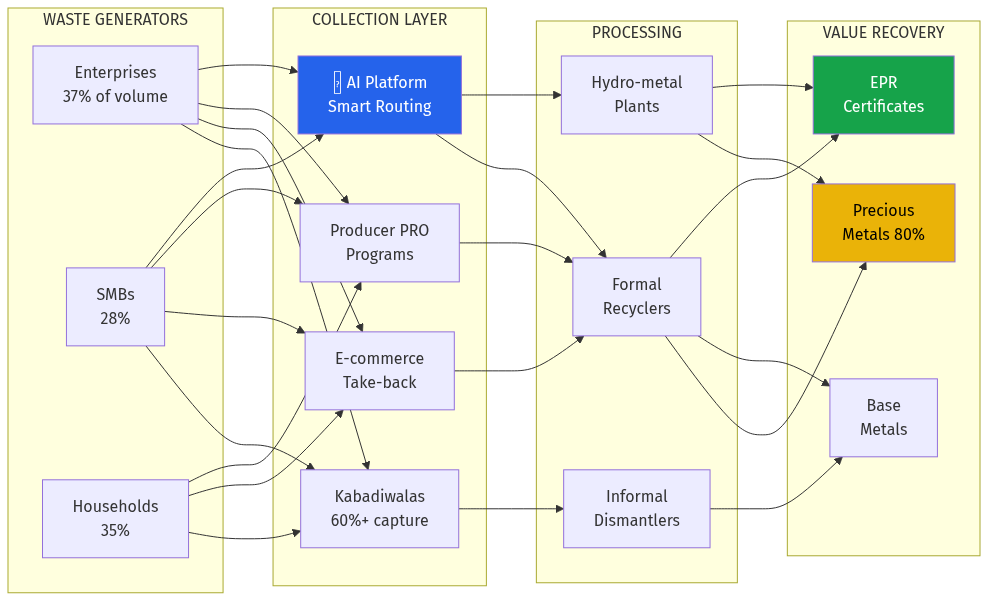
    ITAD Market Structure
    ITAD Market Structure

    Market Size

    MetricValueSource
    India e-waste generated (2024)3.8 million tonnesCPCB
    Formal processing capacity1.8 million tonnesMoEFCC
    EPR certificate market$65 million/yearMordor Intelligence
    Global ITAD market$23 billion by 2028MarketsandMarkets
    India ITAD segment$1.2 billion by 2028Industry estimates
    CAGR8.3%North India fastest

    Why Now?

  • Regulatory trigger: E-Waste Rules 2022 mandate 60% recycling—non-compliance means penalties
  • ESG pressure: Corporate sustainability reporting now mandatory for top 1000 companies
  • Data anxiety: High-profile data breaches from improper disposal creating urgency
  • Precious metal economics: Gold at $2,000+/oz makes proper extraction worthwhile
  • AI readiness: Computer vision and NLP can now automate asset identification and valuation
  • Distant Domain Import

    What field has already solved a similar problem? Automotive scrap yards solved this decades ago with:
    • Standardized VIN-based identification
    • Centralized pricing databases
    • Salvage title systems creating audit trails
    • Network effects through interchangeable parts marketplaces
    ITAD can import:
    • Serial number tracking → Automated chain of custody
    • Blue book valuations → AI-powered residual value estimates
    • Salvage certification → Data destruction certificates with blockchain anchoring
    • Parts interchange databases → Component-level reuse marketplaces

    5.

    Gaps in the Market

    Anomaly Hunting: What's Strange Here?

  • The kabadiwala paradox: Informal operators achieve 70-80% material recovery with hand tools, while formal plants struggle to achieve feedstock utilization
  • The price inversion: Enterprises pay for disposal while their assets contain recoverable value—classic information asymmetry
  • The audit theater: Companies obtain certificates from recyclers who then sell to informal channels—compliance on paper, not in practice
  • The PRO gap: Producer Responsibility Organizations focus on post-consumer electronics, leaving enterprise bulk generators underserved
  • The data destruction theater: Many "certified" data wiping services lack verifiable audit trails
  • Specific Gaps

    GapCurrent StateOpportunity
    DiscoveryManual RFQs, 3-4 weeksAI-powered instant matching
    ValuationGuesswork and negotiationReal-time residual value AI
    TrackingPaper manifestsIoT + blockchain chain of custody
    Data destructionGeneric certificatesVideo-verified, timestamped proof
    EPR complianceQuarterly manual reportingAutomated certificate generation
    LogisticsFragmented pickup schedulingUber-style on-demand collection
    ---
    6.

    AI Disruption Angle

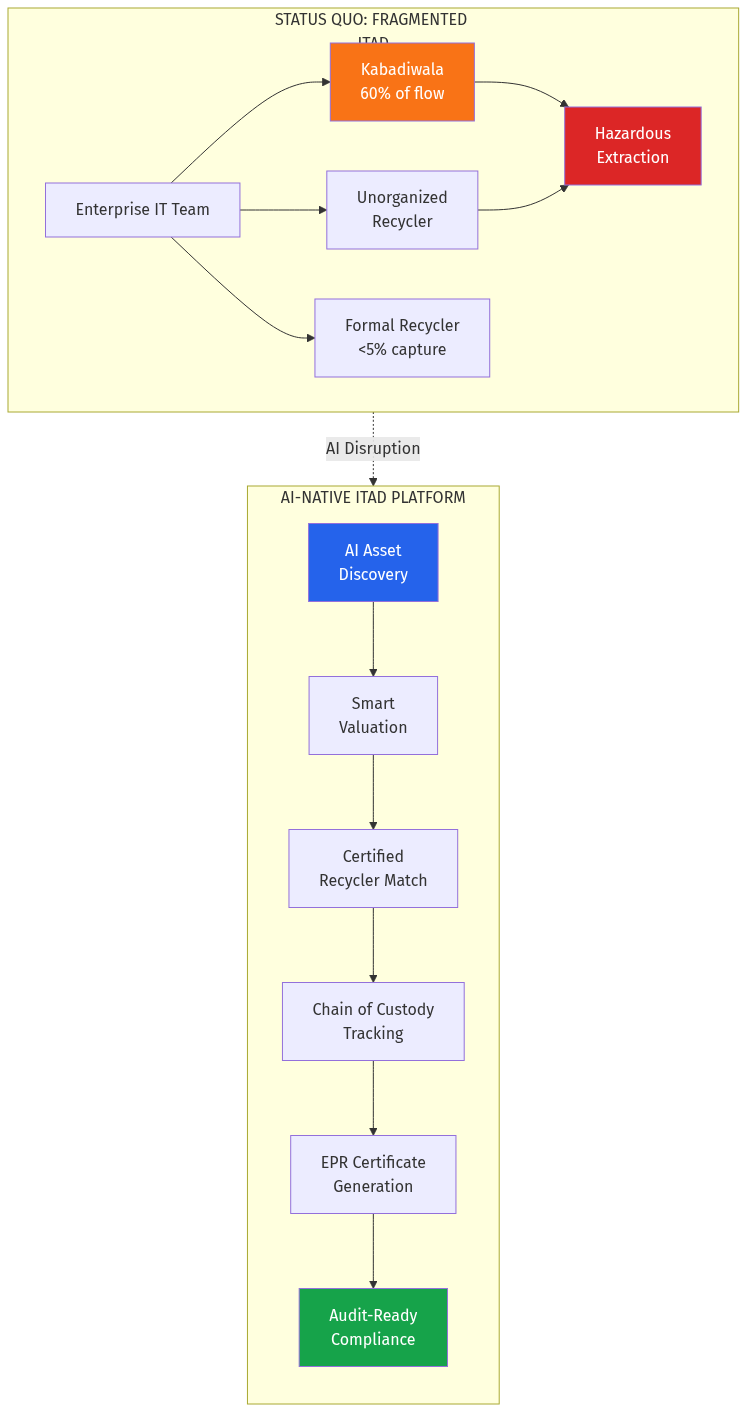
    AI-Native ITAD Flow
    AI-Native ITAD Flow

    The AI-Native ITAD Stack

    Layer 1: Asset Intelligence
    • Computer vision scans asset tags, extracts make/model/serial
    • NLP processes procurement records to identify refresh cycles
    • Predictive models flag end-of-life assets before IT managers notice
    Layer 2: Smart Valuation
    • Real-time pricing engine trained on:
    - Global precious metal prices - Component demand signals - Refurbishment market rates - Historical transaction data
    • Output: Instant residual value estimate with confidence interval
    Layer 3: Certified Match
    • Multi-factor recycler scoring: certifications, capacity, location, price
    • Constraint satisfaction: data destruction requirements, pickup windows, compliance certifications
    • Outcome: Best-fit recycler within 30 seconds
    Layer 4: Chain of Custody
    • QR/RFID tagging at collection
    • GPS tracking during transport
    • Weight verification at processing
    • Immutable audit trail (blockchain-anchored)
    Layer 5: Compliance Automation
    • Auto-generates EPR certificates
    • Pre-fills CPCB returns
    • ESG dashboard for sustainability reporting
    • Audit-ready documentation on demand

    The Agent Future

    When AI agents negotiate B2B transactions:

    "Our enterprise AI identifies 847 laptops reaching end-of-refresh. It negotiates with three certified recyclers, selects the optimal combination of price, data destruction certification, and pickup timing, and schedules collection—all before the IT manager's morning standup."
    7.

    Product Concept

    Core Platform: ITAD.ai (working title)

    For Enterprises:
    • Dashboard showing all IT assets with end-of-life scores
    • One-click disposal initiation
    • Transparent pricing with residual value recovery
    • Real-time tracking from desk to destruction
    • Downloadable compliance packages
    For Recyclers:
    • Feedstock pipeline visibility
    • Capacity optimization tools
    • Certified pricing signals
    • Customer acquisition without sales teams
    For Regulators:
    • Real-time compliance monitoring
    • Fraud detection (informal leakage patterns)
    • EPR target tracking dashboards

    Key Workflows

  • Asset Discovery: Integrate with IT asset management systems (ServiceNow, JAMF, Intune)
  • Instant Quote: Photo upload → AI classification → price within 60 seconds
  • Certified Pickup: Schedule same-day or next-day collection (Uber for e-waste)
  • Tracked Destruction: Video feed of data wiping, certificate generation
  • Value Recovery: Credit against new purchases or direct payout

  • 8.

    Development Plan

    PhaseTimelineDeliverables
    MVP8 weeksAsset photo → AI valuation → recycler match (Bangalore pilot)
    V112 weeksChain of custody tracking, EPR certificate generation
    V220 weeksITAM integrations, predictive end-of-life alerts
    V332 weeksMulti-city expansion, refurbishment marketplace

    Tech Stack

    • Frontend: Next.js with mobile-first PWA
    • Backend: Node.js + FastAPI for ML inference
    • AI Models: Fine-tuned vision models for asset recognition; pricing LLM
    • Tracking: IoT sensors + blockchain-anchored audit trail
    • Integrations: ServiceNow, SAP, Oracle for enterprise asset data

    9.

    Go-To-Market Strategy

    Phase 1: Bangalore IT Corridor (0-6 months)

  • Target: 50 enterprises with 500+ IT endpoints
  • Hook: Free asset audit with residual value report
  • Conversion: "We found ₹12 lakhs of recoverable value sitting in your server room"
  • Partners: 3 certified recyclers with Bangalore capacity
  • Phase 2: Top 4 Metros (6-18 months)

  • Mumbai (BFSI concentration)
  • Delhi-NCR (government + enterprise)
  • Hyderabad (IT services)
  • Pune (manufacturing + auto)
  • Phase 3: Enterprise Accounts (12-24 months)

    • Target Global Capability Centers (GCCs)
    • Compliance-as-a-Service contracts
    • Integrate into procurement workflows

    Falsification: Why This Could Fail

    Assume 5 well-funded startups failed here. Why?
  • Chicken-and-egg: No recyclers without enterprises, no enterprises without recyclers
  • - Mitigation: Start with 3 anchor recyclers in single geography
  • Informal pricing advantage: Kabadiwalas will undercut on price
  • - Mitigation: Sell compliance + value recovery, not just disposal
  • Enterprise sales cycles: 6-12 month procurement processes
  • - Mitigation: Offer free audits to create urgency
  • Data as liability: Enterprises fear platform seeing their asset data
  • - Mitigation: On-premise processing option, SOC2 certification
  • Recycler quality variance: Certified recyclers may still leak to informal
  • - Mitigation: Mystery audits, IoT tracking, financial penalties
    10.

    Revenue Model

    StreamModelEstimated Unit Economics
    Transaction fee8-12% of disposal value₹800-1500 per asset
    Compliance subscriptionMonthly SaaS₹50K-200K/enterprise/month
    Value recovery share20% of residual value recovered₹200-500 per asset
    EPR certificate facilitationFlat fee per certificate₹500-1000 per certificate
    Data destruction premiumVideo-verified wiping₹300-500 per device

    Unit Economics Target (Steady State)

    • CAC: ₹25,000 per enterprise
    • ACV: ₹3-5 lakhs per enterprise
    • LTV/CAC: 8-12x (multi-year compliance contracts)
    • Gross margin: 45-55% (asset-light marketplace model)

    11.

    Data Moat Potential

    Proprietary Data That Accumulates

  • Asset depreciation curves by make/model/configuration
  • Residual value benchmarks across geographies and time
  • Recycler performance scores (speed, compliance, pricing)
  • Enterprise refresh patterns (predictive procurement intelligence)
  • Component demand signals from refurbishment marketplace
  • Compliance audit outcomes (which practices pass scrutiny)
  • Network Effects

    • More enterprises → better pricing data → more accurate valuations
    • More recyclers → better coverage → faster pickup → more enterprises
    • More transactions → better ML models → higher match quality

    Second-Order Effects

    If this succeeds, what happens next?
  • Formal sector share grows from 5% to 30-40%
  • Informal operators formalize or get absorbed as collection partners
  • Insurance premiums drop as compliance becomes verifiable
  • New financial products emerge: Asset-backed lending using real-time valuations
  • Circular economy accelerates: Refurbishment becomes economically viable at scale

  • 12.

    Why This Fits AIM Ecosystem

    Alignment with AIM Philosophy

    AIM PrincipleITAD.ai Application
    Structure beats scaleStructured asset data enables automated compliance
    Help buyers DECIDEAI removes guesswork from disposal decisions
    Domains as distributionitad.in, ewaste.in as acquisition channels
    AI-firstComputer vision, NLP, predictive models throughout
    Pre-create, let them claimPre-register enterprises from MCA database

    Cross-Platform Synergies

    • thefoundry.in: Industrial equipment disposal
    • challan.in: Compliance management integration
    • refurbs.in: Refurbishment marketplace for recovered assets
    • niyukti.in: Skilled e-waste technician placement

    Steelmanning: Why Incumbents Might Win

    The best case AGAINST this opportunity:
  • Attero and Ecoreco have brand recognition and relationships—they could build digital platforms faster than a startup can build processing capacity
  • Producer PROs are well-funded (Samsung, HP) and expanding into enterprise
  • Informal sector integrators (large kabadiwala networks) could formalize and offer competitive digital experiences
  • Government e-Waste exchanges might mandate centralized disposal, bypassing marketplaces
  • Counter-argument: Incumbents are processing-first, not software-first. Their incentive is to maximize throughput, not buyer experience. A platform-native approach can partner with all recyclers while optimizing for enterprise convenience.

    ## Verdict

    Opportunity Score: 8.5/10

    Strengths

    • Clear regulatory tailwind (EPR mandates)
    • Quantifiable compliance gap ($65M certificate market)
    • Strong unit economics (high-value assets, recurring compliance)
    • Data moat potential (proprietary pricing + performance data)
    • AIM ecosystem synergies (multiple vertical touchpoints)

    Risks

    • Enterprise sales cycles slow initial growth
    • Informal sector entrenchment requires patient capital
    • Regulatory enforcement variance across states

    Recommendation

    Build it. The compliance pressure is real, the gap is widening, and AI-native infrastructure doesn't exist yet. Start with a Bangalore pilot targeting IT services companies (compliance-conscious, high asset churn), prove unit economics, then expand.

    The winner in ITAD won't be the biggest recycler—it will be the platform that makes certified disposal as easy as calling a kabadiwala, while recovering value that enterprises didn't know they had.


    ## Sources