ResearchFriday, February 27, 2026

AI-Powered Industrial MRO Spare Parts Procurement: The $180 Billion Opportunity in Manufacturing Maintenance

Every minute a factory machine sits idle waiting for a spare part costs money. In India alone, manufacturers lose an estimated ₹50,000 crore annually to unplanned downtime—and 30% of that is simply waiting for the right part to arrive. The industrial MRO (Maintenance, Repair, and Operations) spare parts market is one of the last great fragmented B2B opportunities, ripe for AI-driven consolidation.

1.

Executive Summary

Industrial spare parts procurement remains stuck in the 1990s. A maintenance engineer at a steel plant needs a specific bearing, but the part number is worn off. They photograph it, call five dealers, wait for quotes, negotiate prices, and hope the part is genuine. This process takes 2-7 days while production bleeds money.

The opportunity: Build an AI-powered procurement intelligence platform that can identify parts from photos, cross-reference OEM part numbers across manufacturers, aggregate real-time pricing from thousands of suppliers, verify authenticity, and enable one-click ordering with guaranteed delivery times.

India's manufacturing sector is approaching $1 trillion, with 27 million workers and FDI inflows of $165 billion in the past decade. The MRO spare parts segment—estimated at $25-30 billion domestically—has no dominant digital player. IndiaMART lists suppliers but doesn't solve the core problems: part identification, price discovery, and quality assurance.


2.

Problem Statement

Who Experiences This Pain?

Factory Maintenance Teams: The frontline soldiers. They know the machine is broken, often know what part they need, but face a labyrinth of sourcing challenges. Procurement Managers: Responsible for cost control but operating blind. No benchmark pricing, no standardized catalogs, no way to compare genuine vs. aftermarket options systematically. Plant Managers: Accountable for OEE (Overall Equipment Effectiveness) but helpless when a ₹500 bearing causes ₹5 lakh in production loss because sourcing took 4 days instead of 4 hours. Small Manufacturers: The most underserved. Large plants have dedicated MRO teams; SMEs have one person juggling maintenance, procurement, and production. They're the most price-sensitive yet pay the highest prices due to low bargaining power.

The Core Problems

  • Part Identification Hell: Old equipment, worn labels, no documentation. "What's this part?" is the first question, and often the hardest.
  • Cross-Reference Chaos: The same bearing might have 15 different part numbers across SKF, FAG, NSK, NTN, and Indian aftermarket brands. No unified database exists.
  • Price Opacity: A dealer in Mumbai quotes ₹8,000; one in Ludhiana quotes ₹4,500 for the identical part. Who knows the right price?
  • Quality Uncertainty: Is it OEM? Aftermarket? Refurbished? Counterfeit? Visual inspection is unreliable.
  • Lead Time Roulette: "In stock" often means "let me check with my source." Actual delivery can be 2x-5x the quoted time.
  • No Memory: Every procurement starts fresh. No learning, no preferred supplier tracking, no consumption analytics.

  • 3.

    Current Solutions

    CompanyWhat They DoWhy They're Not Solving It
    IndiaMARTB2B marketplace connecting buyers and sellersListing platform, not a solution. No part identification, no price intelligence, no quality verification.
    MoglixIndustrial B2B e-commerce, raised $250M+Enterprise-focused, catalog-driven. Doesn't solve the identification problem for non-cataloged parts.
    IndustrybuyingB2B industrial suppliesLimited to standard catalog items. Weak in specialty/OEM parts.
    Amazon BusinessB2B version of AmazonConsumer goods mindset applied to industrial. Poor for technical parts requiring expertise.
    TradeIndiaB2B marketplaceSame limitations as IndiaMART. No intelligence layer.
    Local DealersRelationship-based, phone/WhatsAppKnowledge-rich but fragmented. Can't scale. Price opacity persists.

    The Gap

    Every existing solution assumes the buyer knows exactly what they need and just needs to find a seller. But in MRO, the buyer often doesn't know—or knows imprecisely. The intelligence layer is missing.


    4.

    Market Opportunity

    Market Structure
    Market Structure

    Market Size

    • Global MRO Market: $650+ billion (2025), growing at 5-6% CAGR
    • India MRO Market: $25-30 billion (estimate based on manufacturing GDP ratio)
    • Spare Parts Segment: 40-50% of MRO spend = $10-15 billion in India
    • Addressable via Digital: Currently <5% penetrated = massive runway

    Growth Drivers

    India Manufacturing Boom: The sector is targeting $1 trillion by FY26. Government PLI schemes have attracted ₹1.76 lakh crore ($20 billion) in investments across 12 sectors. More factories = more machines = more spare parts. Aging Equipment Base: India has millions of machines that are 10-30 years old. Legacy equipment means harder-to-find parts, which is exactly where AI excels. Digital Adoption Wave: Post-COVID, even traditional manufacturers have adopted digital procurement. The resistance has crumbled. Make in India, Maintain in India: As manufacturing localizes, so must the maintenance ecosystem. Global OEM parts are expensive; local alternatives need discovery.

    Why Now?

  • AI Vision is Ready: GPT-4V, Claude Vision, and specialized industrial models can now identify parts from photos with high accuracy.
  • WhatsApp Business API: The channel where procurement actually happens. Integrate there, win everywhere.
  • UPI + Credit: Instant payments and embedded financing remove transaction friction.
  • Post-Moglix Validation: Moglix's success (valued at $2.5B) proved industrial B2B works in India. But they left the intelligence layer untouched.

  • 5.

    Gaps in the Market

    Gap 1: No Visual Part Identification

    Show me a platform where I can photograph a worn bearing and get matched to the right part number. Doesn't exist.

    Gap 2: No Cross-Reference Intelligence

    Bearings alone have 50,000+ part numbers across brands. Motors, pumps, valves—multiply by categories. No unified database.

    Gap 3: No Real-Time Price Benchmarking

    What's the fair price for an SKF 6205-2RS bearing today? Nobody knows. Dealers know their margin; buyers don't know the baseline.

    Gap 4: No Quality Signal Layer

    OEM, OES, aftermarket, refurbished, counterfeit—five quality tiers with no standard signaling. Buyers gamble.

    Gap 5: No Predictive Procurement

    Machines fail predictably. Bearings last X hours, seals degrade in Y cycles. Yet procurement is reactive, not proactive.

    Gap 6: No SME-First Product

    Every platform optimizes for large enterprises with dedicated procurement teams. The 10-employee factory owner placing ₹50,000/year in orders is ignored.
    6.

    AI Disruption Angle

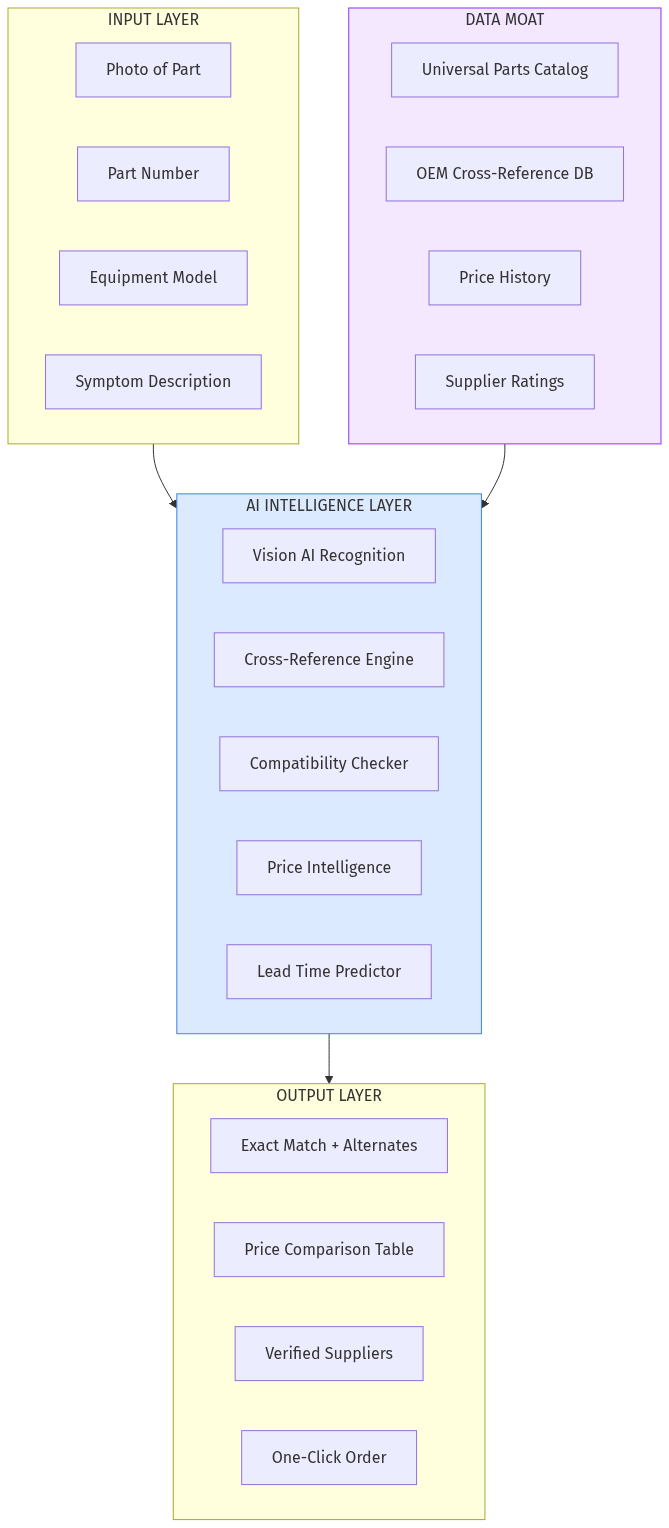
    AI Architecture
    AI Architecture

    Vision AI for Part Recognition

    The Workflow:
  • Maintenance engineer photographs a worn/broken part
  • AI identifies: type (bearing), subtype (deep groove ball), dimensions (6205 series), features (2RS sealed)
  • System returns exact OEM part number + cross-references
  • Technical Approach:
    • Fine-tuned vision model on industrial parts dataset
    • Multi-modal: image + context ("from a lathe machine, spindle side")
    • Confidence scoring with human escalation for edge cases

    Cross-Reference Engine

    Build the world's most comprehensive parts equivalence database:

    • SKF 6205-2RS = FAG 6205-2RSR = NSK 6205DDU = NTN 6205LLU = Timken 205PP
    • Extend to pumps, motors, valves, seals, gears, filters
    Data Sources:
    • OEM interchange catalogs (licensed/scraped)
    • Supplier catalogs (structured extraction)
    • Community contributions (crowdsourced corrections)
    • AI inference (dimension/spec matching)

    Price Intelligence

    Real-time price aggregation from:

    • Listed prices on e-commerce platforms
    • Dealer quotes (anonymized, aggregated)
    • Import data (Zauba, customs records)
    • Historical transaction prices (our own data moat)
    Output: "Fair price range: ₹450-520. You're seeing ₹650? That's 25% above market."

    AI-Powered Negotiation

    The platform negotiates on behalf of the buyer:

    • "We have 50 buyers needing this part this month. Best price for aggregate order?"
    • Demand aggregation = buying power even for small buyers

    Predictive Maintenance Integration

    Connect to machine sensors (vibration, temperature) and predict failures:

    • "Your motor bearing shows wear patterns. Replacement needed in ~300 hours. Order now?"
    • Transform from reactive to proactive procurement
    ---

    7.

    Product Concept

    Transformation Flow
    Transformation Flow

    Core Features

    1. Photo-to-Part Identification
    • Upload image via app or WhatsApp
    • AI returns identified part with 3 levels: exact match, close match, manual review
    • Include context prompts: "What equipment is this from?"
    2. Universal Parts Catalog
    • Searchable by part number, dimensions, application
    • Cross-reference across 50+ brands
    • Filterable by OEM/aftermarket/refurbished
    3. Multi-Supplier Price Comparison
    • Real-time quotes from verified suppliers
    • Price history graphs ("this part cost 20% less 6 months ago")
    • Total cost calculator (part + shipping + GST)
    4. Quality Verification
    • Supplier quality scores based on return rates, complaints
    • Authenticity verification for high-value parts
    • Escrow protection for new suppliers
    5. Instant Ordering
    • One-click checkout with saved payment methods
    • Guaranteed delivery dates (supplier commits or faces penalties)
    • Order tracking with proactive alerts
    6. Procurement Analytics
    • Spend dashboard by category, supplier, machine
    • Consumption forecasting
    • Benchmark your costs vs. industry average

    Channels

    WhatsApp-First: 70% of industrial procurement happens via WhatsApp. Build there. Web App: For analytics, bulk ordering, procurement managers. API: For ERP integration with larger manufacturers.
    8.

    Development Plan

    PhaseTimelineDeliverables
    MVP (Photo ID + Catalog)8 weeksVision AI for top 5 part categories (bearings, seals, belts, filters, switches). Basic catalog with 50,000 SKUs. WhatsApp bot.
    V1 (Price Intelligence)+6 weeksMulti-supplier quoting. Price comparison. Order placement. 10 suppliers onboarded.
    V2 (Quality + Analytics)+8 weeksSupplier quality scores. Buyer spend analytics. Mobile app.
    V3 (Predictive + API)+12 weeksIoT integration for predictive alerts. ERP API for enterprise. Demand aggregation features.

    Technical Stack

    • Vision AI: Fine-tuned Florence-2 or LLaVA for industrial parts
    • Backend: Node.js + PostgreSQL + Redis
    • Search: Meilisearch for parts catalog
    • WhatsApp: Official Business API via Kapso
    • ML Pipeline: Modal/Replicate for inference scaling

    9.

    Go-To-Market Strategy

    Phase 1: Industrial Clusters (Month 1-3)

    Target: 3 industrial clusters—Faridabad (auto components), Rajkot (engineering), Coimbatore (pumps/motors) Approach:
  • Partner with 2-3 key dealers per cluster as founding suppliers
  • Offer them the AI identification tool for free (they get leads)
  • Every identification = demand signal = supplier opportunity
  • Build transaction volume; take 5% commission
  • Phase 2: WhatsApp Virality (Month 4-6)

    Mechanism:
  • "Forward this to your purchasing group" built into every quote
  • Factory A shares with Factory B: "I used this to find my bearing, saved ₹2,000"
  • Network effects in industrial clusters are strong (everyone knows everyone)
  • Phase 3: Enterprise Pilots (Month 7-12)

    Target: Mid-sized manufacturers (₹50-500 crore revenue) Offer:
    • Free procurement analytics dashboard
    • Integrate with their ERP for automatic reorder suggestions
    • Custom pricing based on committed volume

    Channel Partners

    • Machine tool dealers: Already maintain customer relationships
    • Industrial associations: CII, FICCI manufacturing chapters
    • ERP vendors: Tally, SAP resellers—bundle as value-add

    10.

    Revenue Model

    Transaction Commission: 5-8%

    • Standard marketplace model
    • Higher for complex/identified parts (more value created)
    • Lower for commoditized/repeat orders

    Subscription (Procurement Intelligence)

    • Basic: Free (limited searches, basic catalog)
    • Pro: ₹999/month (unlimited AI identification, price alerts, analytics)
    • Enterprise: Custom (API access, ERP integration, dedicated support)

    Supplier Services

    • Featured Listings: ₹5,000/month for priority placement
    • Verified Supplier Badge: ₹2,000/month (quality audit + badge)
    • Lead Generation: ₹50/qualified inquiry

    Financing Margin

    • Partner with NBFCs for invoice financing
    • Spread on working capital loans: 2-4%
    • Massive opportunity as trust builds

    Unit Economics (Target)

    MetricValue
    Average Order Value₹15,000
    Commission6% = ₹900
    CAC (via WhatsApp virality)₹300
    LTV (24-month, 8 orders/year)₹14,400
    LTV:CAC48:1
    ---
    11.

    Data Moat Potential

    Layer 1: Parts Knowledge Graph

    Every part identified, every cross-reference discovered, every dimension recorded—builds the most comprehensive industrial parts database in India. Competitive Value: Years of accumulated data. New entrants start from zero.

    Layer 2: Price Intelligence

    Historical pricing across suppliers, regions, time periods. Competitive Value: "What's the fair price?" Only we can answer with confidence.

    Layer 3: Supplier Quality Signals

    Delivery times, defect rates, return rates, dispute resolution. Competitive Value: Trust scores that can't be faked or bought.

    Layer 4: Demand Patterns

    What parts fail in which machines at what intervals. Competitive Value: Predictive procurement is impossible without this data. We'll have it; competitors won't.

    Layer 5: Procurement Behavior

    How buyers decide, what makes them switch suppliers, price sensitivity curves. Competitive Value: Optimize marketplace dynamics. Match buyers and sellers better than anyone.
    12.

    Why This Fits AIM Ecosystem

    Natural Category for AIM.in

    Industrial spare parts is a perfect AIM vertical:

    • Structured data opportunity: Parts have specs, dimensions, compatibility—highly structurable
    • Trust-critical: Quality matters immensely; verification adds massive value
    • Repeat purchase: Factories buy spare parts continuously, not one-time
    • WhatsApp-native: Already how procurement happens; we just make it smarter

    Domain Synergy

    • thefoundry.in: Industrial procurement hub—spare parts is core category
    • AIM.in Hub: Central business registry where manufacturers list equipment, creating demand signals
    • refurbs.in: Refurbished machinery often needs specific parts—cross-sell opportunity

    Agent Architecture

    Bhavya (WhatsApp Commerce): Handles all customer interactions via WhatsApp—part identification requests, quotes, orders. Netrika (Data Intelligence): Builds and maintains the parts knowledge graph, price intelligence, cross-reference database. Vedika (Architecture): Designs the technical infrastructure for vision AI, real-time pricing, supplier integration.

    ## Mental Models Applied

    Zeroth Principles

    Assumption questioned: "Buyers know what part they need." Reality: They often don't. The part number is worn off, documentation is lost, equipment is 20 years old. Start from identification, not just discovery.

    Incentive Mapping

    Who profits from status quo?
    • Dealers profit from information asymmetry (they know prices; buyers don't)
    • OEMs profit from part exclusivity (no cross-reference = must buy OEM)
    • Large buyers profit from scale (small buyers subsidize their discounts)
    Our disruption: Democratize information. Level the playing field for small buyers.

    Distant Domain Import

    What field solved similar problems?
    • Automotive aftermarket: Companies like RockAuto built massive cross-reference databases for car parts. Industrial is 10x more complex but same pattern.
    • Pharma generics: Generic drug matching to branded equivalents. We do the same for industrial parts.

    Falsification (Pre-Mortem)

    Why would this fail?
  • Data moat takes too long: If building the cross-reference database takes 3 years, competitors catch up.
  • Mitigation: Start with high-volume categories (bearings, seals). 80% of transactions in 20% of SKUs.
  • Suppliers refuse to list prices: Dealers protect margin via opacity.
  • Mitigation: Aggregate anonymized transaction data. Don't need their cooperation.
  • Vision AI isn't accurate enough: Industrial parts are visually similar.
  • Mitigation: Human-in-the-loop for edge cases. 80% automation is still 10x better than 0%.
  • Trust/quality concerns: Buyers fear counterfeit parts.
  • Mitigation: Escrow + inspection for high-value parts. Start with trusted suppliers.

    Steelmanning

    Best argument AGAINST this opportunity:

    "Moglix already has $2.5B valuation and massive catalog. Large manufacturers have entrenched procurement systems. Dealers have relationship moats. The market is big but fragmented for a reason—consolidation is hard. Margins are thin in commoditized parts. You'd need massive capital to build the supply chain trust that established players have."

    Counter: Moglix is enterprise-focused and catalog-driven. They don't solve identification or serve SMEs well. We're not competing on catalog breadth but on intelligence depth. The AI layer is new—previous attempts at industrial marketplaces didn't have this capability.

    ## Verdict

    Opportunity Score: 8.5/10

    Strengths

    • Massive market with clear pain points
    • AI technology finally capable of solving the hard problem (identification)
    • Low digital penetration = greenfield opportunity
    • WhatsApp-native distribution channel
    • Strong data moat potential
    • Natural fit with AIM ecosystem

    Risks

    • Data acquisition is chicken-and-egg (need transactions to learn, need learning to get transactions)
    • Supplier onboarding requires feet-on-street in industrial clusters
    • Quality verification is genuinely hard for technical parts
    • Competition from well-funded players if opportunity becomes obvious

    Recommendation

    Build this. Start with bearings—highest volume, most standardized, easiest to cross-reference. Build the WhatsApp bot that identifies bearings from photos. Partner with 5-10 bearing dealers as founding suppliers. Prove the model in one category, then expand.

    The industrial MRO spare parts market is a $25+ billion opportunity in India with <5% digital penetration. The AI identification layer is the unlock that previous marketplace attempts didn't have. First mover with a genuine intelligence moat can build a category-defining platform.

    Next Step: Vertical deep-dive on bearings procurement—the beachhead market.

    ## Sources