ResearchFriday, February 27, 2026

AI-Powered Industrial Automation Services Intelligence: The Hidden $15B SME Manufacturing Gap

India has 63 million MSMEs, yet only 8% have automated production lines. The bottleneck isn't technology—it's access to trustworthy automation engineers. A new AI-driven marketplace can unlock this dormant demand by matching manufacturers with vetted PLC/SCADA specialists, standardizing pricing, and enabling remote commissioning.

1.

Executive Summary

The global industrial automation market is projected to reach $504 billion by 2033, growing at 10.5% CAGR. Yet in India, where manufacturing contributes 17% of GDP, a massive segment remains untouched: SME manufacturers who need automation but can't access qualified engineers.

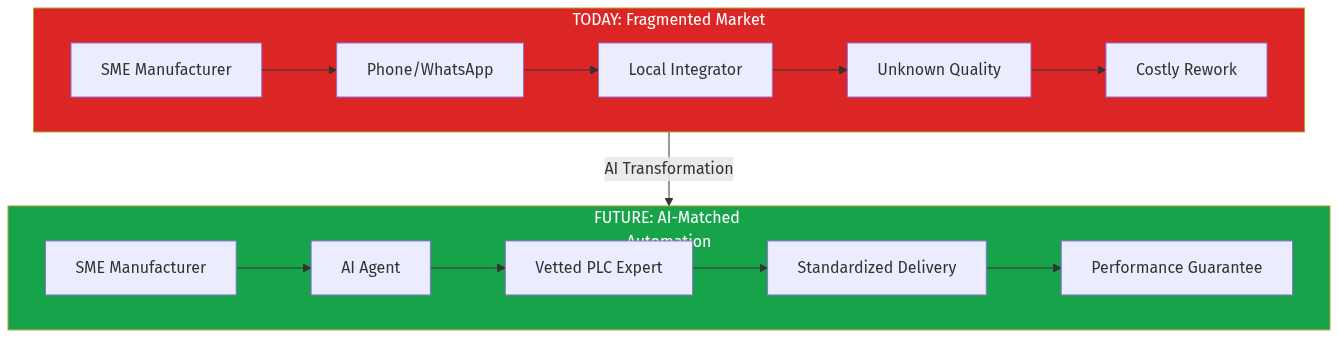
The problem isn't that automation is too expensive—entry-level PLCs cost under ₹50,000. The problem is finding someone trustworthy to program them. Currently, this happens through phone calls to local distributors, WhatsApp referrals, and opaque pricing. The result: poor quality implementations, costly rework, and abandoned automation projects.

This deep dive explores the opportunity for an AI-powered automation services marketplace—a platform that matches SME manufacturers with vetted PLC/SCADA programmers, standardizes project scoping, enables milestone-based payments, and uses AI to predict project success.

Market Transformation

2.

Problem Statement

Who Experiences This Pain?

Primary: SME manufacturers (₹1-50 Cr revenue) in:
  • Food processing (packaging lines, batch control)
  • Pharmaceuticals (compliance-driven automation)
  • Automotive tier-2/3 suppliers (CNC integration, quality inspection)
  • Textile mills (loom automation, dyeing control)
  • Plastic/packaging (injection molding, blow molding)
The Core Problems:
  • Discovery Failure: No reliable way to find automation engineers. Manufacturers rely on equipment vendor referrals (biased) or random WhatsApp contacts (unvetted).
  • Opaque Pricing: Same project quoted at ₹50,000 by one integrator and ₹3,00,000 by another. No benchmarks exist.
  • Skill Mismatch: PLC brands are not interchangeable. A Siemens expert may struggle with Allen-Bradley. Manufacturers don't know what expertise they need.
  • Project Scope Creep: Most failures stem from poor requirement gathering. Manufacturers describe problems in business terms; engineers think in I/O points and ladder logic.
  • No Accountability: Once paid, engineers disappear. No performance tracking, no reviews, no recourse.
  • Zeroth Principles Analysis

    What axiom does everyone accept uncritically?

    > "Industrial automation requires on-site presence."

    This was true when commissioning required physical cable tracing and panel wiring. But modern PLCs support remote programming, VPN access, and remote HMI viewing. 80% of programming work can happen remotely—only final commissioning needs site presence.

    What would we believe with zero prior knowledge?

    If we approached this fresh, we'd see industrial automation as a software service that happens to run on specialized hardware. The programmer's location shouldn't matter if secure remote access exists.


    3.

    Current Solutions

    CompanyWhat They DoWhy They're Not Solving It
    IndiaMARTLists automation integratorsNo vetting, no quality signals, pure lead generation. Manufacturers still do all due diligence manually.
    Rockwell Automation PartnersBrand-certified integratorsExpensive, enterprise-focused, minimum project sizes too high for SMEs.
    Upwork/FreelancerGeneric freelance marketplacesIndustrial automation is too niche. No PLC-specific vetting or project templates.
    Local System IntegratorsOne-stop automation shopsGeographic monopolies, opaque pricing, quality varies wildly.
    Siemens SITRAIN NetworkCertified programmersTraining certification ≠ project delivery capability. No marketplace.
    Automation DirectDIY automation + supportUS-focused, doesn't solve the "who will implement" problem in India.

    Incentive Mapping

    Who profits from the status quo?
    • Equipment distributors: Earn commissions by recommending their network integrators. No incentive for quality.
    • Large SIs (System Integrators): Enjoy information asymmetry—SMEs can't compare prices.
    • PLC brands: Want to sell hardware, not optimize services. Partner programs are marketing, not quality control.
    What feedback loops maintain current behavior?
  • Manufacturers burn money on failed projects → become automation-averse → market shrinks
  • Good engineers stay employed at large SIs → freelance pool remains weak → trust stays low
  • No public reviews → reputation doesn't compound → no differentiation

  • 4.

    Market Opportunity

    Market Size

    SegmentIndiaGlobal
    Industrial Automation Market$18.4B (2025)$226B (2025)
    Automation Services (30% of market)$5.5B$68B
    SME Addressable (25% underserved)$1.4B$17B
    Platform Take Rate (15%)$210M$2.5B

    Growth Drivers

    • Manufacturing PLI Schemes: ₹1.97 lakh crore allocated across 14 sectors. SMEs must automate to qualify.
    • Labor Cost Inflation: Wages up 8% annually; automation ROI improving.
    • Industry 4.0 Push: SAMARTH Udyog initiative targeting 10,000 SME digital transformations.
    • COVID Legacy: Remote monitoring demand permanent—distributed workforce accepted.

    Why Now?

  • Remote PLC programming normalized: COVID forced adoption of VPN-based commissioning.
  • Low-cost automation explosion: Chinese PLCs (Wecon, Delta, Kinco) make sub-₹1L projects viable.
  • WhatsApp Business API maturity: SME manufacturers live on WhatsApp—now automatable.
  • AI code assistance: ChatGPT/Claude can help generate ladder logic drafts, reducing expert time.

  • 5.

    Gaps in the Market

    Anomaly Hunting

    What's strange that doesn't fit?
  • Training market exists, but deployment doesn't: Thousands complete Siemens/Rockwell certifications annually. Where do they go? Most join large SIs or work in-house. No marketplace aggregates freelance supply.
  • Equipment e-commerce works, services don't: You can buy PLCs on Amazon India, but not hire someone to program them. Hardware commoditized; services fragmented.
  • Automotive tier-1s outsource, SMEs don't: Large auto suppliers use platforms like Cognizant for MES integration. Why no equivalent for SME automation?
  • Maintenance is recurring, installation isn't: Annual maintenance contracts (AMC) exist, but initial programming is one-time. This discourages marketplace investment—wrong business model.
  • Gap Analysis

    GapCurrent RealityOpportunity
    VettingTrust based on referralsSkill tests, project reviews, brand certifications
    ScopingPhone calls, site visitsAI-guided requirement templates by industry
    PricingOpaque negotiationTransparent benchmarks by project type
    DeliveryOn-site onlyRemote-first with milestone tracking
    QualityNo accountabilityPerformance guarantees, escrow, reviews
    ---
    6.

    AI Disruption Angle

    Distant Domain Import

    What field has solved similar problems?
    • Legal Services (Clio + LegalZoom): Complex expert services → productized through templates + matching
    • Healthcare (Practo + Vezeeta): Doctor discovery → reviews + booking + teleconsultation
    • Logistics (Rivigo/BlackBuck): Fragmented truckers → digitized with load matching + payments
    The Pattern: Fragmented expert services scale when you:
  • Create standardized service definitions
  • Build trust through transparent reviews
  • Enable remote delivery where possible
  • Handle payments + disputes centrally
  • How AI Transforms This Workflow

    Current StepAI Enhancement
    Describe problem via callNatural language → structured spec conversion
    Get 3-4 quotesInstant benchmark pricing based on project type
    Evaluate engineer skillAI-analyzed portfolio + certification verification
    Coordinate site visitsRemote programming first, site visit only for commissioning
    Check progressReal-time milestone tracking + code review
    Pay on trustEscrow + automated acceptance testing

    AI Agent Vision

    Future state: SME manufacturer describes problem in Hindi on WhatsApp → AI agent classifies project → matches with top 3 engineers → generates standardized quote → handles milestone payments → monitors remote programming → schedules commissioning → collects review.

    The human expert focuses on engineering; AI handles everything else.

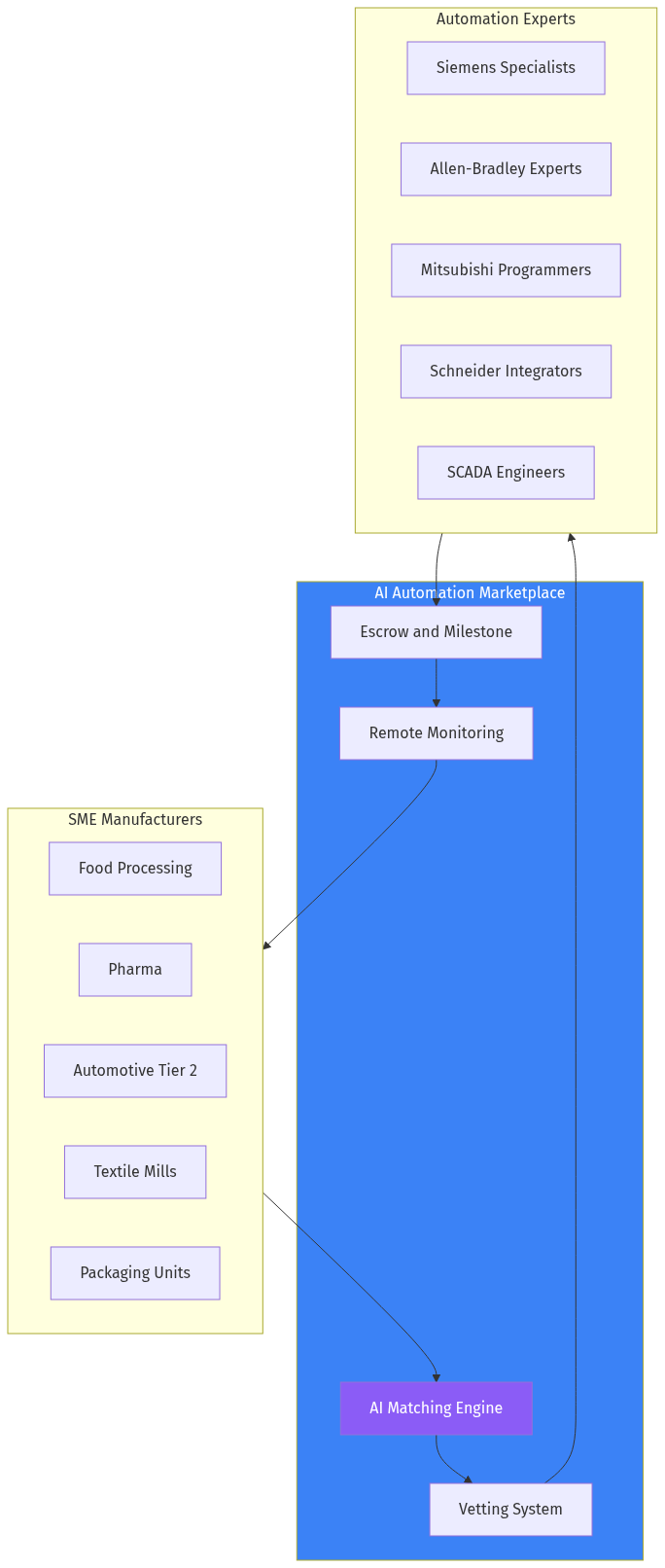
    Platform Architecture
    Platform Architecture

    7.

    Product Concept

    Core Platform Features

    For Manufacturers:
    • AI-powered requirement builder (guided questionnaire by industry)
    • Instant budget estimates based on historical data
    • Matched engineer profiles with verified certifications
    • Milestone-based project tracking
    • Escrow payments with release on acceptance
    • Post-project support subscription options
    For Automation Engineers:
    • Profile with PLC brand certifications (verified)
    • Portfolio showcase with anonymized case studies
    • Project bidding with transparent fee structure
    • Remote programming workspace (VPN management)
    • Milestone submission + acceptance workflow
    • Performance ratings that compound
    AI Intelligence Layer:
    • Requirement → specification translation
    • Project complexity scoring
    • Engineer-project matching (skills, availability, price)
    • Risk prediction (delay probability, scope creep signals)
    • Automated code review (ladder logic best practices)

    Project Categories

    CategoryTypical ScopePrice RangeRemote %
    Single Machine Control1 PLC, basic HMI₹30K-80K70%
    Production Line Integration2-5 PLCs, SCADA₹1L-4L60%
    Batch Process ControlRecipe management₹2L-6L65%
    Quality Inspection SystemVision + PLC₹3L-8L50%
    Full Plant SCADAEnterprise integration₹10L-30L40%
    ---
    8.

    Development Plan

    PhaseTimelineDeliverables
    DiscoveryWeeks 1-430 SME manufacturer interviews, 20 automation engineer interviews, competitor deep-dive
    MVPWeeks 5-12WhatsApp bot for requirements, basic matching, manual escrow
    V1Weeks 13-20Web platform, automated matching, milestone payments, review system
    V2Weeks 21-28AI spec writer, remote workspace, code review, mobile app
    ScaleWeeks 29-40Multi-language, equipment financing integration, AMC marketplace

    Technical Architecture

    • Frontend: WhatsApp Business API (primary) + React web dashboard
    • Backend: Node.js/Python microservices
    • AI Layer: Claude/GPT-4 for requirement parsing, custom ML for matching
    • Payments: Razorpay escrow + milestone release
    • Remote Access: WireGuard VPN management for PLC access
    • Monitoring: Real-time project telemetry + alerts

    9.

    Go-To-Market Strategy

    Phase 1: Supply-Side First (Months 1-3)

  • Partner with training institutes: NSDC skill centers, Siemens SITRAIN, Rockwell academies produce certified programmers. Onboard recent graduates.
  • Poach from large SIs: Offer moonlighting opportunities. Large SI engineers want side income.
  • WhatsApp community building: "Automation Engineers India" group → content → leads.
  • Phase 2: Demand Generation (Months 4-6)

  • Target equipment distributors: They get asked "who will program this?" constantly. Become their answer.
  • MSME scheme tie-ups: Position as ZED certification enabler (automation is a criterion).
  • Industry association partnerships: CII, FICCI manufacturing chapters for credibility.
  • Phase 3: Flywheel Activation (Months 7-12)

  • Launch review system: Public ratings create trust moat.
  • Introduce project templates: "Packaging line automation—₹2.5L, 6 weeks" productized offerings.
  • Add financing: NBFC tie-ups for equipment + services EMI.
  • Distribution Channels

    ChannelRoleCost
    WhatsApp broadcastSME manufacturer reachLow
    Equipment distributor referralsWarm leadsRevenue share
    LinkedIn B2B campaignsEngineer acquisitionMedium
    Industry events (ACMA, IMTEX)Credibility buildingHigh
    ---
    10.

    Revenue Model

    Primary Revenue Streams

    StreamModelExpected Contribution
    Transaction Fee12-15% on project value60%
    Featured ListingsEngineers pay for visibility15%
    Financing Commission2-3% of financed value10%
    AMC Marketplace10% on maintenance contracts10%
    Enterprise APILarge SIs use matching engine5%

    Unit Economics

    MetricTarget
    Average Project Value₹1,50,000
    Platform Take Rate15%
    Revenue per Transaction₹22,500
    CAC (Manufacturer)₹3,000
    CAC (Engineer)₹1,500
    LTV:CAC Ratio8:1
    Gross Margin75%
    ---
    11.

    Data Moat Potential

    Data Moat
    Data Moat

    Proprietary Data Assets

  • Project Specification Library: Thousands of structured automation requirements by industry. No one else has this.
  • Pricing Benchmark Database: What does a "bottling line PLC upgrade" actually cost? Real transaction data creates pricing power.
  • Engineer Performance Graph: Project completion rates, client ratings, skill certifications—compound over time.
  • Code Template Repository: Anonymized ladder logic patterns for common use cases. Accelerates future projects.
  • Equipment Compatibility Matrix: Which PLC works with which drive, which HMI, which protocol. Built from real integrations.
  • Network Effects

    • More engineers → better matching → faster projects → more manufacturers → more projects → more engineers
    • More data → better AI pricing → more trust → more transactions → more data

    Switching Costs

    • Engineers build reputation on platform (not portable)
    • Manufacturers get historical project documentation (vendor lock-in)
    • Industry-specific templates create dependency

    12.

    Why This Fits AIM Ecosystem

    Strategic Alignment

    AIM.in's mission is to help buyers DECIDE, not just discover. Industrial automation is perfect:

    • High-ticket, high-stakes decisions
    • Massive information asymmetry
    • Urgent need for structured evaluation criteria

    Portfolio Synergy

    Existing AIM VerticalAutomation Services Opportunity
    thefoundry.in (Industrial)Automation for foundry machines
    refurbs.in (Equipment)Automation for refurbished machinery
    niyukti.in (Recruitment)Automation engineer hiring
    instabox.in (Logistics)Warehouse automation matching

    Domain Asset

    automate.in or plcmarket.in as potential vertical domain. Fits the AIM pattern of industry-specific B2B marketplaces.

    ## Pre-Mortem: Why This Could Fail

    Falsification Analysis

    Assume 5 well-funded startups tried this and failed. Why?
  • On-site work still dominates: If manufacturers refuse remote programming, unit economics collapse.
  • - Mitigation: Start with maintenance/modifications (more remote-friendly) before greenfield projects.
  • Large SIs crush the marketplace: If Siemens/Rockwell build their own matching platforms, game over.
  • - Mitigation: They've had decades and haven't. Their incentive is hardware, not services.
  • Trust takes too long: SME manufacturers may never trust a platform over personal referrals.
  • - Mitigation: Equipment distributor partnerships provide initial trust transfer.
  • Quality control is impossible: Bad engineers damage the platform reputation.
  • - Mitigation: Aggressive vetting, escrow, and rapid delisting.
  • Market is smaller than it appears: Maybe SMEs just won't automate.
  • - Mitigation: Focus on industries with regulatory/competitive pressure (pharma, auto).

    Steelmanning the Opposition

    Best argument AGAINST this opportunity:

    "Industrial automation is inherently high-touch. The best engineers have all the work they need through existing networks. The remaining supply is low-quality. A platform aggregating mediocre engineers won't create value—it'll just standardize failure."

    Counter-argument:

    The best engineers are overloaded precisely because discovery is broken. A platform with real quality signals allows hidden talent (recent graduates, career changers, semi-retired experts) to emerge. Quality begets quality—initial curation creates a virtuous cycle.


    ## Second-Order Effects

    If this succeeds, what happens next?
  • Equipment financing integration: Once you control the services layer, equipment becomes a bundle. Finance the full project.
  • Predictive maintenance market: Ongoing monitoring creates an AMC marketplace worth 3x initial installation.
  • Manufacturing-as-a-Service emergence: With automation democratized, contract manufacturing scales. New business models emerge.
  • Skill credential disruption: Platform ratings may matter more than brand certifications. Power shifts from training providers to transaction platforms.

  • ## Verdict

    Opportunity Score: 8.5/10
    CriterionScoreRationale
    Market Size9/10$1.4B SAM in India, $17B globally
    Problem Severity9/10Real pain, daily frustration for SMEs
    Current Solutions8/10Fragmented, no clear winner
    AI Disruption Potential8/10Requirement parsing + matching natural fits
    Defensibility7/10Data moat possible, but takes time
    GTM Clarity8/10Equipment distributors as channel clear
    AIM Fit9/10Perfect vertical for structured decision support
    Final Assessment:

    This is a high-conviction opportunity with clear pain, fragmented supply, and an AI-enabled solution that hasn't been attempted at scale. The key risk is execution—building trust in a high-stakes, traditionally relationship-driven market requires patience and curation.

    Recommended Next Steps:
  • Interview 30 SME manufacturing owners about automation blockers
  • Map the freelance PLC programmer ecosystem (LinkedIn, training institutes)
  • Build a WhatsApp-first MVP with manual matching
  • Pilot with 3 equipment distributors as lead sources
  • The SME manufacturer who wants to automate a single machine shouldn't need a ₹10L contract with a large SI. They need a vetted freelancer, a clear price, and a guarantee. That's the gap. That's the opportunity.


    ## Sources

    • Grand View Research: Industrial Automation Market 2033
    • Ministry of MSME: MSME Annual Report 2024-25
    • SAMARTH Udyog Bharat Initiative Documentation
    • Rockwell Automation Partner Network Data
    • Siemens SITRAIN India Certification Statistics
    • IndiaMART Automation Category Analysis (internal research)
    • AIM.in Ecosystem Strategy Documentation