ResearchFriday, February 27, 2026

AI-Powered Compressed Air Systems Procurement and Service Intelligence: The $40B Industrial Utility Nobody's Optimizing

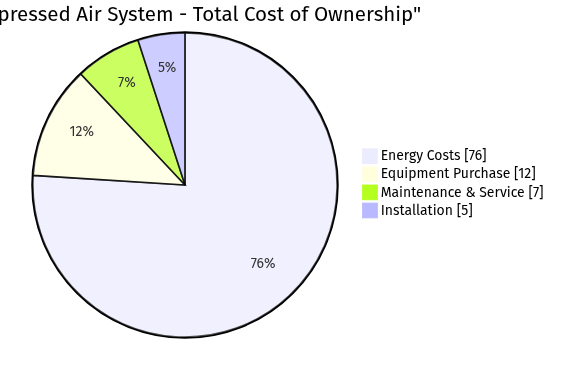
Compressed air is the fourth utility in manufacturing — after electricity, water, and gas. Yet it remains the most expensive, most wasteful, and least intelligently managed. With 76% of total cost going to energy (not equipment), there's a massive opportunity for AI to revolutionize how factories procure, maintain, and optimize their compressed air systems.

1.

Executive Summary

The global air compressor market is valued at $27.7 billion in 2025, projected to reach $40.1 billion by 2033 (4.8% CAGR). But here's what matters more: the service and energy optimization market around these systems is where the real value lies.

Compressed air systems consume 10% of all industrial electricity globally. In a typical manufacturing plant, compressed air costs more to operate over 10 years than the equipment itself cost to buy. Yet most factories run systems that are:

  • Oversized by 20-30% (wasting energy)
  • Serviced reactively (costly downtime)
  • Procured through relationships, not optimization
  • Leaking 20-30% of produced air
The opportunity: An AI-powered platform that helps industrial buyers procure the right compressor systems, connects them with certified service providers, optimizes energy consumption through predictive analytics, and creates transparency in a fragmented market dominated by information asymmetry.


2.

Problem Statement

Who Experiences This Pain?

Plant Managers & Facilities Teams:
  • Compressed air is their largest controllable energy expense
  • They don't know if their systems are sized correctly
  • Service contracts are opaque — unclear what's covered, what's not
  • Downtime from compressor failure stops production lines
Procurement Teams:
  • No visibility into fair pricing for equipment or service
  • Vendor lock-in from OEM service agreements
  • Can't compare independent service providers objectively
  • Quality varies wildly — some technicians are excellent, others incompetent
CFOs & Operations Leaders:
  • Energy costs are rising, compressed air is a black box
  • No data on system efficiency vs. industry benchmarks
  • Capital decisions (repair vs. replace) made on gut feel, not data

The Numbers That Hurt

ProblemImpact
Air leaks (industry average)20-30% of compressed air wasted
Oversized systems25% excess energy consumption
Reactive maintenance5-10x higher repair costs vs. preventive
Unplanned downtime$10,000-$50,000+ per hour in manufacturing
Pressure drop from poor piping10-15% efficiency loss

ZEROTH PRINCIPLES Analysis

What are we assuming that everyone takes for granted?
  • "Compressed air is a commodity utility" — Actually, compressed air quality (oil-free, dry, clean) varies enormously and impacts product quality in food, pharma, electronics
  • "Bigger compressor = better" — Oversizing is the #1 source of waste; variable speed drives + right-sizing saves 30%+
  • "Service contracts are necessary" — Many plants pay for service they don't need, while critical maintenance gets skipped
  • "OEM service is best" — Independent technicians often have equivalent skills at 30-40% lower cost

  • 3.

    Current Solutions

    Equipment Manufacturers (Vertically Integrated)

    CompanyWhat They DoWhy They're Not Solving It
    Atlas CopcoGlobal leader, equipment + serviceIncentivized to sell larger systems; service tied to equipment sales
    Ingersoll RandIndustrial compressors + IoTFocus on enterprise; SME market underserved
    Kaeser CompressorsGerman engineering, air auditsExpensive; audits push their own equipment
    Elgi EquipmentsIndian manufacturer, growing globallyLimited service network outside major metros

    Service Aggregators (Nascent)

    CompanyWhat They DoWhy They're Not Solving It
    FieldAssistGeneral field service managementNot specialized for compressed air; no energy optimization
    FacilioBuilding operations platformFocus on HVAC; compressed air is adjacent but not core

    Energy Auditors (Point Solutions)

    CompanyWhat They DoWhy They're Not Solving It
    Compressed Air ChallengeIndustry education, best practicesNon-profit; no marketplace, no transactions
    Bureau of Energy Efficiency (BEE)Government audits, certificationsSlow, bureaucratic, compliance-focused

    INCENTIVE MAPPING

    Who profits from the status quo?
    • OEMs: Sell oversized systems, lock customers into expensive service contracts
    • Distributors: Margin on equipment sales, not ongoing optimization
    • Complacent service providers: Reactive repairs are more profitable than preventive maintenance
    • Electricity utilities: Higher consumption = higher revenue
    Feedback loops keeping behavior in place:
    • Plant managers don't have data to challenge vendor recommendations
    • Procurement optimizes for upfront cost, not total cost of ownership
    • No benchmarking — plants don't know they're wasting energy
    • Service providers have no incentive to reduce their own future work

    4.

    Market Opportunity

    Global Market Size

    • Air Compressor Market: $27.7 billion (2025) → $40.1 billion (2033)
    • Industrial Compressed Air Services: ~$8-10 billion annually (estimated)
    • Energy Optimization Potential: $15-20 billion in wasted energy globally

    India-Specific Opportunity

    • Market Size: $1.2 billion (equipment) + ~$400 million (services)
    • Growth: 6-7% CAGR, driven by manufacturing expansion
    • Key Verticals: Textile (largest), automotive, pharma, food processing
    • Fragmentation: 500+ service providers, no dominant aggregator

    Why Now?

  • IoT Sensors Are Cheap: Real-time monitoring of pressure, flow, temperature now costs <$200 per system
  • Energy Costs Rising: Industrial electricity up 15-20% in India over 3 years; CFOs are paying attention
  • Manufacturing Expansion: PLI schemes driving new factories that need compressed air
  • Skilled Technician Shortage: Experienced compressor technicians retiring; knowledge not transferred
  • Climate Pressure: Energy efficiency is now a board-level sustainability metric
  • Total Cost of Ownership Reality

    Compressed Air TCO
    Compressed Air TCO
    Critical insight: 76% of lifetime cost is energy. Yet most procurement decisions focus on the 12% (equipment purchase). This is where AI disruption creates massive value.
    5.

    Gaps in the Market

    ANOMALY HUNTING: What's Strange Here?

  • No Price Transparency: A plant in Chennai pays 40% more for the same service as a plant in Pune. Neither knows this.
  • No Outcome-Based Contracts: Service providers charge for visits, not for uptime or efficiency. Misaligned incentives.
  • No Aggregated Demand: 10 factories in an industrial estate each negotiate separately with the same service provider. Zero collective bargaining power.
  • No Technician Ratings: Unlike Uber for drivers or Practo for doctors, no rating system for compressor technicians. Quality is invisible.
  • No Energy Benchmarking: A plant manager doesn't know if their 0.25 kWh/Nm³ is good or terrible compared to industry standards.
  • Training Gap: OEMs train their own technicians; independent techs learn on the job. No structured certification for independents.
  • DISTANT DOMAIN IMPORT

    What other field has already solved a similar problem?
    Solved ProblemSource DomainApplication to Compressed Air
    Fleet fuel optimizationLogistics (BluSmart, Motive)Apply telematics + AI to compressor energy efficiency
    Technician marketplacesHome services (Urban Company)Rating systems, verified skills, transparent pricing
    Predictive maintenanceAviation (GE Aviation)Apply sensor-driven analytics to industrial compressors
    Energy as a serviceSolar (Sunrun, First Solar)Offer "compressed air as a service" with efficiency guarantees
    Aggregated procurementGroup buying (Meesho, Udaan)Cluster factories for volume discounts on equipment and service
    ---
    6.

    AI Disruption Angle

    Compressed Air Platform Architecture
    Compressed Air Platform Architecture

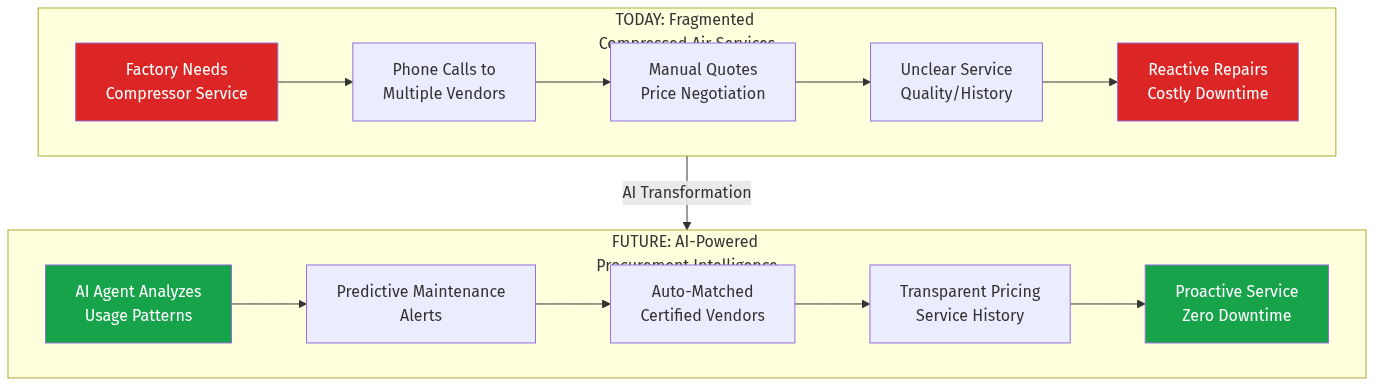
    How AI Agents Transform the Workflow

    Current State → AI-Enabled Future:
    ProcessTodayWith AI Agents
    ProcurementCall 3-4 vendors, negotiate manuallyAgent analyzes requirements, auto-generates RFQs, benchmarks quotes against market
    SizingTrust vendor recommendations (often oversized)AI analyzes actual usage patterns, recommends right-sized system
    Maintenance SchedulingCalendar-based or reactivePredictive: AI detects anomalies in pressure/temperature, schedules service before failure
    Leak DetectionAnnual audit (if any)Continuous monitoring via acoustic sensors + AI pattern recognition
    Energy OptimizationManual adjustmentsAI-controlled pressure setpoints, VSD optimization, load balancing
    Vendor SelectionRelationships, geographyAI matches based on skill matrix, past performance, availability, price

    The AI Agent Workflow

    Current vs Future Workflow
    Current vs Future Workflow

    Specific AI Capabilities

  • Energy Anomaly Detection: Train models on thousands of compressor systems to identify when a specific unit is consuming excess energy (leak, worn parts, wrong settings)
  • Demand Prediction: Correlate compressed air demand with production schedules, weather, shift patterns to optimize compressor sequencing
  • Technician Matching: NLP to parse service requirements, match to technician skill profiles, consider travel time, past ratings, certifications
  • Quote Intelligence: Build pricing database across regions; flag outlier quotes; provide negotiation leverage
  • Compliance Tracking: Auto-monitor for food-grade (ISO 8573), pharma (GMP), and general safety certifications; alert before expiry

  • 7.

    Product Concept

    VayuNet: AI-Powered Compressed Air Intelligence Platform

    Core Value Proposition: "Know your air. Control your costs. Zero downtime."

    Key Features

    For Buyers (Factories):
    FeatureDescription
    Air Audit DashboardReal-time visibility into pressure, flow, energy, leaks across all systems
    Benchmark Score"Your plant uses 0.28 kWh/Nm³ vs. industry best of 0.18 kWh/Nm³ — here's how to improve"
    Smart ProcurementAI-generated RFQs, auto-invite qualified vendors, comparison matrix
    Predictive Alerts"Motor bearing showing wear pattern — schedule service within 2 weeks to avoid failure"
    Energy Savings TrackerMonthly report: "You saved ₹84,000 this month vs. baseline"
    For Service Providers:
    FeatureDescription
    Verified Skill ProfilesCertifications, experience, equipment expertise
    Lead DistributionMatched to relevant service requests based on capability and geography
    Job ManagementSchedule, dispatch, complete, invoice — all in platform
    Rating & ReviewsTransparent feedback from every service call
    Training MarketplaceUpskill through courses; earn higher-tier certifications
    For Equipment Manufacturers:
    FeatureDescription
    Fleet IntelligenceAggregate performance data across installed base
    Warranty ClaimsDigital workflow, faster resolution
    Lead GenerationIdentify plants with aging/inefficient systems
    ---
    8.

    Development Plan

    PhaseTimelineDeliverables
    MVP8 weeksBasic marketplace: buyer posts requirement, vendors respond, rating system
    V116 weeksIoT integration, energy dashboard, predictive alerts (integrate with existing sensors)
    V224 weeksAI procurement (auto-RFQ, quote benchmarking), technician matching algorithm
    V332 weeks"Air as a Service" model — outcome-based contracts with efficiency guarantees

    Technical Stack

    • IoT Layer: Partner with sensor providers (Samsara, Particle) or build low-cost edge devices
    • Data Pipeline: Time-series database (TimescaleDB) for sensor data
    • AI/ML: Anomaly detection (Prophet, LSTM), demand forecasting, recommendation engine
    • Marketplace: Standard B2B stack (Next.js, PostgreSQL, search via Meilisearch)
    • Mobile: Technician app for job management (React Native)

    9.

    Go-To-Market Strategy

    Phase 1: Supply-Side First (Service Providers)

  • Identify Top Technicians: Survey industrial estates, get referrals, onboard best independents
  • Offer Instant Credibility: Create verified profiles, help them win business
  • Training Partnership: Work with SKF, Atlas Copco training centers to certify independents
  • Target: 50 verified technicians across 5 cities in 6 months
  • Phase 2: Demand-Side (Factories)

  • Free Energy Audit: Offer free compressed air assessment to 100 factories
  • Data Hook: "We found ₹12 lakhs/year in energy waste — want to fix it?"
  • Cluster Strategy: Target industrial estates (one sale = access to 50 factories)
  • Industry Associations: Partner with CII, FICCI manufacturing chapters
  • Target: 200 factories on platform in Year 1
  • Phase 3: Expand Services

  • Add Equipment Procurement: Once service is working, add equipment marketplace
  • Energy-as-a-Service: Pilot outcome-based contracts with 10 factories
  • Regional Expansion: Prioritize manufacturing hubs (Pune, Chennai, Ahmedabad, NCR)

  • 10.

    Revenue Model

    Revenue Streams

    StreamModelProjected Revenue
    Service Marketplace Commission10-15% of service transaction value₹8-12 Cr/year at scale
    Energy Savings Share20% of documented savings vs. baseline₹15-20 Cr/year (high-margin)
    Premium Subscriptions₹10,000/month for advanced analytics₹5-8 Cr/year
    Equipment Procurement Fee2-3% of equipment value₹3-5 Cr/year
    Training & Certification₹5,000-15,000 per course₹1-2 Cr/year
    OEM Data ProductsAggregate insights sold to manufacturers₹2-3 Cr/year

    Unit Economics Target

    • Factory LTV: ₹5-8 lakhs over 5 years (service + savings share + subscriptions)
    • CAC: ₹15,000-25,000 (sales team for enterprise, digital for SME)
    • LTV/CAC: 20-30x (excellent for B2B SaaS + marketplace hybrid)

    11.

    Data Moat Potential

    Proprietary Data Accumulates Over Time

  • Energy Benchmarks: Largest database of compressed air efficiency metrics by industry, geography, system type
  • Pricing Intelligence: Real transaction data on service costs across regions (no one else has this)
  • Failure Patterns: Which compressor models fail most? Which failure modes precede catastrophic breakdown?
  • Technician Performance: Ratings, completion rates, first-time-fix rates — enables quality ranking
  • Demand Patterns: Correlate compressed air usage with production data, seasons, shifts
  • SECOND-ORDER THINKING: If This Succeeds...

    What happens next?
    • Expand to other industrial utilities (nitrogen, hydraulics, HVAC)
    • Become the procurement platform for all facility services
    • OEMs may try to acquire or partner (Atlas Copco, Ingersoll Rand)
    • Insurance companies may use data for equipment coverage pricing
    • Energy auditors become obsolete; platform IS the audit
    Unintended consequences:
    • Commoditization of technician labor (may drive wages down)
    • OEMs may restrict data access from platform-connected systems
    • Plants may over-rely on AI, lose internal expertise

    12.

    Why This Fits AIM Ecosystem

    Perfect AIM Vertical

  • Structured Data Opportunity: Equipment specs, service records, energy data — all structurable
  • B2B + Repeat Transactions: Service is recurring; relationships are long-term
  • High-Trust Category: Equipment downtime is costly; buyers need reliable providers
  • AI-Native: Predictive maintenance, energy optimization, matching — all AI-first
  • India Manufacturing Boom: Aligned with PLI, Make in India, manufacturing growth
  • Cross-Ecosystem Synergies

    • thefoundry.in: Factories buying equipment may also need compressed air systems
    • niyukti.in: Technician recruitment and training
    • networth.in: Equipment financing options
    • Data layer: Shared industrial intelligence across AIM verticals

    Domain Synergy

    • vayu.in (air) — Available? Check portfolio
    • compressor.in, airservices.in — Potential acquisitions

    ## Verdict

    Opportunity Score: 8.5/10

    FALSIFICATION: Pre-Mortem — Why Would This Fail?

    Failure ModeProbabilityMitigation
    OEMs block data accessMediumPartner early; offer value to OEMs (fleet intelligence)
    Factories won't share energy dataMediumProve value with free audits; anonymize benchmarks
    Technician supply insufficientLowTraining partnerships; recruit from adjacent trades
    Low margins squeeze viabilityMediumEnergy savings share is high-margin; diversify revenue
    Competitor with better fundingMediumFirst-mover in India; deep relationships matter

    STEELMANNING: Why Incumbents Might Win

    Best argument AGAINST this opportunity: "Atlas Copco and Ingersoll Rand have IoT platforms (SMARTLINK, Helix) that already provide predictive maintenance. They have 50+ years of compressor data, global scale, and existing customer relationships. They could easily add a service marketplace if they wanted to. A startup trying to aggregate across OEM brands will face resistance from manufacturers protecting their service revenue." Counter-argument: OEMs are incentivized to sell expensive service contracts, not optimize efficiency. They won't cannibalize their high-margin service business. An independent platform aligned with buyer interests can win on transparency and neutrality — just as CarDekho/CarWale succeeded despite OEMs having dealer networks.

    Final Assessment

    Compressed air is a massive, invisible cost center that every manufacturer has but few optimize. The combination of:

    • IoT sensors becoming cheap
    • AI enabling predictive maintenance
    • Energy costs forcing attention
    • Fragmented service market with zero transparency
    ...creates a perfect storm for disruption. The market is large ($40B globally), the pain is real (76% of cost is wasted energy), and the current solutions are misaligned with buyer interests.

    Recommendation: Build the service marketplace first (fastest to value), then layer in IoT/AI capabilities. Target India's textile and automotive manufacturing clusters where compressed air usage is highest.

    ## Sources