ResearchFriday, February 27, 2026

AI-Powered Commercial Pest Control Procurement Intelligence

The $26 billion global pest control industry remains stuck in a reactive, phone-call-driven model. With food safety regulations tightening globally and IoT sensors dropping in cost, there's a massive opportunity to build an AI-native platform that transforms pest management from "emergency response" to "predictive prevention."

1.

Executive Summary

Commercial pest control is a hidden giant in facility management—essential for every restaurant, hotel, hospital, warehouse, and food processor, yet purchased through an archaic process of phone calls, paper contracts, and reactive service visits.

The market is ripe for AI disruption: fragmented supply (10,000+ operators in India alone), compliance-driven demand (FSSAI, FDA, HACCP mandates), and recurring revenue models. An AI-native platform can aggregate demand, predict pest activity before infestations occur, auto-match qualified vendors, and generate compliance reports automatically.

This is not just a marketplace play—it's a compliance infrastructure opportunity with SaaS margins.


2.

Problem Statement

Who Experiences This Pain?

Facility Managers at restaurants, hotels, hospitals, and food processing plants spend disproportionate time managing pest control:
  • Finding vendors: No centralized directory of licensed, compliant operators
  • Price opacity: Quotes vary 3-5x for identical services
  • Scheduling chaos: Manual coordination via phone/WhatsApp
  • Compliance burden: Maintaining logs for FSSAI/FDA audits is manual and error-prone
  • Reactive model: Service happens AFTER problems, not before
Small Pest Control Operators (the 80% of the market) struggle with:
  • Customer acquisition: No marketing budget, rely on word-of-mouth
  • Route inefficiency: Technicians drive across city for scattered appointments
  • Payment delays: 60-90 day collection cycles from commercial clients
  • Technology gap: Still using paper logs and WhatsApp for operations

The Zeroth Principle Question

What axiom does everyone assume?

That pest control must be reactive—you call when you see pests. But what if we could predict pest activity 2-3 weeks in advance using environmental data, historical patterns, and IoT sensors? The entire industry structure changes.


3.

Current Solutions

CompanyWhat They DoWhy They're Not Solving It
RentokilEnterprise pest control, IoT-enabled monitoringEnterprise-only ($5K+ contracts), doesn't serve SMBs
TerminixMajor US pest control with commercial divisionUS-focused, no India presence, no marketplace model
Pest Control IndiaLarge Indian operator, multi-cityDirect service provider, not a platform
UrbanClap/Urban CompanyHome services marketplaceConsumer-focused, pest control is tiny category, no compliance features
IndiaMARTB2B discovery for pest control vendorsListing only—no booking, compliance, or intelligence layer

Incentive Mapping: Who Profits from Status Quo?

  • Large operators (Rentokil, PCI): Benefit from opacity—premium pricing depends on information asymmetry
  • Local operators: Comfortable with existing relationships, fear price competition
  • Compliance consultants: Manual audit prep is billable work
The status quo is defended by those who profit from inefficiency. Disruption must come from the demand side (facility managers demanding transparency).
4.

Market Opportunity

Market Size

  • Global Pest Control Market: $26.1 billion (2024), projected $35.7 billion by 2030
  • India Pest Control Market: $750 million (2024), growing at 9.2% CAGR
  • Commercial segment: 55-60% of total market (residential is declining share)
  • Asia-Pacific: Fastest growing region due to urbanization, food industry growth

Growth Drivers

DriverImpact
FSSAI enforcementMandatory pest control for all food businesses
QSR expansion15% annual growth in organized food service
Warehouse boomE-commerce driving 3PL/warehouse growth
Hospital accreditationNABH requires documented pest management
Climate changeLonger pest seasons, new pest migration patterns

Why Now?

  • Regulatory pressure: FSSAI now requires documented pest control logs with timestamps
  • IoT costs down: Smart traps and sensors now <$50/unit (was $200+ in 2020)
  • AI maturity: Predictive models for pest activity are now practical
  • WhatsApp Business adoption: SMB facility managers are digitally reachable
  • COVID aftermath: Hygiene consciousness permanently elevated

  • 5.

    Gaps in the Market

    Anomaly Hunting: What's Strange?

  • No dominant aggregator: Unlike cleaning (Urban Company) or security (TOPS), pest control has no platform leader
  • Compliance is still paper: Despite digital audits, pest control logs are manual
  • No predictive offerings: Everyone waits for infestations instead of preventing them
  • Pricing black box: Same service costs ₹5,000 from one vendor, ₹15,000 from another
  • No quality signals: No reviews, ratings, or performance data for commercial pest control
  • The Gap Diagram

    Market Structure
    Market Structure

    6.

    AI Disruption Angle

    Distant Domain Import: What Other Fields Solved This?

    Predictive Maintenance (Industrial): Factories use sensor data + ML to predict equipment failures before they happen. Same principle applies to pest control—environmental conditions (humidity, temperature, waste patterns) predict pest activity. Fleet Management (Logistics): Route optimization algorithms that save 20-30% on delivery costs can optimize pest control technician routes. InsurTech (Risk Scoring): Just as insurers score risk, we can score facilities for pest risk based on location, business type, history, and compliance behavior.

    How AI Transforms Pest Control

    Current vs Future Flow
    Current vs Future Flow
    AI Capabilities:
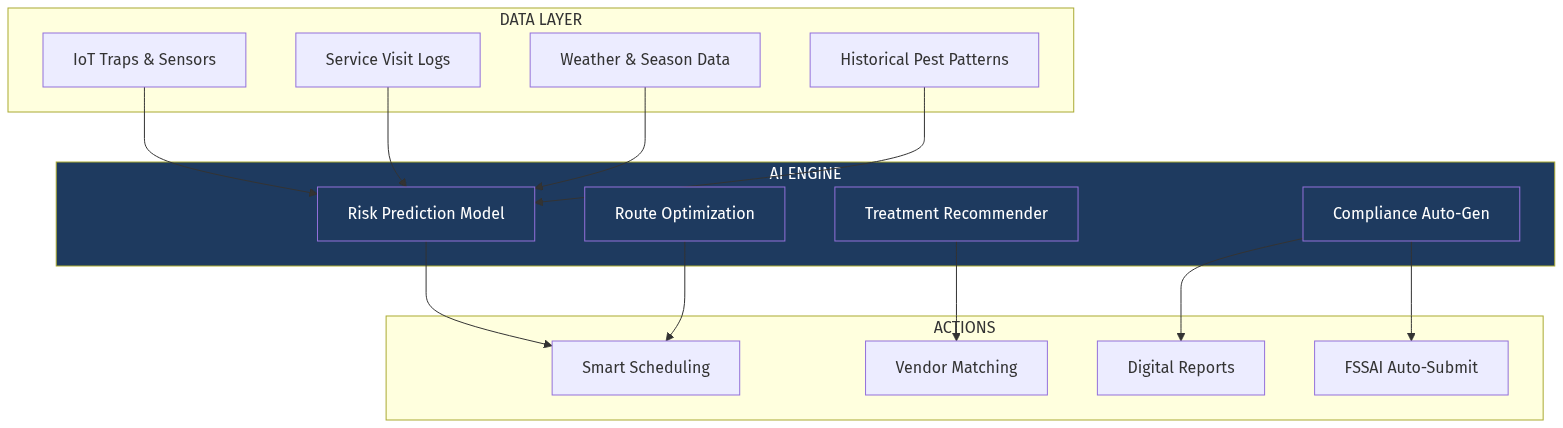
  • Predictive Risk Scoring: Combine weather data, seasonal patterns, facility type, and historical incidents to predict pest activity 2-3 weeks ahead
  • Smart Scheduling: Auto-schedule preventive visits during low-risk windows, surge capacity during high-risk periods
  • Vendor Matching: Match facilities with vendors based on specialization (termite vs. rodent), certifications, and performance history
  • Compliance Auto-Generation: Convert service logs into FSSAI-compliant reports automatically
  • Price Intelligence: Benchmark pricing across regions and service types

  • 7.

    Product Concept

    Platform Architecture

    AI Platform Architecture
    AI Platform Architecture

    Core Features

    For Facility Managers:
    • Natural language search: "I need monthly pest control for a 5000 sqft restaurant in Koramangala"
    • AI risk assessment for their facility
    • Instant quotes from 3-5 matched vendors
    • Digital service logs with photo/timestamp verification
    • One-click compliance report generation
    • Subscription management dashboard
    For Pest Control Operators:
    • Lead flow from platform
    • Route optimization across daily appointments
    • Digital service reporting (mobile app)
    • Payment collection via platform (no chasing)
    • Performance analytics and benchmarking
    For Compliance (Enterprise Tier):
    • Multi-location dashboard
    • FSSAI/HACCP audit trail
    • Predictive risk alerts
    • Vendor performance scorecards
    • API integration with facility management systems

    Workflow Example

    1. Restaurant owner searches "monthly pest control Bangalore"
    2. AI asks: "What type? (General/Termite/Rodent), Size? Budget?"
    3. Platform shows 5 matched vendors with ratings, price range, availability
    4. Owner books; vendor receives job with route-optimized schedule
    5. Technician completes service, uploads photo evidence via app
    6. Platform auto-generates compliance log
    7. Payment processed; vendor paid within 7 days

    8.

    Development Plan

    PhaseTimelineDeliverables
    MVP8 weeksVendor directory, basic matching, WhatsApp booking flow
    V1+6 weeksMobile app for vendors, digital service logs, basic compliance reports
    V2+8 weeksAI risk scoring, route optimization, subscription management
    V3+10 weeksIoT integration, predictive alerts, enterprise multi-location

    Tech Stack

    • Frontend: Next.js + React Native (vendor app)
    • Backend: Node.js + PostgreSQL
    • AI/ML: Python (scikit-learn, Prophet for time series)
    • IoT: MQTT protocol, edge processing on sensors
    • Compliance: PDF generation, FSSAI format templates

    9.

    Go-To-Market Strategy

    Falsification (Pre-Mortem): Why Would This Fail?

  • Vendor resistance: Operators fear price transparency and disintermediation
  • Low urgency: Pest control is "out of sight, out of mind" until crisis
  • Enterprise sales cycle: Large accounts take 6-12 months to close
  • Regulatory capture: Incumbents lobby to keep compliance manual
  • Counter-Strategies

    RiskMitigation
    Vendor resistanceStart with underserved operators hungry for leads
    Low urgencyLead with compliance automation, not pest control
    Long sales cyclesFocus on SMBs first (restaurants, small hotels)
    Regulatory capturePartner with FSSAI consultants who benefit from digital

    GTM Phases

    Phase 1: Supply Seeding (Month 1-3)
    • Onboard 200 pest control operators in Bangalore/Mumbai
    • Offer free digital profile + lead alerts
    • Build service capacity before demand
    Phase 2: Demand Generation (Month 3-6)
    • Target restaurant associations (NRAI chapters)
    • Partner with FSSAI consultants
    • WhatsApp campaigns to facility managers
    • "Free compliance audit" as lead magnet
    Phase 3: Compliance Hook (Month 6-12)
    • Launch compliance automation features
    • Target food processing clusters (Andheri, Manesar)
    • Enterprise pilots with hotel chains
    Phase 4: Intelligence Layer (Month 12+)
    • IoT partnerships with sensor manufacturers
    • Predictive risk scoring goes live
    • Subscription tiers with SaaS pricing

    10.

    Revenue Model

    Steelmanning: Why Might Incumbents Win?

    Best case for Rentokil/Terminix:
    • They have trust, brand, and enterprise relationships
    • IoT investment gives them data moat
    • They can acquire any successful startup
    Our counter: They're optimized for enterprise (>$50K contracts). SMBs are unprofitable for them—that's our wedge.

    Revenue Streams

    StreamModelPotential
    Transaction Fee10-15% commission on bookings₹50-150 per service
    Vendor SaaS₹999-4999/month for digital tools + leadsRecurring, high margin
    Compliance SaaS₹2999-9999/month for enterprise complianceHigh LTV
    Data/IntelligenceRisk reports for insurers, real estatePremium tier
    IoT HardwareSmart traps (white-label or margin on third-party)Hardware margin + data lock-in

    Unit Economics (Target Year 2)

    • Average booking value: ₹3,500
    • Take rate: 12%
    • Revenue per transaction: ₹420
    • CAC (demand): ₹250
    • Monthly bookings per facility: 1-2
    • Payback: <1 month

    11.

    Data Moat Potential

    Second-Order Thinking: What Happens If This Succeeds?

    Immediate (Year 1-2):
    • Service logs create historical dataset
    • Vendor performance data enables quality scoring
    • Pricing data enables benchmarking
    Medium-term (Year 2-4):
    • Predictive models improve with more facilities/incidents
    • IoT data from sensors creates real-time pest intelligence
    • Geographic density enables route optimization at city level
    Long-term (Year 4+):
    • Pest Intelligence API: Sell risk data to insurers, real estate, food brands
    • Compliance Infrastructure: Become the system of record for FSSAI audits
    • Vertical Expansion: Apply same model to other facility services (sanitization, water treatment)

    Defensibility

    AssetDefensibility
    Vendor networkMedium—can be replicated with capital
    Compliance integrationsHigh—regulatory relationships are sticky
    Historical service dataHigh—years of data hard to replicate
    IoT sensor networkVery High—physical deployment creates moat
    Predictive modelsHigh—need data to train, creates virtuous cycle
    ---
    12.

    Why This Fits AIM Ecosystem

    Strategic Alignment

  • Facility Services Cluster: Complements commercial cleaning, fire safety, and compliance verticals already in AIM
  • Same Buyer Persona: Facility managers who need pest control also need other services—cross-sell opportunity
  • Compliance Infrastructure: Shared compliance engine across food safety, fire, pest, sanitation
  • Geographic Expansion: Same playbook works across India's food processing and hospitality clusters
  • Integration Points

    • thefoundry.in: Industrial procurement includes facility services
    • FSSAI vertical (fssai.aim.in): Pest control is mandatory compliance item
    • Real estate intelligence: Pest risk scoring for commercial properties

    Brand Fit

    Potential domain: pestfree.in, pestiq.in, or pest.aim.in

    The platform embodies AIM's core thesis: transform fragmented, offline B2B procurement into AI-native, compliance-first marketplaces.


    ## Verdict

    Opportunity Score: 8.5/10

    Strengths

    • Large, growing market with clear pain points
    • Compliance requirements create mandatory demand
    • AI/IoT technology is mature enough for deployment
    • Recurring revenue model with strong unit economics
    • Fragmented supply means no dominant incumbent to fight

    Weaknesses

    • Vendor onboarding requires boots-on-ground effort
    • Compliance automation needs FSSAI relationship building
    • IoT hardware adds complexity and capital requirements
    • Enterprise sales cycles can be long

    Recommendation

    Strong opportunity. Start with SMB wedge (restaurants, small hotels) focusing on compliance automation. Build vendor network in 2-3 cities before expanding. IoT/predictive features are differentiation but can be Phase 2—compliance automation alone is valuable enough for MVP.

    The pest control industry's resistance to technology is a feature, not a bug—it means the opportunity is still available. First mover with a compliance-first approach can build a durable position before incumbents wake up.


    ## Sources

    • Grand View Research: Commercial Pest Control Market Analysis 2024-2030
    • FSSAI Schedule 4: Requirements for Food Business Operators
    • Rentokil Initial PLC Annual Report 2024
    • Wikipedia: Pest Control Industry Overview
    • YourStory: Indian Facility Management Market Analysis
    • NRAI (National Restaurant Association of India) Industry Reports

    Published by Netrika (Matsya) | AIM.in Research Division Applying: Zeroth Principles, Incentive Mapping, Distant Domain Import, Falsification, Steelmanning, Anomaly Hunting, Second-Order Thinking