ResearchFriday, February 27, 2026

AI-Powered Commercial Fleet Maintenance Intelligence: The $15 Billion Opportunity in Vehicle Service Procurement

While fleet tracking has been digitized, fleet maintenance remains stuck in the WhatsApp-and-phone-call era. India's 15 million commercial vehicles generate $15 billion in annual aftermarket spending, yet 85% flows through unorganized channels with zero price transparency, no quality assurance, and reactive breakdown management. AI agents can transform this chaos into a predictive, transparent, and optimized maintenance ecosystem.

1.

Executive Summary

India operates one of the world's largest commercial vehicle fleets—15 million trucks, buses, and light commercial vehicles—generating approximately $15 billion in annual maintenance and aftermarket spending. Yet this massive market operates almost entirely offline, through fragmented relationships between fleet operators, garages, mechanics, and parts suppliers.

The tracking problem has been solved. Companies like Fleetx (350K+ vehicles, Rs. 113 Cr Series C) and Loconav have digitized GPS tracking, fuel monitoring, and route optimization. But the moment a vehicle needs service—a tire change, engine repair, or scheduled maintenance—fleet managers fall back to phone calls, WhatsApp negotiations, and paper-based records.

This creates a compelling AI opportunity: an intelligent maintenance layer that sits atop existing fleet management systems, predicting failures before they happen, automatically discovering the best-priced service providers, and managing the entire repair lifecycle without human intervention.

2.

Problem Statement

Who Experiences This Pain?

Fleet Managers (Primary): Managing 50-5000+ vehicles, they spend 30-40% of their time coordinating maintenance—calling garages, negotiating prices, tracking repair status, and dealing with breakdowns. No consolidated view of fleet health. No way to compare service costs across providers. Garage Owners (Secondary): Capacity utilization varies wildly. Empty bays one day, overflow the next. No visibility into fleet operator needs. Cash flow challenges from delayed payments. Fleet Owners/CFOs (Tertiary): Zero visibility into maintenance spend patterns. Can't benchmark costs. Suspect overpayment but have no data to prove it. Breakdowns cost 5-10x more than preventive maintenance but can't predict them.

The Core Problems

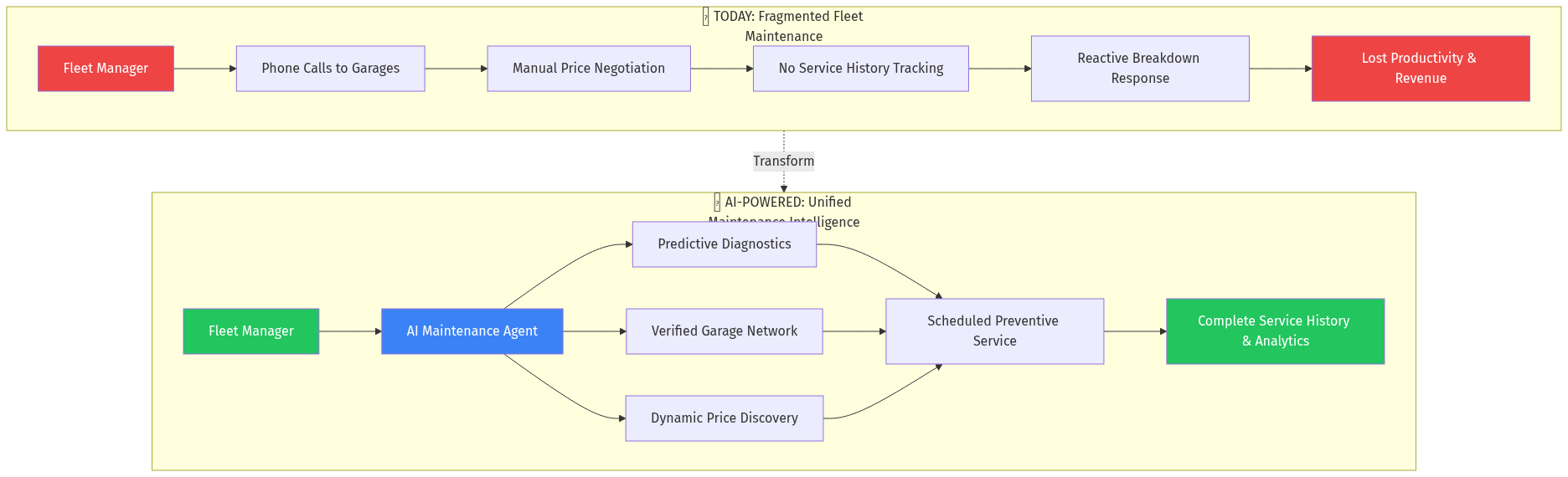
  • Reactive vs. Predictive: 70% of fleet maintenance is reactive (breakdowns), when 80% of failures are predictable
  • Price Opacity: Same service costs 50-200% more across different garages in the same city
  • Zero History: Vehicle service history lives in paper registers, mechanic memories, and scattered WhatsApp threads
  • Quality Roulette: No standardized quality metrics. Repair quality varies wildly. No accountability.
  • Cash Flow Friction: Garages demand cash, fleet operators want credit. Settlement delays strain relationships.
  • Current vs Future State
    Current vs Future State

    3.

    Current Solutions

    CompanyWhat They DoWhy They're Not Solving It
    FleetxAI fleet management—tracking, fuel, analyticsFocuses on logistics/tracking, not maintenance procurement. Alerts on issues but doesn't solve them.
    LoconavGPS tracking, driver managementSimilar gap—knows when vehicles need service but doesn't manage service delivery
    GoMechanicConsumer car service aggregatorB2C focused, passenger cars only. Not designed for commercial fleet contracts. (Also faced financial troubles)
    myTVSMulti-brand service networkPhysical network approach. Limited digital integration. Not AI-native.
    PitstopPredictive maintenance SaaS (North America)North American focus. Enterprise OEM contracts. Not serving Indian fragmented market.
    SamsaraFleet operations platform (US)US/EU market. Premium pricing not viable for Indian SME fleets.

    Zeroth Principles Analysis

    What are we assuming that everyone takes for granted?

    The industry assumes:

    • "Maintenance requires a physical inspection to diagnose"
    • "Garages must be local because vehicles can't travel far"
    • "Price negotiation is necessary for every service"
    • "Quality can only be verified after the job"
    Each assumption is increasingly false with modern telematics, OBD-II data, and AI diagnostics.


    4.

    Market Opportunity

    Market Size

    • India Commercial Vehicles: 15 million registered (trucks, buses, LCVs)
    • Annual Aftermarket Spend: $15-18 billion (maintenance, repairs, parts)
    • Fleet Management Software: $850 million (2025), growing at 15% CAGR
    • Addressable Segment: Fleet operators with 20+ vehicles = ~60% of commercial vehicles
    • Initial TAM: $9-10 billion in organized fleet maintenance spend

    Growth Drivers

    • E-way Bill System: Every commercial movement is digitally logged—creates data backbone
    • BS-VI Emission Norms: Modern vehicles have more sensors, generating richer diagnostic data
    • Rising Fuel Costs: Maintenance optimization directly impacts fleet economics
    • Driver Shortage: Breakdowns waste driver hours—prevention = productivity
    • Insurance Integration: Insurers increasingly want maintenance data for underwriting

    Why Now?

  • Telematics Penetration: 40%+ of new commercial vehicles ship with connected devices
  • OBD-II Standardization: Diagnostic data is finally accessible and interpretable
  • UPI/Digital Payments: Settlement friction is solvable
  • AI Cost Collapse: Running inference on vehicle sensor data is now economically viable
  • Post-COVID Logistics Boom: Fleet utilization is at historic highs—downtime costs more than ever

  • 5.

    Gaps in the Market

    Incentive Mapping

    Who profits from the status quo?
    • Garages with pricing power: Opacity lets them charge premium rates
    • Parts suppliers with relationships: Markup on parts remains hidden
    • Intermediary "fixers": Middlemen who connect fleets to garages take cuts
    • OEM service networks: Authorized dealers charge 40-60% premium
    The incentive alignment is broken—those who could fix the problem profit from it remaining broken.

    Anomaly Hunting

    What's strange about this market?
  • Tracking is AI-native, maintenance is paper-native: Same companies using ML for route optimization still use phone calls for service scheduling
  • Vehicle data rich, service data poor: Sensors generate terabytes but maintenance history is invisible
  • Predictive maintenance exists for factories, not fleets: Industrial equipment has mature predictive solutions; commercial vehicles don't
  • Insurance doesn't reward maintenance: No premium benefit for well-maintained fleets (data gap)
  • OEMs ignore aftermarket: Manufacturers care about sales, not lifetime vehicle health
  • Gap Summary

    GapCurrent StateOpportunity
    Price DiscoveryPhone calls, negotiationReal-time price intelligence across 1000+ garages
    Service QualityWord of mouthAI-verified quality scoring from completion photos, part authenticity
    Predictive AlertsBasic "service due" remindersComponent-level RUL (Remaining Useful Life) predictions
    History ConsolidationScattered recordsComplete digital service passport per vehicle
    Payment SettlementCash, delayed paymentsAutomated escrow with quality gates
    ---
    6.

    AI Disruption Angle

    Distant Domain Import

    What field has already solved a similar problem? Industrial Predictive Maintenance: Factories use vibration sensors, thermal cameras, and ML models to predict equipment failures. Same principles apply to vehicles—telematics data mirrors industrial sensor networks. Healthcare Diagnostics: AI systems analyze patient vitals to flag anomalies before symptoms appear. Vehicle telematics is analogous—engine temperature spikes, fuel efficiency drops, and vibration patterns signal impending failures. Marketplace Dynamics (Uber): Dynamic matching of supply (drivers) and demand (riders) with real-time pricing. Apply to garages (supply) and maintenance needs (demand).

    How AI Transforms the Workflow

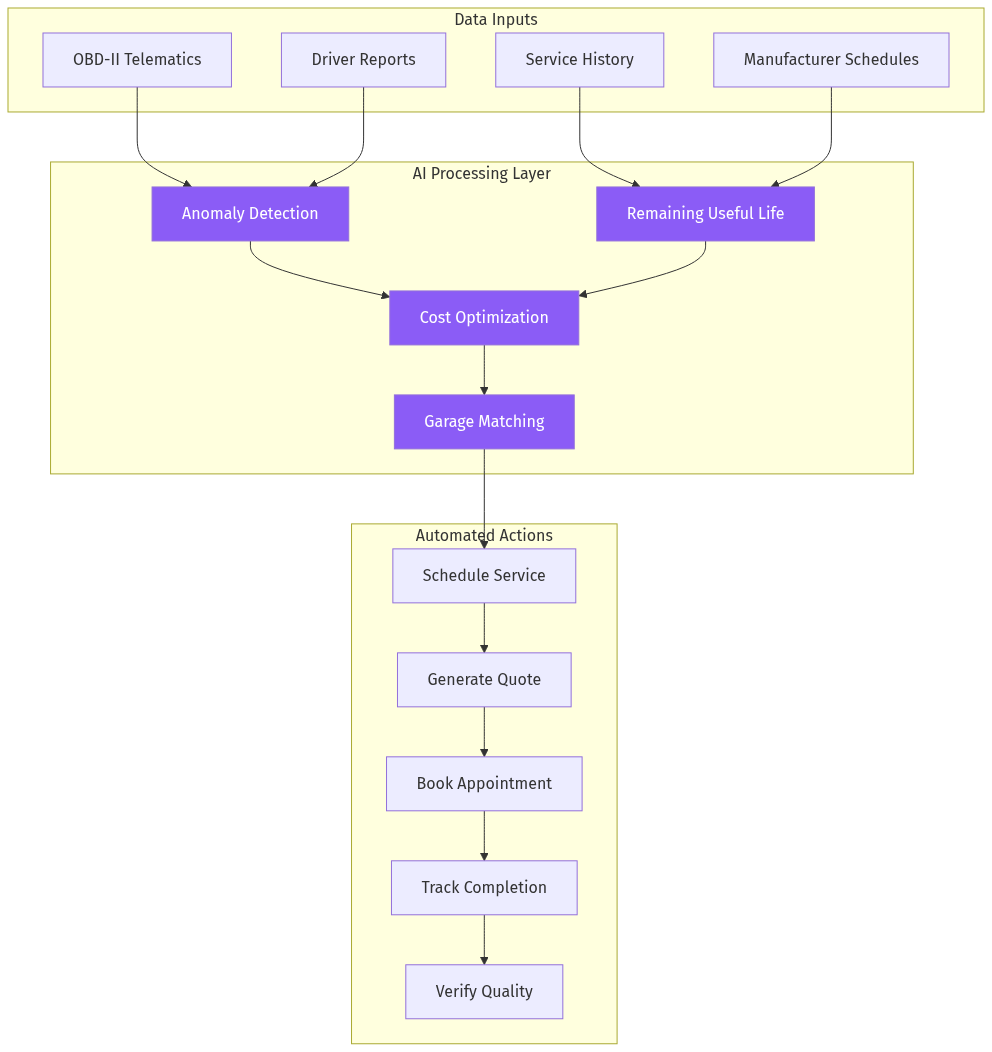
    AI Processing Flow
    AI Processing Flow
    Phase 1: Ingestion
    • Connect to existing telematics (Fleetx, Loconav, OEM systems)
    • Pull OBD-II codes, fuel efficiency trends, driving patterns
    • Ingest manufacturer maintenance schedules
    Phase 2: Prediction
    • Anomaly detection: Identify subtle pattern shifts before failure
    • RUL (Remaining Useful Life): Predict days/km before component failure
    • Severity scoring: Prioritize which vehicles need immediate attention
    Phase 3: Matching
    • Geographic proximity + garage specialization + quality score + price
    • Real-time capacity check (garage bays available)
    • Fleet contract rates vs. spot pricing optimization
    Phase 4: Execution
    • Automated appointment booking via WhatsApp/API
    • Digital job card with required parts pre-identified
    • Photo-based quality verification at completion
    • Automated payment release

    The AI Agent Vision

    Future state: Fleet manager says, "Optimize maintenance for my 200 trucks this quarter."

    AI agent:

  • Analyzes all vehicle health data
  • Identifies 47 vehicles needing preventive service
  • Finds optimal garage slots across 12 cities
  • Negotiates bulk pricing (18% below market average)
  • Schedules services to minimize fleet downtime
  • Handles rescheduling when drivers miss slots
  • Verifies work quality via completion photos
  • Releases payments upon QA pass
  • Updates vehicle service passports
  • Reports cost savings and predicted breakdown avoidance

  • 7.

    Product Concept

    Core Platform Components

    For Fleet Operators:
    • Vehicle health dashboard with predictive alerts
    • Maintenance calendar with AI-optimized scheduling
    • Price comparison across verified garage network
    • Service history and analytics
    • Automated booking and payment
    For Garages:
    • Demand visibility (upcoming maintenance in their area)
    • Digital job cards with pre-identified parts
    • Payment guarantee (escrow system)
    • Quality rating and review system
    • Fleet customer acquisition
    For Parts Suppliers:
    • Demand prediction (which parts needed where)
    • Inventory optimization suggestions
    • Direct integration for genuine parts verification

    Key Features

  • Predictive Health Score: 0-100 score per vehicle, updated daily from telematics
  • Smart Scheduling: AI picks optimal service timing to minimize fleet downtime
  • Price Intelligence: Real-time comparison across 50+ garages per city
  • Quality Verification: Photo-based job completion verification
  • Digital Service Passport: Complete maintenance history per VIN
  • WhatsApp Integration: Garages and drivers interact via familiar interface
  • Multi-language Support: Hindi, Tamil, Telugu, Kannada, Marathi for pan-India scale
  • Marketplace Ecosystem
    Marketplace Ecosystem

    8.

    Development Plan

    PhaseTimelineDeliverables
    MVP8 weeksSingle-city pilot (Hyderabad). 20 fleet operators, 50 garages. Manual price discovery, basic booking. WhatsApp-first interface.
    V116 weeksAI predictions from 3 telematics integrations. Dynamic pricing engine. Payment escrow. Quality verification.
    V224 weeksMulti-city expansion (5 cities). Parts supplier integration. Insurance data feed. Mobile apps.
    V336 weeksPan-India coverage. Full automation. OEM partnerships. EV fleet maintenance module.

    Technical Stack

    • Backend: Node.js/Python (ML services)
    • Database: PostgreSQL + TimescaleDB (telematics time-series)
    • ML Pipeline: Real-time inference on vehicle sensor streams
    • Integration: REST APIs for telematics providers, WhatsApp Business API
    • Payments: Razorpay/Paytm for escrow and settlements

    9.

    Go-To-Market Strategy

    Falsification (Pre-Mortem)

    Why would this fail?
  • Fleet operators won't trust AI recommendations: Mitigation—start with price comparison (low risk), build trust, then expand to predictive
  • Garages won't adopt digital tools: Mitigation—WhatsApp-native interface, payment guarantee as hook
  • Data quality is poor: Mitigation—partner with quality telematics providers, not cheap hardware
  • Incumbents copy quickly: Mitigation—network effects from garage supply and fleet demand
  • Unit economics don't work: Mitigation—SaaS subscription + transaction fee hybrid model
  • Launch Strategy

    Phase 1: Anchor Fleet Partners (Month 1-3)
    • Partner with 5-10 mid-size fleet operators (50-200 vehicles)
    • Free pilot with manual coordination
    • Learn workflows, validate predictions
    • Build initial case studies
    Phase 2: Garage Supply Acquisition (Month 2-4)
    • Onboard 100+ garages in pilot city
    • Use payment guarantee as hook
    • Rate them on quality, build reputation system
    • Create competitive dynamics
    Phase 3: Self-Service Platform (Month 4-6)
    • Launch booking platform
    • Fleet operators can discover and book directly
    • Garages receive leads automatically
    • Transaction fee (5-8%) kicks in
    Phase 4: Predictive Layer (Month 6-9)
    • Integrate with telematics providers
    • Launch predictive alerts
    • Convert to SaaS subscription for analytics

    10.

    Revenue Model

    Steelmanning

    Why might incumbents win?
    • Fleetx could build this: They have the data and customer relationships. Counter—maintenance is a different business model; their focus is logistics SaaS, not service marketplace.
    • OEMs could lock in customers: Authorized service networks have brand trust. Counter—OEMs are 40-60% more expensive; fleet operators want choice.
    • Offline relationships are sticky: Fleet managers know "their" mechanic. Counter—when costs are transparent, loyalty fades; price wins.

    Revenue Streams

  • Transaction Fee (Primary): 5-8% on service bookings facilitated
  • - Expected GMV: ₹100 Cr in Year 2 → ₹5-8 Cr revenue
  • SaaS Subscription: ₹500-2000/vehicle/year for predictive analytics
  • - Target: 50,000 vehicles → ₹5-10 Cr revenue
  • Parts Commission: 3-5% on genuine parts ordered through platform
  • - Parts market is 60% of aftermarket spend
  • Insurance Data Feed: Anonymized maintenance data to insurers
  • - Premium underwriting data product
  • Fleet Financing: Vehicle health data enables better loan underwriting
  • - Partnership revenue with NBFCs

    Unit Economics (Target)

    MetricYear 1Year 3
    Vehicles on platform10,000150,000
    Avg. maintenance spend/vehicle₹60,000₹60,000
    GMV₹60 Cr₹900 Cr
    Take rate5%6.5%
    Revenue₹3 Cr₹58.5 Cr
    Gross margin65%75%
    ---
    11.

    Data Moat Potential

    Second-Order Thinking

    If this succeeds, what happens next?
  • Vehicle Health Intelligence Becomes Standard: Insurance, financing, resale all reference platform data
  • Garage Consolidation Accelerates: Top-rated garages grow, low-quality ones fade
  • OEMs Partner for Data Access: Manufacturers want fleet health data for product improvement
  • EV Transition Creates New Category: Battery health monitoring becomes critical; platform already has relationships
  • Data Assets That Accumulate

  • Vehicle Health Histories: Complete service passport per VIN
  • Component Failure Patterns: Which parts fail when, under what conditions
  • Pricing Intelligence: City-wise, service-wise pricing benchmarks
  • Garage Quality Metrics: Completion time, re-repair rates, customer satisfaction
  • Demand Patterns: Predict maintenance needs by route, season, vehicle age
  • Driver Behavior Impact: Correlation between driving patterns and maintenance needs
  • Defensibility Timeline

    TimelineMoat Layer
    Year 1Garage supply network (switching cost)
    Year 2Vehicle health histories (irreplaceable data)
    Year 3Predictive accuracy (compounding ML advantage)
    Year 4Insurance/financing integrations (ecosystem lock-in)
    ---
    12.

    Why This Fits AIM Ecosystem

    Natural Extension

    AIM.in focuses on structured B2B marketplaces that transform offline, fragmented industries. Fleet maintenance perfectly embodies this:

    • Offline-to-online transformation: Phone calls → AI-mediated transactions
    • Information asymmetry → Transparency: Hidden pricing → Real-time comparison
    • Unstructured → Structured: Paper registers → Digital service passports
    • Reactive → Predictive: Breakdown response → Planned maintenance

    Synergies with Existing AIM Verticals

    AIM VerticalSynergy
    instabox.in (Logistics)Same customers—fleet operators need both load matching and maintenance
    thefoundry.in (Industrial)Factory fleets + equipment maintenance cross-sell
    forx.in (Software)Fleet management software recommendations
    challan.in (Compliance)PUC, fitness certificate, regulatory compliance integration

    Domain Asset: garaj.in or fleetseva.in

    The platform could launch under an AIM-owned domain, immediately signaling B2B focus and Indian market depth.


    ## Verdict

    Opportunity Score: 8.5/10

    Strengths

    • Massive, validated market ($15B+ annual spend)
    • Clear pain points with quantifiable ROI (20-30% cost savings)
    • AI-native solution to a problem currently solved by phone calls
    • Network effects on both supply (garages) and demand (fleets)
    • Data moat that compounds over time

    Risks

    • Execution complexity (physical service + digital platform)
    • Trust building with traditional fleet operators
    • Garage onboarding at scale
    • Working capital for payment guarantees

    Recommendation

    This is a strong build opportunity for the AIM ecosystem. The market is massive, the timing is right (telematics penetration + AI cost collapse), and the problem is genuinely painful for fleet operators.

    Suggested approach:
  • Launch pilot with 10-20 mid-size fleet operators in a single city (Hyderabad/Bangalore)
  • WhatsApp-first interface—zero app adoption required
  • Start with price comparison (low-trust entry), then expand to predictive
  • Build garage network simultaneously with payment guarantee as hook
  • Integrate with 2-3 major telematics providers in V1
  • The winner in this space will own the maintenance intelligence layer for India's 15 million commercial vehicles—a strategic position worth pursuing aggressively.


    ## Sources

    • Fleetx Series C Announcement — Rs. 113 Cr raise, 350K+ vehicles
    • Ministry of Road Transport — Commercial vehicle registration data
    • Industry estimates — Automotive aftermarket market sizing
    • Pitstop.ai — Predictive maintenance approach (North America reference)
    • Internal research — Garage network fragmentation analysis