ResearchFriday, February 27, 2026

AI-Powered Commercial Cleaning Procurement Intelligence: The $90B Market Buying in the Dark

Every year, 2 million US businesses spend $90 billion on commercial cleaning. Yet the procurement process remains stuck in 1995: Google searches, cold calls, manual RFPs, and gut-feel decisions. AI can finally bring transparency to facility services procurement—and whoever builds this captures an essential recurring spend category.

1.

Executive Summary

Commercial cleaning is one of the largest, most fragmented facility services categories. The global market exceeds $400 billion, with the US alone representing $90+ billion. Yet while cleaning COMPANIES have embraced software (scheduling, inspections, time tracking), the BUYERS—facility managers, corporate real estate teams, property managers—still procure these services through a chaotic manual process.

This creates a massive opportunity: an AI-native procurement platform that helps enterprises find, compare, evaluate, and contract commercial cleaning services with unprecedented transparency.

The thesis: Cleaning is bought, not sold. Software has optimized the seller side. Now AI can transform the buyer journey.
2.

Problem Statement

Who Experiences This Pain?

  • Facility Managers at 500+ employee companies
  • Corporate Real Estate teams managing multi-site portfolios
  • Property Managers handling 10+ commercial properties
  • Procurement Officers consolidating facility services spend
  • Healthcare/Education Administrators with strict compliance requirements

What's Broken Today?

Discovery is fragmented. Buyers Google "commercial cleaning near me," ask colleagues, or inherit vendors from predecessors. No structured way to find all qualified providers. Evaluation is subjective. There's no standardized way to compare certifications, insurance coverage, specializations (healthcare vs. industrial vs. office), or quality track records. Pricing is opaque. Quotes vary 300%+ for identical scopes. Without benchmarks, buyers can't tell if a $0.08/sqft quote is competitive or exploitative. RFP creation is painful. Writing scope documents from scratch, distributing them manually, tracking responses in spreadsheets. Contract management is manual. Scope creep, service level tracking, and renewals happen through email threads and tribal knowledge.

The Core Tension

Cleaning companies invest in operations software to run efficiently. But the buyer-seller interface remains primitive: phone calls, site visits, PDF proposals, email negotiations. The information asymmetry favors sellers.


3.

Current Solutions

CompanyWhat They DoWhy They're Not Solving It
SweptScheduling, time tracking, quality control for cleaning companiesSeller-side only; doesn't help buyers find/compare vendors
Janitorial ManagerOperations management for cleaning operationsSame—optimizes provider operations, not procurement
Otuvy (fka CleanTelligent)Inspection & work order managementQuality assurance post-contract; no discovery/sourcing
ConnecteamGeneral deskless workforce managementHorizontal solution; no cleaning-specific procurement
ServiceChannelFacility management platformEnterprise-focused; complex setup; not AI-native
UpkeepCMMS/maintenance managementAsset-focused; cleaning is a secondary feature
Google/YelpGeneral business searchConsumer-oriented; no B2B qualification, pricing data
The gap: No platform helps buyers DISCOVER qualified cleaning vendors, COMPARE them on standardized criteria, BENCHMARK pricing, and AUTOMATE RFP/contracting—all with AI assistance.
4.

Market Opportunity

Market Size

  • Global Contract Cleaning Market: $400+ billion (2025)
  • US Janitorial Services: $90 billion revenue, 1.1 million businesses, 2+ million employees
  • India Commercial Cleaning: ₹15,000+ crore (~$2B), growing 15%+ annually
  • Addressable: ~2 million businesses in the US contract cleaning services; ~500K have 10+ employees (serious procurement needs)

Growth Drivers

  • Hybrid Work Complexity: Unpredictable occupancy = variable cleaning needs
  • Post-COVID Hygiene Standards: Elevated expectations are permanent
  • ESG Pressure: Green cleaning, chemical transparency, sustainability certifications
  • Labor Costs: Minimum wage increases push buyers to optimize vendor selection
  • Consolidation Trend: Facility services increasingly bundled under single vendor relationships

Why Now

  • AI can finally parse unstructured RFPs and generate intelligent scopes from natural language
  • Pricing data abundance: Enough digital exhaust exists to build predictive pricing models
  • Millennial facility managers expect software, not phone calls
  • Platform fatigue: Buyers want consolidated spend visibility, not another point solution

  • 5.

    Gaps in the Market

    Gap 1: Discovery Infrastructure

    No structured database of commercial cleaning companies with verified certifications, insurance, specializations, coverage areas, and capacity. Buyers start from zero every time.

    Gap 2: Scope Standardization

    Every RFP reinvents the wheel. No templates adapted by facility type (healthcare, industrial, office, retail), no best-practice checklists, no automated scope generation.

    Gap 3: Pricing Transparency

    Buyers have no benchmarks. What should cleaning a 50,000 sqft office cost in Dallas vs. San Francisco? What's the premium for LEED-certified green cleaning? Pricing is a black box.

    Gap 4: Quality Signal Aggregation

    Reviews exist on Google/Yelp but are sparse and consumer-focused. No aggregated B2B quality data: inspection pass rates, complaint frequency, retention rates.

    Gap 5: Multi-Site Coordination

    Enterprises managing 50+ locations can't easily find vendors with consistent quality across geographies. No platform enables multi-site vendor matching.

    Gap 6: Contract Intelligence

    Once contracts are signed, they live in file cabinets. No automated tracking of scope compliance, SLA performance, or renewal optimization.
    6.

    AI Disruption Angle

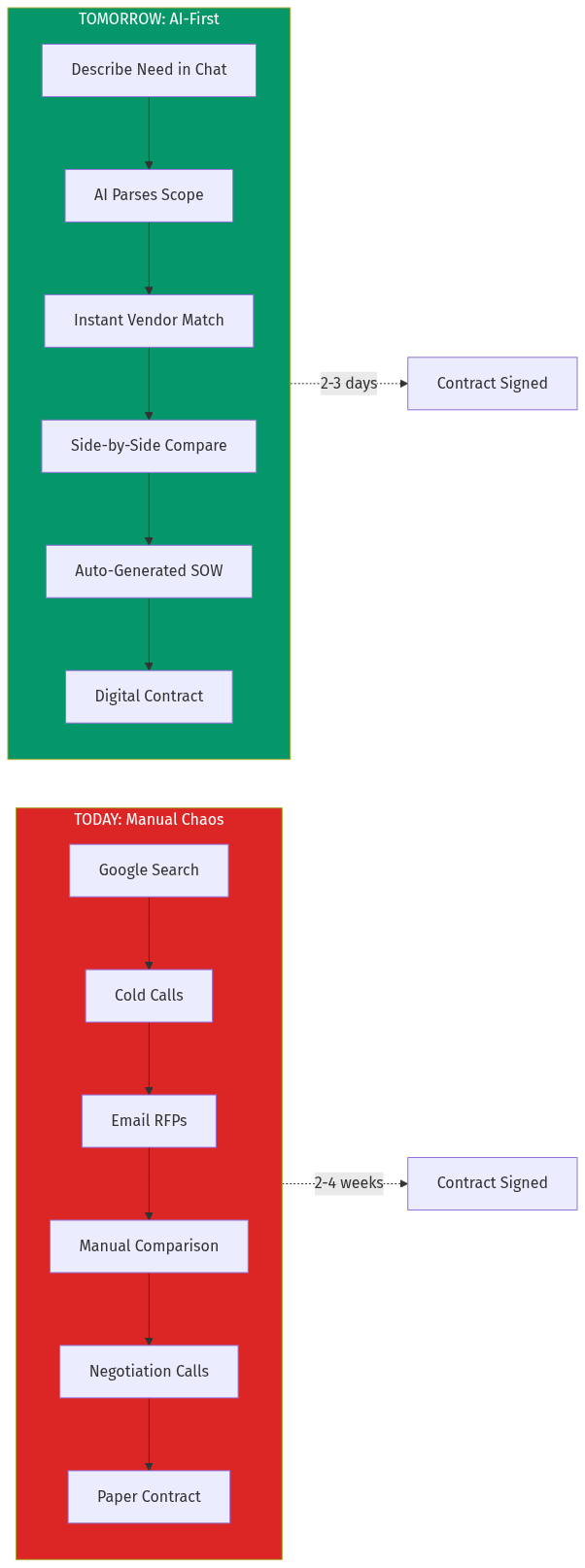
    Current Workflow (Manual)

    Current vs Future Procurement Flow
    Current vs Future Procurement Flow

    AI-Native Workflow

    Natural Language Intake: Facility manager describes needs in plain English: "I need daily cleaning for our 3 office floors (45,000 sqft total) in Austin. Healthcare-grade disinfection in the cafeteria. LEED certification preferred. Budget around $8K/month." AI Scope Parser: Extracts structured requirements—square footage, frequency, specialty needs, certifications, budget constraints. Generates standardized scope document. Intelligent Matching: Queries vendor database against requirements. Ranks by: certification fit, coverage area, capacity availability, price prediction, quality score. Automated RFP: Distributes standardized RFP to matched vendors. Collects responses in structured format. Enables apples-to-apples comparison. Pricing Intelligence: Compares submitted quotes against market benchmarks. Flags outliers. Suggests negotiation leverage. Contract Generation: AI drafts MSA and scope of work from finalized terms. Tracks SLAs automatically.

    The Agent Future

    When AI agents handle facility operations:

    • Buyer Agent: "Find me the best-value cleaning vendor for our new Bengaluru office—comparable to what we pay in Hyderabad."
    • Seller Agent: "We have capacity for 3 new accounts in Chennai. Bid competitively on matching RFPs."
    • Orchestration Agent: Matches, negotiates, contracts—humans approve final decision.
    ---

    7.

    Product Concept

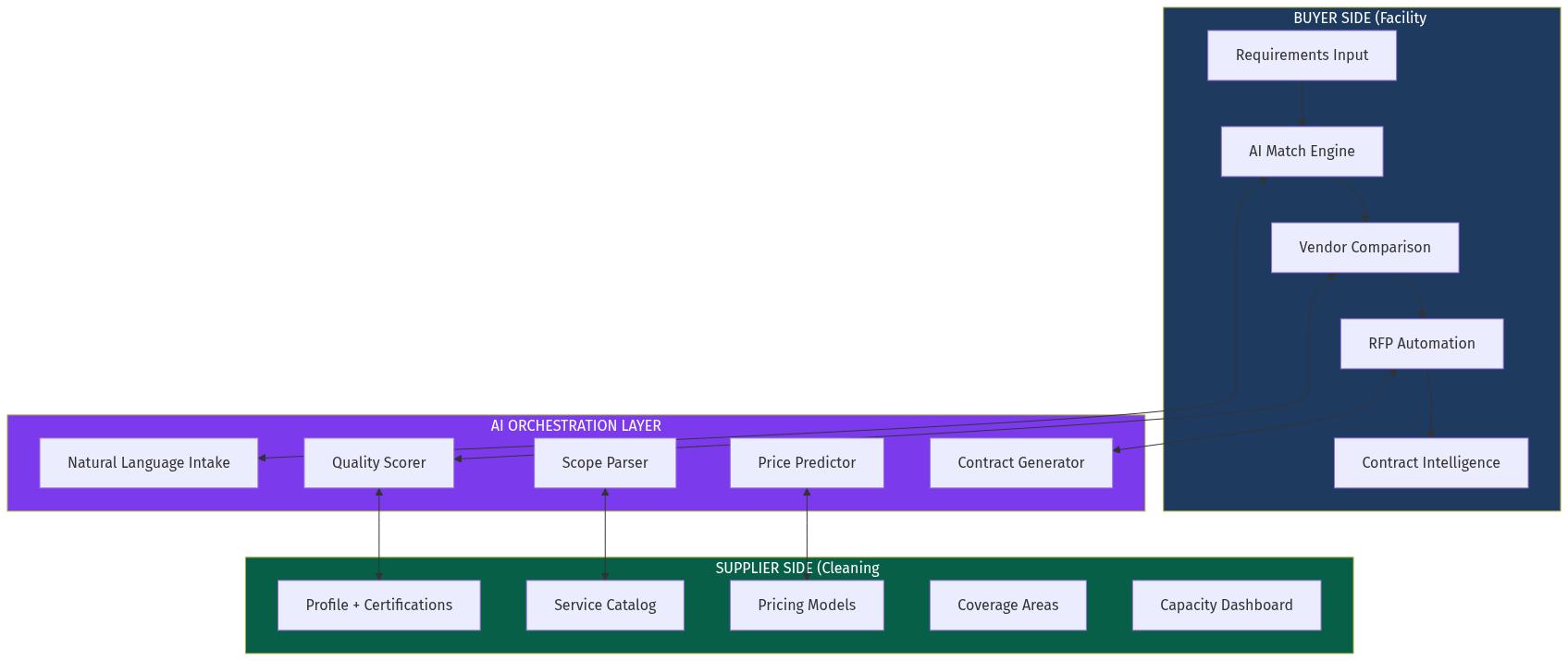
    Platform Architecture

    Platform Architecture
    Platform Architecture

    Core Features

    For Buyers:
  • AI Intake Wizard — Describe needs conversationally; system extracts structured requirements
  • Vendor Discovery — Searchable database with filters for certifications, specializations, coverage
  • RFP Builder — Template library + AI-generated scopes from requirements
  • Quote Comparison — Side-by-side vendor comparison with pricing benchmarks
  • Contract Management — Digital MSAs, SLA tracking, renewal alerts
  • Spend Analytics — Portfolio view of all cleaning spend across locations
  • For Suppliers:
  • Profile Builder — Showcase certifications, insurance, references, service catalog
  • Capacity Dashboard — Indicate availability by geography and service type
  • RFP Inbox — Receive matched opportunities; respond in structured format
  • Pricing Guidance — Market benchmarks to price competitively
  • Performance Analytics — Track win rates, quality scores, customer satisfaction
  • For Both:
  • Messaging Hub — In-platform communication with audit trail
  • Document Vault — Contracts, insurance certificates, compliance docs
  • Review System — B2B quality ratings post-engagement

  • 8.

    Development Plan

    PhaseTimelineDeliverables
    MVP8 weeksVendor database (1 metro), AI intake, basic matching, RFP templates
    V14 weeksQuote comparison, pricing benchmarks, buyer dashboard
    V26 weeksSupplier portal, capacity management, messaging
    V36 weeksContract generation, SLA tracking, multi-site support
    V48 weeksSpend analytics, review system, API integrations

    Tech Stack

    • Backend: Node.js/Python
    • Database: PostgreSQL + vector embeddings for semantic search
    • AI: Claude/GPT-4 for intake parsing, scope generation, contract drafting
    • Frontend: Next.js with conversational UI components
    • Integrations: QuickBooks (invoicing), DocuSign (contracts), Slack/Teams (notifications)

    9.

    Go-To-Market Strategy

    Phase 1: Single Metro Launch (Hyderabad/Austin)

    Supplier Onboarding:
  • Partner with 2-3 industry associations (ISSA, BSCAI) for credibility
  • Offer free premium listings to top 50 cleaning companies in metro
  • Build database through systematic outreach + data enrichment
  • Buyer Acquisition:
  • Target facility managers at 50-500 employee companies
  • LinkedIn outreach: "We'll benchmark your current cleaning costs for free"
  • Content marketing: "What should commercial cleaning cost in [city]?"
  • Partner with co-working spaces, commercial real estate firms
  • Phase 2: Expand Categories

    • Add specialty cleaning (healthcare, industrial, post-construction)
    • Bundle adjacent services (landscaping, pest control, security)
    • Geographic expansion to 3-5 additional metros

    Phase 3: Enterprise + API

    • Multi-site portfolio management
    • API for procurement platforms, ERPs
    • White-label for facility management companies

    10.

    Revenue Model

    Transaction-Based

    • Success Fee: 3-5% of first-year contract value on matched deals
    • Premium Listings: Suppliers pay for enhanced visibility, priority matching

    Subscription

    • Buyer Pro: $199/month — Unlimited RFPs, pricing benchmarks, spend analytics
    • Supplier Pro: $99/month — Premium profile, RFP alerts, capacity management

    Data Products

    • Market Reports: Cleaning cost benchmarks by region, facility type
    • API Access: Pricing predictions for procurement platforms

    Projected Unit Economics

    • Average contract value: $60,000/year
    • Success fee: $2,400 (4%)
    • CAC: ~$800 (blended buyer + supplier)
    • LTV: $4,800+ (2+ year retention, repeat procurement)
    • LTV:CAC: 6:1

    11.

    Data Moat Potential

    Proprietary Data That Accumulates

  • Pricing Database: Every quote, contract, and negotiation outcome builds the most comprehensive cleaning pricing dataset
  • Quality Scores: Aggregated from post-service reviews, inspection pass rates, contract renewals
  • Scope Templates: AI-refined SOW templates by facility type, continuously improved
  • Vendor Capacity: Real-time availability data no competitor can replicate
  • Buyer Preferences: Learned patterns—what certifications matter to healthcare vs. tech companies
  • Network Effects

    • More buyers → More RFPs → More suppliers want to be on platform
    • More suppliers → Better matching → More buyers trust platform
    • More transactions → Better pricing models → More accurate benchmarks

    Switching Costs

    • Historical RFP data, contract archive
    • Trained preferences and vendor relationships
    • Integrated spend analytics

    12.

    Why This Fits AIM Ecosystem

    Perfect AIM Vertical:
    • Fragmented market with millions of transactions
    • Repeat, recurring need (monthly/quarterly cleaning contracts)
    • Clear buyer-seller marketplace dynamics
    • Amenable to AI-first workflow transformation
    Cross-Vertical Synergies:
    • Facilities managers also buy: security services (covered), pest control, landscaping, HVAC maintenance
    • Cleaning vendors cross-sell: janitorial supplies, equipment, specialty services
    • Natural bundle with existing AIM verticals: fire safety, uniform services, facility maintenance
    Domain Opportunity:
    • Primary: cleaning.aim.in, janitorial.aim.in
    • Alternative: safai.in, cleanprocure.in

    ## Mental Models Applied

    Zeroth Principles

    "Why does buying cleaning still involve cold calls?" — Because the industry digitized seller operations, not buyer workflows. The axiom to question: "Procurement requires human relationship building." Actually, 80% of cleaning procurement is commodity sourcing where AI can handle matching and negotiation.

    Incentive Mapping

    • Cleaning companies profit from information asymmetry (pricing opacity)
    • Status quo brokers (local referral networks) extract value from both sides
    • Enterprise procurement is understaffed, defaults to renewals over optimization

    Distant Domain Import

    Hotel booking → Cleaning procurement. Just as Booking.com brought transparency to fragmented hotel inventory, a cleaning marketplace brings transparency to fragmented service providers. The "show price + reviews + availability" model transfers directly.

    Falsification (Pre-Mortem)

    Assume 5 startups failed here. Why?
  • "B2B service marketplaces are hard" — True, but cleaning is high-frequency, repeat purchase (unlike one-time consulting)
  • "Relationships matter" — For large enterprise, yes. SMB segment cares more about price/convenience
  • "Sellers won't list pricing" — Start with indicative ranges; transaction data builds over time
  • "Local markets differ" — That's the moat; hyperlocal data is defensible
  • Steelmanning

    Best case against this opportunity:
    • Large enterprises have preferred vendor programs and multi-year contracts; switching costs are high
    • Local cleaning companies don't want transparency—they'd resist platform participation
    • Facility services consolidation (ISS, ABM, Sodexo) may make fragmentation less acute
    Counter: Enterprise is phase 2. SMB (500-5000 employees) is massive, underserved, and doesn't have procurement infrastructure. They WANT help.

    ## Verdict

    Opportunity Score: 8.5/10

    Strengths

    • Massive, essential spend category ($90B US alone)
    • Clear buyer pain with no incumbent solution
    • High-frequency transactions enable data flywheel
    • AI-native workflow transformation is now feasible
    • Natural AIM ecosystem fit with cross-sell potential

    Risks

    • Marketplace cold-start requires simultaneous buyer/seller onboarding
    • Supplier resistance to pricing transparency
    • Enterprise sales cycle complexity

    Recommendation

    Strong build candidate. Start with a single metro (Hyderabad or Austin), onboard 50 quality suppliers, and acquire 100 SMB buyers. Prove transaction velocity before expansion. The data moat compounds quickly once transaction flow begins.

    This is one of the largest B2B procurement categories without a dedicated AI-native platform. First mover with execution excellence wins.


    ## Sources