ResearchFriday, February 27, 2026

AI Agricultural Input Procurement Intelligence: The $15B Farm Advisory Marketplace

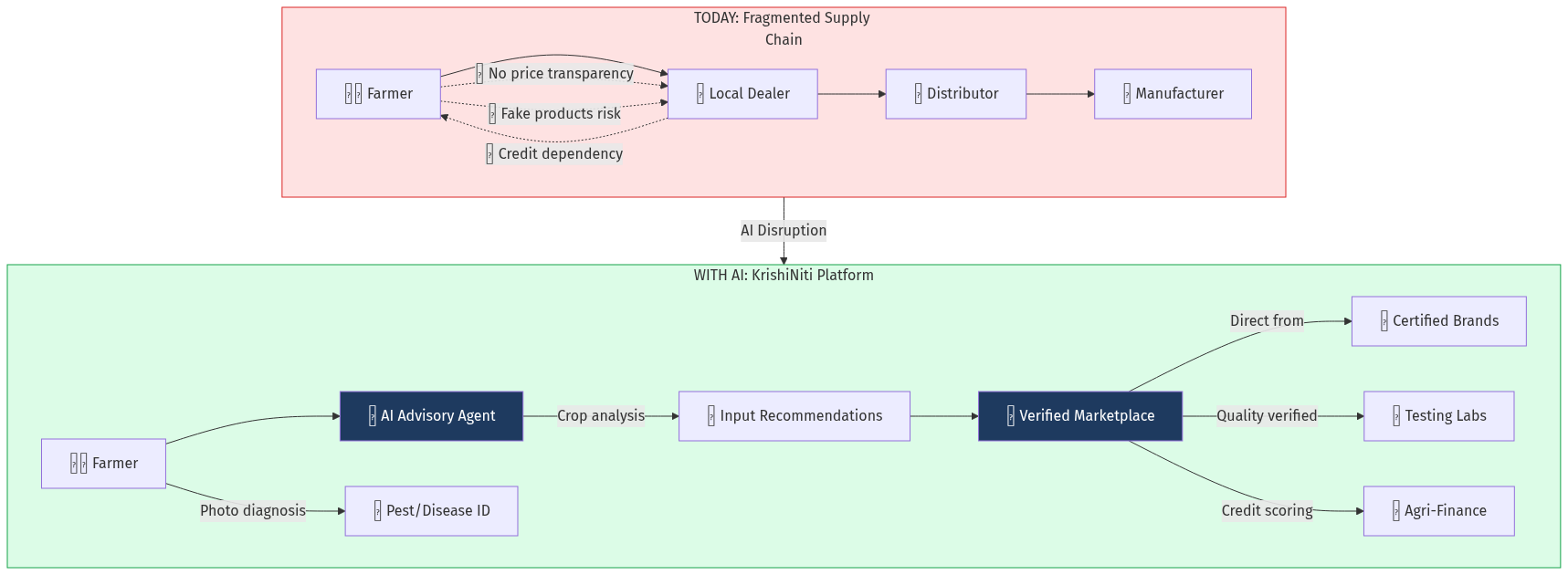
Every cropping season, 140 million Indian farmers make input decisions worth ₹1.2 lakh crore ($15B+) — seeds, fertilizers, pesticides, growth regulators — based on a dealer's recommendation, a neighbor's success, or a salesman's pitch. No data. No price transparency. No accountability. The result? 30% of agrochemicals in circulation are counterfeit or substandard. Farmers overspend by 20-40% due to information asymmetry. Crop losses from wrong input selection run into billions annually. This is the most consequential procurement decision for India's largest workforce, made with the worst possible information infrastructure.

1.

Executive Summary

India's agricultural input market — seeds, fertilizers, pesticides, and plant growth regulators — is a $15+ billion annual procurement decision made by the world's largest farming population with almost no decision support infrastructure. While agriculture contributes 17.8% of India's GDP and employs 55% of the workforce, the input procurement process remains fundamentally unchanged from the 1980s: a farmer visits the local dealer, describes symptoms, receives a recommendation, and hopes for the best.

The opportunity isn't just digitization — it's intelligence. AI agents can transform this from "what's available at my dealer" to "what's optimal for my specific soil, crop, weather, pest pressure, and budget." This represents a shift from dealer-centric procurement to farmer-centric intelligence.

The prize: Platform that captures this procurement workflow becomes the IndiaMART of agriculture — with a crucial difference. Unlike industrial procurement where the buyer is sophisticated, here the buyer needs the platform for decision-making, not just discovery.
2.

Problem Statement

Who Experiences the Pain?

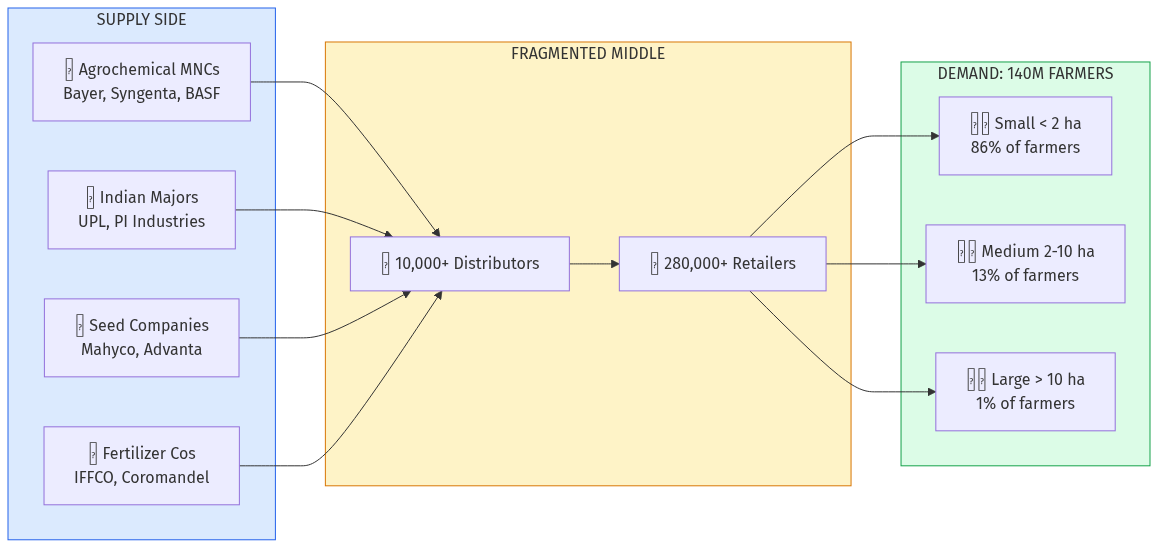
Small and Marginal Farmers (86% of 140M)
  • Average landholding: 1.08 hectares
  • Make 4-6 input purchase decisions per crop cycle
  • Zero access to soil testing, pest diagnostics, or price comparison
  • Entirely dependent on dealer recommendations (conflict of interest)
  • Credit-constrained, can't afford input failures
Local Agri-Input Dealers (280,000+)
  • Manage 500-2,000 SKUs across brands
  • No inventory intelligence — stock based on last year's patterns
  • Can't provide personalized recommendations at scale
  • Face competition from direct-to-farmer apps
  • Credit exposure to farming community
Agri-Input Manufacturers
  • Spend 8-12% revenue on field force and dealer incentives
  • No visibility into actual farmer application patterns
  • Can't differentiate genuine efficacy concerns from application errors
  • Product counterfeiting erodes brand value
  • Limited data on geographic pest/disease patterns

The Core Dysfunction

The agricultural input supply chain has a fundamental misalignment: the person recommending the product profits from the recommendation. Dealers push higher-margin products, not optimal products. Salesmen recommend their company's SKUs regardless of fit. There's no independent intelligence layer.

ZEROTH PRINCIPLES ANALYSIS: The assumption everyone takes for granted: "Farmers need dealers for input selection because farming requires local expertise."

But question this: Do farmers need a dealer or do they need expertise? The dealer is a bundle: credit provider + inventory + recommendation + local presence. AI can unbundle the expertise layer from the commercial transaction, creating a trust layer where none exists.


3.

Current Solutions

CompanyWhat They DoWhy They're Not Solving It
AgroStarAdvisory app + input marketplace (12M farmers, 12 states)Still product-catalog centric, advisory not prescriptive enough
DeHaatFull-stack agri (inputs, output, credit)Infrastructure-heavy model, 650+ centers, hard to scale advisory quality
BigHaatE-commerce + advisory for inputsAdvisory feels bolted-on, not AI-native
Nurture.farmUPL's digital platform (10M farmers)Single brand's distribution play, not independent
BharatAgriCrop-specific packages + advisoryPre-packaged approach, not truly personalized
PlantixAI pest/disease identificationDiagnosis only, not procurement workflow
Local DealersTrust + credit + proximityNo intelligence, conflict of interest, fragmented

Key Observation

Every player either:
  • Leads with products (marketplace-first) and adds advisory as afterthought, OR
  • Leads with diagnosis (vision AI) but doesn't close the procurement loop
  • No one has built prescription-first architecture where the recommendation precedes and determines the product selection.


    4.

    Market Opportunity

    Market Size

    SegmentMarket Size (India, 2025)Growth Rate
    Agrochemicals (pesticides)$6.8 billion8.5% CAGR
    Fertilizers$5.2 billion4.2% CAGR
    Seeds (commercial)$4.1 billion12.3% CAGR
    Bio-inputs (bio-fertilizers, bio-pesticides)$0.8 billion18% CAGR
    Total Addressable$16.9 billion8.1% CAGR
    India's positioning:
    • 3rd largest agrochemical exporter globally ($3.3B in FY25)
    • World's 2nd largest agricultural land area
    • 140M+ operational farm holdings
    • 17.8% GDP contribution from agriculture

    Why Now?

  • Smartphone penetration: 750M+ smartphones, rural digital adoption crossed urban in 2024
  • Vernacular AI: LLMs now handle Hindi, Telugu, Marathi, Tamil at production quality
  • WhatsApp reach: 500M+ users, farmers already share crop photos in groups
  • Regulatory push: Pesticide Management Bill 2020 draft pushes for traceability
  • Climate volatility: New pest patterns require dynamic, not static, recommendations
  • Input cost inflation: Farmers actively seeking cheaper/better alternatives
  • INCENTIVE MAPPING: Who profits from the status quo?
    • Dealers: 15-30% margins on high-margin products, rebates from manufacturers
    • Manufacturer sales teams: Incentivized on volume, not farmer outcomes
    • Credit providers: Higher input purchases = larger loan books
    This creates a system that consistently over-sells to farmers. The AI platform's value is precisely in breaking this incentive structure.
    5.

    Gaps in the Market

    Market Structure
    Market Structure

    Gap 1: No Integrated Soil-Weather-Pest Intelligence

    Current apps treat each variable separately. A farmer might get pest identification from Plantix, weather from IMD, and soil data from a test conducted 2 years ago. No platform integrates all three to generate contextual recommendations.

    Gap 2: Price Transparency Across Brands

    The same active ingredient (say, Imidacloprid 17.8% SL) is sold under 50+ brand names at prices varying 3x. No farmer has visibility into generic equivalents or price comparison.

    Gap 3: Counterfeit Detection

    30% of pesticides in circulation are fake/substandard (CropLife India estimate). No easy verification mechanism exists for farmers at point of purchase.

    Gap 4: Application Timing Intelligence

    "When to spray" is as important as "what to spray." Current apps recommend products but don't optimize spray windows based on weather forecast, pest lifecycle, and pre-harvest intervals.

    Gap 5: Credit-Linked Procurement

    Farmers need credit to buy inputs. Current platforms either don't offer credit or offer it as separate flow. No one has integrated "recommend → verify → finance → deliver → verify application" as single workflow.

    Gap 6: Outcome Tracking

    No platform tracks: "Did this recommendation work?" Without outcome data, recommendations never improve. This is the missing feedback loop. ANOMALY HUNTING: What's strange about this market?
    • Farmers spend ₹15K-50K per hectare on inputs but zero on decision support
    • Agri-input companies spend 8-12% on sales force but <1% on farmer education
    • Government has massive extension infrastructure (100,000+ Krishi Vigyan Kendras) but utilization is <5%
    The anomaly: Everyone acknowledges information asymmetry but no one charges for resolving it. The opportunity is making intelligence the product, not the input.
    6.

    AI Disruption Angle

    AI Advisory Workflow
    AI Advisory Workflow

    The AI-Native Farm Advisory Platform

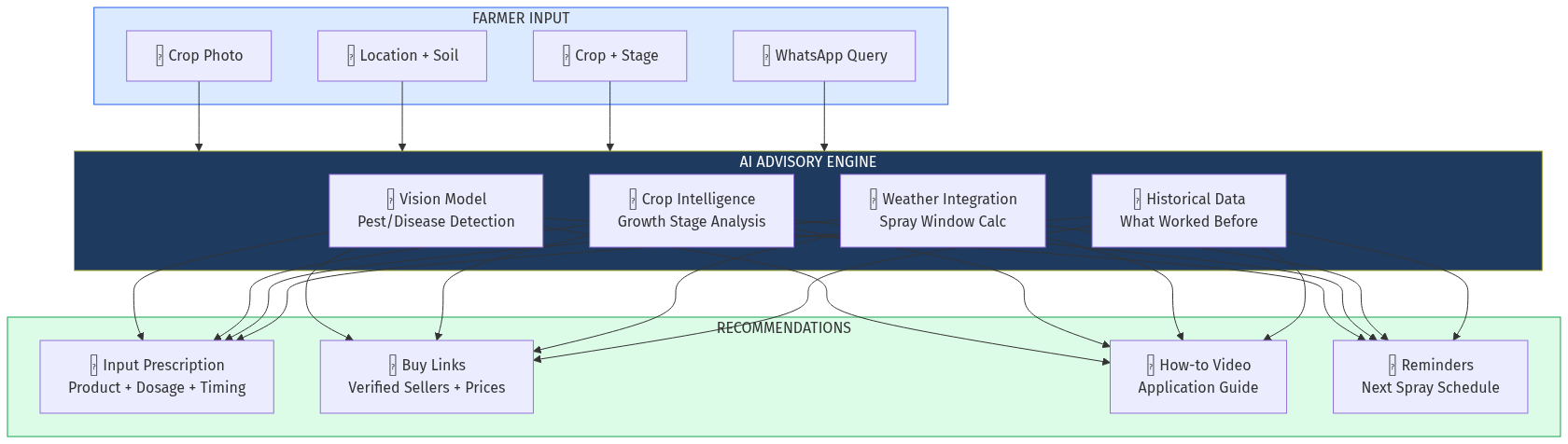
    Vision Input: Farmer sends crop photo via WhatsApp. Multi-modal AI identifies:
    • Crop type and growth stage (92%+ accuracy with fine-tuned models)
    • Pest/disease present (85%+ accuracy for top 50 issues)
    • Severity assessment (mild/moderate/severe)
    • Confidence score triggering human expert escalation when needed
    Contextual Integration: AI agent pulls:
    • GPS location → Soil type (linked to NBSS&LUP soil database)
    • Weather forecast → 7-day spray window optimization
    • Pest surveillance data → Regional pressure maps (crowdsourced from platform)
    • Historical data → What worked on similar farms last season
    Prescription Generation: Not "use pesticide X" but:
    • Active ingredient recommendation with dosage
    • Multiple brand options with prices (generic → premium)
    • Application method and timing (specific to weather window)
    • Pre-harvest interval calculation
    • Safety precautions in farmer's language
    Transaction Closure:
    • One-tap ordering from verified sellers
    • Instant credit pre-approval (based on farm data)
    • QR code verification for authenticity
    • Delivery tracking
    • Application reminder with video guide
    Outcome Feedback:
    • 7-day follow-up: "Did it work?"
    • Photo confirmation of pest/disease control
    • Model learns from outcome data
    • Farmer earns trust score affecting credit terms

    The Future: Autonomous Agent Transactions

    In 2-3 years, this evolves to:

    • AI agent monitors satellite imagery of farmer's plot
    • Detects early stress signs before farmer notices
    • Proactively alerts farmer with recommendation
    • With farmer's standing authorization, agent can auto-order routine inputs
    • Drone spraying integrated for application
    DISTANT DOMAIN IMPORT: What field has solved this? Telemedicine.

    The rural telemedicine model shows the path:

    • Patient describes symptoms → AI triage → Doctor consultation → Prescription → Pharmacy delivery
    • Regulatory framework exists for remote diagnosis + prescription
    • Pharma supply chain digitized, fake medicine problem addressed via QR codes
    Agriculture can follow identical architecture: Farmer describes symptoms → AI triage → Agri-expert consultation → Input prescription → Verified delivery.


    7.

    Product Concept

    Product Name: KrishiNiti (कृषिनीति — "Farm Policy/Intelligence")

    Tagline: "Tell us your problem. We'll tell you the solution."

    Core Modules

    1. KrishiDoc — AI Diagnosis Engine
    • WhatsApp-native interface (no app download required)
    • Photo → Diagnosis → Prescription in <60 seconds
    • Voice input in 8 Indian languages
    • Human expert escalation for complex cases
    2. KrishiMart — Verified Input Marketplace
    • Only certified sellers with traceability
    • Price comparison across brands for same active ingredients
    • QR code authenticity verification
    • Integrated delivery network
    3. KrishiCredit — Embedded Finance
    • Input-specific credit (not general purpose)
    • Repayment linked to harvest cycle
    • Credit limit based on farm data + past outcomes
    • Interest rates improve with outcome track record
    4. KrishiCalendar — Crop Management
    • Season-wise activity reminders
    • Spray window optimization
    • Government scheme deadline alerts
    • MSP (Minimum Support Price) announcements
    5. KrishiInsight — Farmer Analytics (B2B)
    • Anonymized, aggregated data for input companies
    • Regional pest pressure maps
    • Product efficacy benchmarks
    • Demand forecasting for distributors

    Technical Architecture

    Architecture Diagram
    Architecture Diagram
    Key Technical Choices:
    • WhatsApp Business API as primary interface (500M users, no friction)
    • Fallback to USSD for feature phone users
    • Vision models: Fine-tuned on 2M+ Indian crop images (public dataset + crowdsourced)
    • Vernacular NLU: Hindi, Telugu, Marathi, Tamil, Kannada, Punjabi, Gujarati, Bengali
    • Offline-first: Recommendations cached on device for connectivity gaps

    8.

    Development Plan

    PhaseTimelineDeliverables
    Phase 1: MVPWeeks 1-8WhatsApp bot for 5 crops (cotton, rice, soybean, chili, tomato) in 2 languages (Hindi, Telugu). Pest/disease ID + recommendation. No commerce yet.
    Phase 2: MarketplaceWeeks 9-16Verified seller onboarding (50 dealers in AP/Telangana). Price comparison. Order flow. Payment integration.
    Phase 3: CreditWeeks 17-24NBFC partnership. Input credit product. Credit scoring based on farm data.
    Phase 4: ScaleWeeks 25-3620 crops, 8 languages. 10,000 dealers. Drone spray integration pilot.
    Phase 5: IntelligenceWeeks 37-52Outcome tracking loop closed. Predictive alerts. B2B data products.

    Key Milestones

    • Month 2: 10,000 advisory interactions
    • Month 4: First transaction on marketplace
    • Month 6: ₹1 crore GMV
    • Month 9: Credit product live with 1,000 farmers
    • Month 12: 100,000 active farmers, ₹10 crore monthly GMV

    9.

    Go-To-Market Strategy

    Beachhead: Cotton Belt of Telangana/Andhra Pradesh

    Why:
    • High input intensity (₹25K-40K/acre on pesticides alone)
    • Severe pest pressure (pink bollworm, whitefly) — desperate for advice
    • Strong WhatsApp adoption among farmers
    • Established FPO (Farmer Producer Organization) network
    • AIM.in existing relationships in region

    Channel Strategy

    1. FPO Partnerships (B2B2C)
    • Partner with 50 FPOs (each has 500-2,000 farmers)
    • FPO becomes KrishiNiti's local face
    • Commission sharing on transactions
    • Volume: 50,000 farmers in Year 1
    2. Input Dealer Integration
    • Don't fight dealers — make them fulfillment partners
    • Dealer gets orders via platform, earns commission
    • Platform handles advisory, dealer handles logistics
    • Solves dealer's biggest pain: inventory planning
    3. Government Integration
    • Partner with state agriculture departments
    • Integrate with e-NAM, PM-KISAN databases
    • Position as extension service augmentation
    • Potential for government contracts (advisory as public good)
    4. Manufacturer Partnerships
    • White-label advisory for input companies
    • Brands pay for premium placement (not manipulation — disclosed)
    • Efficacy data sold back to manufacturers
    • Co-funded farmer education campaigns

    Pricing Strategy

    ServicePriceModel
    Basic AdvisoryFreeWhatsApp bot, standard recommendations
    Premium Advisory₹499/seasonExpert consultation, priority response
    Marketplace5-8% take rateTransaction fee from sellers
    Credit18-24% APRInterest + processing fee
    B2B Data₹5-20 lakh/yearSubscription for insights
    ---
    10.

    Revenue Model

    Year 1 Projections (Conservative)

    Revenue StreamAssumptionRevenue
    Marketplace GMV₹10Cr GMV × 6% take rate₹60 lakh
    Credit Interest₹2Cr disbursal × 8% spread₹16 lakh
    Premium Subscriptions2,000 farmers × ₹499₹10 lakh
    B2B Data (pilot)2 contracts × ₹5 lakh₹10 lakh
    Total Year 1₹96 lakh

    Year 3 Projections (Scale)

    Revenue StreamAssumptionRevenue
    Marketplace GMV₹500Cr GMV × 6% take rate₹30 crore
    Credit Interest₹100Cr disbursal × 8% spread₹8 crore
    Premium Subscriptions100,000 farmers × ₹499₹5 crore
    B2B Data20 contracts × ₹15 lakh avg₹3 crore
    Total Year 3₹46 crore

    Unit Economics Target

    MetricTarget
    CAC (Farmer)₹50 (WhatsApp viral loops)
    LTV (Farmer)₹2,500 (over 3 years)
    LTV:CAC50:1
    Gross Margin65-70%
    ---
    11.

    Data Moat Potential

    What Data Accumulates?

  • Pest/Disease Corpus
  • - Geo-tagged images with verified diagnoses - Regional and temporal patterns - Climate correlation data
  • Efficacy Database
  • - Which products worked on which problems - Dosage vs. outcome correlation - Brand performance benchmarking
  • Farmer Behavior Data
  • - Crop choices, planting dates, input spending - Credit behavior and repayment patterns - Risk profiles by geography and crop
  • Supply Chain Intelligence
  • - Dealer inventory levels (inferred from orders) - Regional demand patterns - Price sensitivity by segment

    Defensibility

    After 3 years, the platform has:
    • 50M+ labeled crop images (largest in India)
    • Efficacy data covering 80% of crop-pest-product combinations
    • Credit risk models trained on 1M+ farmer seasons
    • Real-time pest pressure maps across major growing regions
    This data is:
    • Proprietary: No one else has the farmer feedback loop
    • Compounding: Every interaction improves recommendations
    • Network-effect enabled: More farmers → better data → better recommendations → more farmers
    STEELMANNING: Why might incumbents win?
    • AgroStar has 12M farmers, $100M+ raised, strong brand
    • DeHaat has on-ground infrastructure (650 centers)
    • Manufacturers (UPL, Syngenta) can outspend on farmer acquisition
    • Government could build this with Kisan Call Centers + AI
    Counter-arguments:
    • AgroStar is product-first, not intelligence-first — different DNA
    • DeHaat's asset-heavy model limits AI investment capacity
    • Manufacturers have brand conflict — farmers won't trust single-brand advice
    • Government moves slowly, lacks tech talent for AI-native builds
    The moat is trust + intelligence + network effects — not scale alone.
    12.

    Why This Fits AIM Ecosystem

    Strategic Alignment

    AIM's thesis: India needs vertical B2B discovery platforms that help buyers DECIDE, not just FIND.

    Agricultural inputs is the most decision-support-starved B2B vertical in India:

    • 140M buyers making $15B in annual purchases
    • Near-zero decision intelligence infrastructure
    • Massive information asymmetry favoring sellers
    • High-stakes decisions (crop failure = financial ruin)
    Integration opportunities:
    • masale.in: Spice farmers overlap with agri-input users
    • networth.in: Agri-credit as product category
    • demo.aim.in: Agriculture as showcase vertical

    Domain Portfolio Leverage

    AIM.in domains relevant to this play:

    • krishi.in, krishak.in, kissan.in (farmer-facing)
    • khet.in, bhoomi.in (farm-facing)
    • agri-input relevant .in TLDs for SEO

    Technical Synergies

    • WhatsApp hooks built for AIM ecosystem
    • AI advisory architecture reusable across verticals
    • Embedded finance playbook applicable to other segments
    • Multi-language NLU investments compound across products

    ## Verdict

    Opportunity Score: 9/10

    PRE-MORTEM (Falsification Test)

    Assume 5 well-funded startups failed here. Why?
  • They led with e-commerce, not intelligence — Farmers don't need another online store. They need someone they trust to tell them what to buy. Starting with marketplace before earning trust is backwards.
  • They hired city engineers, not agri-scientists — Understanding "Thrips on chilli" requires domain depth. Teams that treated this as "another marketplace" failed to build recommendation quality.
  • They ignored credit — Farmers can't buy without credit. Input purchase is fundamentally a credit transaction. Platforms that didn't solve credit couldn't capture transactions.
  • They underestimated vernacular complexity — "Safed makhi" (whitefly) is described 20 ways across regions. NLU failures broke trust immediately.
  • They couldn't close the outcome loop — Without tracking "did it work?", recommendations never improved. Farmers stayed with dealers who at least showed up and listened.
  • Why This Time Is Different

    • AI capability inflection: Vernacular multi-modal AI didn't exist 3 years ago
    • WhatsApp reach: 500M users means zero app-download friction
    • Startup failures created awareness: Farmers now know digital advisory exists, demand is validated
    • Credit-tech maturity: Embedded finance infrastructure (UPI, Account Aggregator) enables seamless lending

    Recommendation

    BUILD. This is a generational opportunity to create the decision-support layer for India's largest workforce. The market is massive, fragmented, and desperately underserved. AI capability has caught up to the problem complexity. The winner will be whoever builds the most trusted recommendation engine — not the biggest marketplace.

    Start narrow (cotton in Telangana), nail the recommendation quality, close the outcome loop, then expand.


    ## Sources