ResearchThursday, February 26, 2026

AI-Powered Vertical Transport Service Intelligence: The $35B Elevator & Escalator Maintenance Opportunity

Every commercial building needs elevators. Every elevator needs maintenance. Yet the $114B vertical transport industry still relies on phone calls, paper contracts, and reactive service — a market ripe for AI-enabled procurement intelligence.

1.

Executive Summary

The global elevator and escalator market is projected to reach $113.8 billion by 2030, with maintenance and repair services comprising approximately 30-35% of industry revenue — a $35B+ addressable market growing at 4-5% annually. Despite this scale, vertical transport service procurement remains fragmented, opaque, and largely offline.

Property managers juggle multiple service providers, track compliance certificates manually, and have no visibility into whether they're paying market rates. Meanwhile, independent service providers (ISPs) struggle to compete against OEM-captured accounts despite often offering comparable quality at 20-40% lower cost.

An AI-enabled vertical transport service intelligence platform can transform this market by creating transparency, automating compliance, and enabling data-driven service provider matching — while building a proprietary database that becomes more valuable with every transaction.
2.

Problem Statement

Who experiences this pain?
  • Property Managers & Facility Teams: Managing 5-50+ elevators across portfolios with different manufacturers, service histories, and compliance requirements. Each unit may be under a different contract with varying terms.
  • Building Owners & REITs: No visibility into whether maintenance spend is competitive. Trapped in auto-renewing OEM contracts because switching feels risky.
  • Independent Service Providers: Qualified technicians who can't reach potential customers because OEMs control the initial installation relationship.
  • Housing Associations & Co-ops: Volunteer-run boards making $50K+ annual decisions without industry expertise.
The core problems:
  • Information Asymmetry: Building owners don't know fair market rates for maintenance contracts. OEMs leverage this to maintain premium pricing.
  • Compliance Complexity: Elevator inspections are legally mandated (typically annually), with different requirements by jurisdiction. Tracking expiration dates across a portfolio is manual and error-prone.
  • Lock-in by Default: 80%+ of buildings stay with OEM maintenance because switching requires understanding technical specifications, finding qualified ISPs, and managing transition risk.
  • No Performance Benchmarks: Was your elevator down 3 times last year because of poor maintenance or normal wear? Owners have no industry baseline to compare.

  • 3.

    Current Solutions

    CompanyWhat They DoWhy They're Not Solving It
    OTIS Connected ServicesIoT monitoring for OTIS elevators onlyProprietary to OEM equipment; doesn't help procurement
    BuildingLinkProperty management softwareGeneric facility management; no vertical transport specialization
    FacilioConnected CMMSFocuses on HVAC/sustainability; elevators are afterthought
    UpCodesBuilding code complianceCode research tool; doesn't track actual equipment compliance
    Elevator World DirectoryIndustry directoryStatic listings; no matching, pricing, or intelligence
    Key insight: No platform exists that combines equipment intelligence, service provider matching, compliance tracking, and pricing transparency specifically for vertical transport.
    4.

    Market Opportunity

    • Total Market Size: $113.8 billion globally by 2030 (elevators & escalators)
    • Service Market: ~$35-40 billion (maintenance, repair, modernization)
    • Growth: 2.9% CAGR for equipment; 4-5% for services
    • Installed Base: 18+ million elevators globally, 1.1M+ in the US alone
    Why Now:
  • IoT Adoption: Smart elevator systems are generating maintenance data that's currently siloed within OEMs.
  • Aging Infrastructure: 40%+ of US elevators are 20+ years old, requiring modernization decisions.
  • Regulatory Pressure: Cities are tightening inspection requirements post-pandemic (NYC added new benchmarking requirements in 2024).
  • Labor Shortage: Skilled elevator technicians are scarce, making matching supply/demand more valuable.
  • ESG Mandates: Building owners need to report on equipment efficiency, creating demand for data infrastructure.

  • 5.

    Gaps in the Market

    ZEROTH PRINCIPLES Analysis: What do we assume that might be wrong?

    The fundamental assumption is that elevator maintenance is a commodity service where the only differentiator is price. But questioning this reveals:

    • Service quality varies dramatically (callback rates range from 5% to 25%)
    • Technician expertise on specific equipment brands matters
    • Response time SLAs are often unmeasured
    • Preventive vs. reactive maintenance ratios differ significantly
    INCENTIVE MAPPING: Who profits from status quo?
    • OEMs profit from information asymmetry — they know your equipment better than you
    • Large maintenance companies benefit from long-term contracts with auto-renewal
    • Inspection agencies have no incentive to help you optimize maintenance
    • Building owners lose because they can't benchmark or compare
    ANOMALY HUNTING: What's strange here?
    • Why do 80% of buildings stay with OEM maintenance when ISPs are 20-40% cheaper?
    • Why is there no Glassdoor/Yelp for elevator service providers?
    • Why do property managers manually track certificate expirations in spreadsheets?
    • Why is there no equipment registry that follows the elevator, not the owner?
    Gap Summary:
  • No centralized equipment registry with service history
  • No service provider quality ratings based on actual performance
  • No pricing transparency or benchmarking
  • No compliance automation across jurisdictions
  • No predictive maintenance recommendations for non-OEM owners

  • 6.

    AI Disruption Angle

    DISTANT DOMAIN IMPORT: What field solved this already? Aviation MRO (Maintenance, Repair, Overhaul): Airlines have digital twin systems that predict part failures, optimize maintenance schedules, and create transparent marketplaces for service. Elevators share similar characteristics:
    • Safety-critical equipment
    • Regulated inspection cycles
    • High-value service contracts
    • Mix of OEM and independent providers
    How AI Transforms Vertical Transport Service:
  • Equipment Intelligence:
  • - Build profiles for every elevator: make, model, age, controller type, traffic patterns - Predict failure modes based on equipment type and service history - Generate "health scores" from IoT data or inspection reports
  • Smart Matching:
  • - Match service providers to equipment based on brand expertise, geographic coverage, and performance history - Calculate expected costs based on equipment profile and local market rates - Recommend optimal maintenance tier (full-service, preventive-only, on-call)
  • Compliance Automation:
  • - Track inspection due dates across all jurisdictions - Auto-file permit renewals where possible - Alert on regulatory changes affecting your equipment
  • Predictive Procurement:
  • - Forecast when modernization becomes cost-effective vs. continued maintenance - Identify components likely to fail in next 12 months - Recommend bundling opportunities across portfolio

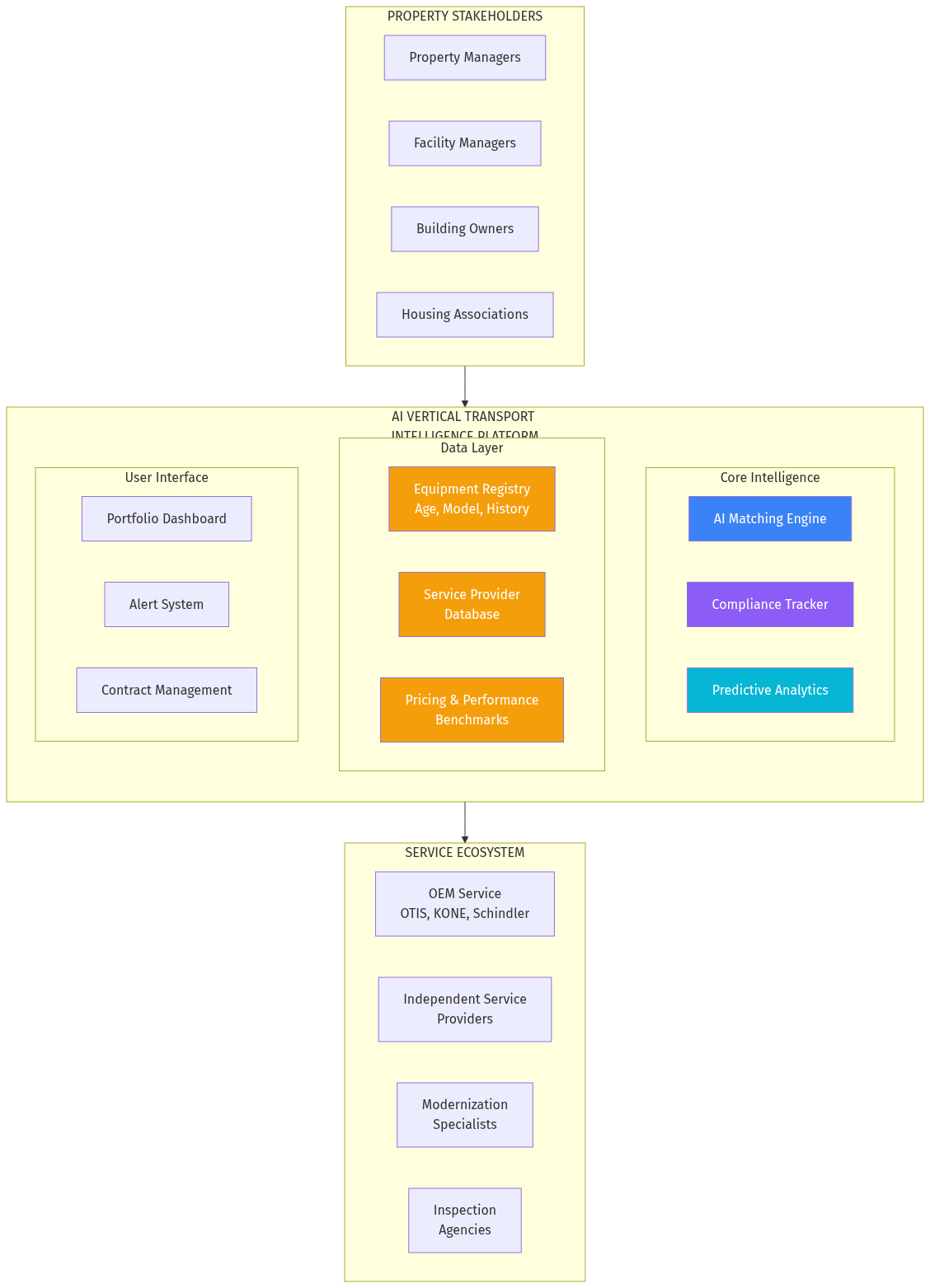
    ## Architecture: AI Vertical Transport Intelligence Platform

    Platform Architecture
    Platform Architecture

    7.

    Product Concept

    LiftIQ — The intelligent platform for vertical transport service procurement. Core Features:
  • Portfolio Dashboard:
  • - Register all elevators/escalators with equipment profiles - Real-time compliance status across jurisdictions - Upcoming service needs and contract expirations
  • Service Marketplace:
  • - RFQ generation with equipment specifications - Side-by-side provider comparisons with verified reviews - Transparent pricing based on equipment type and scope
  • Compliance Engine:
  • - Automatic inspection scheduling - Certificate storage and expiration tracking - Regulatory update alerts by jurisdiction
  • Analytics Suite:
  • - Maintenance spend benchmarking vs. industry - Equipment reliability scores - Total cost of ownership projections
  • AI Recommendations:
  • - "Your 15-year-old OTIS Gen2 has 3 callbacks in 6 months — similar units show 40% improvement with controller modernization" - "3 ISPs in your area specialize in ThyssenKrupp TAC32 controllers at 28% below OEM rates"

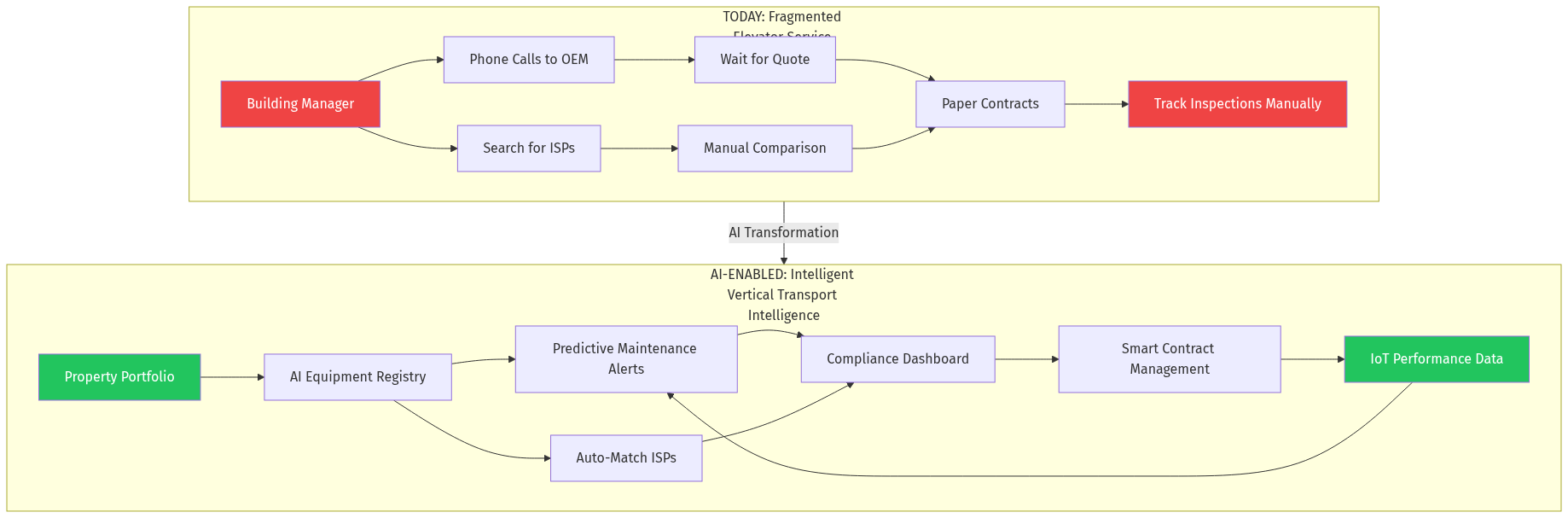
    ## Transformation: From Manual to Intelligent Procurement

    Service Transformation
    Service Transformation

    8.

    Development Plan

    PhaseTimelineDeliverables
    MVP12 weeksEquipment registry, compliance tracker, basic directory of 500 ISPs in 10 metros
    V18 weeksRFQ workflow, provider profiles with verification, pricing calculator
    V210 weeksPerformance analytics, contract management, multi-property dashboard
    V312 weeksIoT integrations, predictive maintenance alerts, API for property management systems
    Technical Stack:
    • Equipment data: PostgreSQL with time-series extension for maintenance history
    • Compliance rules: Rules engine per jurisdiction (start with top 20 US cities)
    • AI matching: Fine-tuned model on elevator specifications and provider capabilities
    • IoT ingestion: Event streaming for connected elevator data

    9.

    Go-To-Market Strategy

    STEELMANNING Opposition: Why might incumbents win?

    OEMs have the installed base relationship and can bundle monitoring with maintenance. They could build similar intelligence tools and give them away to lock in customers. Large property managers may have internal systems and resist switching.

    Counter-Strategy:
  • Start with ISP Empowerment (Supply-Side First):
  • - Free tools for ISPs to create verified profiles and receive RFQs - Help ISPs showcase certifications and brand expertise - ISPs become advocates who recommend the platform to prospects
  • Target Underserved Segments:
  • - Mid-size property managers (5-30 buildings) — too small for custom solutions, too big for spreadsheets - Housing cooperatives and HOAs — volunteer boards need guidance - Regional REITs — want portfolio visibility without enterprise software costs
  • Compliance-First Hook:
  • - "Never miss an elevator inspection again" — free compliance tracking - Upsell to procurement marketplace once trust established
  • Data Partnerships:
  • - Partner with inspection agencies to digitize records - Integrate with property management software as elevator module
    10.

    Revenue Model

    FALSIFICATION Test: What would prove this wrong?

    If building owners genuinely don't care about maintenance costs and prefer OEM convenience, marketplace transaction volume would be low. If ISPs can't compete on quality and only on price, the platform becomes a race-to-bottom. If compliance tracking isn't painful enough, the free hook fails.

    Revenue Streams:
    StreamModelYear 1 Target
    Marketplace Fee3-5% of contract value on facilitated deals$400K
    Premium Subscriptions$199-999/month for portfolio management$300K
    ISP Featured Listings$99-499/month for enhanced profiles$150K
    API AccessPer-call pricing for property management integrations$50K
    Data ProductsAnonymized market reports and benchmarks$100K
    Unit Economics:
    • Average elevator maintenance contract: $3,000-8,000/year
    • Average portfolio: 12 units
    • Platform-facilitated contract: 4% fee = $1,440-3,840/deal
    • LTV assumption: 5-year customer relationship

    11.

    Data Moat Potential

    The Data Flywheel:
  • Equipment Registry: Every elevator registered creates a permanent asset record. Service history follows the equipment, not the owner — valuable during property sales.
  • Performance Benchmarks: Aggregate callback rates, downtime, and maintenance costs by equipment type, age, and service provider. No one else has this cross-portfolio view.
  • Pricing Intelligence: Real transaction data creates accurate market rate estimates by geography and equipment type.
  • Compliance Database: Jurisdiction-specific inspection requirements, form templates, and regulatory updates — compound documentation advantage.
  • Technician Quality Scores: Over time, associate technicians (not just companies) with outcomes. Match specific technician expertise to equipment brands.
  • Second-Order Effects:
    • Insurance companies want elevator reliability data for underwriting
    • Real estate due diligence requires equipment condition reports
    • Modernization companies pay for lead generation to aging-equipment portfolios
    • OEMs may eventually license the data to improve their own offerings

    12.

    Why This Fits AIM Ecosystem

    Strategic Alignment:

    This vertical exemplifies AIM's thesis: take fragmented, offline, trust-dependent B2B transactions and create structured intelligence layers.

    • Repeat Purchase: Elevator maintenance is annual/monthly recurring — high retention
    • High Trust: Safety-critical equipment requires verified provider credentials
    • Compliance Driver: Regulatory requirements force engagement
    • Portfolio Applicability: Property managers manage multiple buildings — network effects
    • Data Value: Equipment lifecycle data compounds over decades
    AIM Integration Points:
    • thefoundry.in: Industrial equipment procurement (elevators for factories)
    • refurbs.in: Modernization component marketplace
    • challan.in: Compliance tracking pattern replicable
    • niyukti.in: Technician staffing for ISPs
    Potential Domain: liftiq.in, vertigo.in, elevate.in (check portfolio availability)

    ## Mental Models Applied

    FrameworkApplication
    Zeroth PrinciplesQuestioned assumption that maintenance is commodity — quality variance is high
    Incentive MappingOEMs profit from opacity; owners lose from information asymmetry
    Distant Domain ImportAviation MRO systems provide proven model for safety-critical equipment intelligence
    Anomaly Hunting80% OEM retention despite 30% cost premium suggests lock-in, not satisfaction
    FalsificationTested whether owners care about costs — compliance hook reduces risk
    SteelmanningAcknowledged OEM bundling advantage; countered with ISP-first strategy
    Second-Order ThinkingData flywheel creates insurance, real estate, and OEM partnership opportunities
    ---

    ## Verdict

    Opportunity Score: 8.5/10 Strengths:
    • Large, stable market with recurring revenue characteristics
    • Clear pain points validated by fragmented, offline procurement
    • Compliance requirements create natural engagement hooks
    • Data moat potential is exceptional — equipment lifecycle is decades
    • Multiple revenue streams beyond marketplace fees
    Risks:
    • OEMs could build competing solutions with existing customer relationships
    • Elevator technician shortage may limit ISP supply
    • Property manager switching costs include learning new workflows
    • Initial data collection requires manual entry before IoT integration
    Recommendation:

    This is a "slow and steady" opportunity — not a viral consumer app, but a methodical B2B infrastructure play. Start with compliance-first free tier targeting mid-size property managers, build supply through ISP empowerment, and let the data flywheel compound over 3-5 years.

    The elevator follows the building for 30+ years. Own the equipment record, own the maintenance relationship.


    ## Sources