Every year, companies spend $15+ billion on patent prosecution. Yet most have no idea if they're overpaying by 30% or 50%. The data exists in public filings. The benchmarks can be computed. AI can finally expose the black box of IP legal spend.
1.
Executive Summary
Patent prosecution—the process of obtaining patents through national patent offices—is a $15+ billion annual spend for companies worldwide. Despite this massive expenditure, the market operates with almost zero cost transparency. Law firms quote prices based on "complexity" assessments that vary wildly. Companies accept these quotes without benchmarking data. The result: systematic overpayment, particularly by startups and mid-market companies who lack negotiating leverage.
This deep dive examines the opportunity for AI-powered patent cost intelligence—a platform that analyzes public patent data (filings, prosecution history, grant timelines, fee payments) to provide real-time cost benchmarks, predict prosecution costs from draft claims, and match companies with optimally-priced law firms.
The core insight: Every patent prosecution leaves a detailed paper trail in USPTO/EPO/WIPO systems. This data has never been systematically mined for cost intelligence. AI changes the economics of extraction.
2.
Problem Statement
Who Experiences This Pain?
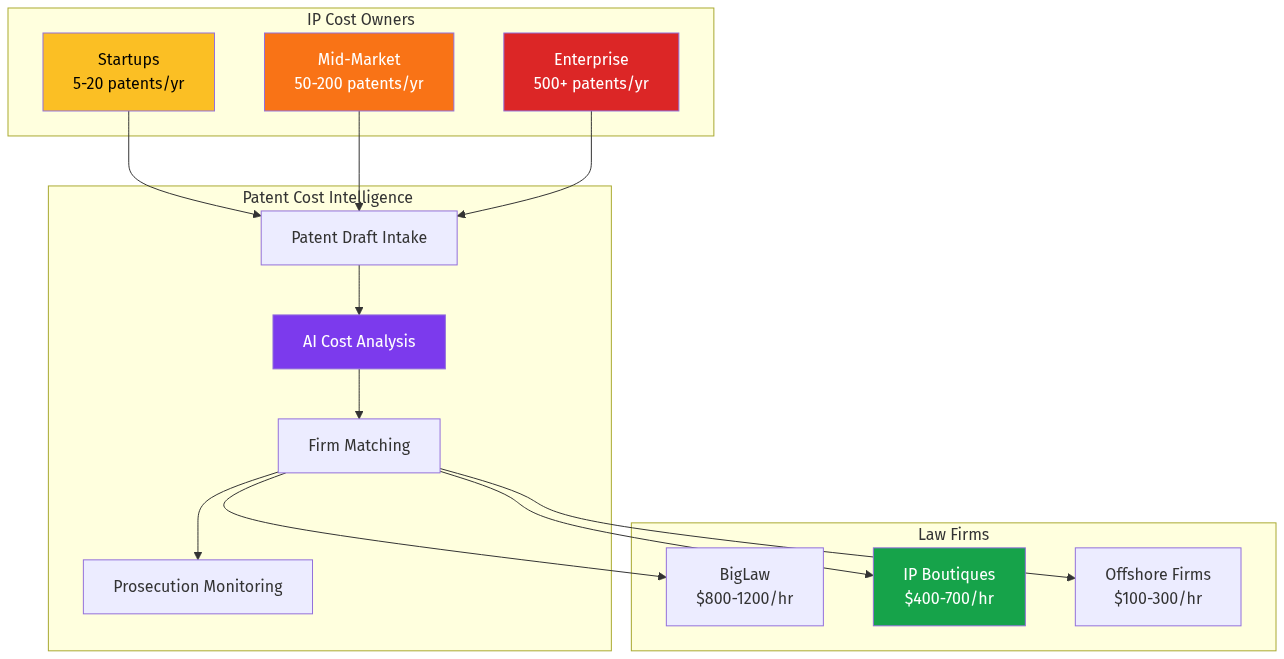
Startups (5-20 patents/year)
Budget $200K-$1M annually on patent prosecution
Accept law firm quotes at face value
No internal IP expertise to evaluate pricing
Often overpay 40-60% compared to optimized portfolios
Mid-Market Companies (50-200 patents/year)
Budget $2M-$10M annually
Have IP counsel but lack benchmarking data
Locked into legacy law firm relationships
Overpay 20-35% on average
Enterprise IP Departments (500+ patents/year)
Budget $20M-$100M+ annually
Have procurement processes but limited cost visibility
Use manual RFP processes that take months
Miss optimization opportunities worth millions
The Fundamental Problem
Applying Zeroth Principles: What axioms are we assuming that might be wrong?
The legal industry operates on an axiom that "quality legal work cannot be commoditized." This belief protects pricing opacity. But patent prosecution is highly procedural:
Claims drafting follows established patterns
Office action responses are templated across technology areas
Prosecution strategies are well-documented in prosecution histories
Outcomes are measurable (grant rates, time to grant, claim breadth)
The axiom that justifies opacity is false. Patent prosecution can be benchmarked, scored, and optimized.
Applying Incentive Mapping: Who profits from the status quo?Law firms profit from opacity. They have no incentive to provide cost benchmarks that would compress their margins. IP management software vendors serve law firms as primary customers—they won't build features that commoditize their customers' services.
Patent offices provide data but not intelligence. USPTO, EPO, and WIPO publish prosecution histories, fee payments, and timing data. But this data is fragmented, inconsistent, and requires significant processing.
Corporate IP departments lack resources. Building internal benchmarking requires data engineering capabilities that IP lawyers don't have. Procurement departments don't understand patent prosecution well enough to drive optimization.
The gap is systematic: no party in the ecosystem has aligned incentives to create cost transparency.
4.
Market Opportunity
Market Size
Global patent prosecution spend: $15-20 billion annually
AI/biotech patent surge: Fastest-growing technology areas drive complexity
Corporate cost pressure: CFOs demanding procurement rigor in all spend categories
Procurement digitization: Legal spend management emerging as a category
Why Now?
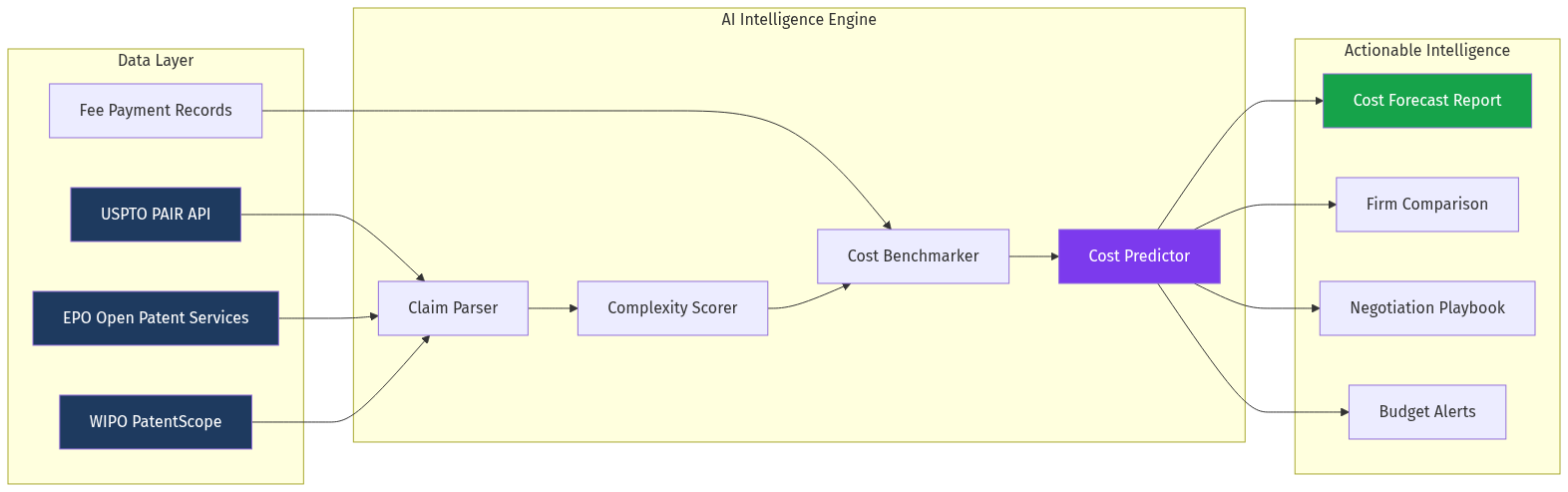
Data availability: USPTO PAIR API, EPO Open Patent Services, WIPO PatentScope now provide programmatic access to prosecution histories
AI capabilities: LLMs can parse claim language and prosecution correspondence at scale
Benchmark culture: Companies now expect benchmarking for every major spend category
Law firm unbundling: Alternative legal service providers (ALSPs) create price competition
Remote work: Geographic arbitrage opportunities (US-quality work at global prices)
5.
Gaps in the Market
Applying Anomaly Hunting: What's surprising about this market?
Gap 1: No Public Cost Benchmarks
Surprising absence: Despite millions of patents being prosecuted annually, no public benchmark exists for "what should this patent cost?" Compare to real estate (Zillow), cars (Kelly Blue Book), or even law firm associate salaries (Chambers, Am Law). Patent prosecution costs remain a complete black box.
Gap 2: No Complexity-Cost Correlation
Patent offices track claim counts, office actions, and prosecution timelines. But nobody has correlated these metrics to actual legal spend. The data exists on both sides—it's just never been connected.
Gap 3: No Firm Performance Scoring
Law firms are evaluated by subjective reputation, not measurable performance. Metrics that matter (grant rate, time to grant, office action response quality, appeal success rate) are computable from public data but never published.
Gap 4: No Predictive Cost Modeling
Given a draft patent application, what should it cost to prosecute to grant? This prediction is possible using historical data (similar applications → similar prosecution paths → predictable costs) but nobody offers it.
Gap 5: No Dynamic Matching
Companies use legacy law firm relationships even when better-priced alternatives exist. No platform matches patent applications to optimally-priced firms based on technology area, jurisdiction, and complexity.
6.
AI Disruption Angle
Applying Distant Domain Import: What field has already solved this?Healthcare claims pricing offers a structural parallel. Before AI-powered claims intelligence, hospitals accepted whatever insurers paid. Platforms like Waystar and Change Healthcare now benchmark every claim, predict reimbursement, and optimize payer selection. The result: 15-25% revenue improvement for providers.
Patent prosecution can follow the same playbook:
AI Capabilities Required
Claim Language Parsing
- Extract claim scope and complexity from draft applications
- Identify technology classification automatically
- Compare to corpus of similar granted patents
Prosecution History Analysis
- Parse office actions and responses at scale
- Identify successful vs. unsuccessful response strategies
- Compute firm-specific performance metrics
Cost Prediction Models
- Train on correlated cost-complexity data (from willing customers)
- Predict expected prosecution costs with confidence intervals
- Identify anomalies (unusually cheap or expensive outcomes)
Firm Matching Algorithms
- Score firms by technology area expertise, pricing, and performance
- Match applications to optimal firms based on requirements
- Enable bid-style competitive pricing
Patent Cost Intelligence Architecture
The Flywheel Effect
Every customer who uploads their prosecution costs improves the benchmark. More data → better predictions → more customers → more data. First mover with sufficient data has a durable advantage.
7.
Product Concept
Core Platform: PatentCost Intelligence
For Startups and SMBs ($99-499/month)
Upload draft claims → get instant cost prediction
Benchmark against similar patents in your technology area
Get matched with 3-5 qualified law firms with competitive quotes
Track prosecution progress and costs against predictions
For Mid-Market IP Departments ($2,000-10,000/month)
Portfolio-wide cost analytics and benchmarking
Firm performance scorecards (grant rate, time, cost)
Negotiation playbooks based on benchmark data
Budget forecasting and alert systems
API integration with IP management systems
For Enterprise ($50,000+/year)
Custom benchmarking against industry peers
Strategic analysis (which firms outperform by technology area?)
M&A due diligence (assess target's IP prosecution efficiency)
- Upload draft application or describe invention
- AI parses claims and estimates complexity
- Returns predicted cost range with confidence interval
- Shows similar patents and their actual prosecution costs
Firm Finder
- Search firms by technology area, geography, pricing tier
- View performance metrics (grant rate, time to grant, appeal success)
- Request competitive quotes directly through platform
- Compare quotes against benchmark
Portfolio Analytics
- Upload existing portfolio for benchmarking
- Identify overspend (applications that cost 2x+ benchmark)
- Flag prosecution efficiency opportunities
- Track trends over time
Prosecution Monitor
- Real-time alerts on USPTO/EPO/WIPO actions
- Predict next office action timing and cost
- Compare prosecution progress to similar applications
- Early warning on potentially abandoned applications
8.
Development Plan
Phase
Timeline
Deliverables
MVP
3 months
Cost estimator for US utility patents, basic firm directory, benchmark dashboard
Firm matching commission: 10-15% of first-year legal spend from matched engagements
Competitive quote service: $500-2,000 per RFP facilitated
Portfolio audit: $5,000-50,000 per engagement
Data Products
Benchmark API: License cost data to IP management platforms
Firm analytics: Sell performance data to law firms for self-improvement
Industry reports: Annual "State of Patent Prosecution Costs" sponsorships
Revenue Mix Target (Year 3)
60% SaaS subscriptions
25% transaction fees
15% data products
11.
Data Moat Potential
Applying Second-Order Thinking: If this succeeds, what happens next?
Proprietary Data Assets
Cost Benchmark Database
- Every customer who shares costs improves the benchmark
- Network effects: more data → better predictions → more customers
- Defensible: competitors would need to rebuild from scratch
Firm Performance Metrics
- Aggregated prosecution outcomes by firm and technology area
- No public equivalent exists
- Firms can't easily replicate (they only see their own data)
Complexity-Cost Correlations
- Maps claim structures to prosecution costs
- Enables predictive modeling impossible without cost data
- Improves with every completed prosecution
Data Flywheel
More customers → More cost data → Better benchmarks →
→ More value → More customers
Defensibility Assessment
Strong:
Proprietary cost data (nobody else has it)
Benchmark accuracy improves with scale
Switching costs once integrated into workflow
Moderate:
AI models can be replicated with sufficient data
Patent office data is public (prosecution histories)
Law firms could collaborate on competing benchmark
Weak:
No regulatory moat
Enterprise buyers can build internal tools
Law firms have incentive to disrupt
12.
Why This Fits AIM Ecosystem
Vertical B2B Marketplace Thesis
This opportunity exemplifies the AIM thesis: fragmented B2B markets where information asymmetry creates inefficiency, and AI can restore balance.
Parallels to Other AIM Verticals
Characteristic
Patent Cost Intel
Industrial Procurement
Equipment Rental
Fragmented supply
✓ 10K+ law firms
✓ 50K+ suppliers
✓ 20K+ rental cos
Opaque pricing
✓ No benchmarks
✓ Quote-based
✓ Negotiated
High trust required
✓ IP is strategic
✓ Quality critical
✓ Reliability key
Repeat business
✓ Ongoing prosecution
✓ Recurring MRO
✓ Project-based
AI advantage
✓ Cost prediction
✓ Spec matching
✓ Availability
Integration Opportunities
AIM Procurement Hub: Patent costs as part of enterprise spend analytics
AIM Professional Services: Legal alongside other professional services
Shared AI Infrastructure: Claim parsing, firm matching reuse patterns from other verticals
Patent Cost Intelligence Ecosystem
## Mental Model Analysis
Falsification (Pre-Mortem)
Assume 5 well-funded startups failed here. Why?
Insufficient cost data: Companies refused to share actual legal spend. Benchmark never achieved critical mass.
Law firm resistance: Major firms coordinated to blacklist the platform. Clients faced pressure not to use it.
Enterprise sales complexity: Selling to legal + procurement + finance = too many stakeholders. Deals stalled.
Inaccurate predictions: Early models made poor predictions, eroding trust. "Garbage in, garbage out" from inconsistent cost reporting.
Steelmanning: Why Incumbents Might Win
Build the strongest case AGAINST this opportunity.Anaqua/IPfolio could add cost benchmarking. They already have enterprise relationships and IP management workflows. Adding a benchmarking module would be a feature, not a new product. They have resources to acquire cost data through partnerships.
Law firms could pre-empt with fixed-fee pricing. If firms move to transparent fixed-fee models (already happening at some boutiques), the opacity problem disappears. Platform becomes unnecessary.
Corporate procurement already handles this. Enterprise companies with sophisticated procurement teams might view this as a tool they can build internally. Build vs. buy calculus may favor build for large IP portfolios.
The market may be smaller than assumed. Most patent spend is concentrated in top 1,000 filers. If they don't need this tool, the market is only mid-market and startups—potentially too small for venture scale.
Bayesian Confidence Assessment
Factor
Evidence
Confidence Impact
Problem exists
Direct conversations with IP counsel
+25%
Data is available
USPTO PAIR, EPO OPS confirmed accessible
+15%
No competitor in space
Market scan shows gap
+15%
Customer willingness to pay
Anecdotal only
+5%
Law firm resistance risk
Similar resistance in other legal tech
-10%
Data collection challenge
Cold-start problem for benchmarks
-10%
Final Confidence: 7/10
Strong problem-solution fit. Primary risk is data collection for the benchmark—requires creative GTM to solve cold-start problem.
## Verdict
Opportunity Score: 7.5/10
Strengths
Massive market ($15B+ annual spend)
Clear problem with measurable cost impact
Data availability through public APIs
AI well-suited to cost prediction
Network effects in benchmark data
Aligns with enterprise procurement trends
Risks
Cold-start problem for cost benchmark
Law firm ecosystem resistance
Enterprise sales complexity
Potential for incumbents to add feature
Recommendation
BUILD with the following approach:
Start with free cost estimator to attract users and collect cost data
Partner with patent agents and boutique firms who benefit from transparency
Target mid-market first (Series B-D companies) where pain is acute and decision cycles are shorter
Position as procurement tool, not legal tool to access budget and reduce law firm resistance
Build benchmark credibility before monetizing through published reports and thought leadership
The patent prosecution cost intelligence market is ready for disruption. The data exists, the problem is acute, and no incumbent is solving it. First mover with sufficient cost data wins the benchmark game.
## Sources
USPTO Patent Application Information Retrieval (PAIR) API documentation
European Patent Office Open Patent Services (OPS) API