ResearchThursday, February 26, 2026

AI Industrial Gas Procurement Intelligence: The $119B Cylinder Chaos Opportunity

Every day, millions of industrial gas cylinders crisscross global supply chains with paper invoices, phone orders, and lost deposits. An AI-native procurement platform could bring transparency, predictive ordering, and cylinder tracking to this fragmented industry where Excel spreadsheets still reign supreme.

1.

Executive Summary

Industrial gases—oxygen, nitrogen, argon, CO₂, hydrogen, acetylene—form the invisible backbone of modern manufacturing. From steel plants and semiconductor fabs to hospitals and food processing facilities, these gases are essential yet procured through remarkably primitive workflows: phone calls, WhatsApp messages, and paper-based cylinder tracking.

The global industrial gases market stands at $119.11 billion (2025), projected to reach $172.59 billion by 2033 at 4.4% CAGR. Yet procurement and distribution remain trapped in analog chaos. Cylinder deposits go missing. Price comparisons are impossible. Stockouts surprise production managers. Compliance documentation lives in filing cabinets.

An AI-native procurement intelligence platform could transform this industry by bringing real-time cylinder tracking, multi-vendor price intelligence, predictive consumption analytics, and automated compliance—delivering the "Amazon Business" experience to industrial gas buyers while building an invaluable data moat on industrial consumption patterns.

2.

Problem Statement

Who Experiences This Pain?

Primary: Manufacturing plants, hospitals, research laboratories, welding shops, food processors, metal fabricators Secondary: Gas distributors struggling with route optimization, cylinder recovery, and customer retention Tertiary: OEMs and contractors needing on-site gas supply coordination

The Pain Points

  • Cylinder Deposit Hell: Industrial gas cylinders require deposits (₹3,000-15,000 each). Tracking which cylinders belong to which customer, which are due for return, and reconciling deposits is a nightmare managed through paper ledgers.
  • Price Opacity: No standardized pricing. Different customers pay wildly different rates for the same gas. No easy way to compare prices across distributors.
  • Manual Reordering: Production managers call distributors when they notice cylinders running low—often too late. No predictive reordering based on consumption patterns.
  • Stockout Disasters: An oxygen stockout at a hospital or a manufacturing plant can halt operations entirely. Current systems provide no early warning.
  • Multi-Vendor Chaos: Different gases often come from different suppliers. Coordinating deliveries, invoices, and payments across 3-5 vendors is administratively brutal.
  • Compliance Blind Spots: Industrial gas handling requires safety documentation, pressure testing certificates, material safety data sheets. Tracking expirations and renewals is manual.

  • 3.

    Current Solutions

    CompanyWhat They DoWhy They're Not Solving It
    Linde (Global)Largest industrial gas producer, offers some digital orderingVertically integrated—pushes own products, not multi-vendor marketplace
    Air Products (Global)Industrial gas production + distributionLimited digital tools, focused on enterprise contracts
    Air Liquide (Global)Major producer with some IoT cylinder tracking pilotsExpensive solutions aimed at large accounts only
    IndiaMARTB2B marketplace listing gas suppliersLead generation only, no transactional capability, no cylinder tracking
    MOXē by Ellenbarrie (India)Regional cylinder trackingSingle-vendor, no procurement intelligence
    GasApp (Various)Simple ordering apps by individual distributorsFragmented, no cross-vendor visibility
    Key Gap: No platform aggregates multiple gas suppliers, provides price transparency, tracks cylinders across the customer lifecycle, and uses AI for predictive procurement.
    4.

    Market Opportunity

    Market Size

    • Global Industrial Gases Market (2025): $119.11 billion
    • Projected (2033): $172.59 billion
    • CAGR: 4.4%
    • India Industrial Gases Market: ~$4.2 billion (2025), growing at 8-9% CAGR

    Segment Breakdown (Global)

    SegmentMarket Share
    Oxygen38.52%
    Nitrogen~25%
    Hydrogen~12%
    Carbon Dioxide~10%
    Argon~8%
    Acetylene & Others~6.5%

    Distribution Channel Split

    ChannelShare
    Cylinder Distribution36.55%
    Bulk/Liquid Transport~35%
    On-site Production~28.5%

    Why Now?

  • IoT Maturity: Low-cost sensors can now track cylinder location, pressure levels, and usage in real-time for under $15/unit
  • Manufacturing Digitization: Industry 4.0 adoption creates demand for connected procurement
  • Safety Regulations Tightening: Compliance tracking becomes mandatory, not optional
  • SME Manufacturing Boom: India's SME manufacturing sector is growing rapidly, creating new gas demand
  • Carbon Tracking Requirements: Industrial gas usage increasingly needs CO₂ accounting

  • 5.

    Gaps in the Market

    ZEROTH PRINCIPLES Analysis

    Questioning the fundamental assumptions reveals that industrial gas procurement is built on an axiom that no longer holds: "Gas distribution is inherently local, therefore procurement must be relationship-based."

    Modern logistics, real-time tracking, and AI matching make regional optimization possible while preserving local delivery economics.

    ANOMALY HUNTING

    Strange absence #1: No cylinder-as-a-service model exists. Customers buy gas but rent cylinders through a primitive deposit system. Why isn't there a "cylinder subscription" with guaranteed availability? Strange absence #2: No price index exists for industrial gases. Unlike steel, aluminum, or oil, there's no transparent benchmark. This opacity benefits incumbents. Strange absence #3: Despite massive safety requirements, no integrated compliance platform tracks cylinder testing schedules, MSDS updates, and handler certifications together.

    Gap Summary

  • No Multi-Vendor Price Intelligence: Buyers can't compare prices across suppliers
  • No Cylinder Lifecycle Management: From delivery to return to refill, tracking is manual
  • No Predictive Consumption Tools: Usage patterns aren't analyzed for auto-reordering
  • No Integrated Compliance Platform: Safety documentation scattered across vendors
  • No SME-Focused Solutions: Enterprise tools exist; affordable SME tools don't

  • 6.

    AI Disruption Angle

    DISTANT DOMAIN IMPORT: What Can We Learn?

    From Fleet Management (Logistics): Real-time vehicle tracking + route optimization → Real-time cylinder tracking + delivery optimization From AWS Reserved Instances: Commit-to-consume pricing models → Gas subscription tiers with volume commitments From Predictive Maintenance (Manufacturing): Sensor data predicts equipment failure → Consumption sensors predict stockout before it happens

    AI Agent Capabilities

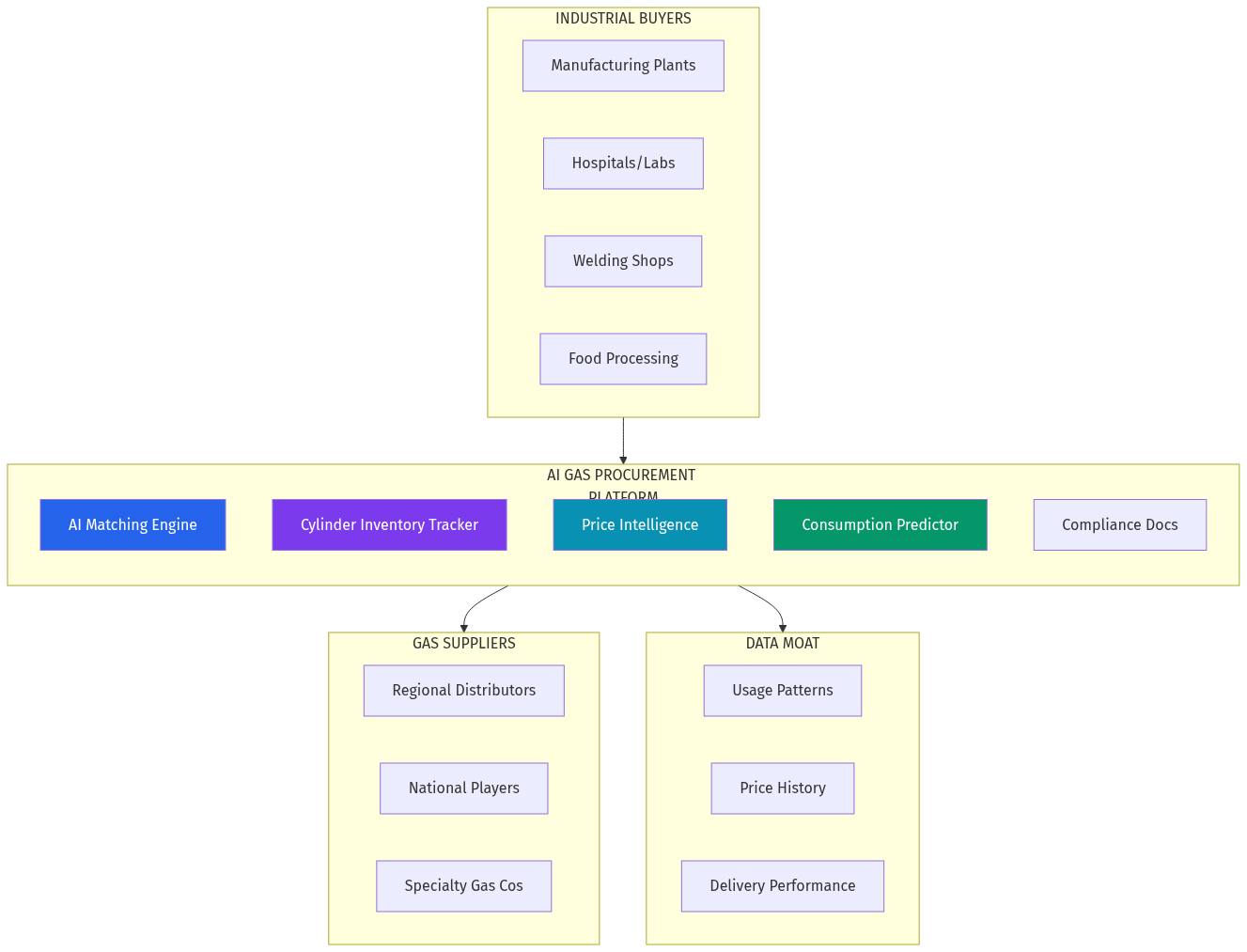
    AI Industrial Gas Procurement Flow
    AI Industrial Gas Procurement Flow
  • Predictive Reordering Agent: Analyzes historical consumption, production schedules, and external factors (weather, holidays) to automatically trigger reorders before stockout
  • Price Optimization Agent: Continuously monitors pricing across suppliers, suggests optimal sourcing, negotiates bulk discounts automatically
  • Cylinder Tracking Agent: Uses IoT + computer vision to track cylinder inventory, flag overdue returns, reconcile deposits automatically
  • Compliance Copilot: Tracks certification expirations, auto-generates safety documentation, alerts before compliance lapses
  • Supplier Matching Agent: For new requirements, instantly matches buyer specs to qualified suppliers based on gas type, purity grade, delivery capability, and pricing
  • The Agent-Native Future

    Imagine: A hospital's oxygen consumption sensor detects elevated usage during flu season. The AI agent automatically:

  • Projects increased demand for next 2 weeks
  • Queries connected suppliers for availability
  • Negotiates optimal pricing for increased volume
  • Schedules staggered deliveries to avoid storage constraints
  • Updates compliance documentation
  • Alerts procurement manager only for approval
  • No phone calls. No stockouts. No surprises.


    7.

    Product Concept

    Platform Architecture

    Platform Architecture
    Platform Architecture

    Core Modules

    For Buyers:
    • Multi-vendor gas sourcing marketplace
    • Real-time cylinder inventory dashboard
    • Consumption analytics + predictive alerts
    • Automated compliance document management
    • Unified billing across suppliers
    For Suppliers/Distributors:
    • Demand visibility across customer base
    • Route optimization for deliveries
    • Cylinder tracking and recovery tools
    • Customer consumption insights
    • Dynamic pricing management

    Key Features

    FeatureDescription
    GasMatch AIMatches requirements to suppliers by gas type, purity, volume, location, delivery speed
    CylinderTrackIoT-enabled cylinder lifecycle management
    PriceIntelReal-time pricing across suppliers with historical trends
    StockoutShieldPredictive reordering based on consumption patterns
    ComplianceHubSafety documentation, certifications, MSDS management
    DeliveryOptimizeRoute planning for distributors
    ---
    8.

    Development Plan

    PhaseTimelineDeliverables
    MVP8 weeksMulti-vendor marketplace, basic ordering, supplier onboarding
    V1+6 weeksCylinder tracking (manual entry), consumption dashboards
    V2+8 weeksIoT integration, predictive reordering, price intelligence
    V3+6 weeksAI matching, compliance automation, route optimization
    V4+8 weeksFull agent capabilities, subscription models, API platform

    Technical Stack

    • Core: Next.js, PostgreSQL, Redis
    • AI/ML: Custom consumption models, price prediction
    • IoT: MQTT protocol, low-power sensors
    • Mobile: React Native for delivery tracking
    • Integrations: ERP connectors (SAP, Tally), WhatsApp Business API

    9.

    Go-To-Market Strategy

    INCENTIVE MAPPING: Understanding Resistance

    Who profits from status quo?
    • Large distributors with opaque pricing (price transparency hurts margins)
    • Relationship-based salespeople (commission on upsells)
    • Cylinder manufacturers (lost deposits = free inventory)
    Strategy: Don't threaten distributors initially—empower them with better tools, then expand buyer-side features.

    Launch Sequence

  • Phase 1: Distributor SaaS (Months 1-6)
  • - Target: Regional gas distributors with 50-500 cylinders - Offer: Free cylinder tracking + route optimization - Goal: Onboard 50 distributors, build supplier network
  • Phase 2: Buyer Marketplace (Months 6-12)
  • - Target: Manufacturing SMEs in industrial clusters - Offer: Multi-vendor sourcing, price comparison - Goal: 200 active buyer accounts
  • Phase 3: Enterprise Intelligence (Year 2)
  • - Target: Large manufacturing plants, hospital chains - Offer: Predictive procurement, compliance automation - Goal: 20 enterprise accounts, ₹2Cr ARR

    Geographic Focus

    Start with India's industrial clusters:

    • Pune-Chakan (automotive)
    • Jamshedpur-Rourkela (steel)
    • Chennai-Sriperumbudur (electronics)
    • Visakhapatnam (pharma + steel)
    • Ahmedabad-Rajkot (engineering)
    ---

    10.

    Revenue Model

    For Buyers

    ModelDescriptionPricing
    Transaction FeePercentage on orders through platform1.5-3%
    SubscriptionPremium features (predictive, compliance)₹5,000-25,000/month
    Cylinder-as-a-ServiceManaged cylinder fleet₹500-2,000/cylinder/month

    For Suppliers

    ModelDescriptionPricing
    SaaS SubscriptionCylinder tracking, route optimization₹3,000-15,000/month
    Lead GenerationQualified buyer inquiries₹200-500/lead
    Premium PlacementPriority visibility in marketplace₹10,000-50,000/month

    Projected Unit Economics

    • Average Order Value: ₹15,000
    • Take Rate: 2.5%
    • Gross Margin: 85%
    • Buyer CAC: ₹3,000
    • LTV: ₹45,000 (36-month retention)
    • LTV:CAC: 15:1

    11.

    Data Moat Potential

    SECOND-ORDER THINKING: What Data Accumulates?

    First-Order Data:
    • Transaction prices across regions
    • Cylinder inventory levels
    • Delivery times by supplier
    Second-Order Insights:
    • Industrial production forecasting (gas consumption = leading indicator)
    • Regional manufacturing health indices
    • Supply chain disruption early warning
    • Carbon emissions tracking by facility

    Proprietary Data Assets

  • Price Index: First transparent industrial gas price benchmark for India
  • Consumption Patterns: Factory-level usage data predicts economic activity
  • Supplier Performance: Delivery reliability, quality scores
  • Compliance Database: Certification status across the ecosystem
  • Demand Forecasting Models: Trained on actual consumption data
  • Moat Depth Over Time

    • Year 1: Basic pricing data
    • Year 2: Consumption pattern library
    • Year 3: Predictive models with 90%+ accuracy
    • Year 5: De facto industrial gas intelligence standard

    12.

    Why This Fits AIM Ecosystem

    Alignment with AIM Philosophy

    • Structure over Scale: Gas procurement is unstructured chaos—we bring organization
    • Domains as Distribution: gases.aim.in, industrialgas.in, cylindertrack.in
    • AI-Native Workflows: Perfect for agent-based transaction automation
    • IndiaMART Gap: They list suppliers; we enable transactions

    Cross-Pollination

    • With thefoundry.in: Manufacturing plants need both equipment AND consumables
    • With instabox.in: Logistics optimization capabilities transfer directly
    • With challan.in: Compliance documentation patterns reuse

    AIM Vertical Potential

    Industrial gases could become a flagship AIM vertical demonstrating:

    • Multi-vendor procurement
    • IoT-enabled tracking
    • Predictive AI agents
    • Compliance automation
    ---

    ## Verdict

    Opportunity Score: 8.5/10

    FALSIFICATION: Why This Could Fail

  • Distributor Resistance: Incumbents may refuse platform participation
  • IoT Adoption Friction: Sensor installation requires physical access
  • Thin Margins: Industrial gas margins are already thin; platform take-rate limited
  • Safety Liability: Platform involvement in gas delivery creates legal exposure
  • STEELMANNING: Why Incumbents Might Win

    • Linde/Air Products could launch their own marketplace with deeper pockets
    • Existing ERP systems might add gas procurement modules
    • Relationship-based selling may resist digital displacement

    Final Assessment

    The industrial gas procurement space presents a rare combination: massive market ($119B+), primitive technology (phone/WhatsApp), fragmented supply (thousands of distributors), and clear AI applicability (predictive, matching, tracking).

    The distributor-first GTM strategy mitigates resistance by initially serving suppliers rather than threatening them. Once network effects establish, buyer-side features create lock-in.

    Recommendation: High-conviction opportunity. Build MVP focused on cylinder tracking for distributors, expand to multi-vendor marketplace once supply-side is locked.

    ## Sources