The global waste management market is projected to reach $1.6 trillion by 2029, with hazardous waste representing one of the most heavily regulated and compliance-intensive segments. Yet the compliance infrastructure remains stubbornly manual: paper-based manifests, phone-coordinated pickups, and spreadsheet tracking that crumbles under audit scrutiny.
The opportunity: Build an AI-powered compliance intelligence platform that transforms hazardous waste management from a regulatory burden into an automated, audit-proof workflow. The platform would classify waste streams, match generators with licensed haulers, auto-generate compliant documentation, and maintain perpetual audit readiness. Why now: Regulatory pressure is intensifying globally, EPA enforcement budgets are increasing, and SMBs—which generate 40% of hazardous waste—lack access to enterprise-grade compliance tools. Meanwhile, AI capabilities have matured to the point where waste classification, document generation, and compliance monitoring can be fully automated.1.
Executive Summary
2.
Problem Statement
Who Experiences This Pain?
Small-to-Medium Manufacturers (machine shops, electronics assembly, chemical processing)- Generate multiple hazardous waste streams (solvents, oils, heavy metals)
- Lack dedicated environmental compliance staff
- Face $70,000+ penalties per violation
- Produce biomedical, pharmaceutical, and sometimes radioactive waste
- Subject to overlapping OSHA, EPA, and state health regulations
- 72% report "significant confusion" about proper disposal procedures
- Generate used oil, antifreeze, brake fluid, and contaminated rags
- 65% of independent shops have compliance documentation gaps
- Average fine: $37,500 per violation
- Encounter asbestos, lead paint, contaminated soil
- Project-based nature makes consistent tracking difficult
- Subcontractor coordination adds complexity layers
The Compliance Nightmare
Zeroth Principles Question: Why does hazardous waste compliance exist at all?The answer reveals the depth of the problem: improper disposal causes groundwater contamination, air pollution, and long-term health damage. The regulatory framework exists because the externalities of mishandling are catastrophic. This means:
- Regulations will only get stricter, not weaker
- Enforcement will increase, not decrease
- The compliance burden is permanent and growing
Current Pain Points
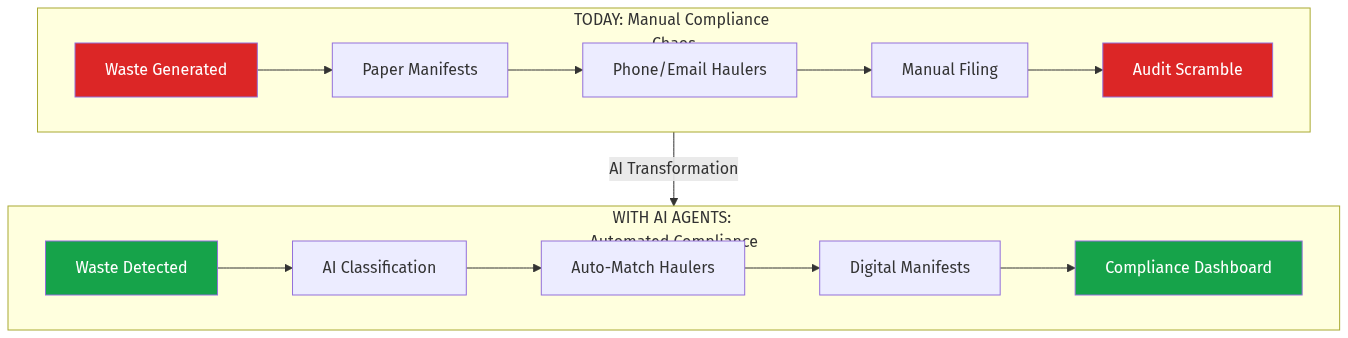
3.
Current Solutions
Enterprise Giants (Won't Serve SMBs)
| Company | What They Do | Why They're Not Solving It |
|---|---|---|
| Veolia | Full-service waste management for large enterprises | Minimum contract sizes exclude SMBs; opaque pricing |
| SUEZ | Integrated water/waste for industrials | European-focused; enterprise-only sales motion |
| Stericycle | Medical/pharmaceutical waste specialist | Narrow focus; compliance is manual overlay |
| Clean Harbors | Hazardous waste treatment & disposal | B2B2B model; no direct SMB tooling |
Tech-Enabled Waste Platforms (Wrong Focus)
| Company | What They Do | Why They're Not Solving It |
|---|---|---|
| Rubicon | Tech-enabled waste & recycling brokerage | Focuses on general waste, not hazardous compliance |
| Bigbelly | Smart bins with fill-level sensors | Municipal focus; no compliance layer |
| Compology | Computer vision for dumpster monitoring | Route optimization, not regulatory compliance |
| RoadRunner | Waste/recycling for multi-location businesses | Commercial waste; hazardous is afterthought |
Compliance Software (Horizontal, Not Vertical)
| Company | What They Do | Why They're Not Solving It |
|---|---|---|
| Enablon | Enterprise EHS management | $100K+ implementations; 12-month deployments |
| Intelex | Environmental compliance tracking | Requires dedicated compliance staff to operate |
| Perillon | Hazmat management software | Legacy architecture; poor mobile experience |
The Gap
Incentive Mapping: Who profits from the status quo?- Large haulers benefit from opaque pricing and long-term contracts
- Consultants thrive on compliance complexity (hourly billing for manifest prep)
- Legacy software vendors have enterprise sales motions that can't serve SMBs profitably
4.
Market Opportunity
Market Size
| Segment | Size | Growth |
|---|---|---|
| Global Waste Management | $1.6T by 2029 | 5.6% CAGR |
| Hazardous Waste Treatment | $42B (US) | 4.2% CAGR |
| Environmental Compliance Software | $12B | 8.3% CAGR |
| Smart Waste Management | $4.7B by 2027 | 16.9% CAGR |
Serviceable Market
US Small-to-Medium Hazardous Waste Generators:- 1.2 million registered generators
- Average compliance spend: $8,000-25,000/year
- SAM: $12B-30B in compliance + disposal spend
- 46,000+ registered hazardous waste generating units
- CPCB enforcement intensifying post-2020 rules update
- 78% lack digital compliance systems
- SAM: ₹8,000-15,000 crore ($1-2B)
Why Now?
5.
Gaps in the Market
Anomaly Hunting: What's Strange Here?
Anomaly 1: No "TurboTax for Hazardous Waste" Tax compliance (equally complex, equally penalty-prone) has consumer-friendly software. Hazardous waste compliance—affecting similar numbers of businesses—has nothing comparable. Anomaly 2: Hauler Discovery is Still Phone-Based You can find a restaurant on your phone in 30 seconds but can't easily discover which licensed haulers serve your area for your specific waste type. Anomaly 3: Manifests are Still Paper-First Despite EPA e-Manifest (launched 2018), only 35% of manifests are submitted electronically. The software to generate them is clunky and expensive. Anomaly 4: Pricing is Completely Opaque Unlike freight (where digital brokers exposed rates), hazardous waste disposal pricing remains hidden behind "call for quote."Gap Analysis
| Gap | Current State | Opportunity |
|---|---|---|
| Waste Classification | Requires consultant or environmental engineer | AI classifier from photo + description |
| Hauler Discovery | Phone calls, industry contacts | Searchable marketplace with reviews/pricing |
| Manifest Generation | Complex forms, error-prone | Auto-generated from waste profile |
| Compliance Tracking | Spreadsheets, filing cabinets | Real-time dashboard with alerts |
| Audit Preparation | Panic-driven document hunting | Always-ready digital audit package |
| Price Transparency | Opaque, relationship-based | Data-driven market rates |
6.
AI Disruption Angle
How AI Agents Transform the Workflow
Distant Domain Import: What field has solved a similar problem? Freight logistics faced identical challenges: fragmented carriers, complex documentation, opaque pricing, compliance requirements. Digital freight brokers (Flexport, Convoy) solved it with:- Carrier marketplaces
- Automated documentation
- Real-time tracking
- Price transparency
AI Agent Capabilities
1. Waste Classification Agent- Input: Photo of waste container + natural language description
- Output: EPA waste codes, DOT shipping classification, proper handling requirements
- Accuracy target: 95%+ with human-in-loop for edge cases
- Input: Waste type, volume, location, urgency
- Output: Ranked list of licensed haulers with availability and pricing
- Optimization: Balance cost, transit time, and handler reputation
- Input: Waste profile, generator info, hauler selection
- Output: Complete EPA Form 8700-22 (Uniform Hazardous Waste Manifest)
- Validation: Auto-checks for common errors before submission
- Tracks regulatory changes (EPA, state, local)
- Alerts when permits need renewal
- Flags when training certifications expire
- Monitors manifest return deadlines (45-day rule)
- Maintains organized digital archive of all compliance documents
- Generates audit-ready packages on demand
- Pre-identifies potential compliance gaps
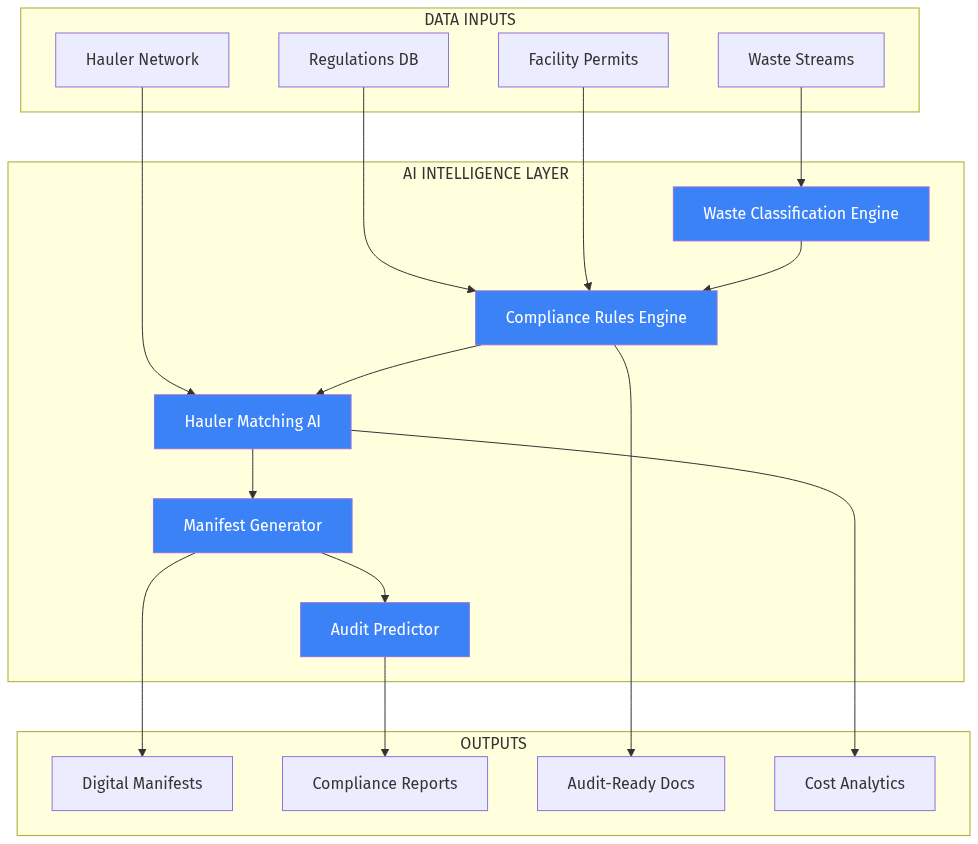
The AI-Native Future
In 3-5 years, the workflow becomes:
7.
Product Concept
Core Platform Features
For Waste Generators (SMBs)| Feature | Description |
|---|---|
| Smart Waste ID | Photo-based classification with AI; returns EPA codes + handling requirements |
| Hauler Marketplace | Search/filter licensed handlers by waste type, location, price, rating |
| Digital Manifest | Auto-populated e-Manifest with error checking; electronic signature |
| Compliance Dashboard | Real-time status of permits, training, manifest returns |
| Audit Vault | Organized archive with one-click audit package generation |
| Cost Analytics | Spend tracking, price benchmarking, optimization recommendations |
| Feature | Description |
|---|---|
| Lead Marketplace | Receive qualified pickup requests matching capabilities |
| Route Optimization | AI-optimized pickup scheduling |
| Digital Documentation | Electronic manifest acceptance, delivery confirmation |
| Compliance Verification | Maintain current permit/license status for visibility |
| Feature | Description |
|---|---|
| Aggregated Reporting | Anonymous industry benchmarks |
| Trend Analysis | Waste stream patterns by geography, industry |
| Compliance Intelligence | Risk-based inspection targeting |
User Experience Philosophy
"Compliance as a Byproduct"Users shouldn't "do compliance." They should manage their waste, and compliance documentation happens automatically as a side effect of normal operations.

8.
Development Plan
Phase Roadmap
| Phase | Timeline | Deliverables | Success Metrics |
|---|---|---|---|
| MVP | 12 weeks | Waste classifier + manifest generator + basic hauler directory | 100 beta users, 90% classification accuracy |
| V1 | +16 weeks | Full marketplace, digital manifests, compliance dashboard | 500 paying customers, 1,000 manifests/month |
| V2 | +20 weeks | AI hauler matching, audit vault, cost analytics | 2,000 customers, $500K ARR |
| Scale | +24 weeks | Multi-state expansion, API for ERP integration, hauler network effects | 10,000 customers, $3M ARR |
Technical Stack
- Classification Model: Fine-tuned vision-language model on EPA waste code dataset
- Backend: Node.js/Python microservices on Kubernetes
- Database: PostgreSQL (transactional) + Elasticsearch (search)
- Compliance Rules Engine: Decision tree + LLM for natural language interpretation
- Mobile: React Native for field classification
- Integration: REST API + Zapier/Make for ERP/accounting systems
Key Technical Challenges
9.
Go-To-Market Strategy
Launch Market Selection
Criteria:- High SMB generator density
- Active enforcement environment
- Digital-friendly business culture
Acquisition Channels
1. SEO/Content (Long-term)- "How to dispose of [waste type] properly"
- "EPA hazardous waste manifest guide"
- "[State] hazardous waste regulations 2026"
- Build authority in compliance education
- Onboard haulers first (free); they refer generators
- Haulers become distribution channel
- Each hauler brings 20-50 generator customers
- Auto service associations (ASA, AAIA)
- Manufacturing associations (NAM, regional)
- Healthcare compliance networks
- Offer member discounts for credibility
- Environmental consultants as resellers
- They get tools to serve clients better
- Revenue share on referred subscriptions
- Partner with state environmental agencies on digital manifest adoption
- Get listed as "approved software" (if applicable)
- Participate in EPA e-Manifest stakeholder programs
Pricing Strategy
| Tier | Price | Features | Target |
|---|---|---|---|
| Starter | $99/month | 10 classifications/month, basic manifests, hauler directory | Micro-generators (auto shops, clinics) |
| Professional | $299/month | Unlimited classification, full compliance dashboard, audit vault | Small manufacturers, multi-location healthcare |
| Enterprise | $799/month | API access, ERP integration, dedicated support, multi-site | Mid-market manufacturers, hospital systems |
| Hauler | Free / 3% transaction | Marketplace listing, lead acceptance, route tools | Licensed haulers (demand-side) |
10.
Revenue Model
Revenue Streams
1. Subscription Revenue (Primary)- Generator subscriptions: $99-799/month
- Target: 80% of revenue
- High retention (compliance is sticky; switching is risky)
- 3-5% fee on hauler bookings through marketplace
- Target: 15% of revenue
- Grows with transaction volume and hauler network
- Per-call pricing for classification API
- Enterprise ERP integration fees
- Target: 5% of revenue (grows over time)
- Anonymous benchmarking reports
- Industry waste analytics
- Regulatory trend intelligence
- Sell to haulers, consultants, regulators
Unit Economics Target
| Metric | Target |
|---|---|
| CAC | $200-400 |
| LTV | $3,600+ (3-year average retention) |
| LTV:CAC | 9:1+ |
| Gross Margin | 75%+ |
| Net Revenue Retention | 110%+ (upsell + transaction growth) |
11.
Data Moat Potential
What Proprietary Data Accumulates?
1. Waste Stream Classification Data- Every classification improves the model
- Industry-specific patterns emerge
- Becomes the definitive waste code database
- On-time pickup rates
- Pricing by waste type and geography
- Compliance track records
- Creates trusted hauler ratings
- Common violation triggers
- Audit timing patterns
- Industry benchmarks
- Enables predictive compliance alerts
- True market rates by waste type/location
- Seasonal patterns
- Negotiation leverage data
- Powers "fair price" guarantees
Defensibility Analysis
Steelmanning: Why might incumbents win?- Veolia/SUEZ could acquire and integrate
- Large haulers could build competing software
- EPA could build free government solution
- Environmental consultants could resist disintermediation
If this platform succeeds:
- Compliance costs drop → more businesses properly dispose → environmental outcomes improve
- Price transparency → hauler margins compress → industry consolidation accelerates
- Classification data → better waste characterization → smarter recycling/treatment
- Platform becomes essential infrastructure → acquisition target for Veolia/SUEZ/tech giants
12.
Why This Fits AIM Ecosystem
AIM.in Integration Points
1. Discovery Layer- "Find hazardous waste haulers near me" queries
- Category page: aim.in/hazardous-waste
- Structured supplier data feeds platform
- Hauler booking flows through AIM infrastructure
- Payment processing via AIM systems
- Verification/trust signals from AIM network
- Cross-reference with manufacturing directory
- Healthcare facility database integration
- Auto service business network
- Could launch as safewaste.in or complywaste.in
- Fits AIM's "structured B2B discovery" mission
- Adds regulatory compliance as platform capability
Strategic Value
- High-margin vertical - Compliance software has 75%+ gross margins
- Sticky customers - Compliance = locked in (switching risk is high)
- Regulatory moat - Deep expertise creates barrier
- Data value - Waste stream data valuable for ESG/sustainability plays
## Pre-Mortem: Why This Could Fail
Falsification exercise: Assume 5 well-funded startups failed here. Why?## Verdict
Opportunity Score: 8.5/10Strengths
- ✅ Large, growing market with clear pain points
- ✅ Regulatory tailwinds (enforcement increasing)
- ✅ AI capabilities now mature enough for classification
- ✅ Incumbent solutions poorly serve SMB segment
- ✅ Strong data moat potential
- ✅ High retention due to compliance stickiness
Risks
- ⚠️ Classification liability requires careful product design
- ⚠️ Hauler supply-side requires manual effort to bootstrap
- ⚠️ Regulatory complexity demands phased geographic expansion
- ⚠️ SMB sales require efficient self-serve motion
Recommendation
Build it. This is a $50M+ ARR opportunity with clear path to market leadership. The intersection of:- Regulatory complexity (creates value)
- AI capabilities (enables automation)
- SMB underservice (opens market)
Start with California + Texas, focus on auto service + small manufacturing, build the classification engine, and let hauler partnerships drive distribution.
First milestone: 100 paying customers generating 1,000 compliant manifests/month within 12 months.## Sources
- MarketsandMarkets - Waste Management Market Report 2024
- EPA - Hazardous Waste Regulations
- EPA - e-Manifest System
- Rubicon - Waste & Recycling Solutions
- Bigbelly - Smart Waste Solutions
- CPCB India - Hazardous Waste Management
- Stericycle - Hazardous Waste Services
- Grand View Research - Hazardous Waste Market Analysis
❧