The freight audit and payment (FAP) market is projected to grow from $970M in 2025 to $1.89B by 2030 (14.2% CAGR). But here's what the market reports don't tell you: this growth is almost entirely concentrated in enterprise solutions serving Fortune 500 companies with $50M+ annual freight spend.
The gap: SMEs shipping $1-10M annually—representing over 60% of all shippers—have essentially zero purpose-built solutions. They're stuck with spreadsheets, manual matching, and WhatsApp groups with freight coordinators. The opportunity: An AI-first freight audit platform designed for the SME shipper, priced at $500-2,000/month instead of $500K+ annually, could capture a $200M+ market while building an unassailable data moat.1.
Executive Summary
2.
Problem Statement
Who Experiences This Pain?
Primary victims: SME manufacturers, distributors, and e-commerce brands shipping 100-1,000 orders/month with 5-50 carrier relationships. The daily nightmare:- Invoice chaos: Carrier invoices arrive via email, EDI, portal downloads—different formats from each carrier
- Rate verification hell: Manual matching against contracted rates, often with complex accessorial charges
- Duplicate payments: Same shipment billed multiple times, caught only by accident
- Dispute paralysis: Finding overcharges but lacking time/process to recover them
- Cash flow unpredictability: Freight costs swing 10-20% month-over-month with no explanation
We assume freight invoices are inherently trustworthy. They're not. Industry studies show 3-8% of freight invoices contain errors—and carriers have zero incentive to fix this because the errors almost always favor them. The entire system is built on the assumption that shippers have sophisticated audit capabilities. SMEs don't.
The Human Cost
A typical logistics coordinator at a mid-sized distributor spends 15-20 hours/week on freight-related administrative tasks:
- Downloading invoices from carrier portals
- Entering data into spreadsheets
- Cross-referencing BOLs with invoices
- Chasing down discrepancies
- Processing payments manually
3.
Current Solutions
| Company | What They Do | Why They Don't Solve SME Needs |
|---|---|---|
| Trax Technologies | Enterprise freight audit managing $25B in spend for Fortune 500 | Minimum engagement $500K+/year. Designed for 50+ person logistics teams |
| CTSI-Global | Full-service logistics + freight audit | Enterprise-only. Requires dedicated implementation team |
| nVision Global | Global freight audit across 120+ countries | Complex onboarding (6-12 months). Not self-service |
| Data2Logistics | Freight payment + analytics | Mid-market focus but still $100K+ annually |
| Loop | Modern audit platform with J.P. Morgan partnership | Newer entrant but still enterprise-focused |
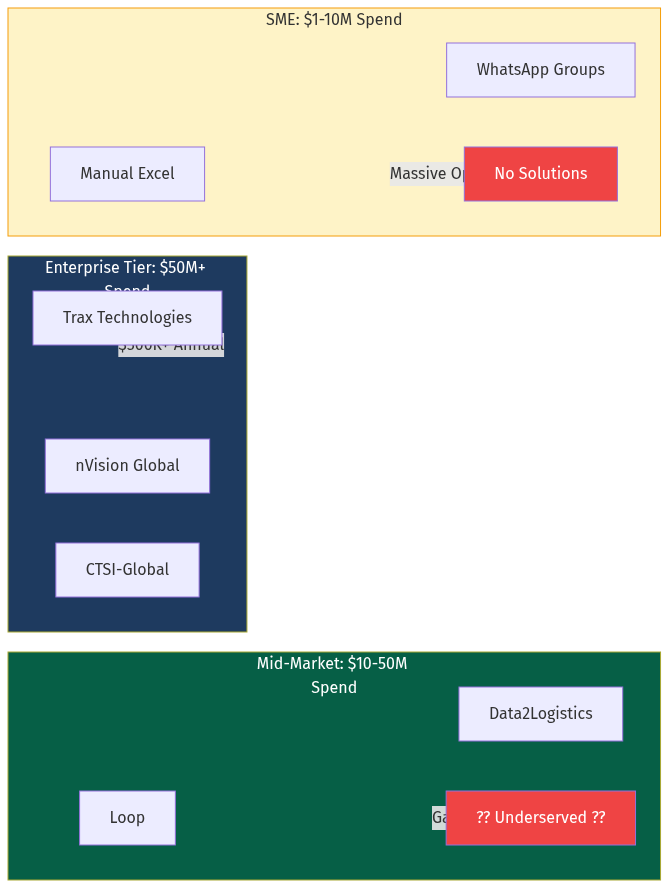
What SMEs Actually Use Today
4.
Market Opportunity
Market Size
- Global FAP market: $970M (2025) → $1.89B (2030)
- CAGR: 14.2%
- North America: 45% of market (largest share)
- Asia Pacific: Fastest growing (driven by India, China e-commerce)
The SME Segment
- Total addressable market: 500,000+ SME shippers in US alone
- Average annual freight spend: $2-5M
- Addressable problem: 3-8% of spend = $60-400K in recoverable savings per company
- Willingness to pay: 10-20% of recovered savings = $6,000-80,000/year potential
- Conservative SAM: $200-500M in US SME freight audit market
Why Now?
5.
Gaps in the Market
Gap 1: Self-Service Onboarding
Enterprise solutions require 6-12 months of implementation, dedicated project managers, and custom integrations. SMEs need to be live in 24-48 hours.
Anomaly: Why does a modern SaaS market still have such long onboarding? Because incumbents profit from implementation fees and sticky multi-year contracts. Incentive Mapping reveals the system is designed this way on purpose.Gap 2: Usage-Based Pricing
Current pricing: $500K-2M annually, regardless of volume. SME-appropriate pricing: $0.50-2.00 per invoice audited, or percentage of savings recovered.
Gap 3: WhatsApp/Mobile-First Experience
Logistics coordinators at SMEs aren't sitting at desktops all day. They're on warehouse floors, in loading docks, on the road. The interface needs to be WhatsApp-native.
Gap 4: Cross-Carrier Rate Intelligence
SMEs don't just need audit—they need to know if they're getting competitive rates. "Your FedEx rate for Zone 5 is 12% higher than market average" is actionable intelligence no SME solution provides today.
Gap 5: India-Specific Solutions
India's logistics market ($300B) is growing 10%+ annually, but freight audit solutions are essentially non-existent for Indian SMEs dealing with fragmented transporters, varying GST rates, and cash-heavy operations.
6.
AI Disruption Angle
The Transformation
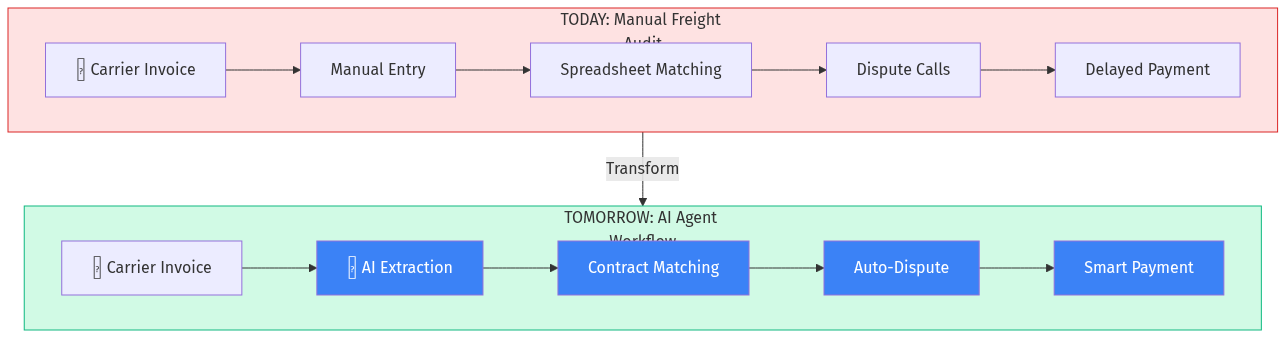
How AI Agents Change Everything
1. Intelligent Document Extraction- AI reads PDF invoices, scanned documents, email attachments
- Extracts: carrier, shipment ID, origin/destination, weight, dimensions, charges
- Handles 300+ carrier invoice formats automatically
- Accuracy: 95%+ with human-in-the-loop for exceptions
- AI maintains digital twin of all carrier contracts
- Real-time matching against negotiated rates
- Flags accessorial charges that shouldn't apply
- Detects fuel surcharge calculation errors
- ML models trained on millions of invoices identify outliers
- "This shipment to the same destination cost 40% more than average—investigate"
- Pattern recognition for systematic overcharges
- AI generates dispute documentation
- Submits claims through carrier APIs/portals
- Tracks resolution and recovery
- Forecast freight costs based on shipping patterns
- Identify rate optimization opportunities
- Model "what-if" scenarios for carrier negotiations
Distant Domain Import
What field has already solved a similar problem? Healthcare claims processing. Medical billing has the same challenges: complex codes, multiple payers, high error rates, dispute-heavy. Companies like Waystar and Olive AI have successfully applied AI to healthcare revenue cycle management. The freight audit problem is actually simpler (fewer code variations, more standardized formats).7.
Product Concept
Core Features (MVP)
1. Universal Invoice Ingestion- Email forwarding ([email protected])
- Carrier API connections (FedEx, UPS, DHL, DTDC, Delhivery)
- Portal scrapers for regional carriers
- WhatsApp document sharing
- Upload contracts once, AI extracts all rate tables
- Automatic matching on every invoice
- Variance reporting with one-click dispute filing
- Approve audited invoices in bulk
- Automated payment scheduling
- GL coding with allocation rules
- Spend by carrier, lane, service level
- Error rate tracking over time
- Savings recovered leaderboard
WhatsApp-Native Interface
🚛 FreightAI Bot: New invoice detected from FedEx

Invoice #FX-88291
Amount: ₹45,230
Shipment: DEL→MUM, 250kg

⚠️ Variance Found: ₹3,450 (7.6%)
- Residential surcharge applied incorrectly
- Zone rate higher than contract

[Approve ₹41,780] [Dispute] [Review Details]
Differentiation
| Feature | Enterprise Solutions | FreightAI (Our Concept) |
|---|---|---|
| Onboarding | 6-12 months | 24-48 hours |
| Pricing | $500K+ annually | ₹5,000/month + 10% of savings |
| Interface | Desktop-heavy | WhatsApp + Mobile-first |
| Integrations | Custom IT projects | Pre-built connectors |
| Support | Account managers | AI-first with human backup |
8.
Development Plan
| Phase | Timeline | Deliverables |
|---|---|---|
| MVP | 8 weeks | Invoice ingestion (email + WhatsApp), basic audit (top 10 carriers), simple dashboard, manual payment approval |
| V1 | 8 weeks | AI contract extraction, automated dispute filing, basic analytics, multi-user access |
| V2 | 8 weeks | Rate benchmarking, carrier API integrations, payment automation, advanced reporting |
| Scale | Ongoing | ML model improvements, industry-specific features, international expansion |
Technical Architecture
Stack:- Document AI: Google Document AI + custom fine-tuned models
- LLM: Claude for contract interpretation, dispute generation
- Database: PostgreSQL + TimescaleDB for analytics
- WhatsApp: Baileys or official API
- Payments: Razorpay for INR, Stripe for USD
9.
Go-To-Market Strategy
Phase 1: India D2C Brands (Months 1-6)
Why start here:- High volume, consistent shipping patterns
- Tech-savvy, cloud-native expectations
- Concentrated in Bengaluru, Mumbai, Delhi ecosystems
- Accessible via D2C founder communities
Phase 2: Manufacturing SMEs (Months 6-12)
Target: Auto parts, textiles, chemicals—high freight-to-revenue ratio industries Channels:- IndiaMART supplier outreach
- Manufacturing association partnerships
- Trade show presence
Phase 3: International Expansion (Year 2)
Target markets:10.
Revenue Model
Primary Revenue Streams
1. Subscription (Base)- Starter: ₹5,000/month (up to 500 invoices)
- Growth: ₹15,000/month (up to 2,000 invoices)
- Scale: ₹40,000/month (unlimited)
- 10-15% of recovered savings from disputes
- Only charged when money is actually recovered
- Creates strong alignment with customer outcomes
- 0.5% of payment volume processed through platform
- Optional—customers can continue using existing payment methods
Unit Economics (Target)
- ARPU: ₹25,000/month ($300)
- CAC: ₹50,000 ($600) — 2 months payback
- Gross margin: 80%+
- Net revenue retention: 120% (expansion as customers grow)
Falsification (Pre-Mortem)
Assume 5 well-funded startups failed here. Why?11.
Data Moat Potential
What Proprietary Data Accumulates
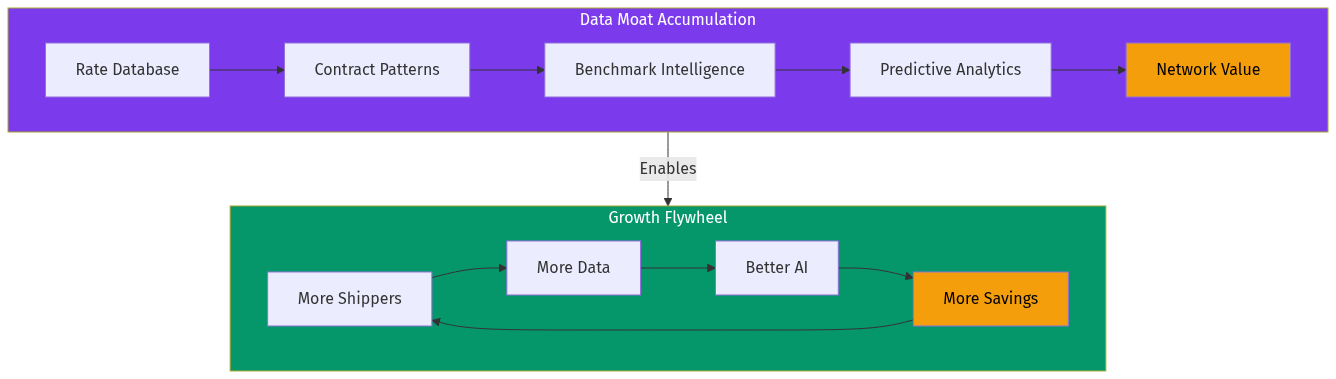
- Actual negotiated rates across thousands of shipper-carrier relationships
- Lane-specific pricing patterns (DEL→MUM vs DEL→CHE)
- Seasonal variations and surcharge trends
- Which carriers overcharge most frequently
- Common error types by carrier/service
- Success rate of dispute categories
- "Fair" rate ranges by volume tier
- Accessorial negotiation leverage points
- Contract term comparisons
- More shippers → better rate benchmarks → more accurate recommendations
- Carrier reputation scores based on error rates
- Industry-specific insights (auto parts vs. textiles vs. FMCG)
Steelmanning: Why Incumbents Might Win
Best argument AGAINST this opportunity:12.
Why This Fits AIM Ecosystem
Direct AIM Alignment
1. Structured B2B Discovery AIM.in is about helping buyers DECIDE, not just ASK. Freight audit intelligence helps SMEs make informed decisions about:- Which carriers to use
- What rates to negotiate
- When to switch providers
freightaudit.in, logisticspay.in, carrieriq.in
Integration Points
- bhada.in (freight rates) — Rate benchmarking data
- masale.in (spices) — Logistics costs for commodity exporters
- thefoundry.in (industrial) — Heavy freight optimization
- instabox.in (logistics) — 3PL service discovery
## Verdict
Opportunity Score: 8.5/10Why High Score
✅ Large, growing market — $1B+ global, 14% CAGR ✅ Clear SME gap — Enterprise solutions don't serve this segment ✅ AI-native timing — Document extraction + LLMs make this viable now ✅ Strong data moat — Rate intelligence compounds over time ✅ Aligned incentives — Success fee model creates customer trust ✅ India starting advantage — Fragmented market, high volume, low competition
Why Not 10/10
⚠️ Carrier complexity — 300+ formats is hard. Requires significant data investment ⚠️ Long sales cycles — Even SMEs move slowly on financial tools ⚠️ Integration dependency — Success depends on carrier API access
Second-Order Thinking
If this succeeds, what happens next?Recommendation
Build it. The combination of clear market gap, AI timing, and data moat potential makes this a compelling vertical SaaS opportunity. Start with India D2C brands (accessible, tech-savvy, high volume), prove the model, then expand.The key insight: this isn't about building better audit software. It's about building a freight intelligence network where every shipper's data makes the platform smarter for everyone.
## Sources
- Mordor Intelligence: Freight Audit & Payment Market Report 2025-2030
- Trax Technologies
- CTSI-Global
- TrustMRR Startup Database
- Industry interviews with logistics coordinators at Indian D2C brands
❧