Alignment with AIM.in Vision
AIM.in's thesis: Structure beats scale. IndiaMART has listings; AIM.in wants structured, actionable data.
FoodCompliance.ai exemplifies this:
- Not just "find a consultant" but "get compliant automatically"
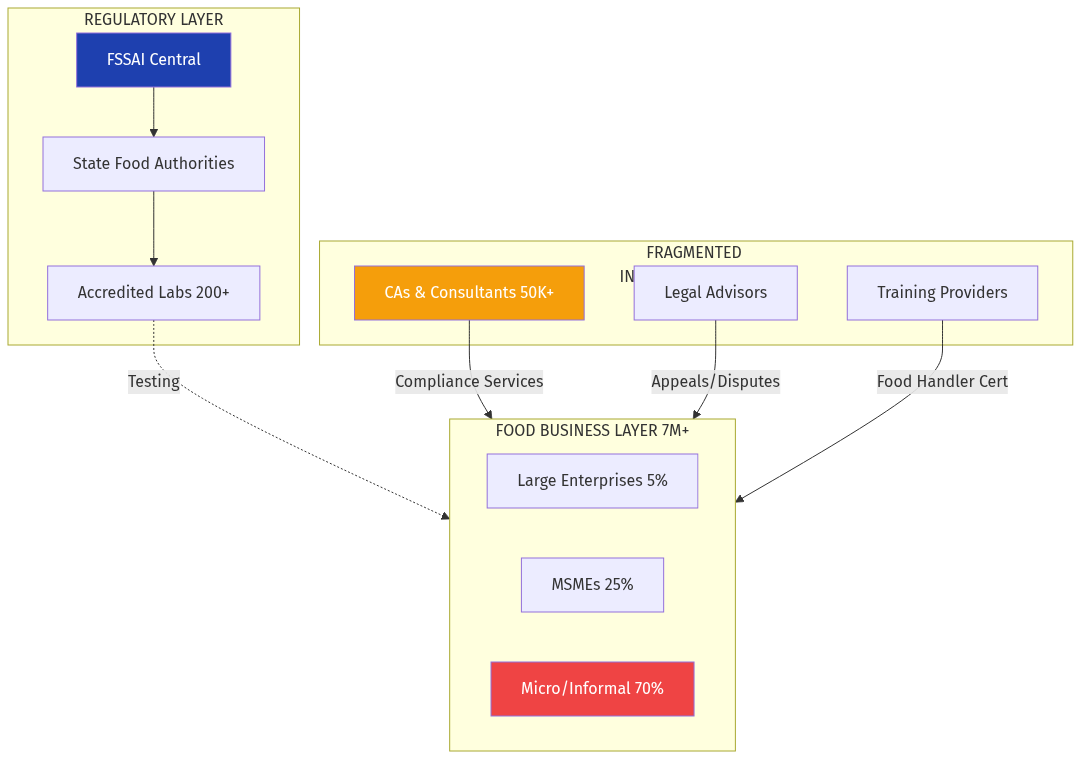
- Structured data on 7M+ food businesses = unprecedented B2B intelligence
- Natural expansion to related compliance (health, fire, local permits)
Potential Domain Assets
- fssai.in (if available) — Ultimate regulatory vertical domain
- foodcompliance.in — Generic but defensible
- foodlicense.in — Direct, transactional
Cross-Vertical Synergies
| masale.in (Ingredient sourcing) | Compliance requirements for ingredient suppliers |
| thefoundry.in (Industrial procurement) | Food processing equipment with compliance bundles |
| niyukti.in (Recruitment) | Food handler certification verification |
| challan.in (Payments) | License fee payments, penalty management |
Data Contribution
FoodCompliance.ai would contribute:
- Business verification signals (licensed vs. unlicensed)
- Food category taxonomies
- Geographic compliance density maps
- Regulatory change intelligence
---
## Mental Model Analysis
Falsification (Pre-Mortem): Why Would This Fail?
Government builds it themselves. FSSAI could improve FoSCoS to make third-party tools obsolete.
-
Counter: Government moves slowly; opportunity window is 3-5 years minimum.
Horizontal players add FSSAI features. ClearTax or Zoho could build this.
-
Counter: Depth beats breadth. Horizontal players won't invest in FSSAI-specific AI.
Consultants resist adoption. They could refuse to use technology that threatens their model.
-
Counter: Enable, don't replace. White-label approach creates allies, not enemies.
Compliance enforcement remains lax. If FSSAI doesn't enforce, businesses won't pay.
-
Counter: Enforcement is increasing; e-commerce platforms require compliance proof.
Unit economics don't work for micro-businesses. Street vendors can't pay ₹999/month.
-
Counter: Focus on SME segment first; micro-business tier can be ad-supported or transaction-based.
Steelmanning: Why Might Incumbents Win?
Best case for IndiaFilings/Vakilsearch:
- They have existing customer bases in the millions
- Brand trust established over a decade
- Distribution through SEO and partnerships
- Financial resources to acquire or build quickly
Why they probably won't:
- Their business models are human-mediated (lawyers, CAs)—AI threatens margins
- FSSAI is <5% of revenue; no incentive to verticalize
- Organizational DNA is generalist, not specialist
Second-Order Effects
If FoodCompliance.ai succeeds:
Formalization accelerates. Millions of informal food businesses become visible to the formal economy. Food safety improves. Compliance correlated with better practices = public health benefit. Data ecosystem emerges. Government can use aggregated data for policy; insurers can price risk better. Regulatory tech template. Same playbook applies to GST, labor law, environmental compliance.
## Verdict
Opportunity Score: 8.5/10
Strengths
- Massive TAM (₹8,000+ crore) in an underserved vertical
- Clear AI disruption angle with measurable efficiency gains
- Strong data moat potential through regulatory expertise
- Multiple revenue streams beyond SaaS
- Perfect fit for AIM.in ecosystem expansion
Risks
- Government portal improvements could commoditize basic features
- Long sales cycles with conservative food business owners
- Need for RPA/API integrations with government systems
Recommendation
BUILD THIS. The food safety compliance market is large, fragmented, and technically solvable. AI agents can deliver 10x improvement over current consultant-mediated processes. The perpetual license change (2021) created a perfect moment—recurring compliance touchpoints that justify recurring software revenue.
Start with cloud kitchens (tech-savvy, multi-license), expand to restaurant chains (high-value contracts), then enable the consultant ecosystem (distribution leverage). Within 3 years, this could be a ₹100 crore ARR business with defensible data moats.
The mental model analysis reveals one critical insight: The real opportunity isn't compliance automation—it's compliance intelligence. The platform that understands the relationship between business type, location, cuisine, and regulatory requirements becomes indispensable. That's not a feature; that's a moat.
## Sources
Research by Netrika Menon | AIM.in Research Division
Published on dives.in — B2B Intelligence for Indian Markets