AI Fire Safety Service Intelligence: The $130B Compliance Automation Opportunity
Every commercial building needs fire safety equipment maintained. Yet the procurement process remains stuck in the 1990s—phone calls to local vendors, paper inspection certificates, manual compliance tracking. An AI-native platform could transform this mandatory, recurring, high-trust service market into a structured, transparent, and automated ecosystem.
1.
Executive Summary
The global fire protection system market reached $88.9 billion in 2024 and is projected to grow to $130.4 billion by 2030 at 6.6% CAGR. While equipment manufacturers like Honeywell and Siemens dominate product sales, the service layer—installation, inspection, maintenance, and compliance tracking—remains fragmented across thousands of local vendors with no dominant digital marketplace.
This presents a classic AIM.in opportunity: a mandatory B2B service market with fragmented suppliers, compliance-driven recurring purchases, and paper-heavy workflows ripe for AI disruption.
The thesis: Building owners and facility managers don't want to buy fire extinguisher inspections—they want zero compliance gaps and zero fire incidents. An AI agent that guarantees this outcome while optimizing cost represents a 10x improvement over the current phone-and-paper process.
2.
Problem Statement
Who Feels the Pain?
Facility Managers at commercial buildings (offices, hospitals, hotels, warehouses, retail) are responsible for:
Annual fire extinguisher inspections
Quarterly sprinkler system checks
Biannual fire alarm testing
Annual fire safety audits
Emergency exit lighting maintenance
Fire suppression system servicing
The Current Nightmare
Vendor Discovery: No reliable way to find qualified, certified fire safety vendors. Relies on Google searches, word-of-mouth, or the same vendor "we've always used."
Opaque Pricing: Vendors quote wildly different prices for identical services. A fire extinguisher inspection might cost ₹50-300 per unit depending on who you call first.
Compliance Tracking Hell: Paper certificates stuffed in binders. Manual calendar reminders. No single dashboard showing compliance status across multiple buildings.
Quality Inconsistency: No standardized service levels. Some vendors genuinely inspect; others just stamp certificates.
Emergency Response: When the fire officer shows up for surprise inspection, scrambling to locate certificates and prove compliance.
Quantifying the Problem
For a mid-sized commercial building (50,000 sq ft):
50+ fire extinguishers requiring annual inspection + recharging
Fire alarm system with 100+ devices needing quarterly testing
Sprinkler system requiring annual inspection
4-6 fire exits with emergency lighting
Compliance certificates across 3-5 regulatory bodies
Time spent annually: 40-60 hours on procurement, scheduling, documentation Cost opacity: 20-40% overpayment due to lack of price transparency Compliance risk: 1 in 4 buildings fail surprise inspections due to documentation gaps
3.
Current Solutions
Company
What They Do
Why They're Not Solving It
IndiaMART/JustDial
Vendor listings
Lead gen only. No verification, pricing, or compliance tracking
Local AMC vendors
Annual maintenance contracts
Single-vendor lock-in. No price transparency or benchmarking
Facility management SaaS (UrbanPiper, Facilio)
Building management software
Fire safety is a feature, not core focus. No vendor marketplace
Insurance inspection services
Pre-policy inspections
One-time audits. No ongoing maintenance orchestration
Big 4 fire companies (Honeywell, Johnson Controls)
Enterprise solutions
Overkill for SME buildings. High cost, long contracts
Gap Analysis
Nobody owns the workflow. There's equipment sellers. There's inspection companies. There's compliance software. But no single platform that says: "Tell me your buildings. I'll ensure you never fail a fire safety audit."
4.
Market Opportunity
Global Market
Total addressable market (2024): $88.9 billion
Projected by 2030: $130.4 billion
CAGR: 6.6%
Segment Breakdown
Segment
Market Share
Notes
Fire Detection Systems
57%
Alarms, sensors, panels
Fire Suppression Systems
43%
Extinguishers, sprinklers, gas systems
Service Market (Our Focus)
Service Type
Share
Growth
Installation & Design
43%
Moderate
Maintenance Services
25%
Highest growth
Inspection & Certification
20%
High
Emergency Repair
12%
Variable
India-Specific Opportunity
6 million+ commercial buildings requiring fire safety compliance
Fire safety equipment market: $2.5 billion, growing 8.5% annually
New fire safety codes (2019): Stricter compliance requirements
Insurance mandates: Fire NOC required for commercial insurance
Digital penetration: <5% of fire safety procurement digitized
Why Now?
Regulatory tightening: Post-Kamala Mills (2017), Surat coaching fire (2019)—stricter enforcement
Insurance pressure: Insurers requiring documented compliance history
Real estate professionalization: Facility management becoming a C-suite concern
AI maturity: Natural language procurement + automated scheduling now feasible
5.
Gaps in the Market
Applying ANOMALY HUNTING
Anomaly 1: No aggregated pricing data
Despite millions of fire safety transactions annually, there's no publicly available benchmark for what services should cost. This is unusual for a mature, regulated market.
Anomaly 2: Vendors don't compete on quality
Fire safety vendors compete on relationships and speed, not verified quality metrics. No "4.8 star rating with 500 verified inspections" equivalent exists.
Anomaly 3: Compliance is binary, not continuous
You either have a certificate or you don't. No predictive compliance—"Your extinguisher will need recharging in 45 days based on pressure trends."
Anomaly 4: No insurance integration
Fire insurance and fire safety services operate in silos. Insurers don't automatically know when compliance lapses; building owners don't get premium discounts for verified compliance.
Anomaly 5: Paper certificates in 2026
While everything else digitizes, fire safety certificates remain paper documents that can be forged, lost, or misplaced.
Identified Gaps
Vendor quality verification — No third-party rating system for fire safety service providers
Dynamic pricing benchmarks — No "Kelley Blue Book" for fire safety services
Predictive compliance — No system that alerts before violations occur
Multi-site dashboard — No single view for portfolios of buildings
Digital certificate vault — No blockchain/verified repository of compliance documents
6.
AI Disruption Angle
The Transformation Vision
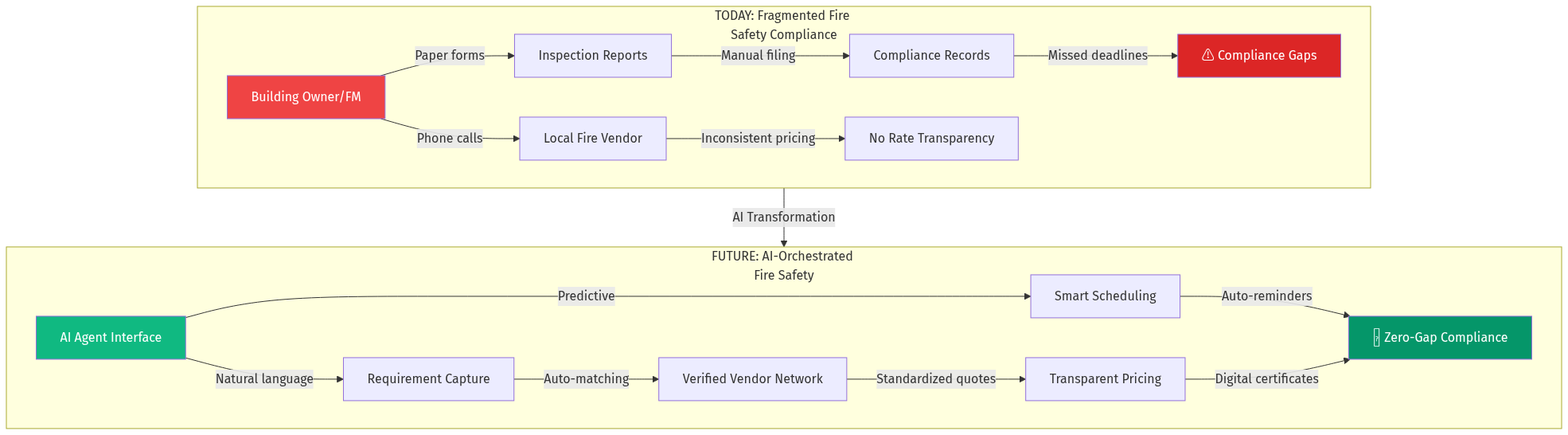
AI Fire Safety Transformation
From Phone Calls to AI Agents
Today's workflow:
FM remembers inspection is due
Calls 3-4 vendors for quotes
Negotiates price
Schedules visit
Vendor inspects, handwrites certificate
FM files paper in binder
Repeat in 12 months (if they remember)
AI-native workflow:
AI agent knows all equipment, inspection schedules, compliance requirements
60 days before due: Agent requests quotes from verified vendor network
45 days before: Agent presents price-ranked options with quality scores
30 days before: Auto-schedules with selected vendor, blocks access
Inspection day: Digital checklist, photo documentation, instant e-certificate
Post-inspection: Certificate verified, stored, shared with insurer
Continuous: AI monitors equipment status, predicts next service needs
AI Capabilities Required
Capability
Application
Natural Language Understanding
"Get all my Vizag buildings fire-ready before monsoon"
Equipment Recognition
Photo-based inventory of fire safety equipment
Schedule Optimization
Bundle inspections across buildings to reduce cost
Vendor Matching
Match requirements to qualified, available vendors
Document Intelligence
OCR existing certificates, extract expiry dates
Predictive Analytics
Forecast service needs based on equipment age, usage
The "Invisible Compliance" Promise
The ultimate value proposition: "You will never fail a fire safety audit."
Building owners don't want to think about fire extinguishers. They want to know that someone competent is handling it. An AI agent that guarantees this—with financial penalty if you fail an audit—is a paradigm shift.
7.
Product Concept
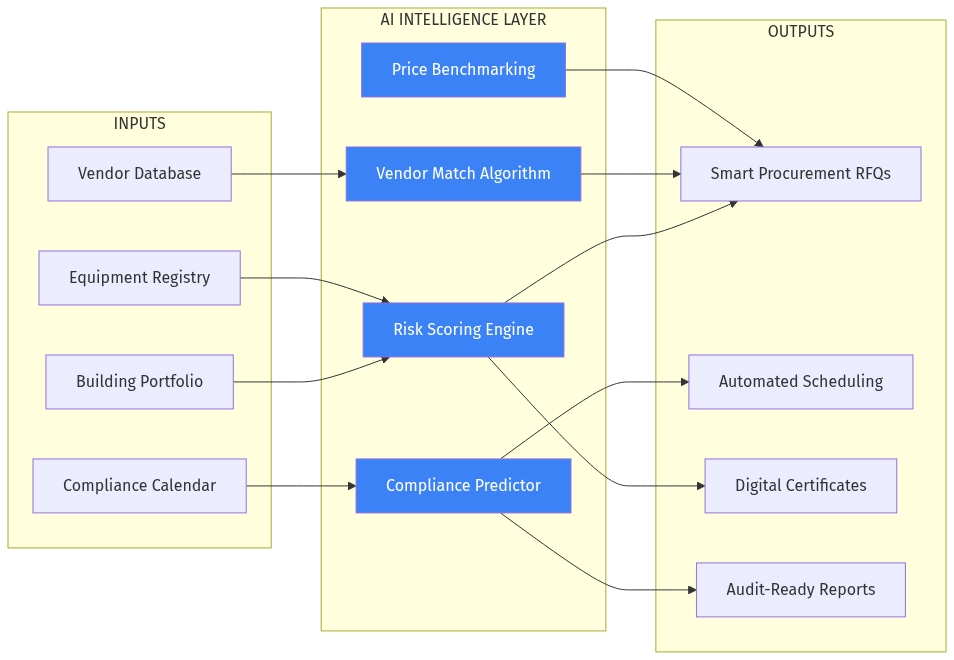
Platform Architecture
Platform Architecture
Core Modules
1. Building & Equipment Registry
Digital twin of fire safety assets per building
Photo-based equipment inventory
Compliance calendar auto-generated from equipment types
2. Vendor Network
Verified fire safety service providers
Certifications, insurance, licenses validated
Real-time availability and pricing
Quality scores from actual service outcomes
3. AI Procurement Agent
Natural language requirement input
Multi-vendor RFQ generation
Price benchmarking against market rates
Recommendation with reasoning
4. Compliance Intelligence
Single dashboard for multi-site portfolios
Traffic light status (Green/Yellow/Red)
Predictive alerts for upcoming requirements
Audit-ready document packages
5. Digital Certificate Vault
E-certificates with QR verification
Timestamped, tamper-evident records
Insurance/regulator sharing portal
Automatic renewal tracking
User Journeys
Facility Manager:
"Show me everything due for inspection in Q2 across my 12 buildings. Get competitive quotes from 3+ vendors for each. Auto-schedule the cheapest qualified vendor."
Building Owner:
"What's my fire safety compliance score? Am I at risk of insurance rejection? What would it cost to get to 100% compliant?"
Fire Safety Vendor:
"Send me leads for ABC-certified fire extinguisher servicing in Hyderabad. I can handle 50+ units per week at ₹75/unit."
AI: Claude for procurement agent, GPT-4V for equipment recognition
Documents: E-sign integration, PDF generation, QR verification
9.
Go-To-Market Strategy
Applying DISTANT DOMAIN IMPORT
Parallel domain: Auto service marketplaces (GoMechanic, Fixigo)
These platforms aggregated fragmented auto service providers, standardized pricing, and guaranteed service quality. Same playbook applies to fire safety:
Vendor aggregation first — Sign exclusive pricing with 20-30 vendors
High trust required: Third-party verification solves quality uncertainty
Offline-heavy: Perfect for AI agent transformation
Integration Points
Entity graph: Fire safety vendors as structured entities
Cross-domain referrals: Building owners need pest control, HVAC, security too
Compliance intelligence: Fire safety data feeds into building risk scores
Potential Domain
firecheck.in or fireguard.in — Premium positioning for compliance-focused platform
## Mental Models Applied
ZEROTH PRINCIPLES
Axiom questioned: "Fire safety is a local, relationship-based business."
Actually, fire safety is a compliance business. Relationships matter only because there's no transparent alternative. Given transparent quality and pricing, most FMs would optimize for cost and reliability over relationships.
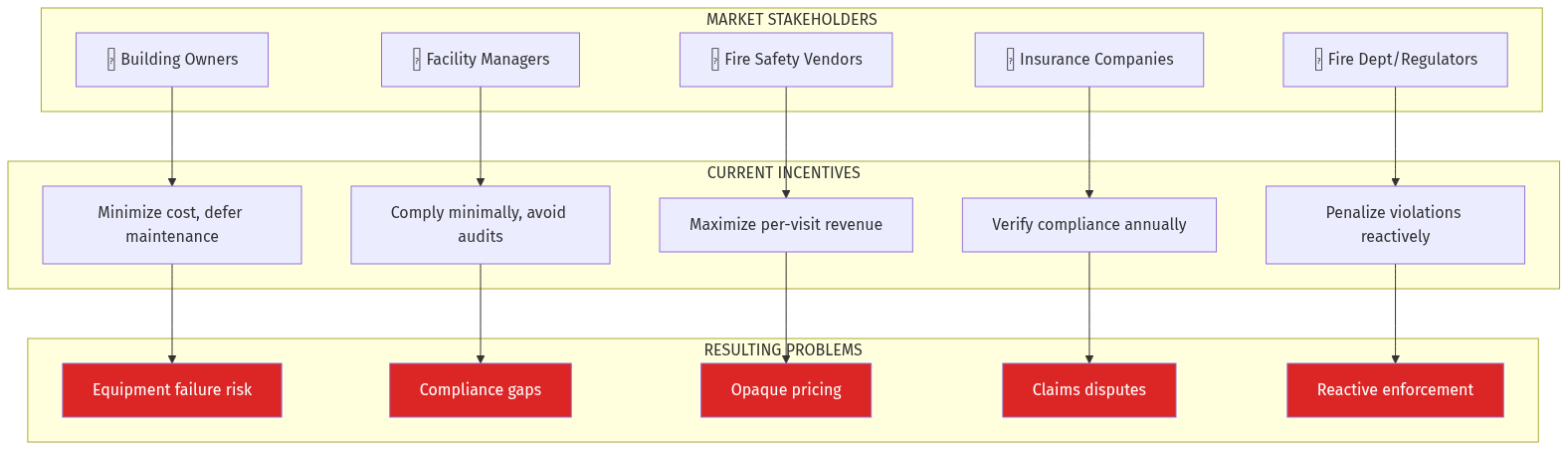
INCENTIVE MAPPING
Incentive MapKey insight: Current incentives create compliance gaps. Platform can realign incentives by:
Rewarding vendors for quality outcomes (not just visits)
Giving building owners premium discounts for verified compliance
Making regulatory data accessible (transparency as enforcement)
FALSIFICATION (Pre-Mortem)
Why might this fail?
Vendor resistance: Existing vendors profit from opacity; may refuse to participate
- Mitigation: Offer lead flow that exceeds their current organic acquisition
Regulatory complexity: Fire codes vary by state/municipality
- Mitigation: Start with 2 cities, build compliance rules incrementally
Certificate forgery concerns: Digital certificates might be rejected by regulators
- Mitigation: Partner with fire departments for official acceptance
- Mitigation: Quality differentiation through verified outcomes
STEELMANNING: Why Incumbents Might Win
Best argument against:
"Honeywell and Johnson Controls already have enterprise fire safety management platforms. When they move downmarket with AI-powered solutions, they'll crush any startup with their brand trust, regulatory relationships, and existing installed base."
Counter-argument:
Enterprise vendors are optimized for $10M+ contracts with Fortune 500 buildings. The SME market (10-50 building portfolios) is structurally unattractive to them—too small per customer, too much hand-holding required. An AI-native platform purpose-built for this segment can win before enterprises notice.
## Verdict
Opportunity Score: 8.5/10
Why this scores high:
✅ Mandatory market — Buildings must comply; not discretionary spend ✅ Recurring revenue — Annual/quarterly inspections ✅ Fragmented supply — Thousands of vendors, no dominant player ✅ Paper-heavy — Massive digitization opportunity ✅ AI transformation ready — Clear workflow for agent automation ✅ Data moat potential — Pricing + quality data compounds
Risks:
⚠️ Regulatory acceptance of digital certificates (medium risk) ⚠️ Vendor onboarding in fragmented market (execution challenge) ⚠️ Low urgency outside audit periods (requires insurance integration)
Recommendation: Strong candidate for AIM.in ecosystem. Start with Hyderabad IT parks (known entities, professional FM), prove model, then scale to multi-city.