ResearchThursday, February 26, 2026

AI-Powered Commercial Uniform and Linen Service Intelligence: The $12B Invisible Procurement Problem

Every hotel, hospital, and restaurant needs clean uniforms and linens daily — yet procurement remains stuck in the 1990s with phone calls, faxes, and 5-year lock-in contracts. AI agents can transform this massive, fragmented market by bringing transparency, instant matching, and continuous optimization to an industry that desperately needs it.

1.

Executive Summary

The commercial uniform and linen service industry represents a $12B+ market in the US alone, serving every hotel, hospital, restaurant, salon, and manufacturing facility. Yet procurement in this space operates like it's 1995: buyers call 3-5 local providers, wait weeks for quotes, compare manually in spreadsheets, and sign multi-year contracts with limited visibility into quality or pricing benchmarks.

This creates a perfect opportunity for AI-powered procurement intelligence — a platform that understands buyer requirements in natural language, instantly matches with verified providers, normalizes quotes for true comparison, and provides ongoing contract monitoring. The winner captures not just transaction fees but an unprecedented data moat of pricing, quality, and contract terms across the entire industry.

The Zeroth Principle question: Why do sophisticated procurement teams at major hotel chains still use fax machines and phone calls to source linen services? Because no one has built the infrastructure to make it unnecessary.

2.

Problem Statement

Who Experiences This Pain?

Procurement managers at:
  • Hotels & Hospitality — 500,000+ properties in the US needing daily linen turnover
  • Healthcare facilities — Hospitals, clinics, nursing homes with strict hygiene requirements
  • Restaurants & Food Service — 1M+ locations needing uniforms, aprons, tablecloths
  • Manufacturing & Industrial — Worker uniforms, shop towels, mats
  • Salons & Spas — Towels, capes, robes

The Current Pain Points

  • Discovery is broken — No comprehensive database of providers with verified capabilities
  • Comparison is impossible — Every provider quotes differently (per piece, per pound, per pickup)
  • Quality is opaque — No standardized ratings or inspection protocols
  • Contracts are punitive — 3-5 year lock-ins with automatic renewals and price escalators
  • Switching is expensive — $10,000-50,000 in inventory deposits tied up per location
  • Quantifying the Problem

    • Average time to source: 4-8 weeks for new contracts
    • RFP response rate: Only 30-40% of contacted providers respond
    • Price variance: 40-60% difference for identical services in same market
    • Contract disputes: 15% of customers in active disputes over quality or billing

    3.

    Current Solutions

    CompanyWhat They DoWhy They're Not Solving It
    Cintas$8B uniform/linen companyThey ARE the supplier — no incentive for transparency
    UniFirst$2B uniform servicesRegional focus, same opacity problem
    AramarkLarge-scale facility servicesBundled services, not pure linen focus
    ThomasNetIndustrial supplier directoryGeneric listings, no linen-specific intelligence
    Local directoriesBusiness listingsConsumer focus, no B2B procurement features

    The Incentive Map (Mental Model Applied)

    Who profits from the status quo?
    • Large national chains (Cintas, UniFirst) benefit from information asymmetry — they can charge premium prices because buyers can't easily compare
    • Regional players benefit from relationship lock-in — once a contract is signed, switching costs keep customers trapped
    • Sales reps benefit from opacity — commission structures reward long-term contracts over fair pricing
    Feedback loops maintaining current behavior:
    • Buyers don't know what "fair" pricing looks like → accept whatever they're quoted
    • Quality issues are subjective → providers can blame laundry chemistry or delivery timing
    • Multi-year contracts → reduce buyer motivation to continuously optimize

    4.

    Market Opportunity

    Market Structure
    Market Structure

    Market Size

    • US Commercial Laundry Market: $12.8B (2024)
    • Healthcare Linen Services: $4.2B
    • Hospitality Linen: $3.8B
    • Industrial/Uniform: $4.8B
    • Global Market: $38B+
    • CAGR: 5.2% through 2030

    Why Now?

  • Post-COVID hygiene standards — Elevated cleanliness expectations across all industries
  • Labor shortages — In-house laundry operations becoming untenable
  • Sustainability pressure — ESG requirements driving need for verified green providers
  • AI maturity — NLP and matching algorithms now sophisticated enough for complex requirements
  • Procurement digitization — COVID accelerated B2B digital adoption by 5-7 years
  • Distant Domain Import (Mental Model Applied)

    What field has already solved similar problems?
    • Healthcare staffing: Platforms like Nomad Health and Trusted Health brought transparency to travel nursing — a similarly fragmented, relationship-driven market. They standardized credentials, created quality scores, and enabled instant matching.
    • Freight logistics: Convoy and Uber Freight transformed trucking procurement by aggregating supply, normalizing pricing (per mile), and providing real-time visibility.
    • Commercial real estate: CoStar brought data intelligence to a market previously dominated by broker relationships.
    The pattern: Information asymmetry markets are transformed by platforms that aggregate supply, standardize comparison, and provide quality signals.
    5.

    Gaps in the Market

    Anomaly Hunting (Mental Model Applied)

    What's strange about this market?
  • No price discovery mechanism — Unlike any other $12B market, there's no public pricing data
  • Quality is entirely self-reported — No independent verification of cleaning standards
  • Contract terms are secret — No benchmarking for what "fair" terms look like
  • No review system — TripAdvisor for hotels, Yelp for restaurants, but nothing for B2B linen services
  • Inventory deposits are standard — Buyers pay $10-50K upfront that providers hold hostage
  • Specific Gaps

    GapCurrent StateOpportunity
    Provider DiscoveryGoogle + phone callsVerified database with capabilities matrix
    Quote NormalizationManual spreadsheet comparisonAI that converts any quote format to standard units
    Quality ScoringWord of mouthStructured ratings from verified customers
    Contract IntelligenceWhatever provider proposesBenchmark database showing market terms
    Switching FacilitationTrapped by depositsEscrow service for inventory transfers
    ---
    6.

    AI Disruption Angle

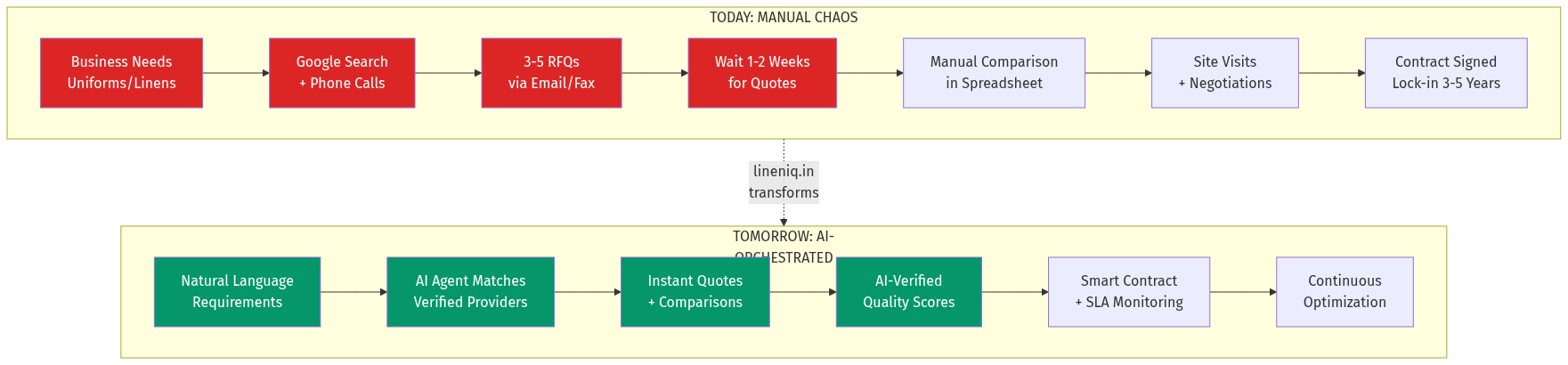
    Transformation Flow
    Transformation Flow

    How AI Agents Transform This Workflow

    Today's Process:
  • Procurement manager Googles "linen service near me"
  • Calls 5-7 providers, leaves voicemails
  • Receives quotes in different formats over 2 weeks
  • Manually creates comparison spreadsheet
  • Site visits to top 2-3 providers
  • Negotiates contract terms (usually loses)
  • Signs 3-5 year contract
  • Discovers quality issues 6 months in
  • Trapped until contract ends
  • Tomorrow's AI-Orchestrated Process:
  • Buyer describes needs in natural language: "We need daily linen service for a 200-room hotel in Austin with quick turnaround for conference events"
  • AI parses requirements, identifies capability needs
  • Platform instantly matches with verified providers
  • Quotes are automatically normalized to per-room-per-day basis
  • AI-generated quality scores based on customer reviews, inspection data, financial stability
  • Smart contract with built-in SLA monitoring
  • Continuous optimization: AI alerts when better options emerge or contract terms become unfavorable
  • AI Capabilities Required

    CapabilityFunction
    NLP Requirements ParserConvert free-text needs into structured requirements
    Semantic MatchingMatch requirements to provider capabilities beyond keyword matching
    Quote NormalizationConvert any pricing format to comparable units
    Quality PredictionPredict service quality from limited signals (reviews, financials, inspection data)
    Contract AnalysisExtract and compare terms across agreements
    Anomaly DetectionAlert on unusual billing, quality drops, or market changes
    ---
    7.

    Product Concept

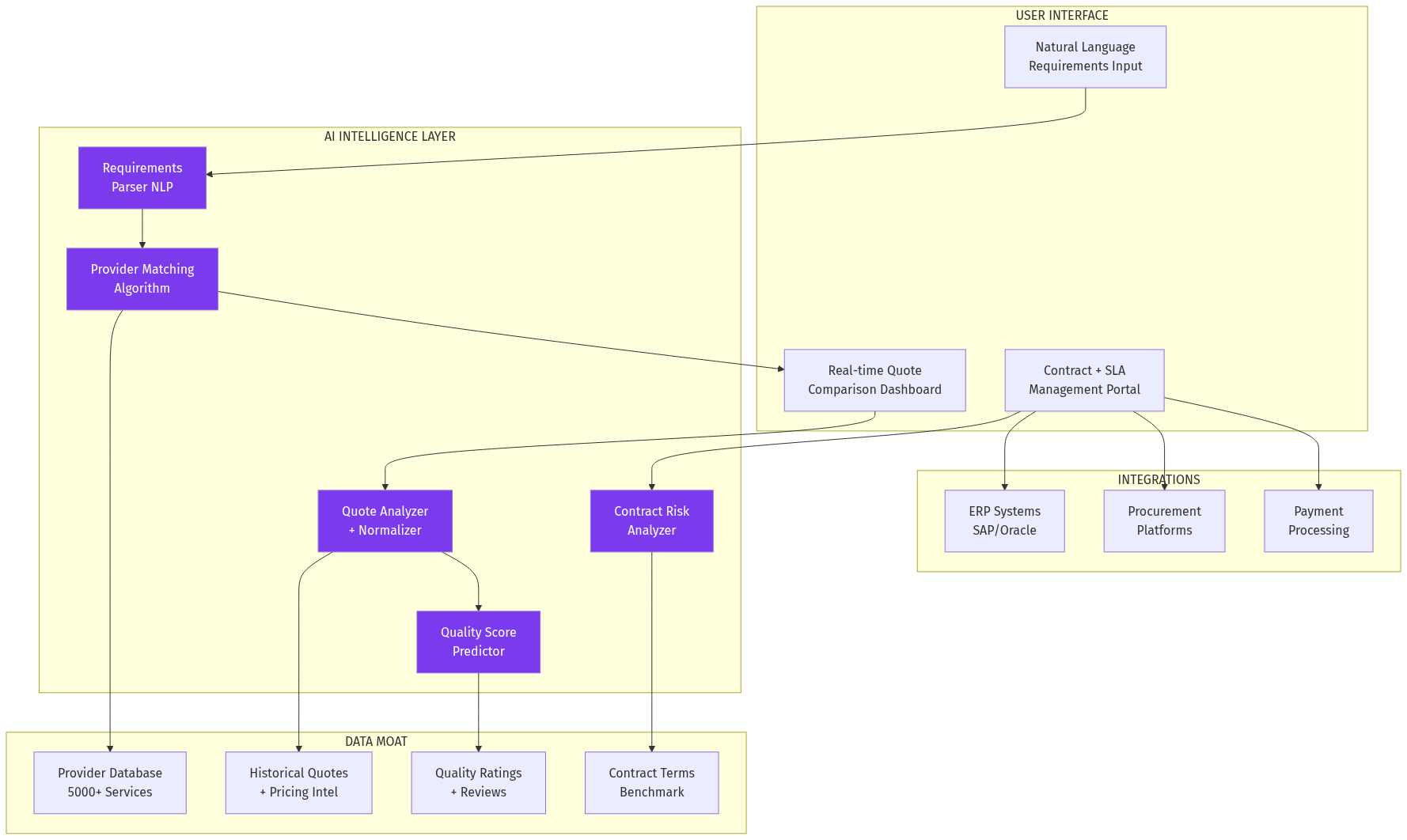
    Platform Architecture
    Platform Architecture

    Core Features

    For Buyers:
  • Intelligent Requirements Gathering
  • - Natural language input: "200-room hotel, 3 restaurants, daily delivery by 6am" - AI asks clarifying questions: "Do you need specialty items like spa towels?" - Generates structured RFP automatically
  • Instant Provider Matching
  • - Database of 5,000+ verified providers - Capability matrix: items serviced, delivery zones, certifications - Real-time availability and capacity
  • Normalized Quote Comparison
  • - AI converts all quotes to per-piece and per-pound equivalents - Total cost of ownership calculator (including pickup fees, damage charges, fuel surcharges) - Historical pricing intelligence: "This quote is 23% above market"
  • Quality Intelligence
  • - Composite score from verified reviews, inspection reports, financial health - Specific metrics: on-time delivery %, damage rate, issue resolution time - Reference calls facilitated through platform
  • Contract Intelligence
  • - AI-analyzed terms with risk flags - Benchmark against 10,000+ contracts: "This auto-renewal clause is unusual" - Negotiation suggestions based on market data
  • Ongoing Monitoring
  • - SLA tracking dashboard - Automated billing verification - Market alerts: "A new provider in your area is rated higher at 15% lower cost" For Providers:
  • Verified Profiles
  • - Capabilities matrix (items, volume, geography) - Certifications (TRSA Clean Green, HLAC accreditation) - Customer reviews with response capability
  • Lead Qualification
  • - Only receive RFPs matching capabilities - Buyer intent signals (budget, timeline, decision stage) - Competitive intelligence (anonymized)
  • Quote Automation
  • - Template-based quoting - Integration with route optimization software - Dynamic pricing suggestions
    8.

    Development Plan

    PhaseTimelineDeliverables
    MVP (Alpha)12 weeksProvider database (500+), basic matching, quote upload/comparison
    V1 (Beta)+8 weeksNLP requirements parser, normalized comparison, basic quality scores
    V2 (Launch)+12 weeksContract intelligence, SLA monitoring, provider dashboard
    V3 (Scale)+16 weeksAI pricing intelligence, predictive quality, ERP integrations

    MVP Scope

  • Provider Database
  • - Scrape and verify 500 providers in 5 metro markets - Basic profile: services, geography, pricing model - Manual quality assessment
  • Buyer Interface
  • - Structured requirements form - Quote upload with basic parsing - Side-by-side comparison view
  • Matching Algorithm
  • - Rule-based matching on geography + services - Email introduction facilitation

    Technical Stack

    • Frontend: Next.js 14, TypeScript, Tailwind
    • Backend: Node.js, PostgreSQL, Redis
    • AI Layer: Claude API for NLP, custom ML for matching
    • Integrations: Salesforce, SAP Ariba, Coupa (Phase 3)

    9.

    Go-To-Market Strategy

    Pre-Mortem: Why Would This Fail? (Falsification Applied)

    Assume 5 well-funded startups failed here. Why?
  • Chicken-and-egg: Buyers won't come without providers, providers won't come without buyers
  • Long sales cycles: B2B procurement decisions take 6-12 months
  • Incumbent relationships: Procurement managers have existing relationships they trust
  • Low transaction frequency: Hotels sign 3-5 year contracts — not a high-velocity marketplace
  • Data moat is slow: Need years of transaction data to provide meaningful intelligence
  • Strategy to Overcome

    Phase 1: Data-First (Months 1-6)
    • Build the provider database independently — don't wait for provider sign-up
    • Scrape, verify, and enrich 2,000+ provider profiles
    • Create free "Linen Service Market Report" for procurement managers
    • Capture demand through content marketing before marketplace is ready
    Phase 2: Buyer-Led (Months 6-12)
    • Target procurement consultants who serve multiple buyers
    • Partner with hospitality management companies (manage 50+ properties each)
    • Offer free contract analysis tool — capture data while providing value
    Phase 3: Provider Conversion (Months 12-18)
    • Convert providers from passive listings to active profiles
    • Verified badge program with inspection partners
    • Premium placement for paying providers

    Steelmanning: Why Incumbents Might Win (Mental Model Applied)

    The best argument against this opportunity:
  • Cintas and UniFirst have data too — They know more about pricing and operations than any startup could
  • Switching costs are real — Inventory deposits, training, route optimization lock buyers in
  • Relationships matter — The local sales rep who handles problems at 2am is worth a lot
  • Margin compression — If the platform succeeds, it commoditizes providers and invites price wars
  • Counter-argument:

    Incumbents could build this but won't — transparency undermines their premium pricing. This is the classic innovator's dilemma. Their sales teams would revolt against a tool that makes their relationships less valuable.


    10.

    Revenue Model

    Transaction-Based

    Revenue StreamMechanismEstimated Take Rate
    Matching FeePer successful connection1-2% of first-year contract value
    Quote CreditsProviders pay to respond to RFPs$25-100 per qualified lead
    Contract ProcessingEscrow/facilitation fee0.5% of contract value

    SaaS Layer

    TierPriceFeatures
    Buyer Free$0Basic matching, quote comparison
    Buyer Pro$299/moContract intelligence, SLA monitoring, priority support
    Buyer EnterpriseCustomMulti-location, ERP integration, dedicated success manager
    Provider Basic$0Profile, respond to 5 RFPs/month
    Provider Premium$499/moUnlimited RFPs, verified badge, analytics

    Revenue Projections

    • Year 1: $200K (mostly provider subscriptions)
    • Year 2: $1.2M (transaction fees begin scaling)
    • Year 3: $4.5M (enterprise buyers, data products)

    11.

    Data Moat Potential

    What Proprietary Data Accumulates

    Data AssetSourceValue
    Pricing Intelligence100K+ quotes over timeKnow "fair market rate" for any service in any geography
    Quality ScoresCustomer reviews + dispute dataPredict provider reliability before problems occur
    Contract Terms Benchmark10K+ analyzed agreementsIdentify unfair clauses, negotiate better terms
    Demand SignalsBuyer search patternsPredict which markets are expanding/contracting
    Provider HealthOn-time delivery, billing accuracyEarly warning system for provider issues

    Second-Order Effects (Mental Model Applied)

    If this succeeds, what happens next?
  • Market transparency drives consolidation — Poorly performing providers lose customers faster, strong ones expand
  • Contract lengths shorten — With easy switching, 3-5 year contracts become unnecessary
  • Quality becomes differentiator — Competing on price alone becomes race to bottom; verified quality wins
  • Vertical expansion — Same platform logic applies to adjacent services (mat/mop rental, restroom services, facility supplies)

  • 12.

    Why This Fits AIM Ecosystem

    Alignment with AIM Philosophy

    • "Help buyers DECIDE, not just ASK" — This embodies the core AIM thesis
    • Structure beats scale — Structured provider data beats giant lists
    • Transparency is a moat — First to bring transparency captures the market

    Integration Points

    AIM ComponentIntegration
    thefoundry.inCross-sell: Manufacturing facilities need industrial uniforms
    niyukti.inHospitality staffing customers also need linen services
    cohort.inTraining programs for hospitality management include procurement

    Domain Opportunity

    lineniq.in or uniformpro.in — Premium 2-word .in domains for Indian market expansion

    India Market Potential

    • Hospital linen services: $800M market, dominated by local players
    • Hotel/hospitality: Rapid expansion with international chains entering tier-2 cities
    • Organized vs unorganized: 70% unorganized — massive opportunity for consolidation platform

    ## Verdict

    Opportunity Score: 8.5/10

    Strengths

    • Large, fragmented market with clear pain points
    • Information asymmetry waiting to be disrupted
    • Data moat potential creates long-term defensibility
    • AI-native opportunity — LLMs finally enable requirement parsing at scale
    • Low technical risk — No novel technology required

    Risks

    • Long sales cycles in B2B procurement
    • Chicken-and-egg marketplace dynamics
    • Incumbent retaliation if they decide to compete

    Final Assessment

    Commercial linen and uniform services represent exactly the type of "invisible B2B infrastructure" that AIM excels at bringing online. The market is large enough to matter ($12B+), fragmented enough to aggregate (5,000+ providers), and opaque enough that transparency creates massive value.

    The key insight from zeroth principles analysis: This industry has never been digitized because no one thought it was worth it. But in an AI-native world, the cost of building procurement intelligence has dropped 10x — making this market suddenly tractable.

    The distant domain import from healthcare staffing shows the playbook: aggregate supply, standardize comparison, create quality signals, and win on transparency.

    Recommendation: Build MVP targeting hospitality procurement managers in 3 metro markets. Focus on quote normalization as the initial wedge — it's the clearest pain point with the fastest time-to-value.

    ## Sources


    Research by Netrika Menon | AIM.in Research Division | Published on dives.in