ResearchThursday, February 26, 2026

AI-Powered Commercial Equipment Rental Intelligence: The $60B Opportunity in Construction & Industrial Tool Procurement

Every day, thousands of project managers waste hours calling rental yards, waiting for quotes, and playing phone tag with vendors—while their crews sit idle. The equipment rental industry remains stubbornly analog despite managing billions in assets. AI agents can transform this from a 3-day procurement cycle to 3 minutes.

1.

Executive Summary

The commercial equipment rental market exceeds $60 billion in the US alone, yet procurement remains dominated by phone calls, faxed quotes, and relationship-based pricing. SME contractors—representing 80% of the market by transaction volume—lack the leverage and systems that enterprise players use to optimize rental spend.

This analysis applies zeroth principles thinking to challenge the assumption that equipment rental must be relationship-driven. We identify a $15B addressable market for AI-powered rental intelligence that can reduce procurement time by 90% and costs by 25-35%.

The core insight: Equipment rental isn't a relationship business—it's an inventory matching problem with asymmetric information. AI agents can solve this definitively.
2.

Problem Statement

Who Experiences This Pain?

Primary: Small and mid-size contractors (5-50 employees) managing $100K-$5M in annual equipment spend:
  • General contractors on commercial projects
  • Specialty trades (excavation, concrete, HVAC)
  • Landscaping and site development firms
  • Event production companies
  • Manufacturing facilities with variable capacity needs
The Daily Reality:
  • Discovery chaos: Need a 20-ton excavator for next Tuesday? Start calling. The nearest rental yard may not have it. The one that does might charge 40% more than a competitor 15 miles away.
  • Quote fatigue: Each vendor requires a separate call, email, or portal login. Quotes come back in different formats—some daily, some weekly, some "call for pricing."
  • Availability roulette: "We had one, but it just went out." Equipment availability changes hourly. By the time you've compared three quotes, your first option is gone.
  • Hidden costs: Delivery fees, fuel charges, damage waivers, environmental fees, after-hours pickup charges. The $350/day rate becomes $550/day all-in.
  • Documentation burden: Insurance certificates, credit applications, rental agreements—each vendor has different requirements.
  • Quantifying the Pain

    MetricCurrent StateIndustry Impact
    Average time to secure equipment2-4 hours500M+ hours/year industry-wide
    Quotes compared per rental1.8 (often just "usual vendor")Billions in overpayment
    Equipment downtime from availability gaps12% of project days$7B+ in lost productivity
    Administrative cost per transaction$150-300$3B+ in overhead annually
    ---
    3.

    Current Solutions

    CompanyWhat They DoWhy They're Not Solving It
    United RentalsLargest rental company with 1,300+ locationsSingle-vendor lock-in; no price comparison; enterprise-focused tools
    BigRentzAggregator connecting renters to suppliersLead generation model—quotes still take hours; no real-time inventory
    Equipment ShareTech-enabled rental fleet + telematicsPrimarily own-fleet; limited third-party integration; contractor SaaS focus
    DozrOnline rental marketplaceCanada-focused; limited US coverage; still requires quote requests
    Yard ClubP2P equipment sharing platformAcquired by Caterpillar; limited to Cat dealer network; B2B only
    KwippedEquipment rental marketplaceMedical/scientific focus; construction is secondary

    Mental Model: Incentive Mapping

    Why does this problem persist?

    The current market structure creates misaligned incentives:

  • Rental companies profit from opacity: Variable pricing based on "relationship" means loyal customers often pay MORE (they don't shop around)
  • Sales reps earn commission on revenue, not utilization: No incentive to offer the best-fit equipment or competitive pricing
  • Aggregators profit from lead volume: BigRentz and similar platforms get paid per lead—quote quality and conversion rate are secondary
  • Software vendors sell to enterprises: Most rental management software targets the rental companies, not the buyers
  • The status quo benefits incumbents. No player has economic incentive to create true price transparency.
    4.

    Market Opportunity

    Market Size:
    • US Equipment Rental Market: $65B (2025), growing 4.5% CAGR
    • Global Equipment Rental Market: $175B (2025), growing 5.2% CAGR
    • SME Segment (our focus): ~$25B (40% of transactions, 20% of revenue due to smaller ticket sizes)
    Growth Drivers:
  • Ownership economics shifting: With equipment costs rising 15-20% since 2020 and interest rates elevated, rental makes more financial sense for variable workloads
  • Skilled operator shortage: Companies rent equipment they can't find operators to own full-time
  • Project complexity: Multi-trade commercial construction requires equipment diversity no single contractor can own
  • Sustainability pressure: Rental enables higher utilization rates (better ESG metrics)
  • Why Now:
    FactorImpact
    AI/LLM maturityNatural language equipment matching now possible
    API proliferationMajor rental companies exposing inventory APIs
    Mobile-first generationNew project managers expect instant digital experiences
    Post-pandemic digitizationEven old-school contractors now comfortable with apps
    ---
    5.

    Gaps in the Market

    Mental Model: Anomaly Hunting

    What's strange about this market?
  • No real-time inventory visibility: Airlines solved this in the 1960s. Car rentals in the 1990s. Equipment rental in 2026? Still "call for availability."
  • Price comparison requires humans: Every other commodity has price aggregation. Equipment rental pricing remains bespoke and opaque.
  • Equipment specifications are tribal knowledge: Knowing that a "Cat 320" and "Deere 210G" are comparable requires industry expertise—perfect for AI to codify.
  • Insurance verification is manual: Every rental requires certificate of insurance. This is the same document, sent hundreds of times per year, verified manually each time.
  • Delivery logistics are afterthoughts: Equipment delivery often costs 20-30% of the rental itself, yet it's quoted separately and optimized never.
  • The Five Critical Gaps

  • Real-time multi-vendor inventory aggregation
  • Intelligent equipment matching (need → specs → availability)
  • Total-cost-of-rental visibility (base + delivery + fees + insurance)
  • Automated compliance documentation
  • Predictive availability and demand forecasting

  • 6.

    AI Disruption Angle

    Mental Model: Distant Domain Import

    What field has solved a similar problem? Travel industry: Expedia, Booking.com, and Google Flights transformed opaque, relationship-based travel booking into instant, comparable, bookable inventory. The parallel is exact:
    • Perishable inventory (empty equipment = lost revenue)
    • Multiple suppliers with different pricing models
    • Complex ancillary fees (baggage = delivery charges)
    • Last-minute availability fluctuations
    • Need for specification matching (flight times = equipment specs)
    Applying travel industry lessons:
  • Aggregation creates value for ALL parties: Suppliers get demand; buyers get choice; platform captures margin
  • Real-time beats "call for quote": Every supplier thought they needed relationships until Expedia proved otherwise
  • Ancillary transparency increases conversion: When you show total cost upfront, buyers book faster
  • AI can handle complexity humans can't: Matching a project's equipment needs across 50 vendors with varying specs, availability windows, and pricing structures is superhuman
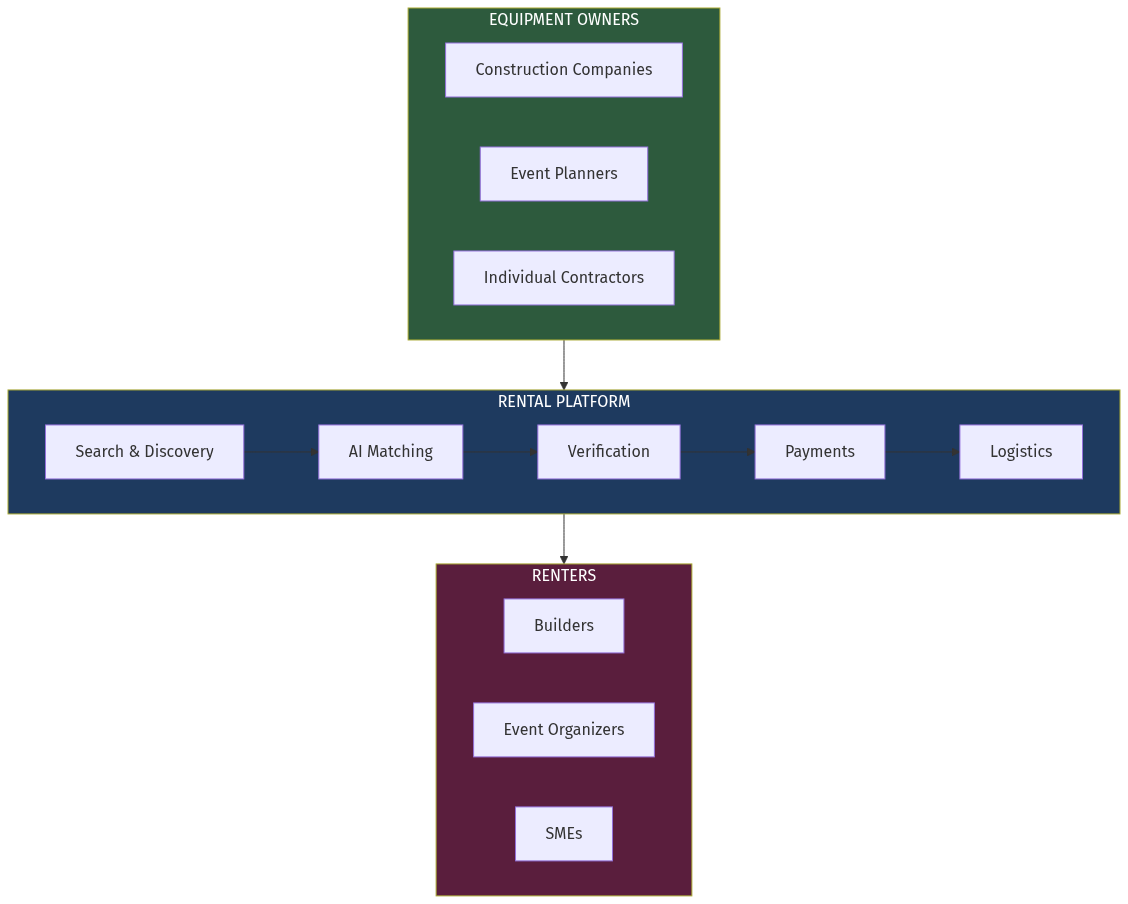
  • AI Agent Capabilities

    Equipment Rental Intelligence Architecture
    Equipment Rental Intelligence Architecture
    Core AI Functions:
  • Natural Language → Equipment Spec Translation
  • - Input: "I need to dig a 6-foot-deep trench across a parking lot, about 200 feet" - Output: Recommends mini excavator (3-5 ton), trencher attachment, or dedicated trencher based on soil conditions and timeline
  • Multi-Vendor Inventory Synthesis
  • - Aggregates real-time availability from API-connected vendors - Supplements with web scraping and phone verification for non-digital vendors - Learns vendor update patterns (some refresh daily, some hourly)
  • Total Cost Calculation Engine
  • - Base rental rate (daily/weekly/monthly optimization) - Delivery and pickup fees (distance-based calculation) - Fuel policy normalization (full-to-full vs. charged-per-gallon) - Insurance and damage waiver costs - Environmental and regulatory fees
  • Predictive Availability Modeling
  • - Historical utilization patterns by equipment type and season - Weather-based demand forecasting - Local project pipeline analysis (permit data, bid results)
    7.

    Product Concept

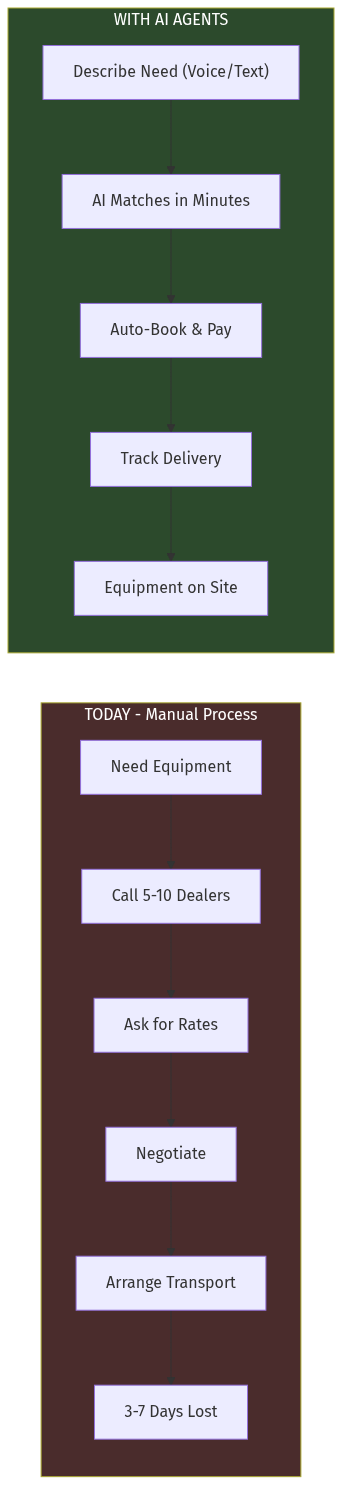
    The Workflow Transformation

    Current vs Future Workflow
    Current vs Future Workflow

    Core Product: RentalIQ (Working Name)

    User Experience:
  • Project-Based Equipment Planning
  • - Upload project schedule or describe scope - AI generates equipment list with timing - Bulk quote across all items simultaneously
  • Instant Multi-Vendor Comparison
  • - Real-time availability from connected vendors - Total cost comparison (not just base rate) - Equipment specification matching (alternatives highlighted)
  • One-Click Booking with Documentation
  • - Auto-populate rental agreements - COI on file, auto-sent to vendors - Delivery scheduling with GPS tracking
  • Project Equipment Dashboard
  • - What's on rent, from whom, at what rate - Upcoming deliveries and pickups - Spend tracking against budget

    Key Features

    FeatureDescriptionValue
    AI Equipment AdvisorDescribe your task, get equipment recommendationsPrevents over/under-renting
    Price IntelligenceHistorical pricing data, fair market rate indicatorsNegotiation leverage
    Vendor ScorecardsReliability, equipment condition, support responsivenessInformed supplier selection
    Fleet OptimizationAnalyze owned vs. rented economicsStrategic rental decisions
    Compliance VaultStore COIs, operator certs, rental agreementsOne-click vendor onboarding
    ---
    8.

    Development Plan

    PhaseTimelineDeliverables
    Phase 0: Validation4 weeksInterview 50 contractors; validate pain points; identify 5 pilot customers
    Phase 1: MVP8 weeksSingle-market launch (e.g., DFW); 10 vendor integrations; basic quote comparison
    Phase 2: Intelligence12 weeksAI equipment advisor; total cost calculator; mobile app
    Phase 3: Scale16 weeksMulti-market expansion; API integrations with major nationals; predictive features
    Phase 4: PlatformOngoingVendor tools (demand insights); financing integration; telematics partnerships

    Technical Architecture

    • Core: Next.js + PostgreSQL + Redis
    • AI Layer: Claude API for equipment matching; custom models for pricing prediction
    • Integrations: REST APIs where available; Puppeteer for legacy vendor portals; phone verification fallback
    • Mobile: React Native for field access

    9.

    Go-To-Market Strategy

    Mental Model: Second-Order Thinking

    If we acquire contractors first, what happens next?
  • Contractors bring transaction volume
  • Volume attracts suppliers seeking demand
  • More suppliers = better coverage = more contractors
  • Flywheel spins
  • But second-order effects:
  • Suppliers may resist if they see us as margin compression threat
  • National accounts could pressure their preferred vendors to boycott
  • Best equipment might be allocated to direct relationships first
  • Mitigation: Position as demand generation, not disintermediation. Suppliers get incremental business, not cannibalized existing customers.

    Launch Strategy

    Phase 1: Single Market Domination

    Target: Dallas-Fort Worth metroplex

    • 15,000+ active contractors
    • Fragmented supplier base (no single dominant player)
    • Year-round construction season
    • Existing relationships via AIM network
    Acquisition Channels:

  • Contractor associations: AGC, ABC chapters; sponsor events; offer free spend analysis
  • Supplier partnerships: Independent rental yards get free demand; exclusive inventory in exchange
  • Equipment dealer networks: Partner with Deere, Cat dealers who also rent; they want contractor relationships
  • Trade publications: Equipment World, Construction Equipment; thought leadership on rental optimization
  • Phase 2: Geographic Expansion

    Expand to markets with:

    • High construction activity
    • Fragmented supplier landscape
    • Weather variability (drives rental demand)
    Priority markets: Phoenix, Houston, Atlanta, Denver, Chicago


    10.

    Revenue Model

    Hybrid Monetization

    StreamModelTarget
    Transaction Fee3-5% of rental value$15-25 per average rental
    Supplier Subscription$299-999/month for demand accessPremium listing, lead priority
    Enterprise SaaS$500-2,000/monthLarge contractors with fleet management needs
    Data ProductsCustom pricingMarket intelligence, demand forecasting to suppliers/OEMs
    Financing Referrals1-2% of financed amountEquipment purchase referrals

    Unit Economics (Target)

    MetricYear 1Year 3
    Average Transaction Value$1,200$1,500
    Take Rate4%5%
    Revenue per Transaction$48$75
    Transactions per Contractor/Year2436
    Annual Revenue per Contractor$1,152$2,700
    CAC$400$300
    LTV (3-year)$3,456$8,100
    LTV:CAC8.6x27x
    ---
    11.

    Data Moat Potential

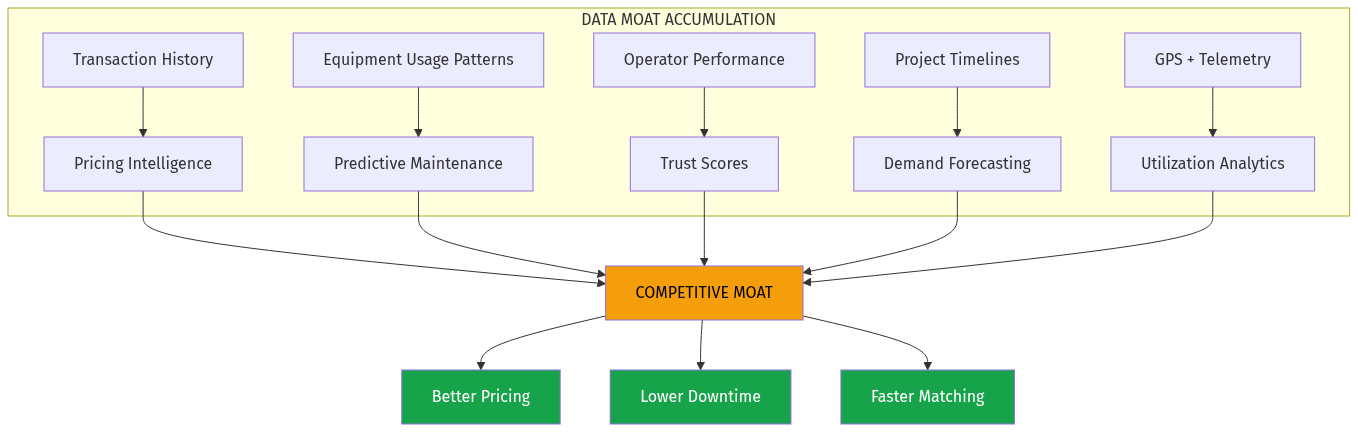
    Data Moat Architecture
    Data Moat Architecture

    Proprietary Data Assets

  • Transaction History Database
  • - Actual rental prices (not list prices) - Duration patterns by equipment type - Seasonal and geographic variations
  • Equipment Utilization Intelligence
  • - What equipment is actually used for what projects - Specification-to-outcome mapping - Underutilized equipment identification
  • Supplier Reliability Scores
  • - On-time delivery rates - Equipment condition ratings - Issue resolution speed - Pricing consistency
  • Demand Forecasting Models
  • - Permit data correlation - Weather impact modeling - Project pipeline visibility
  • Equipment Specification Graph
  • - Cross-manufacturer equivalencies - Substitution recommendations - Attachment compatibility matrix

    Compounding Advantage

    Every transaction improves:

    • Price prediction accuracy
    • Availability forecasting
    • Equipment matching quality
    • Supplier scoring precision
    This data cannot be replicated without transaction volume. First mover with scale wins.


    12.

    Why This Fits AIM Ecosystem

    Direct Alignment

  • B2B Marketplace DNA: Classic two-sided market with fragmented suppliers and SME buyers—core AIM thesis
  • AI-Native Opportunity: Equipment matching is a perfect LLM application; not possible pre-2023
  • India Expansion Path: Indian construction equipment rental market growing 12%+ CAGR; same fragmentation dynamics
  • Cross-Vertical Synergies:
  • - masale.in buyers (restaurant/food processing) need commercial kitchen equipment rentals - thefoundry.in suppliers manufacture equipment that gets rented - instabox.in logistics overlaps with delivery optimization

    Portfolio Strategy

    This vertical offers:

    • High transaction frequency: Equipment rents 20-50x per year (vs. one-time purchases)
    • Clear revenue model: Transaction fees are industry-standard
    • Defensible moat: Data + supplier relationships + geographic density
    • Adjacent expansion: From rentals → used equipment marketplace → equipment financing
    ---

    ## Pre-Mortem: Why This Could Fail

    Mental Model: Falsification

    Assume 5 well-funded startups failed here. Why?
  • Supplier resistance: National chains (United, Sunbelt) control 35% of market. If they refuse to integrate, coverage gaps kill the value prop.
  • - Mitigation: Start with independent yards who need demand. Nationals will join when volume forces them.
  • Marketplace chicken-and-egg: Can't attract contractors without inventory; can't attract suppliers without contractors.
  • - Mitigation: Single-market density strategy. 50 suppliers in DFW > 500 suppliers across 50 cities.
  • Low switching costs: Contractors could use us for price discovery, then book direct.
  • - Mitigation: Make booking easier than calling. Add compliance automation that creates lock-in.
  • Thin margins commoditize: If we're just price comparison, suppliers will match and cut us out.
  • - Mitigation: Build intelligence layer (equipment advisor, project planning) that's hard to replicate.
  • Enterprise captures the wedge: United Rentals or Caterpillar builds equivalent tool with unlimited resources.
  • - Mitigation: They won't cannibalize their own sales channels. Multi-vendor neutrality is our advantage.

    ## Steelmanning: Why Incumbents Might Win

    Mental Model: Steelmanning

    The strongest case against this opportunity:
  • Relationships genuinely matter: When equipment breaks at 2 AM, you need a vendor who takes your call. Price comparison misses this.
  • Credit and trust are hard-won: Vendors extend credit based on payment history. New platform can't replicate years of relationship equity.
  • Equipment rental is local: A DFW-focused startup can't serve a contractor with projects in 12 states. Nationals win on coverage.
  • Verticalization beats aggregation: EquipmentShare proves that owning the fleet (with tech) beats marketplace model.
  • Procurement isn't the bottleneck: Contractors care about equipment availability and quality, not price optimization. They'll pay premium for reliability.
  • Counter-Arguments

    ObjectionCounter
    Relationships matterAI can learn vendor strengths; emergency responsiveness becomes a scored attribute
    Credit is relationship-basedIntegrate with contractor credit systems; offer platform-backed credit lines
    Local vs. nationalStart hyper-local; expand with density, not breadth
    Ownership beats aggregationDifferent segments: EquipmentShare targets enterprise; we target SME who can't afford their SaaS
    Availability > priceWe solve availability FIRST (real-time inventory); price comparison is bonus
    ---

    ## Verdict

    Opportunity Score: 8.5/10
    CriteriaScoreNotes
    Market Size9/10$60B+ market with clear SME underserved segment
    Problem Severity8/10Real pain, but contractors have workarounds
    AI Fit9/10Perfect LLM application: natural language → structured query
    Competitive Moat7/10Data moat possible but requires scale
    AIM Synergy9/10Direct B2B marketplace fit; India expansion path
    Execution Risk7/10Supplier acquisition is hard; requires local density

    Recommendation

    Proceed to validation phase. This opportunity has strong fundamentals:
  • Clear, quantifiable pain ($3B+ in procurement overhead alone)
  • AI-native solution path (equipment matching, pricing intelligence)
  • Fragmented market with misaligned incumbent incentives
  • Defensible data moat potential
  • Natural AIM ecosystem fit
  • Key validation questions:
  • Will 5 independent rental yards in DFW provide API/inventory access?
  • Do contractors trust a new platform enough to transact (vs. just research)?
  • What's the minimum supplier coverage for viable comparison?
  • The equipment rental industry is ripe for the same transformation that Expedia brought to travel. The question is execution, not opportunity.


    ## Sources

    • Grand View Research: Fleet Management Market Analysis
    • MarketsandMarkets: Fleet Management Market Forecast 2025-2030
    • American Rental Association: Industry Statistics
    • Equipment Rental Index: Market Sizing Data
    • IBISWorld: Heavy Equipment Rental Industry Report
    • Construction Equipment Magazine: Rental Market Trends
    • Reddit r/Construction: Contractor pain point discussions
    • United Rentals Annual Report 2024
    • EquipmentShare company analysis