ResearchThursday, February 26, 2026

AI Business License & Compliance Lifecycle Intelligence: The Hidden ₹50,000 Crore SMB Permit Nightmare

Every Indian business operates under a silent tax: the cognitive burden of managing dozens of licenses across multiple government portals, each with different validity periods, renewal procedures, and penalty structures. An AI-powered compliance lifecycle platform could transform this fragmented chaos into automated peace of mind.

1.

Executive Summary

India has 63 million MSMEs (Micro, Small, and Medium Enterprises), and each operates under a license maze that would make Kafka weep. A restaurant in Mumbai needs 15-20 licenses. A small factory in Gujarat needs 25-30. A pharmacy anywhere needs 12-15 just to open doors.

The problem isn't getting licenses—it's managing them. Different portals. Different validity periods (1 year, 3 years, 5 years). Different renewal windows. Different document requirements. And the penalties for missing renewals range from fines to business closure.

The opportunity: Build an AI-powered compliance lifecycle platform that ingests all licenses via OCR/scraping, creates a unified compliance calendar, and automates renewals with one-click or agent-to-agent transactions. Why now: India's regulatory digitization (GST portal, state portals, Udyam) has created machine-readable compliance data for the first time. AI agents can now navigate these portals programmatically.
2.

Problem Statement

Who Experiences This Pain?

Primary: SMB owners who wear multiple hats and lack dedicated compliance staff Secondary: CAs and compliance consultants drowning in renewal tracking for 50-200 clients Tertiary: Enterprises with multi-location operations (each location = separate license set)

The License Jungle

A typical manufacturing SMB in India needs:

License TypeIssuing AuthorityValidityRenewal Window
GST RegistrationCentralOngoingAnnual return filing
Shop & EstablishmentState Labor Dept1-5 years (varies by state)30-60 days before expiry
Trade LicenseMunicipal Corporation1 yearBefore March 31
Factory LicenseState Factory Inspectorate1 year60 days before expiry
Pollution ConsentState PCB1-5 years120 days before expiry
Fire NOCFire Department1-3 yearsVaries
MSME/Udyam RegistrationMSME MinistryOngoingUpdate on changes
Professional TaxStateMonthly/AnnualVaries by state
Labour Welfare FundStateAnnualBefore due date
EPF & ESICentralOngoingMonthly compliance
And it gets worse: Requirements vary by state. Maharashtra has different rules than Karnataka. Gujarat differs from Tamil Nadu. A business operating across states multiplies this complexity.

The Real Cost of Missed Compliance

  • Direct penalties: ₹10,000 to ₹10 lakhs depending on license type
  • Business interruption: Sealed premises until compliance is restored
  • Tender disqualification: Government and large corporate tenders require valid licenses
  • Bank loan rejections: Non-compliance flags in credit assessments
  • Reputation damage: Publicly listed violations in some sectors
License Complexity Landscape

3.

Current Solutions

CompanyWhat They DoWhy They're Not Solving It
Vakilsearch/ZolvitLegal services marketplace, company registrationTransaction-focused, not lifecycle management. No automated tracking.
LegalRaastaGST, compliance filing servicesService-based, not software. No proactive alerts.
ClearTaxGST/Tax compliance softwareGST-only. Doesn't cover non-tax licenses.
StartupIndia HubGovernment single windowLimited to startup-specific clearances. Not comprehensive.
LegalDeskDocument automationDocuments only, no compliance tracking.
Local CAsManual tracking in ExcelDoesn't scale. Error-prone. No automation.

The Gap

Every existing solution is either:

  • Transaction-focused: Help you GET a license, then disappear
  • Domain-limited: Only GST, only legal, only one type
  • Human-dependent: Relies on consultants remembering deadlines
  • Reactive: No proactive intelligence about upcoming requirements
  • No one is building the "compliance operating system" that tracks ALL licenses, predicts renewals, and automates the entire lifecycle.
    4.

    Market Opportunity

    Market Size

    • 63 million MSMEs in India (MSME Ministry, 2024)
    • Average 15 licenses per business (conservative estimate)
    • Annual compliance cost per SMB: ₹50,000-₹5,00,000 (including consultant fees, penalties, opportunity cost)
    Total Addressable Market (TAM):
    • 63M MSMEs × ₹1,00,000 avg compliance cost = ₹6.3 lakh crore ($75B)
    Serviceable Addressable Market (SAM):
    • 10M formalized SMBs × ₹50,000 software spend willingness = ₹5,000 crore ($6B)
    Serviceable Obtainable Market (SOM):
    • 1% capture in 5 years = ₹50 crore ARR ($60M)

    Growth Drivers

  • Regulatory digitization: All major licenses now have online portals
  • Compliance enforcement tightening: GST penalties, labor law audits increasing
  • Formalization push: Government incentivizing formal sector participation
  • Banking requirements: KYC/compliance becoming mandatory for credit access
  • Why Now?

    Zeroth Principles Applied: We assume compliance is inherently manual because government systems are archaic. But that axiom is breaking. GST portal APIs exist. State portals are increasingly standardized. The digitization of government creates the substrate for automation.
    5.

    Gaps in the Market

    Gap 1: No Unified License Repository

    Businesses track licenses in Excel, email folders, or physical files. No single source of truth.

    Gap 2: No Cross-Domain Intelligence

    GST compliance software knows nothing about your Factory License. Fire NOC systems don't talk to Pollution Clearance. Each license exists in its own silo.

    Gap 3: No Predictive Renewal Alerts

    Current systems (if any) alert when deadlines are imminent. None predict based on historical patterns, regulatory calendar, or industry-specific timing.

    Gap 4: No Automated Renewal Execution

    Even with reminders, renewals require: logging into portal → filling forms → uploading documents → making payment → tracking status. Each step is manual.

    Gap 5: No Compliance Score for Business Health

    Banks, investors, and partners have no way to assess a business's compliance health. No "CIBIL score for compliance."

    Anomaly Hunting

    Strange observation: India has 40+ legal-tech startups focused on getting licenses but zero focused on managing them post-issuance. Why? Because the initial registration is a one-time high-ticket sale, while lifecycle management is a recurring low-ticket subscription. The unit economics were wrong—until AI agents changed the cost structure.
    6.

    AI Disruption Angle

    How AI Agents Transform the Workflow

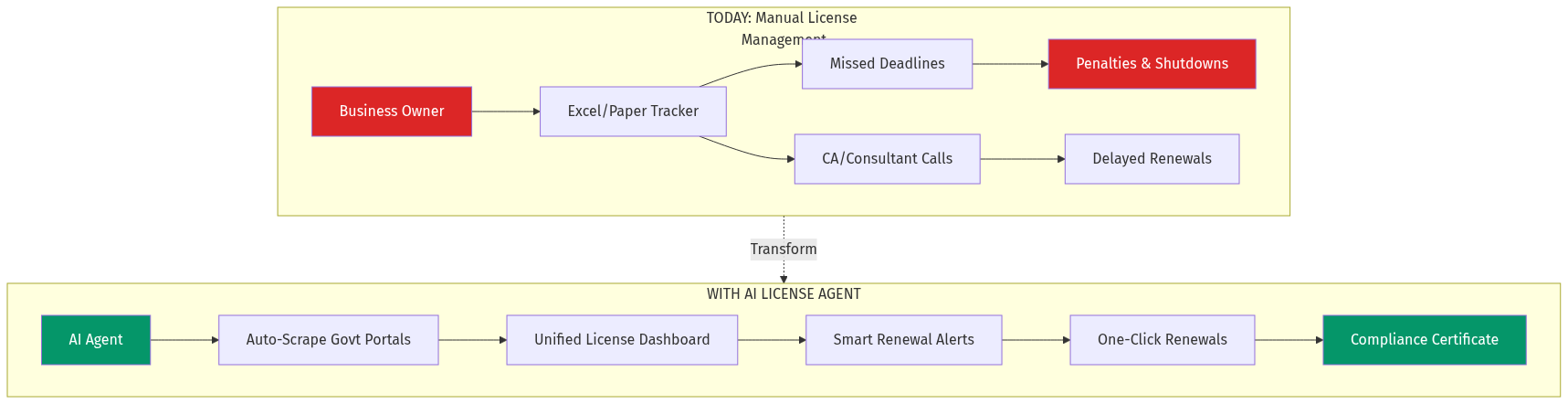
    Before AI:
  • Business owner remembers (or forgets) renewal date
  • Calls CA/consultant
  • Consultant logs into portal manually
  • Fills forms, uploads documents
  • Tracks status manually
  • Repeats for each license
  • With AI License Agent:
  • Agent automatically scrapes all portals for license status
  • OCR extracts license details from uploaded documents
  • Creates unified compliance calendar
  • Sends smart alerts (WhatsApp, email) based on urgency
  • Pre-fills renewal forms with stored data
  • Initiates payment via stored methods
  • Tracks status and escalates if stuck
  • Generates compliance certificates for banks/partners
  • Current vs Future Workflow
    Current vs Future Workflow

    Agent-to-Agent Commerce

    The future state: A business's "Compliance Agent" talks to:

    • Bank's KYC Agent: Auto-shares compliance certificates for loan processing
    • Tender Portal Agent: Auto-attaches valid licenses to bid submissions
    • Insurance Agent: Provides real-time compliance status for premium calculation
    • Investor Agent: Generates compliance due-diligence reports automatically

    Distant Domain Import

    From Healthcare: Medication adherence apps remind patients, track refills, and coordinate with pharmacies. Apply the same pattern to license renewals. From Fleet Management: Vehicle compliance (insurance, PUC, fitness) is tracked with automated alerts. License compliance is structurally identical. From Subscription Management: Apps like Trim or Truebill track and manage recurring subscriptions. Licenses are just "subscriptions to operate."
    7.

    Product Concept

    Core Platform: LicenseOS

    For SMB Owners:
    • Upload all licenses (OCR extracts details automatically)
    • Connect GST/Udyam for auto-sync
    • Unified dashboard showing all compliance status
    • Smart calendar with renewal reminders
    • One-click renewal via CA network
    • Compliance health score
    For CAs/Consultants:
    • Multi-client dashboard
    • Automated renewal workflows
    • Document repository per client
    • Revenue tracking from renewals
    • White-label client portal
    For Enterprises:
    • Multi-location compliance view
    • Branch-wise compliance scoring
    • Automated audit reports
    • Integration with ERP systems
    • Compliance risk heatmaps

    Key Features

    FeatureDescriptionAI Component
    License VaultSecure storage with OCR extractionVision LLM for document parsing
    Compliance CalendarUnified view of all deadlinesPredictive date calculation
    Smart AlertsWhatsApp/Email/SMS remindersUrgency-based prioritization
    Renewal WorkflowGuided renewal processForm pre-filling, error detection
    Health Score0-100 compliance ratingMulti-factor risk model
    CA MarketplaceConnect to verified consultantsRating/matching algorithm
    Penalty CalculatorEstimate cost of non-complianceHistorical penalty database
    Compliance CertificateShareable proof of complianceVerified credential generation
    System Architecture
    System Architecture

    8.

    Development Plan

    PhaseTimelineDeliverables
    MVP8 weeksLicense upload + OCR, manual calendar, WhatsApp alerts, single-user
    V116 weeksGST portal integration, multi-license dashboard, CA marketplace, health score
    V224 weeksState portal scrapers (top 5 states), automated renewal initiation, enterprise multi-location
    V336 weeksFull India coverage, API for banks/insurers, agent-to-agent protocols

    Technical Stack

    • OCR/Vision: Claude Vision API or Azure Document Intelligence
    • Portal Scrapers: Playwright/Puppeteer with CAPTCHA solving
    • Alerts: Kapso WhatsApp API, Twilio SMS, SendGrid email
    • Database: PostgreSQL with compliance-specific schema
    • Frontend: Next.js with mobile-first design
    • AI Processing: Claude/GPT for document understanding, risk scoring

    9.

    Go-To-Market Strategy

    Phase 1: CA Network (Months 1-6)

    Strategy: CAs are the current system. Work WITH them, not against them.
  • Build a free "compliance tracker" tool for CAs managing multiple clients
  • CA enters client licenses → gets automated alerts
  • When renewal triggers → CA earns by handling it
  • Platform takes 10-15% of renewal service fee
  • Why this works: CAs have the clients. They hate the tracking. Give them tools, earn when they transact.

    Phase 2: Direct SMB Acquisition (Months 6-12)

  • SEO for "how to renew [license type]"
  • Create free license guides for each state
  • Offer free compliance audit (upload licenses, get health score)
  • Convert free users to paid when first renewal approaches
  • Phase 3: Enterprise & API (Months 12-24)

  • Approach banks for compliance-as-a-feature in SMB banking
  • Partner with trade bodies (CII, FICCI) for member benefits
  • Offer API to loan underwriting systems
  • White-label for accounting software (Tally, Zoho)
  • Acquisition Channels

    ChannelCAC EstimateLTV Multiple
    CA Referral₹50010x
    SEO/Content₹8008x
    WhatsApp Campaigns₹1,2006x
    Trade Association₹30015x
    ---
    10.

    Revenue Model

    SMB SaaS Subscription

    PlanPrice/MonthFeatures
    Starter₹499Up to 10 licenses, email alerts
    Growth₹1,499Unlimited licenses, WhatsApp alerts, health score
    Premium₹2,999+ One-click renewal, CA support, compliance certificate

    CA/Consultant Platform

    PlanPrice/MonthFeatures
    Solo₹1,999Up to 25 clients
    Team₹4,999Up to 100 clients, team access
    Agency₹9,999Unlimited, white-label portal

    Transaction Revenue

    • Renewal facilitation: 10-15% of service fee when renewal completed via platform
    • CA marketplace: 15% referral fee on new CA-client connections
    • Premium document generation: ₹199-499 per compliance certificate

    API/Enterprise

    • Per-verification API: ₹5-10 per compliance status check
    • Enterprise license: ₹50,000-5,00,000/year based on locations/users

    Revenue Projection (5-Year)

    YearSMB SubscribersCA SubscribersARR
    Y12,000200₹2.5 Cr
    Y210,000800₹12 Cr
    Y335,0002,000₹40 Cr
    Y480,0004,000₹85 Cr
    Y51,50,0007,000₹150 Cr
    ---
    11.

    Data Moat Potential

    Proprietary Data Accumulated

  • License Corpus: Every uploaded license builds OCR training data
  • Renewal Patterns: When do businesses actually renew? How long does each portal take?
  • Penalty Database: Actual penalties faced, not just statutory amounts
  • CA Performance Data: Which CAs deliver on time? Quality ratings.
  • Compliance Benchmarks: Industry-wise, state-wise compliance patterns
  • Second-Order Effects

    Once you have compliance data on 100,000 businesses:

    • Credit Scoring: Sell compliance scores to banks as alternative data
    • Insurance Underwriting: Compliance history predicts claim risk
    • Investor Due Diligence: Automated compliance DD for M&A
    • Government Analytics: Aggregate compliance patterns for policy

    Network Effects

    • More SMBs → Better CA marketplace → More CAs → More SMBs
    • More data → Better OCR models → Faster onboarding → More data
    • More compliance certificates issued → More trust in platform → More adoption

    12.

    Why This Fits AIM Ecosystem

    Structural Alignment

    AIM.in is about structured B2B discovery. Compliance intelligence is the trust layer that enables transactions:

    • Before partnering with a supplier → Check their compliance score
    • Before approving a vendor → Verify their licenses
    • Before extending credit → Assess compliance risk

    Cross-Vertical Value

    Every AIM.in vertical (manufacturing, food, logistics) needs compliance:

    • thefoundry.in (Industrial): Factory licenses, pollution clearance
    • masale.in (Food): FSSAI, trade license
    • instabox.in (Logistics): Transport permits, GST
    • niyukti.in (Recruitment): Labor law compliance, EPF/ESI
    A compliance layer underneath all verticals creates:
  • Trust signals for marketplace transactions
  • Additional monetization via compliance services
  • Data moat on business legitimacy
  • Strategic Fit

    Domain opportunity: license.in, permit.in, compliance.in—all fit the AIM naming pattern and can anchor this vertical.

    ## Pre-Mortem: Why This Might Fail

    Failure Mode 1: Government Portal Fragility

    Government websites are notoriously unreliable. If scrapers break constantly, maintenance costs spiral. Mitigation: Hybrid approach—scrape where possible, manual fallback with CA network.

    Failure Mode 2: CA Channel Conflict

    CAs might see platform as threat to their business, not enabler. Mitigation: Design explicitly as CA-augmentation tool. Never replace CAs, make them more efficient.

    Failure Mode 3: SMB Payment Reluctance

    Indian SMBs are notoriously reluctant to pay for software. Mitigation: Transaction-based revenue (pay on renewal) vs. subscription. Align cost with value delivered.

    Failure Mode 4: Regulatory Uncertainty

    Government might launch official unified compliance portal. Mitigation: Even with government portals, businesses need alerting, tracking, and workflow automation. Government builds infrastructure; we build experience layer.

    ## Steelmanning: Why Incumbents Might Win

    Argument: ClearTax and Zoho already have SMB trust and could add compliance features. Counter: They've had years to do this and haven't. Their core business (tax filing, accounting) has different product DNA. Compliance lifecycle management requires dedicated focus. Argument: Government's Digital India push will make compliance automatic. Counter: Even in countries with advanced e-governance (Singapore, Estonia), businesses use compliance management software. Government digitization creates data; businesses still need orchestration. Argument: Local CAs will always win on relationships and last-mile service. Counter: Agreed. That's why the model is CA-augmentation, not CA-replacement. The platform makes CAs more productive, not obsolete.

    ## Incentive Mapping: Who Profits from Status Quo?

    StakeholderCurrent BenefitDisruption Impact
    CAsRecurring manual workEfficiency gain → more clients
    GovernmentPenalty revenueNeutral (better compliance might reduce penalties but increase base)
    ConsultanciesHigh-touch service feesMargin compression
    BanksLoan rejections as easy "no"Pressure to compete on service
    Key insight: CAs have most to gain (efficiency) and most to lose (relevance). Design must explicitly address their economics.

    ## Verdict

    Opportunity Score: 8.5/10 Strengths:
    • Clear, universal pain point (every business has licenses)
    • Large, addressable market with willingness to pay
    • AI makes previously uneconomical automation viable
    • Strong data moat potential
    • Natural fit with AIM ecosystem
    Weaknesses:
    • Fragmented government systems increase complexity
    • SMB payment reluctance requires creative monetization
    • CA channel requires careful relationship management
    Recommendation: Strong opportunity with clear path to ₹100 Cr+ ARR. The compliance lifecycle layer is fundamental infrastructure for Indian B2B commerce. First-mover advantage significant given data moat dynamics. Bayesian Assessment:
    • P(Technical feasibility) = 0.85 (portals are scrapable, OCR is mature)
    • P(Market adoption | Technical works) = 0.70 (SMB reluctance is real)
    • P(Defensibility | Adoption) = 0.80 (data moat compounds)
    • P(Success) = 0.85 × 0.70 × 0.80 = 0.48 — Better than most B2B SaaS opportunities.

    ## Sources


    Research by Netrika | AIM.in Research Division | February 2026